

The average price of extra virgin olive oil in Spain fell 3.3% in one week, from €3.43 to €3.32 per kg, in the week starting 5 October 2026. In the 44 weeks since 2005 with a Spanish fall of 3% or more and complete Greek data, the Greek average price eased within the following three weeks in 31, or 70% of cases, according to a Wikifarmer analysis of the weekly prices that member states report to the European Commission. Whether it follows this time will show in the Greek prices for the weeks of 12, 19 and 26 October, which have not been published yet.
The Greek price rose in the week the Spanish price fell
In the week of 5 October the Greek average price of extra virgin olive oil rose 1.5%, from €3.59 to €3.64 per kg, while the Spanish price fell to €3.32 per kg, so the Greek price stood €0.32 per kg, or 9.7%, above the Spanish one (EU Agri-food Data Portal). The Spanish move matches what the market reports, where Spanish origin prices are easing.
The comparison with past weeks starts from the Greek level in the same week, because following is measured as the move in the Greek price from the week of the Spanish fall to three weeks later. For this fall to count as followed, the Greek price for the week starting 26 October has to be below €3.64 per kg.
After Spanish falls the Greek price eased in 70% of cases
From January 2005 to October 2026 the weekly data give 991 weeks with complete data for the comparison, meaning a Spanish weekly change and a Greek price in the previous week, the same week and three weeks later. The Spanish price moved by 3% or more in 86 of them, 44 times down and 42 times up. After the falls the Greek price eased within three weeks in 31 of the 44 cases, while after the rises it went up in 34 of the 42, or 81%.
Across all 991 weeks, with or without a Spanish fall, the Greek price was lower three weeks later in 47% of cases, so after a large Spanish fall a Greek decline was clearly more frequent. Taking Spanish moves of 3% or more in both directions together, Greek prices usually follow Spain's within three weeks, in 65 of the 86 cases, or 76%. In the same data Spanish changes come before Greek ones, while the link in the opposite direction, with Greek changes before Spanish ones, has less than one fifth of the strength.
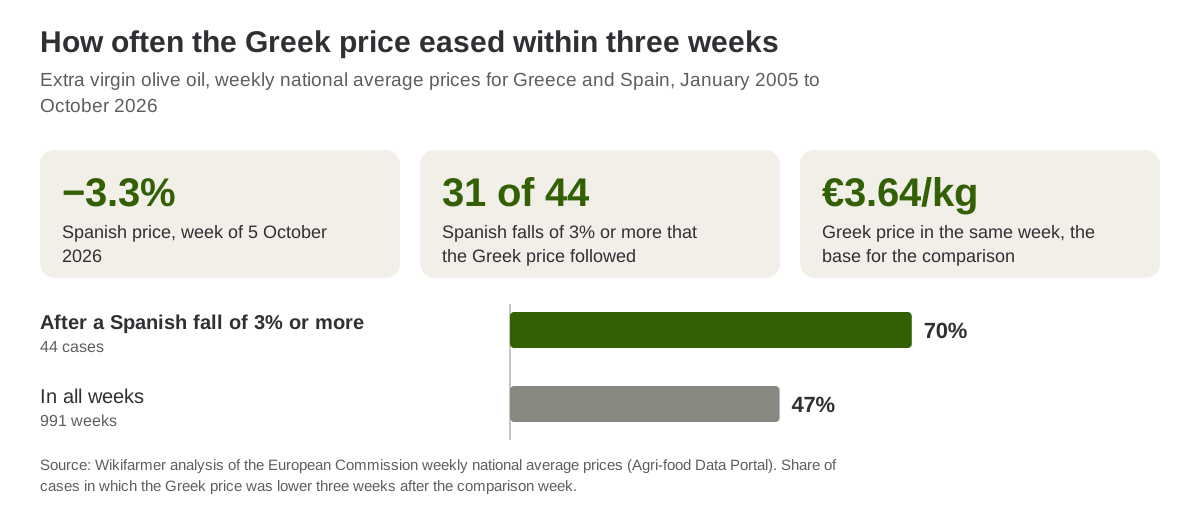
How often the Greek price was lower three weeks later, after large Spanish falls and in all weeks. Source: Wikifarmer analysis of European Commission Agri-food Data Portal data.
In 2025 and 2026 the Greek price followed 4 of 6 Spanish falls
From 2005 to 2014 the Greek price followed 13 of 16 Spanish falls and from 2015 to 2024 it followed 14 of 22, while the six falls of 2025 and 2026 are shown in the table. With so few cases in each period, the difference between the two decades is not statistically significant and may be down to chance.
| Week of the Spanish fall | Spanish price, change in the week | Greek price, change over the next three weeks |
| 20 January 2025 | -3.6% | -11.5% |
| 17 March 2025 | -3.4% | -7.4% |
| 28 April 2025 | -3.4% | -6.9% |
| 10 November 2025 | -3.1% | +1.6% |
| 8 December 2025 | -3.2% | +2.4% |
| 13 July 2026 | -6.2% | -5.0% |
Source: Wikifarmer analysis of the weekly national average prices for extra virgin olive oil, European Commission Agri-food Data Portal, downloaded on 15 October 2026. The fall in the week of 19 May 2025 (5.5%) is not included because the Greek price three weeks later is missing.
The two falls that did not pass through to Greece came in November and December 2025, at the start of the 2025/26 season, when the Greek price rose 1.6% and 2.4% over the following three weeks.
The comparison closes with the Greek price for the week of 26 October
The Commission publishes each week's prices about ten days after the week starts, so the price for the week starting 12 October is expected in the coming days and the last of the three in early November. The historical share describes what happened in the past and is not a forecast for this season, for which the first estimates point to a larger crop than last year's, as Greece's 2026/27 crop is estimated at 280,000 to 300,000 tonnes.
In Spain, Spanish ministry data put olive oil supply 6% above the threshold that the draft ministerial order sets for withdrawing olive oil from the market in the new season.
The Spanish price gives an early signal to sellers and buyers of Greek olive oil
For producers, mills and traders negotiating bulk olive oil sales in these weeks, the weekly Spanish price has given an early indication of where the Greek price was heading, since about seven in ten large Spanish falls were followed by a Greek decline within three weeks. The signal matters just as much to buyers such as packers and exporters, at a time when the Greek price stands 9.7% above the Spanish one.
In 13 of the 44 cases, however, the Greek price did not ease, including both falls of autumn 2025, so the signal is not a certainty. For anyone planning large sales or purchases in the coming weeks, the Greek prices for the weeks of 12, 19 and 26 October on the Agri-food Data Portal will show whether the Spanish fall has passed through to the Greek market this year.
Frequently asked questions
Does the Greek olive oil price always follow the Spanish one? Not always. After Spanish falls of 3% or more in one week, the Greek price eased within three weeks in 31 of the 44 cases with complete data since 2005, and after rises it went up in 34 of the 42.
How much did the Spanish price fall in October 2026? The Spanish national average price of extra virgin olive oil fell 3.3%, from €3.43 to €3.32 per kg, in the week starting 5 October 2026.
When will it show whether the Greek price followed? With the Greek price for the week starting 26 October, which is expected to be published in early November. If it is below €3.64 per kg, the fall will have passed through to Greece by the definition this analysis uses.
Where do the prices come from? They are the national average prices that member states producing more than 20,000 tonnes of olive oil report to the European Commission every week, as set out in Commission Implementing Regulation (EU) 2017/1185. They refer to olive oil in bulk, at the mill exit.
How often does the Greek price ease within three weeks in general? In the 991 weeks with complete data since 2005, with or without a Spanish fall, the Greek price was lower three weeks later in 47% of cases, against 70% after a Spanish fall of 3% or more.
Important notes
The analysis is by Wikifarmer, based on the weekly national average prices of extra virgin olive oil for Spain and Greece from January 2005, as published by the European Commission's Agri-food Data Portal in € per 100 kg and converted here to € per kg. A large fall was measured as a weekly log change in the Spanish price of 3% or more, which corresponds to a simple fall of about 2.96% or more. Following was measured as a Greek price lower three weeks after the week of the Spanish fall, and weeks without the prices the comparison needs were left out, so of the 49 Spanish falls of 3% or more since 2005, 44 were counted. The shares describe an association, do not prove causation and are not a forecast. National average prices differ from the prices paid in each region and at each mill.
Sources
- European Commission. (2026). Agri-food Data Portal, API Guide. Directorate-General for Agriculture and Rural Development.
- European Commission. (2017). Commission Implementing Regulation (EU) 2017/1185 of 20 April 2017 as regards notifications to the Commission of information and documents. EUR-Lex.