
A potting mix is the blend of materials in which plant roots grow in a container, providing drainage, aeration, water retention and nutrients at the same time. Shops sell ready-made blends for every plant category, but you can also make your own. This cuts cost, gives control over exactly what the mix contains, and lets you adapt it to each plant. What follows first explains what makes a mix good, then gives recipes by category, and finally a table for fixing whatever goes wrong.
Why make your own potting mix
Making your own blend gives control over the composition, lets you adapt each recipe to the plant and to your climate, uses materials you already have such as compost and garden soil, and often cuts cost compared with ready-made blends, especially in large quantities. Most importantly, you understand what each material does, so you can fix a mix that is not working instead of throwing it away.
The four properties that decide a good mix
Every potting recipe, however complex it looks, adjusts four properties. Once you understand them, the ratios stop being rules and become tools.
The first is water retention, how much water the mix keeps available to the roots between waterings. Organic materials provide it, with coir and peat standing out. The second is aeration, the air gaps that let roots breathe and prevent rot. Inert materials such as perlite, pumice and coarse sand secure it. The third is nutrient-holding, also known as cation exchange capacity, which shows how many nutrients the mix keeps without them washing away. It is high in compost, zeolite and leonardite, and almost zero in sand and perlite. The fourth is pH, which decides which nutrients are available, with peat being acidic and coir neutral.
What each material adds to the mix
The table below shows how each material contributes to these properties, so you can choose deliberately.
| Material | Water retention | Aeration | Nutrients | pH |
|---|---|---|---|---|
| Coir | High | Medium | Medium | Neutral |
| Blonde peat | High | Medium | Low | Acidic |
| Compost | Medium | Low | High | Neutral |
| Perlite | Low | High | None | Neutral |
| Pumice | Low | High | Low | Neutral |
| Coarse sand | Very low | High | None | Neutral |
| Pine bark | Low | High | Low | Slightly acidic |
| Zeolite | Medium | Medium | Very high | Neutral |
| Leonardite | Medium | Low | Very high | Acidic |
| Diatomaceous earth | Medium | Medium | Medium | Neutral |
The base is usually potting mix or garden soil and, for water retention, coir or peat. Aeration comes from perlite, pumice or sand, while pine bark gives structure to chunky mixes. For nutrients, compost and manure are the base, while a little zeolite or leonardite raises how well they are held. A small amount of diatomaceous earth adds aeration and helps hold water.
Potting mix recipes by plant type
The ratios are given by volume, measuring the materials with the same container, and serve as a starting point that adapts to your conditions.
| Category | Example plants | Suggested mix |
|---|---|---|
| Seed starting | Tomato, pepper, lettuce and flowers from seed | Coir 60% + Perlite 30% + Fine compost 10% |
| Outdoor ornamentals | Geranium, petunia, rose, hibiscus, lantana | Potting soil 40% + Compost 25% + Coir 20% + Perlite 15% |
| Acid-loving plants | Gardenia, hydrangea, azalea, rhododendron, camellia | Blonde peat 40% + Pine bark 25% + Coir 20% + Perlite 15% |
| Houseplants | Monstera, philodendron, pothos, peace lily, ZZ plant | Coir 40% + Perlite 30% + Pine bark 20% + Potting soil 10% |
| Container vegetables | Tomato, pepper, aubergine, cucumber, strawberry | Potting soil 30% + Compost 30% + Coir 25% + Perlite 15% |
| Mediterranean herbs | Thyme, oregano, lavender, rosemary, sage | Potting soil 40% + Coarse sand 40% + Compost 20% |
| Succulents and cacti | Crassula, echeveria, aloe, sansevieria, cacti | Coir 30% + Coarse sand 30% + Pumice 30% + Fine gravel 10% |
| Container fruit trees | Lemon, orange, kumquat, mandarin | Potting soil 40% + Compost 25% + Pumice 25% + Pine bark 10% |
In any recipe, a small amount of leonardite or zeolite, around 5%, boosts nutrient-holding without changing the structure. Orchids are a separate case, as they are not planted in soil but in almost pure, coarse pine bark with a little horticultural charcoal.
What to watch in each category
For seed starting the mix is fine, fluffy and low in nutrients, because seeds do not need rich soil and young plants burn easily from excess fertiliser. For acid-loving plants no lime is added, so the pH stays low. Houseplants, especially aroids, want a chunky, airy mix with plenty of air gaps, because their roots rot in dense soil. Mediterranean herbs prefer a lean, free-draining mix and do not tolerate rich, wet soil, unlike tender herbs such as basil and mint, which suit the vegetable mix better. Succulents and cacti want a mostly mineral mix that drains in seconds.
How to blend the materials
For a uniform mix, follow a few simple steps:
- Sieve the materials and have them dry or slightly moist, in clean tubs.
- Pre-moisten the peat or coir, because when dry they struggle to absorb water later.
- Measure the materials by volume, using the same container for all.
- Mix the inert materials first, that is perlite, pumice and gravel, then add the base, and last the heavy organics, compost and manure.
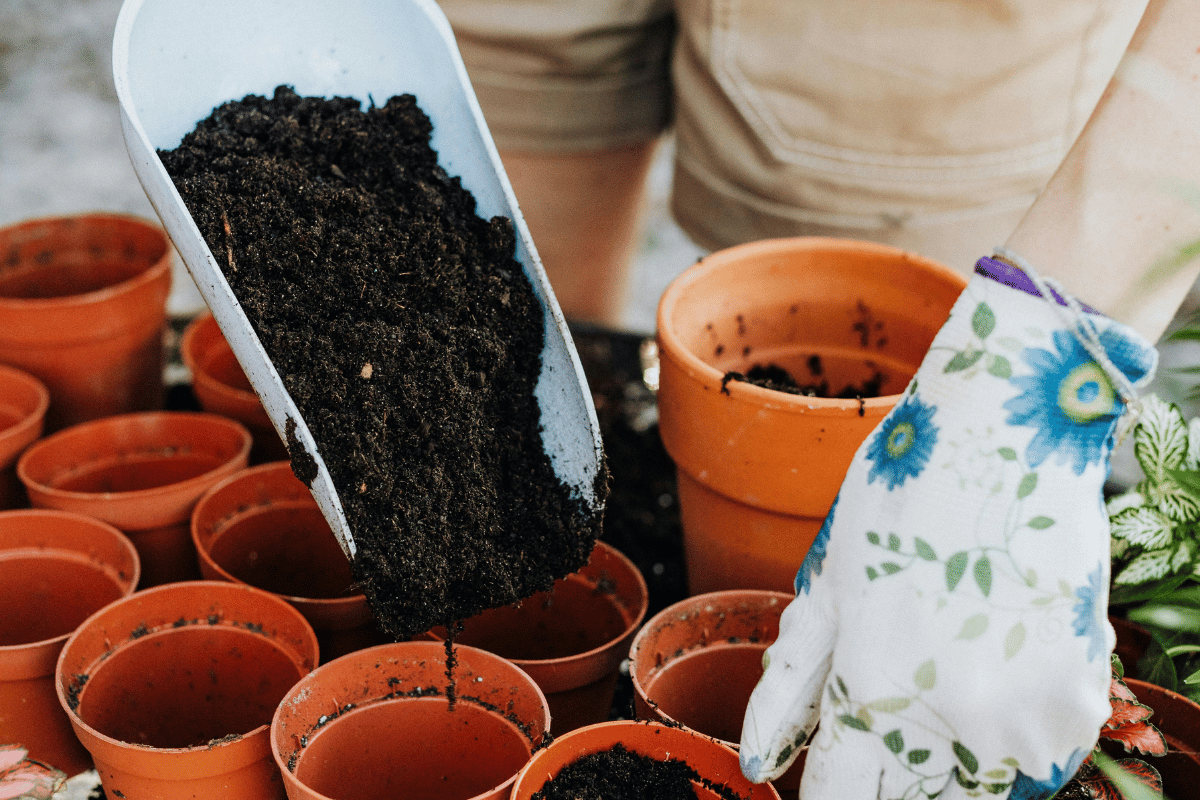
- Blend well, with a trowel or gloved hands, until the mix is uniform.
Good blending also has a practical reason. When very different particle sizes sit together without even mixing, the fine particles settle and fill the gaps between the coarse ones, creating layers that trap water and block aeration. If mix is left over, store it in a bag or bucket, in a shaded, dry place.
How to fix a problem mix
Most container problems start with the mix rather than the watering. The table below links the symptom to the likely cause and the fix.
| Symptom | Likely cause | Fix |
|---|---|---|
| Water pools on the surface and drains slowly | Too many fine organics, little aeration | Add perlite or sand and refresh the mix |
| Soil pulls away from the pot walls and hardens | Dry peat that has turned hydrophobic | Soak and re-wet, switch to coir that re-wets easily |
| The plant wilts while the soil is wet | Root rot from saturation and lack of oxygen | Stop watering, add more inert material, check drainage holes |
| The mix compacts over time | Organics break down and lose pore space | Refresh with new mix, add pine bark or pumice |
| Lower leaves yellow and growth is slow | Nutrients leached out, mix exhausted | Fresh compost, regular feeding, leonardite or zeolite for holding |
| The soil dries out far too quickly | Too much inert material, little retention base | More coir or peat in the mix |
| Small flies hover over the soil | Constant moisture at the surface | Dry the surface, add a layer of sand or diatomaceous earth |
| Chlorosis on acid-lovers with yellowing between veins | pH too high, iron locked up | Blonde peat and bark, no lime, leonardite with iron |
| White crust and burnt leaf edges | Salt build-up from unwashed coir or over-feeding | Washed coir, flush the pot with plenty of water |
How to adapt the mix to your conditions
The ratios are a starting point, not a rule. If the garden soil you use as a base is heavy and clay-rich, reduce its share and add more sand or perlite for drainage. In a hot, dry climate or on a sunny balcony, raise the water-retention base a little, so the soil does not dry out abruptly. In a wet environment or with plants prone to rot, increase the inert materials for better drainage. After the first plantings, observation shows whether the mix holds too much or too little water, and you correct it next time using the troubleshooting table.
Frequently asked questions
Can I use plain garden soil in a pot
No. Garden soil on its own compacts, drains poorly and often carries weeds and pathogens. In a pot it is always used within a mix, together with materials that give aeration and retention.
Why does water sit on the surface and not soak in
Usually the mix has turned hydrophobic because the peat dried out completely, or it has compacted and no longer aerates. Soaking the pot, adding perlite and using coir, which re-wets easily, all help.
Which mix goes in a seed tray
A fine, fluffy mix that is low in nutrients, for example coir 60%, perlite 30% and a little fine compost 10%. Feeding is added only after the first true leaves appear.
Does homemade potting mix need feeding
Compost and manure supply nutrients at the start, but for plants that stay months in the same pot, feeding continues normally during growth, depending on the plant.
How do I make the mix more acidic for acid-loving plants
Increase the blonde peat and pine bark, which have an acidic effect, and avoid adding lime. This keeps the pH low, as gardenia, azalea and hydrangea prefer.
How long does homemade potting mix last
Used in a pot, the mix gradually loses structure and nutrients within one to two growing seasons. Fresh mix, stored in a dry, shaded place, keeps for several months.
Sources
- Royal Horticultural Society, How to make your own potting mix.
- The Old Farmer's Almanac, How to make seed-starting mix.