
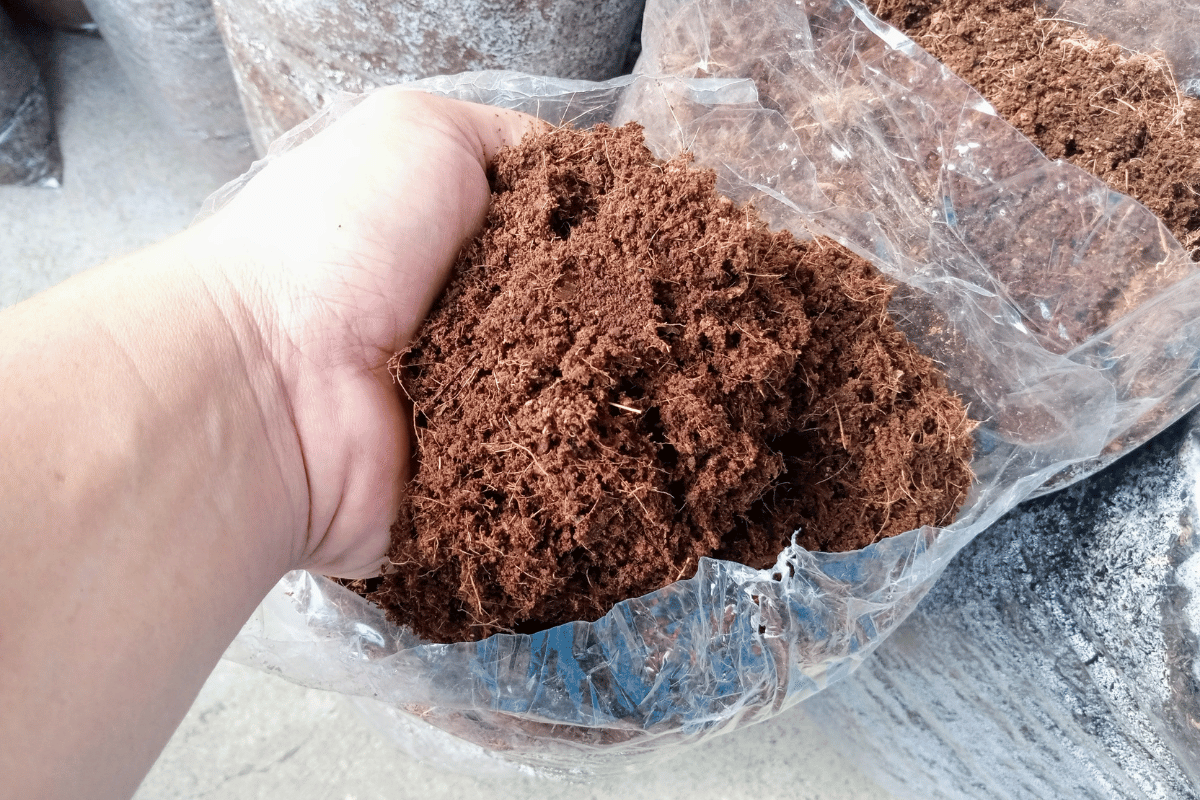
Coir is a growing medium made from the husk of the coconut, a by-product of the coconut industry that is put to use in gardening. It comes in three main forms, the fine pith, the small chips and the fibre, and it stands out because it holds a lot of water and plenty of air at the same time, with a near-neutral pH. Because it is a renewable and stable material, it is increasingly used as an alternative to peat. It should not be confused with the ornamental palm of a similar name, here the term refers to the growing medium made from coconut fibre.
What coir does in the mix
The material has a very high porosity, close to 90%, so it holds up to eight to ten times its weight in water and releases it gradually, while its fibrous structure keeps pores filled with air even when saturated. This way the roots breathe and do not rot, while at the same time they never sit in drought. Its pH stays close to neutral, around 6.0 to 6.8, unlike acidic peat, so it needs no correction for most plants. It is sterile, free of weed seeds and pathogens, and thanks to its high lignin content it breaks down slowly and does not shrink in the pot, even in crops that run for months. It also has a useful cation exchange capacity, so it holds nutrients and releases them gradually, although its natural content of potassium and sodium calls for care, as explained below.
How coir differs from peat
The two materials are alike in water retention, but they have important differences that guide the choice. The most significant is pH, since coir is nearly neutral while peat is acidic, along with re-wetting, since coir takes up water again easily while dry peat becomes water-repellent.
| Characteristic | Coir | Peat |
|---|---|---|
| Origin | Coconut husk, renewable | Peat bogs, non-renewable |
| pH | Neutral (6.0 to 6.8) | Acidic (blonde 3.5 to 4.5) |
| Re-wetting | Takes up water easily | Hard once it dries out |
| Nutrient retention | High, but with potassium and sodium | Low |
| Environment | Uses a by-product | Extraction has an environmental cost |
The forms it comes in and which suits what
On the market coir is found either loose and ready to use, or in compressed bricks and tablets that take up very little space and expand with water. One brick can yield many times its volume in ready medium, for example a tablet with a few litres of water gives around ten litres of material. Beyond the packaging, coir also differs in the shape of the particle, which changes the balance between water and air.
| Form | What it is | Best suited to |
|---|---|---|
| Pith | Fine material that holds a lot of water | Seed starting and potting mixes |
| Chips | Coarse pieces with more air | Containers and hydroponics |
| Fibre | Long fibres that add structure | Improving aeration in mixes |
How much coir to add
Coir can be used as the main base of a mix, at a high proportion, or as an amendment at around 20 to 50% together with potting soil and compost. For even better drainage it is combined with perlite at around 10 to 30%. In hydroponics it is often used at a very high proportion or even pure, because it gives a stable, inert environment with good aeration.
Where coir is used
It is used in seed trays and for rooting cuttings, where the light, sterile material helps young plants, as well as a component in potting mixes alongside potting mix ingredients and inert materials. It is one of the most popular media in hydroponics, because it feeds the roots directly with the nutrient solution and offers extra aeration. It also suits transplanting and general use with vegetables, herbs and houseplants, while its neutral pH makes it a convenient base for mixes that will host plants with different needs.
What to watch
Quality varies significantly between products, and cheap, untreated coir can be high in salts, which is why good coir is washed and buffered. Because it holds sodium and potassium and tends to lock up calcium and magnesium, intensive crops often add calcium and magnesium feeding. On its own it is relatively low in readily available nitrogen, so feeding carries on as normal. Finally, compressed bricks need to be fully hydrated before use, so they release their full volume.
Frequently asked questions
What is coir as a growing medium
It is a material made from the coconut husk, light and porous, that holds water and air and is used in seed trays, pots and hydroponics. It has a neutral pH and is regarded as a renewable alternative to peat.
Coir or peat
Coir has a neutral pH, re-wets easily and is renewable, while peat is acidic and suited mainly to acid-loving plants. For general use and for environmental reasons, coir is increasingly preferred.
How much coir do I add to a mix
It is used either as a base at a high proportion, or as an amendment at 20 to 50% together with potting soil and compost, while for better drainage it is combined with perlite at around 10 to 30%.
How do I prepare a coir brick
The compressed brick or tablet is placed in a container with water for a short time, so it expands and breaks apart into a loose medium. One brick yields many times its own volume in ready material.
What pH does coir have
Its pH stays close to neutral, around 6.0 to 6.8, so it needs no correction for most plants, unlike acidic peat.
Does coir need feeding
Yes. It is relatively low in readily available nitrogen, so feeding carries on as normal. Because it tends to lock up calcium and magnesium, intensive crops add calcium and magnesium feeding.
Sources
- PT Horticulture, Coir, a component of growing media.
- Royal Horticultural Society, Alternatives to peat-based compost.