
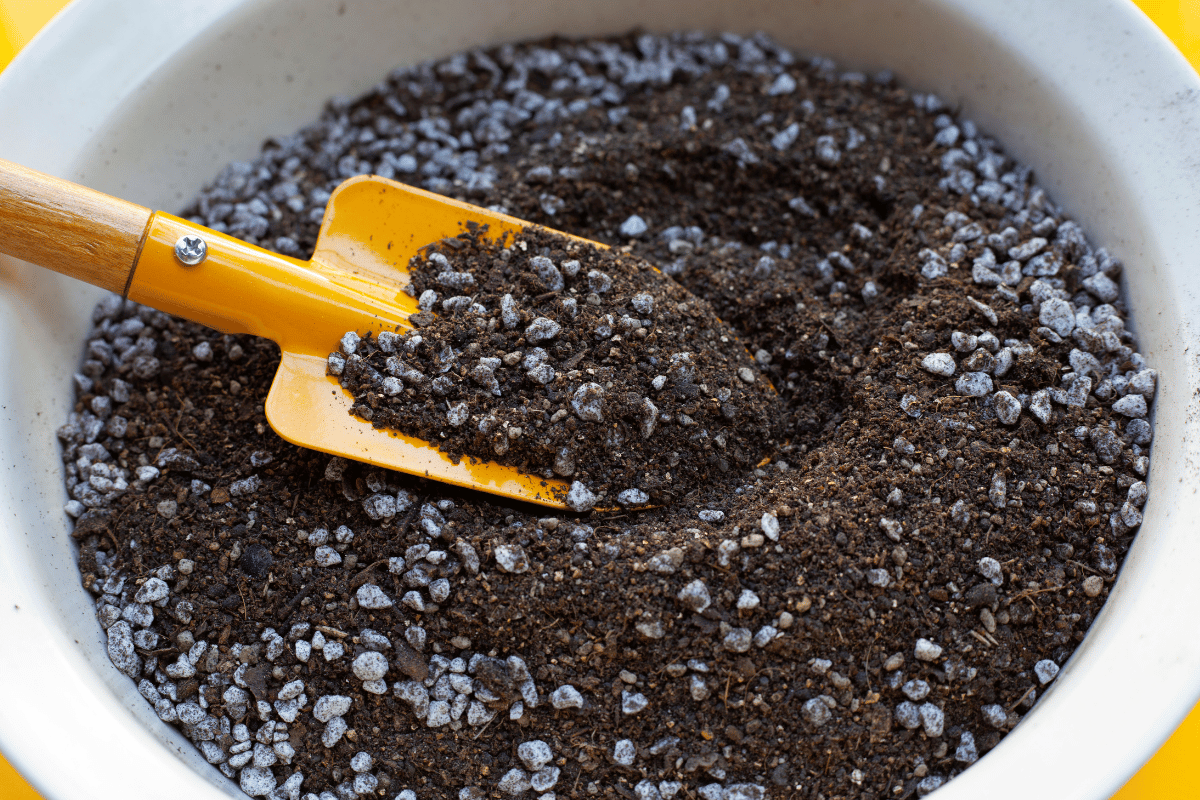
Potting mix is the material in which roots grow inside pots, planters, seed trays and containers. In technical terms, it is called a growing medium or substrate, and for the most part, it contains no soil at all. It is a blend of organic and inorganic materials built to hold water and air next to the root at the same time, something ordinary soil fails to do within a limited volume. Which blend fits a given case depends on the use, the type of plant and the way it is watered.
Why potting mix is not the same as garden soil
Garden soil works well in the field, but inside a pot it compacts, closes its pores and starves the root of air. In a small volume it holds too much water at the bottom, dries unevenly at the surface, and often carries weed seeds, insects and pathogens. A good growing medium, by contrast, is built to drain the excess and hold as much water as the plant needs, to let the root breathe, and to start clean of weeds and disease.
What a good growing medium must provide
The quality of a growing medium is judged first by its physical properties, meaning the balance between water and air. A suitable blend has a total porosity of at least 50%, air of at least 10% and a water-holding capacity of at least 40% at container capacity. Commercial media usually sit at a total porosity of 60 to 80%, while best growth is linked with an air-filled porosity of around 10 to 15% at container capacity. The mix of coarse particles, which open large pores for air and drainage, with fine particles, which hold water, sets this balance.
The chemical behaviour comes second. The pH controls nutrient availability and for most plants stays between 5.5 and 6.5. Electrical conductivity shows the concentration of salts, which must not be so high that it burns tender roots. Cation exchange capacity shows how much of the applied nutrients the medium can hold so they are not washed out with each watering. A good medium is also biologically stable, so it does not break down quickly and compact within the season, and it starts free of pathogens and weed seeds. It is no accident that peat became the standard base, precisely because it combines nutrient control, pH buffering, water retention, the absence of harmful microorganisms and structural stability.
The main components and what each one contributes
Every material enters the blend for a specific reason. Some hold water and nutrients, others open pores for air and drainage.
| Component | What it contributes | What to watch |
|---|---|---|
| Peat | Holds a lot of water, decomposes slowly, gives stable structure. Blonde peat is coarser and better aerated, black peat is finer and holds more water | It is acidic and needs lime, and once it dries out completely it struggles to take up water again |
| Coir (coconut fibre) | Substitutes for peat, holds water while still aerating, with a more neutral pH | It can carry salts and needs rinsing before use, and it calls for slightly more nitrogen and less potassium |
| Compost and worm castings | Add nutrients, organic matter and biological life | Only when mature and well finished, in a moderate share, so they do not raise the salts |
| Perlite | A light volcanic material that opens lasting air pores and improves drainage, neutral pH | It is dusty when dry, so it is best moistened before blending |
| Vermiculite | Holds water and nutrients, useful in seed starting and in light blends | It compacts over time and gives less air than perlite |
| Pine bark | Adds aeration and stability, ideal for trees, shrubs and orchids | Coarse pieces hold less water, so it needs balancing with water-holding materials |
| Pumice and zeolite | Improve drainage and aeration, with zeolite also holding extra water and nutrients | Inert materials, they add no organic matter on their own |
| River sand | Adds weight and drainage, useful for cacti and succulents | It weighs the pot down and in excess reduces aeration |
| Limestone | Raises and stabilises the pH in peat-based blends | It needs the right dose, since an excess locks up micronutrients |
In commercial media, peat or coir forms the base, while perlite, vermiculite and bark set the aeration. The organic matter that carries nutrients comes from mature compost or from worm castings, which also feed the biological life of the medium. Many mixes also contain a wetting agent, so the material takes up water easily, since peat is difficult to wet by nature.
How the blend changes with the use
There is no single medium for everything. Seed starting calls for a fine, clean material with low fertiliser, vegetables call for nutrients and water retention, cacti call for fast drainage. The blends below are indicative, by volume, and adjust to experience and conditions.
| Use | Indicative blend | Reasoning |
|---|---|---|
| Seed starting | 50% blonde peat or coir, 30% fine perlite or vermiculite, 20% fine mature compost | Fine, aerated and low in salts, so germination is not held back |
| Ornamentals in containers | 60% peat or coir, 20% compost, 20% perlite | A balance of water, nutrients and air for a long season |
| Vegetables in containers | 50% peat or coir, 30% mature compost or finished manure, 20% perlite | More nutrients for the high demand, with good moisture retention |
| Cacti and succulents | 40% base medium, 40% coarse sand or pumice, 20% perlite | Very fast drainage, so the root never sits in wet material |
| Acid-loving plants such as hydrangea and camellia | Acidic peat without lime, with added pine bark and perlite | Keeping the low pH that these plants require |
| Indoor plants | A light blend with a higher share of perlite or pumice | Good aeration and less risk of waterlogging in a closed space |
pH and feeding within the medium
Peat is acidic, so limestone is added to the relevant blends to raise the pH into an acceptable range. Coir, which is more neutral, needs less of this, though it calls for slightly more nitrogen and less potassium. Many ready-made media carry a starter charge of fertiliser that covers the first few weeks. Once it runs out, the crop needs supplementary feeding, either with a water-soluble fertiliser at watering or with a slow-release product. Seed-starting media, by contrast, are kept low in fertiliser, since a high concentration of salts holds back germination.
The move away from peat
Peat offers excellent properties, but its cost is environmental. Peatlands store enormous amounts of carbon, and extracting peat destroys habitats and releases carbon into the atmosphere. For this reason the European Union does not treat peat as a renewable resource, and the United Kingdom has set a target to end its use in horticulture. The alternatives already in use are coir, wood fibre, bark and green-waste compost. Care is needed, though, since some peat substitutes carry an elevated risk of harbouring plant pathogens, so their source and processing matter.
When water does not drain and the gravel myth
Inside a pot a saturated layer forms at the bottom, a zone where the material stays permanently wet. The height of this layer is fixed regardless of the pot size, which is why shallow pots hold proportionally more water and drain worse than deep ones. Despite the common belief, gravel at the bottom of the pot does not improve drainage, instead it raises this saturated zone closer to the roots. Drainage is secured by the holes at the bottom and by a medium with the right porosity, not by a layer of inert material.
Common mistakes that cost the crop
The first and most frequent is using garden soil inside a pot, where it compacts and suffocates the root. Next comes overwatering, especially in a material that already holds a lot of water, which leads to root rot. When peat dries out completely it becomes hard to wet, and water runs off the sides without soaking the root ball, so it needs slow watering or soaking. Reusing old medium without renewal builds up salts and pathogens and reduces aeration. Finally, pressing the medium down too hard while filling the pot closes the air pores and cancels the benefit of a good blend.
Frequently asked questions
What potting mix do vegetables need in containers
A blend with good water retention and enough nutrition, meaning a base of peat or coir, mature compost or finished manure for nutrients, and perlite for aeration. Because vegetables grow in a limited volume, supplementary feeding through the season is essential.
Can I use garden soil in a pot
Not as a base. Garden soil compacts inside a pot, drains poorly and carries weeds and pathogens. It can be added only in a small share within a blend that has enough inert material, never on its own.
What is the difference between blonde and black peat
Blonde peat is less decomposed, coarser and leaves more air, which suits seed trays and blends that need aeration. Black peat is more decomposed and fine, holds more water, but compacts more easily.
How do I make my own potting mix
Starting from a base that holds water, such as peat or coir, add compost for nutrients and perlite or pumice for aeration. A balanced starting point for general use is roughly 60% base, 20% compost and 20% perlite, which you then adjust to the plant.
What potting mix do cacti and succulents need
A material that drains very fast, with a high share of inert components such as coarse sand, pumice and perlite over a small base of medium. The aim is to keep the root out of wet material.
How often should the potting mix be replaced
For annual plants it is renewed each growing season. For perennials, the medium is refreshed or replaced every one to two years, along with repotting into a larger container, since over time it compacts and accumulates salts.
Sources
- University of Massachusetts Amherst Extension, Bagged Potting Mixes and Garden Soils for Home Gardeners.
- University of Florida IFAS Extension, Homemade Potting Mix.
- Purdue University Extension, Evaluating Container Substrates and Their Components.
- University of California ANR, Soil Mixes, How Much Air and Water.
- Iowa State University Extension, Potting Media, Components and Handling.
- University of Connecticut Soil Nutrient Analysis Laboratory, Packaged Potting Media.
- ATTRA NCAT, Potting Mixes for Certified Organic Production.
- Royal Horticultural Society, Peat-free gardening.
- Blok C. et al., The persistent challenge of alternatives to peat in container-based horticulture, Frontiers in Horticulture.
- Litterick A. et al. (2025), How safe are peat-free growing media, Plants, People, Planet.