
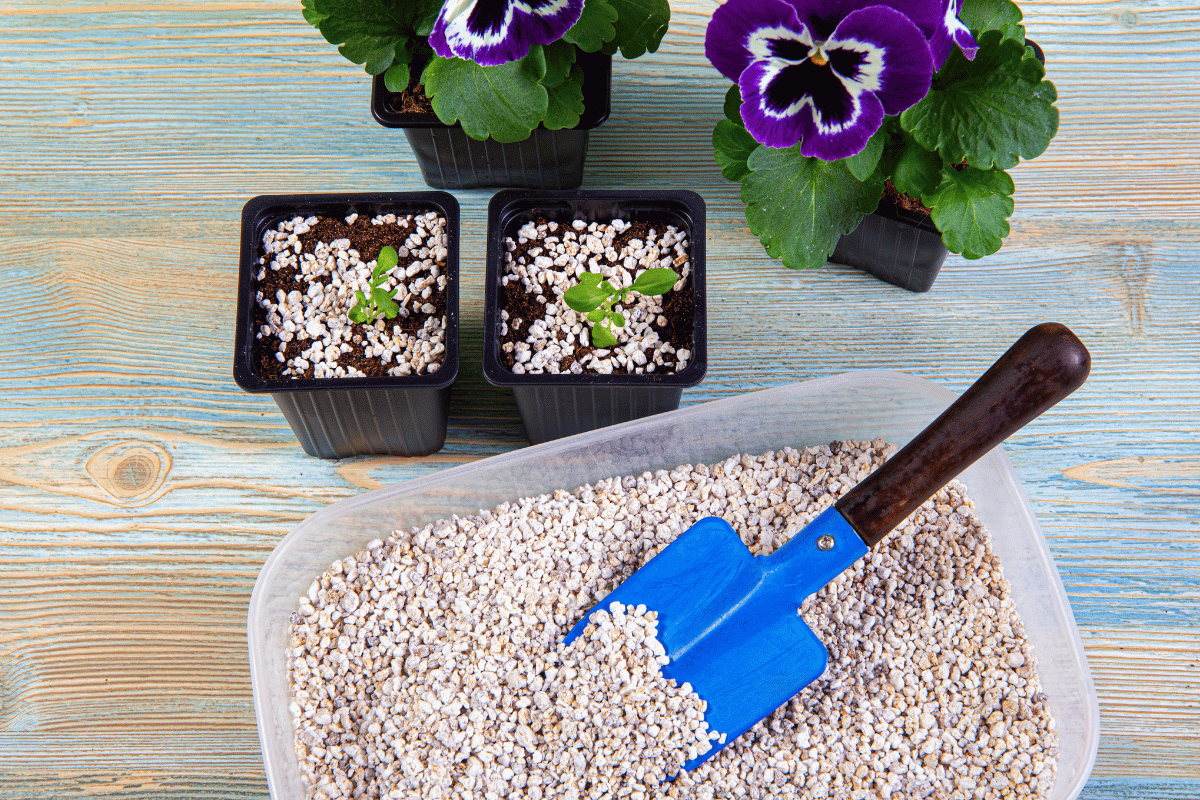
Perlite is a natural volcanic glass that, when heated to a high temperature, expands into a white, porous and very light material, the familiar small white granules in potting mix. In gardening it works as a soil conditioner that opens up the pores of the medium, improving aeration around the roots and drainage. It is not a fertiliser and supplies no nutrients, it works purely through its physical structure.
What perlite does in the mix
The microscopic pores created during expansion hold air and a film of water on their surface, so the mix drains the excess and lets the roots breathe. The material is light and reduces the weight of the pot, it has a neutral pH and is chemically inert, so it does not change the balance of the soil. It is also sterile, carrying no pathogens or weed seeds, and it does not decompose, so it keeps its structure for years. Because its cation exchange capacity is very low, it holds almost no nutrients, so feeding carries on as normal. It almost always goes in as one part of a blend, alongside materials that hold water and nutrients, as covered in choosing the right potting mix.
How much perlite to add by use
The proportion changes with the goal. General container use needs a moderate share, while seed starting and cuttings call for much more.
| Use | Indicative share of perlite | Reasoning |
|---|---|---|
| Houseplants and containers | 20 to 30% of the blend | Better aeration and less risk of waterlogging |
| Seed starting | 30 to 50%, fine grade | Gentle support and steady moisture for young roots |
| Rooting cuttings | 50 to 100%, up to pure | Air and moisture without rot before roots form |
| Cacti and succulents | 30 to 50%, coarse grade | Very fast drainage for roots that rot easily |
| Heavy or clay garden soil | Coarse grade worked into the top layer | Loosens the soil and improves how water moves |
| Hydroponics | Up to 100% | A stable, inert medium with good aeration |
Grade matters. Fine perlite suits seed starting, medium grade suits general potting blends, and coarse grade suits heavy soils and plants that need fast drainage.
How to root cuttings in perlite
Perlite is one of the most reliable materials for rooting cuttings, because it holds moisture without suffocating the base of the cutting. Moisten it so it is damp rather than soaked, insert the cuttings, and keep the humidity steady with a clear cover, in a bright spot out of direct sun. Drainage holes are essential so water does not pool. Once roots form, the young plants move into a normal medium, since pure perlite has no nutrients.
How perlite compares with other inert materials
All four materials improve a growing mix, but with a different role. The biggest difference is that perlite acts purely physically, while zeolite also has chemical activity, meaning it holds and releases nutrients through its high cation exchange capacity.
| Material | Main action | Nutrient retention | Particularity |
|---|---|---|---|
| Perlite | Aeration and drainage | Minimal | Very light, floats to the surface |
| Vermiculite | Water retention | Moderate | Compacts over time |
| Pumice | Drainage and aeration | Minimal | Heavier, does not float |
| Zeolite | Water and nutrients | High, through cation exchange | Chemically active, stable for years |
In practice gardeners often combine materials, adding perlite for aeration over a water-holding base such as peat or coir.
Where it fits and what to watch
Perlite is dusty when dry, so it helps to moisten it before mixing or to wear a mask. Because it is so light, it rises to the surface of the pot with watering, which is normal and does not reduce its effect. It supplies no nutrients, so it does not replace feeding. Good drainage in a pot comes from the holes at the base and a well-structured medium, not from a layer of gravel at the bottom, and here perlite helps from within the mix. On some sensitive houseplants, such as dracaena and peace lily, a build-up of fluoride can rarely cause brown leaf tips, something seldom seen in ready-made mixes.
Frequently asked questions
What is perlite and what is it used for
It is expanded volcanic glass, light and porous, added to a growing medium for better root aeration and drainage. It is not a fertiliser, it only improves the physical structure of the mix.
How much perlite do I add to a pot
For general container use, 20 to 30% of the blend is enough. For seed starting and cuttings the share rises to 30 to 50% or more, while for cacti and succulents a coarse grade is preferred at a similar proportion.
Perlite or vermiculite
Perlite gives more air and drainage, vermiculite holds more water and some nutrients. For plants that dislike too much moisture perlite is preferred, while vermiculite helps plants that want steady moisture.
Can I root cuttings in pure perlite
Yes. Damp perlite holds moisture and air without rotting the base of the cutting. Once roots form, the plant moves into a normal medium with nutrients.
Does perlite contain nutrients
No. It is inert and holds almost no nutrients, so feeding carries on as normal. If nutrient retention is also needed, it is combined with materials such as zeolite or compost.
Sources
- Perlite Institute, Perlite for Horticulture.
- The Old Farmer's Almanac, What is Perlite, Uses and Benefits.