Scroll through this page for an overview of the state of the climate in Europe for July, as well as seasonal outlooks for August-September 2025. Want to find out more? Explore the in-depth seasonal climate outlook for July Seasonal Climate Outlook for Europe, July 2025 — Climate Strategies (PDF).
State of the Climate – June 2025 Observations
Europe experienced its 5th warmest June on record, at 1.1°C above the 1991-2020 mean. Record high monthly-mean temperatures were observed in England, France, Italy and most of Spain. The western Mediterranean also experienced the warmest June since 1960.
In terms of precipitation, June was a record-dry period for the Balkans, with weak negative anomalies characterising most of Italy and central Europe. Much of northeastern Europe experienced positive precipitation anomalies.
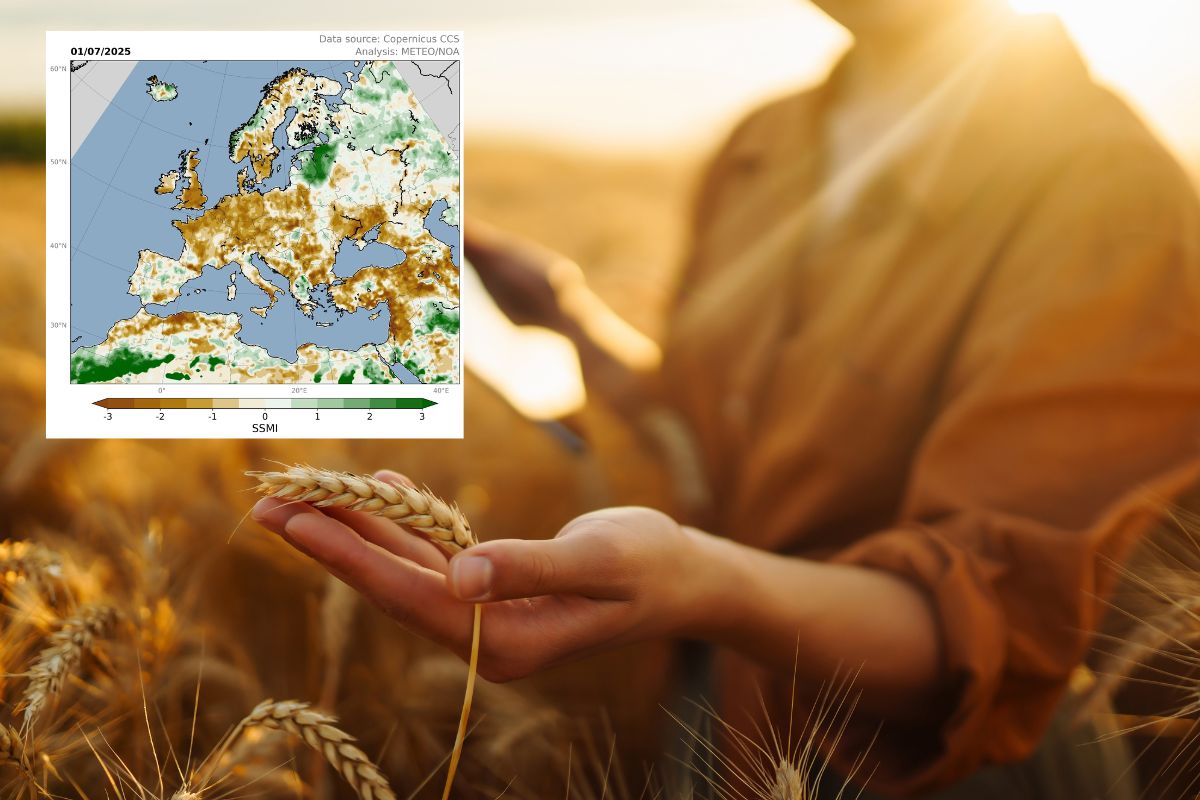
A state of moderate or severe drought affects much of central Europe, Italy, and the Balkans based on the July 1st soil moisture conditions (Fig. 1). Extreme drought conditions affect the British Isles. The aforementioned record-low rainfall in the Balkans reduced soil moisture from near-normal to below-normal levels.
Figure 1. Agrometeorological overview of June 2025 in Europe. Upper row: Anomalies in temperature at 2m (left) and precipitation accumulation (right). Green dots indicate the areas where the observed anomalies were record-high (positive or negative) for May in the period from 1960 to today. Lower row: Standardised anomaly in soil moisture in the 28-100cm layer below the surface. Values below -1, -1.5, and -2 indicate “moderately dry”, “severely dry”, and “extremely dry” conditions, respectively. Values above +1, +1.5, and +2 indicate “moderately wet”, “very wet”, and “extremely wet” conditions. Values between -1 and +1 reflect near-normal conditions. The climatological baseline for the computation of anomalies is the 1991-2020 period.
Seasonal Outlook – Forecasts for August-September 2025
The key points of the seasonal forecasts issued in early July 2025 for the August-September period in Europe are summarised below:
Most of Europe is projected to be 1-2°C warmer than average, with the strongest anomalies expected in eastern, central, and southern Europe (Fig. 2).
While the day-to-day weather evolution of the coming months cannot be foreseen, an increase of 1-5 Warm Days (i.e., days when the daily maximum temperature exceeds the climatological 90th percentile) per month is expected almost throughout Europe.
In terms of the total summer precipitation, the mean of all examined scenarios results in negative anomalies of 10-40% for parts of southeastern and southwestern Europe, while only weak signals emerge for the rest of the continent (Fig. 2).
Given the state of the climate and the aforementioned forecasts, negative soil moisture anomalies are projected to persist in much of Europe and especially the British Isles and central Europe.
Considering the complexity of the Earth system, seasonal forecasts are characterised by large uncertainty. Daily and local weather conditions may differ significantly from the monthly average conditions in a broader region.
Figure 2. Multi-model mean 2m-temperature (left) and precipitation (right) anomaly for the upcoming August-September period in Europe, based on the seasonal forecasts issued in July 2025.
Important note: Seasonal forecasts are intended for informational purposes only and should not be interpreted as precise predictions. The team accepts no liability for any decisions or actions taken based on this information.
The Wikifarmer team of agronomists uses the data presented above to make some data-driven assumptions about how these conditions may affect the crops growing across Europe for the indicative period, highlight possible risks that may arise, and advise farmers on management measures.
Agricultural Weather Outlook and Advice: August–September 2025
Eastern and Central Europe (e.g., Poland, Hungary, Czechia, Slovakia, Austria, Romania, Moldova)
Main crops: Wheat, barley, maize, sunflower, sugar beet, potatoes, vegetables
Forecast:
Temperatures: Expected to be 1–2°C above the long-term average for August and September. Probability of “very warm” months (50–80% chance), with a noticeable uptick in hot days—expect 1–5 more days monthly above the 90th percentile.
Precipitation: 10–40% below normal, especially in August, continuing soil moisture deficits that have persisted since June.
Drought: Moderate to severe drought likely to persist or intensify, with already low soil moisture and high evapotranspiration.
Risks that may arise:
Maize and sunflower: High vulnerability during flowering and grain filling to both heat and soil moisture stress. Expect lower kernel set and smaller seeds, particularly in non-irrigated fields. Some regions may see visible plant wilting and stunted growth.
Sugar beet and potatoes: Decreased root and tuber size, with increased chances of off-shapes and lower storage quality due to water stress.
Vegetables: Uneven fruit sizing, flower/pod abortion, and quality loss. Risk of surface cracking or scald on sensitive crops.
Cereals (late-harvested): Grain shriveling, lower protein content, and poor test weights if exposed to repeat spells over 35°C.
Pests: Numbers of aphids, spider mites, and flea beetle may jump; hot, dry weather can bring new outbreaks.
Advice:
Irrigation: Prioritize maize, sunflower, potatoes, and high-value vegetables. Use deficit or spot irrigation if water is tight.
Field Practices: Apply mulch and reduce tillage to conserve soil moisture. Consider earlier sowing/harvest to escape late-summer heat.
Varieties: Evaluate drought-tolerant hybrids for the future; trial resistant lines in small areas this season.
Scout: Check fields for pest “hot spots” and use integrated pest management. Monitor for new and secondary pest species.
Prepare: Discuss water-sharing plans and connect with local resources on possible irrigation restrictions.
Southern Europe (e.g., Spain, Portugal, Italy, Greece, Bulgaria, southern France)
Main crops: Olives, grapes, citrus, tomatoes, maize, rice, cotton, vegetables
Forecast:
Temperatures: 1–2°C above normal with frequent heatwaves; record events still possible into September, especially inland and coastal plains.
Precipitation: 10–40% below usual, particularly low in Iberia, Italy, and the Balkans. Mountainous and coastal areas may get local thunderstorms, but not enough to restore deficits.
Risks:
Grapes and olives: Accelerated ripening, more sugar accumulation (wine quality risk), smaller olive size, sunburn, and potentially higher acidity in olive oil.
Tomatoes and vegetables: Blossom-end rot and low fruit set as temperatures pass critical thresholds (e.g., >32°C).
Maize and rice: Yield loss at flowering due to poor pollination under extreme heat. Sunflower at risk for poor oil quality and head filling.
Pests: Hot summers may suppress olive fly but can trigger other pests (whiteflies, thrips, red mites).
Advice:
Harvesting: Schedule early harvests for grapes and olives if ripening is quickened. Monitor fruit for sunburn and quality loss.
Canopy/Shading: Use shade nets or adjust pruning to keep fruit and trunks shaded.
Water: Use drip irrigation if feasible; water at night or early morning to cut evaporative losses.
Fertilization: Avoid heavy nitrogen applications during hot, dry periods to prevent further stress.
Contingency: Develop alternative water source plans; monitor local restrictions.
Western and Northern Europe (e.g., UK, France, Germany, Benelux, Scandinavia)
Main crops: Wheat, barley, oats, potatoes, rapeseed/canola, sugar beet, grassland
Forecast:
Temperatures: Warmer than average (+1–2°C), frequent “warm days,” especially in central UK, northern France, and Germany.
Precipitation: Ongoing drought in many areas; local intense storms may bring flooding instead of helping soil moisture.
Risks that may arise:
Cereals (spring): Risk of grain shriveling if water stress continues or if irrigation is unavailable.
Potatoes: Poor tuber size and yield losses if the dry pattern persists.
Grassland: Slow regrowth and reduced quality for grazing and winter fodder.
Delayed harvests: Some regions may see local flooding from storms leading to lodging and secondary grain spoilage.
Advice:
Irrigation: Focus on potatoes and high-value vegetables where possible; detailed scheduling for optimal timing and savings.
Fodder: Monitor grass growth closely and secure additional silage or hay supplies if needed.
Harvest: Collect winter cereals promptly to avoid storm-induced quality losses; check local advisories for storm windows.
Water rights: Monitor abstraction licenses and connect with water management authorities.
Nordic Region (e.g., Sweden, Finland, Denmark, Baltic states)
Main crops: Wheat, barley, oats, potatoes, grassland
Forecast:
Temperatures: Above normal, periods of “micro-drought” (3–4 weeks dry) likely, especially in August.
Rain: Scattered; some areas may receive heavy local rainfall, complicating field operations.
Risks:
Cereals and potatoes: Reduced grain filling, risk of poor tuber development and scab in non-irrigated fields.
Forage: May turn brown or go dormant; risk of shortfall in silage/hay, especially after dry periods.
Advice:
Monitor: Check for drought stress and irrigate at key crop stages when feasible.
Prepare: Test more drought-tolerant lines in small plots. Watch fields for emerging pests and diseases that thrive in heat.
Field readiness: Be flexible in harvest schedules to capitalize on rain-free periods.
General Recommendations for All Regions
Water management: Review irrigation plans and invest in on-farm water storage.
Variety selection: Prioritize drought- and heat-tolerant options for upcoming seasons.
Communication: Alert buyers and co-ops early to potential changes in harvest quality or timing.
Climate alerts: Sign up for local advisories and extension updates.
Summary
Across Europe, summer 2025 is set to be hotter and drier than usual, with drought-affected areas facing high risk of lower maize, sunflower, vegetable, and forage yields. Water management, targeted harvest timing, and vigilant crop scouting are essential to minimize impacts, maintain quality, and support long-term farm viability.