Seasonal climate outlooks for Europe – December 2025
Scroll through this page for an overview of the state of the climate for Europe this autumn, as well as seasonal outlooks for December 2025 – February 2026. Want to find out more? Explore the in-depth seasonal climate outlook for the month Seasonal Climate Outlook for Europe, December 2025 — Climate Strategies (PDF).
State of the climate – November 2025 observations
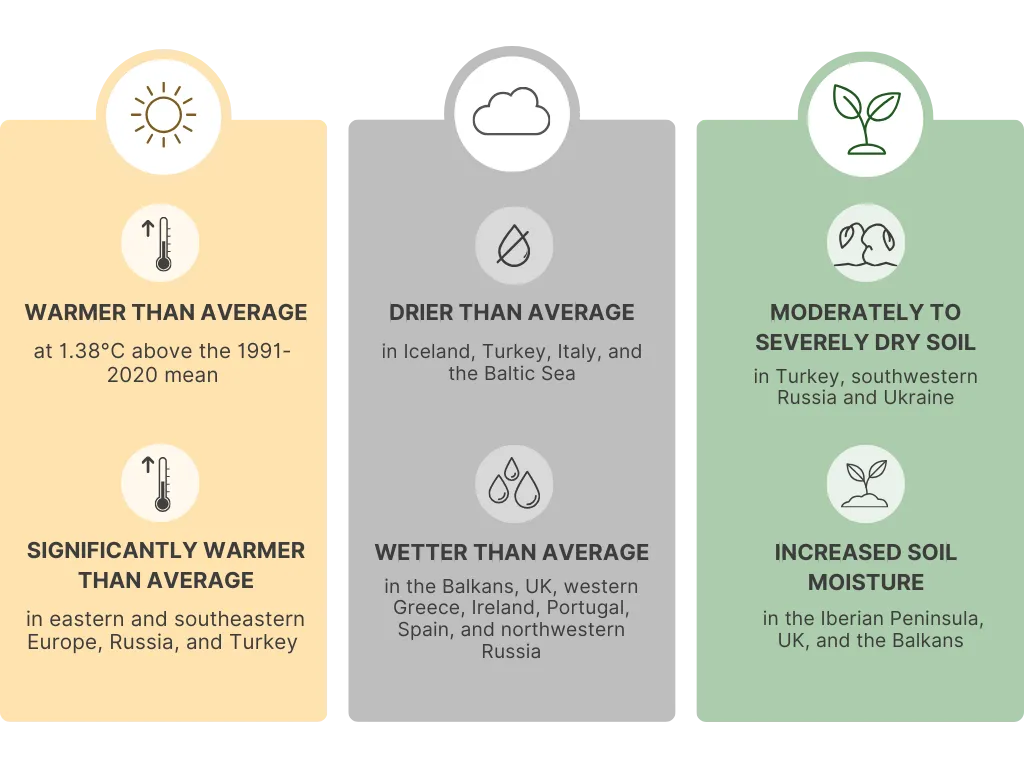
- Europe experienced a much warmer than average November, at 1.38°C above the 1991-2020 mean. Monthly-mean temperatures were significantly above normal in eastern and southeastern Europe, Russia (record high in central parts of western Russia), and Turkey, while they were below normal in parts of central Europe and northern Fennoscandia (Fig. 1).
- In terms of precipitation, November had a mixed imprint for Europe, with negative anomalies in Iceland, Turkey (record low in much of the country), Italy, and the Baltic Sea. Significant positive anomalies characterised the Balkans, western Greece, UK, Ireland, Portugal, Spain, and northwestern Russia.
- While much of Europe is snow-covered as of December 1st, the soil remains moderately to severely dry (index between -1 and -2.5) in Turkey, southwestern Russia, and Ukraine (relative to the average conditions for this period of the year). Compared to November 1st, soil moisture has increased significantly in the Iberian Peninsula, UK, and the Balkans, owing to the aforementioned precipitation anomalies. The values are now significantly above average in the Balkans and much of mainland Greece.
.png)
.png)
.png)
Figure 1. Agrometeorological overview of November 2025 in Europe. Top row: Anomalies in temperature at 2m, and Middle row: precipitation accumulation (right) based on ERA5. Black dots indicate the areas where the observed anomalies were record-high (positive or negative) for July in the period from 1960 to today. Lower row: Standardised anomaly in soil moisture in the 28-100cm layer below surface on December 1st, 2025, based on ERA5-Land. Values below -1, -1.5, -2, and -2.5 indicate “moderately dry”, “significantly dry”, “severely dry”, and “extremely dry” conditions, respectively. Values above +1, +1.5, +2, and +2.5 indicate “moderately wet”, “significantly wet”, “severely wet”, and “extremely wet” conditions. Values between -1 and +1 reflect near-normal conditions. The climatological baseline for the computation of anomalies is the 1991-2020 period. Purple hatching indicates snow-covered areas.
Seasonal outlook – Forecasts for January – March 2026
The key points of the seasonal forecasts issued in early December 2025 for the upcoming January-March period in Europe are summarised below:
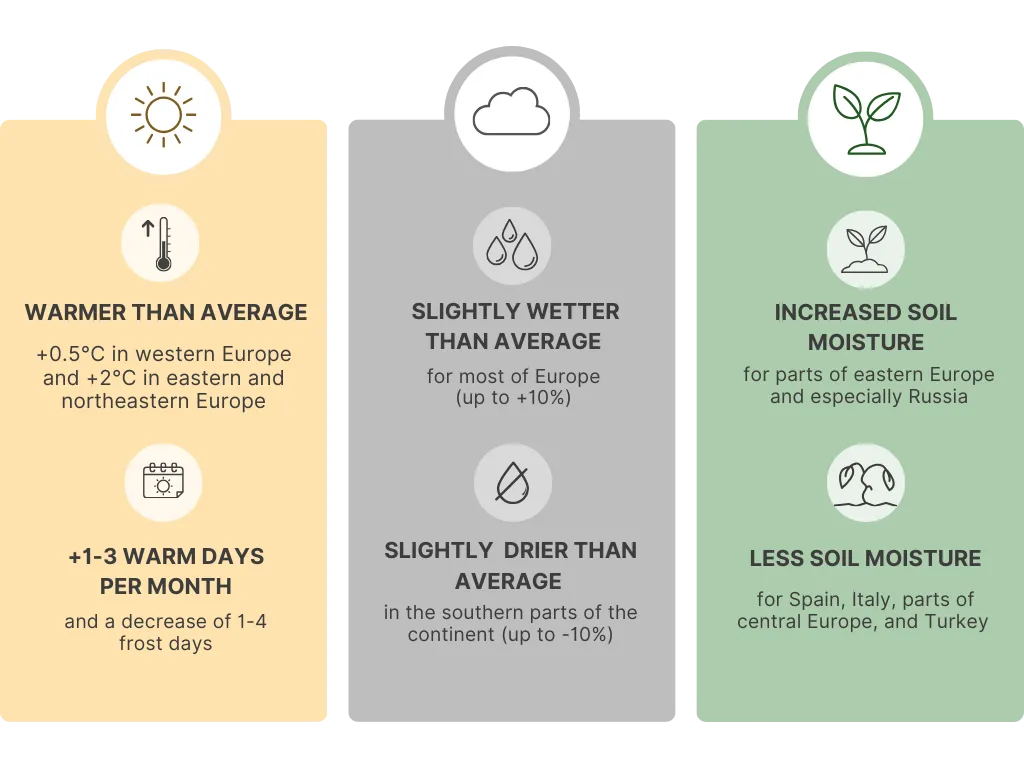
- Europe is projected to be warmer than average, with the anomalies increasing gradually from 0.5°C in western Europe to 2°C in eastern and especially northeastern Europe (Fig. 2).
- While the day-to-day weather evolution of the coming months cannot be foreseen, an increase of 1-3 Warm Days and a decrease of 1-4 Frost Days per month are expected throughout Europe.
- In terms of the total precipitation, the mean of all examined scenarios results in weakly positive anomalies for most of Europe (up to +10%), with patches of slightly negative anomalies in the southern parts of the continent (up to -10%). This is an expected result, as winter weather systems in Europe are highly unpredictable even at shorter timescales (Fig. 2).
- Positive soil moisture anomalies are projected for parts of eastern Europe and especially Russia, while weakly negative anomalies are projected for Spain, Italy, parts of central Europe, and Turkey (Fig. 2).
Considering the complexity of the Earth system, seasonal forecasts are characterised by large uncertainty. Daily and local weather conditions may differ significantly from the monthly average conditions in a broader region.
.png)
.png)
Figure 2. Climate outlook for the upcoming January-March period in Europe based on the seasonal forecasts issued in December 2025. Upper row: Multi-model mean 2m-temperature (Top row) and precipitation (Middle row) anomaly. Lower row: ECMWF soil moisture anomaly in layer-3 (28-100cm).
Agricultural impact analysis: Late winter 2026 climate outlook for Europe
Europe enters winter 2025–26 following an exceptionally warm November (~1.38°C above the 1991–2020 average). Eastern and southeastern Europe saw the most unusual warmth, while parts of central and northern Europe were slightly cooler. Rainfall was a study in contrasts: flooding in the Balkans and western Greece but extreme dryness in Turkey and Italy. As a result, soils in Greece and the Balkans are now wetter than normal, whereas Turkey, southwest Russia, and Ukraine remain in drought.
Outlook: Europe’s winter and early spring are forecast to be warmer than normal across the board (about +0.5–2°C, highest in the northeast). Expect fewer frost days and more warm days than usual each month. Precipitation is harder to predict: most models show only small deviations (~±10% of average). Southern areas lean drier (greater chance of dry months), while central and northern regions lean wetter. Notably, forecasts suggest eastern Europe’s deep soils will get wetter despite the warmth, but Spain, Italy, Turkey and parts of Central Europe may stay drier than usual.
Regional climate dynamics and agricultural consequences
Eastern and Northeastern Europe
Eastern and northeastern Europe face the most pronounced warming trajectory, with temperature anomalies projected to reach 2°C above average through March 2026. November saw record-high temperatures in central parts of western Russia, and the forecasted reduction of 1-4 frost days per month threatens to fundamentally disrupt the chilling accumulation required for winter cereal vernalization. Winter wheat, barley, and rapeseed that have not accumulated adequate cold exposure may experience delayed or asynchronous flowering, compromising grain fill synchrony and potentially reducing both yield potential and quality metrics such as test weight and protein content.
Paradoxically, the forecast indicates positive soil moisture anomalies for eastern Europe and Russia, which would typically favor early spring crop establishment. However, the combination of warm soil temperatures and adequate moisture creates conditions conducive to premature crop metabolic activation. If dormancy breaks prematurely in February, subsequent hard freezes (even if less frequent) could inflict severe damage on vulnerable vegetative tissue. Farmers in these regions should conduct field assessments of crop development stages and consider protective measures, including delayed nitrogen applications to avoid stimulating excessive early growth.
Mediterranean regions (Spain, Italy, Greece, Turkey)
Southern Europe remains under hydrological stress. Italy and much of Turkey just saw record-low November rainfall, and the winter outlook stays drier than normal. Warm, scant rainfall will hinder soil moisture recharge for olives, vineyards, and citrus. Early irrigation planning is critical: ensure water sources and systems are ready in case spring 2026 is dry. Mulching and other water-saving practices (drip irrigation, drought-tolerant varieties) can help crops cope. The low frost risk is a silver lining for cold-sensitive crops, but a mild winter also means more pests (e.g. olive fruit fly) may survive, pest control must stay on the radar.
Farmers managing rainfed systems should prioritize soil conservation measures, including residue retention, cover crop termination timing adjustments, and reduced tillage to maximize infiltration and minimize evaporative losses. For irrigated systems, early assessment of water allocation availability and infrastructure readiness is critical, as spring irrigation demand may arrive earlier and persist longer than historical norms.
Western Europe, Iberia, and the Balkans
In stark contrast to the south and east, western Europe, the Iberian Peninsula, the United Kingdom, Ireland, and the Balkans experienced significant positive precipitation anomalies in November, with soil moisture levels now significantly above average in the Balkans and much of mainland Greece. While this moisture recovery alleviates drought concerns established in earlier months, it introduces new management challenges related to waterlogging, soil compaction, and delayed field access.
Farmers in these regions must balance the benefits of replenished soil profiles against the risks of anaerobic soil conditions that can compromise root health in winter cereals and promote fungal pathogens such as Fusarium and Pythium species. Field drainage systems should be evaluated and maintained to prevent prolonged saturation. Additionally, spring fieldwork timing may be delayed if soils remain excessively wet, compressing the operational window for spring crop planting and potentially forcing suboptimal planting dates.
The forecasted continuation of weakly positive precipitation anomalies (up to +10%) suggests that moisture availability will remain adequate, but the unpredictability of winter weather systems means farmers should avoid complacency. Soil moisture monitoring and flexible operational planning will be essential to capitalize on favorable planting windows when they emerge.
Cross-regional agronomic risks and management imperatives
Elevated winter temperatures accelerate microbial mineralization of soil organic matter, releasing nitrogen and other nutrients at times when crop uptake capacity is minimal. In regions with above-average precipitation and soil moisture (particularly the Balkans, Iberia, and the UK), this creates substantial risk for nutrient leaching, especially of mobile nitrate forms. Nitrogen lost through leaching represents both an economic cost and an environmental concern, contributing to groundwater contamination and aquatic eutrophication.
Maintaining living cover crops or crop residues with high carbon-to-nitrogen ratios can mitigate leaching by immobilizing excess nitrogen in microbial biomass and plant tissue. Where cover crops are employed, termination timing must be carefully managed to ensure nutrient release aligns with spring crop demand. In contrast, in moisture-deficient regions such as Turkey and parts of central Europe, dry soil conditions may limit microbial activity, potentially reducing nutrient availability during the critical spring growth period. Soil testing in late winter can inform targeted fertilizer applications to correct deficiencies before peak crop demand.
Water management strategies
Regional water strategies must adapt to this outlook. In soggy southeastern Europe, emphasize drainage and use ditches and tiles to remove excess water and avoid heavy machinery on saturated fields. In drier central and western zones, focus on moisture retention, minimal tillage and maintaining residues will help capture any snowfall or rain. Mediterranean growers should secure irrigation resources now, readying reservoirs and systems for likely dry months ahead. Overall, remain agile: monitor conditions and adjust plans as needed. This unusual winter will reward farmers who adapt in real time, while rigid, calendar-based practices could be caught off guard.
Strategic recommendations for late winter and early spring operations
For Eastern and Northeastern Europe: Monitor winter crop phenology closely to detect premature dormancy release. Delay early-season nitrogen applications to avoid stimulating excessive vegetative growth vulnerable to late-season freezes. Consider variety selection for future seasons that emphasizes flexible vernalization requirements and freeze tolerance.
For Mediterranean and Southern Regions: Prioritize soil moisture conservation through residue management and reduced tillage. Assess irrigation infrastructure and secure water allocations early. For perennial crops, consider supplemental irrigation to support critical spring phenological stages if winter precipitation remains below average.
For Western Europe, Iberia, and the Balkans: Ensure field drainage systems are functional and prepared to manage excess moisture. Avoid trafficking wet soils to prevent compaction. Plan spring operations with flexibility to capitalize on favorable soil conditions when they occur. Implement cover crop termination strategies that align nutrient release with spring crop uptake.
Across All Regions: Intensify pest and disease monitoring, adjusting treatment thresholds and application timing to account for elevated pressure. Utilize soil testing to inform precision nutrient management strategies that minimize leaching risk while meeting crop demand. Maintain adaptive decision-making frameworks that prioritize real-time field observations over historical calendar-based schedules.
Moving with uncertainty toward spring 2026
The agricultural implications of the January-March 2026 climate outlook are defined by regional divergence and elevated uncertainty. While some regions benefit from moisture recovery, others face compounding drought stress, and nearly all contend with the disruption of traditional cold-weather crop dormancy. Success in 2026 will depend on farmers' ability to adapt management practices dynamically, integrating real-time monitoring of soil conditions, crop phenology, and pest pressure into operational decisions.