What does the latest outlook indicate for the coming spring?
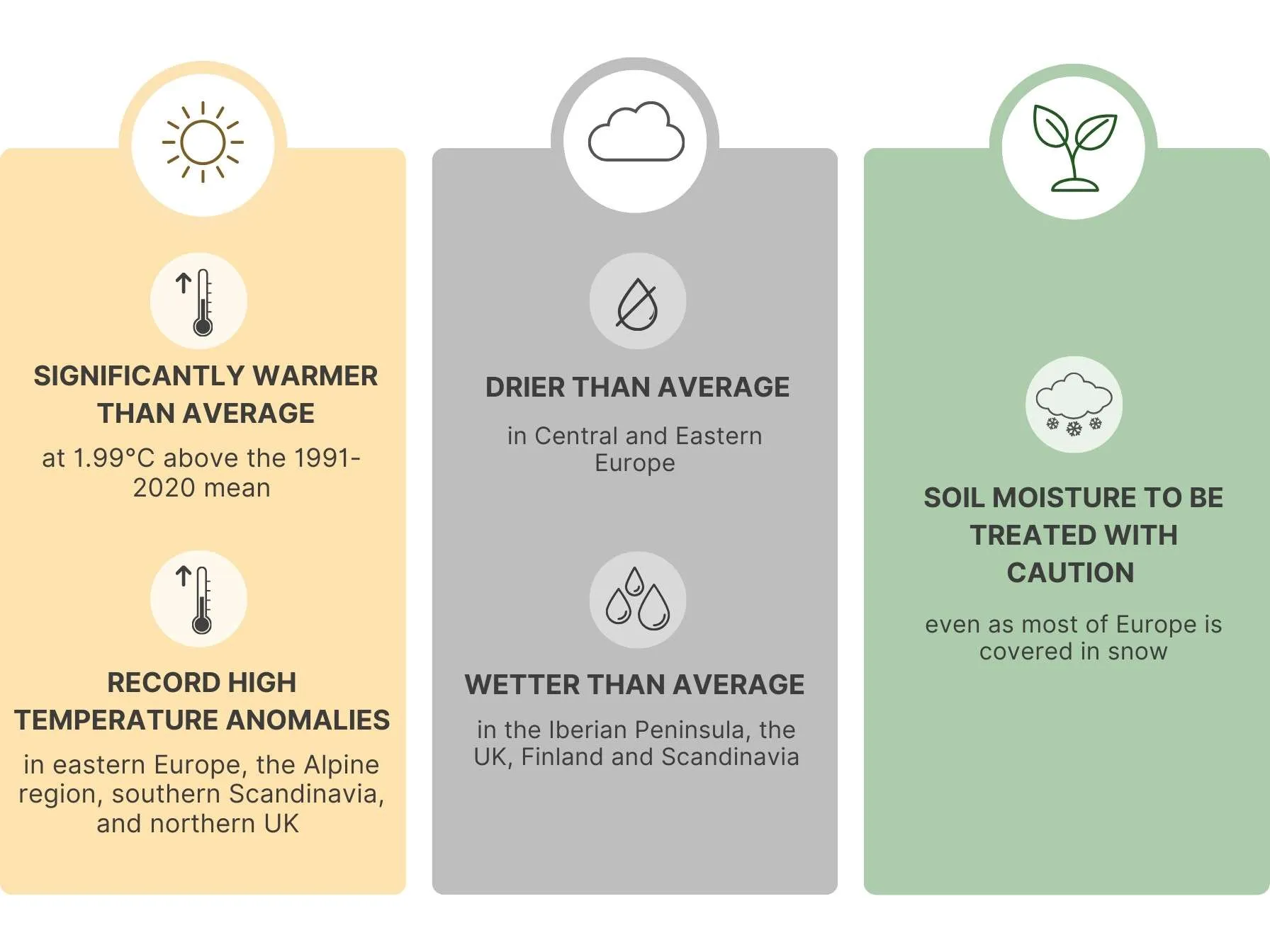
The newest spring outlook from Augures Project, describes a continent that entered 2026 with unusual winter warmth and projects a broadly mild spring across Europe. In the report’s observational baseline, December 2025 was the joint fourth warmest December on record over European land, at +1.99°C versus 1991–2020. The warmth affected almost the whole continent, with record-high anomalies flagged across a broad swath that included parts of the Alpine region, eastern Europe, and the northern.
This analysis is based on seasonal climate data from the Augures project. The full climate outlook, including regional forecasts and interactive maps, is available in theSeasonal Climate Outlooks for Europe January 2026Seasonal Climate Outlook for Europe – January 2026.
Moisture conditions were more mixed. The report notes that December precipitation was drier than normal for much of central and eastern Europe, while positive precipitation anomalies occurred in Fennoscandia, the United Kingdom, and northern France. The same report cautions that where snow cover is present, soil moisture fields should be interpreted carefully.
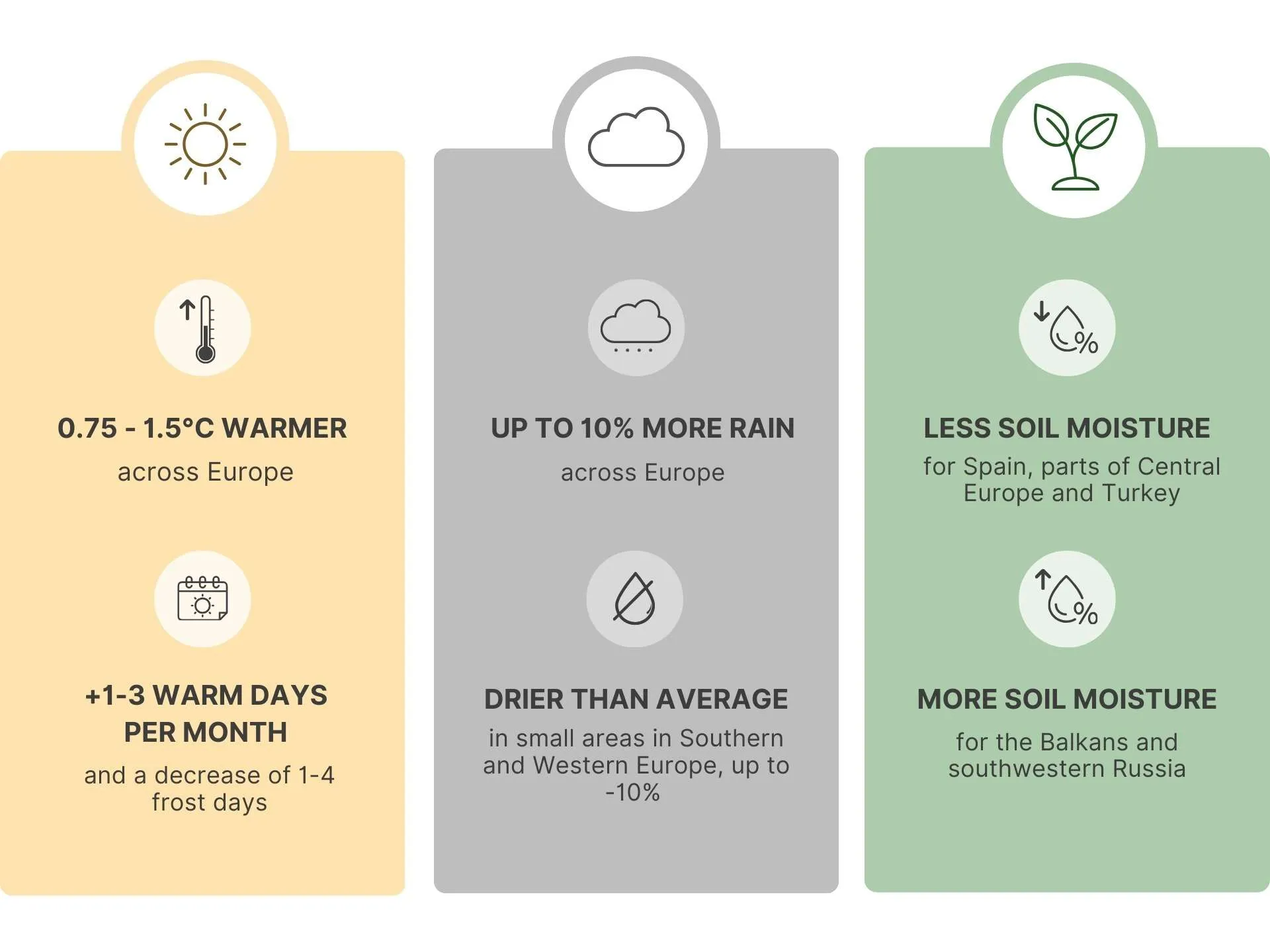
Looking ahead to spring (March through May), the multi-model signal is clearest for temperature. The outlook projects above-average temperatures across most of Europe, with anomalies increasing from about +0.75°C in western Europe to about +1.5°C in eastern and especially northeastern Europe. It also anticipates 1–3 more warm days and 1–4 fewer frost days per month, on average. Total precipitation is comparatively uncertain, trending only weakly. The multi-model mean suggests mostly small deviations (roughly within ±10%), with slightly drier pockets in southern and western areas.
A key practical detail for farming is the projected soil moisture pattern. Positive soil moisture anomalies for the Balkans and southwestern Russia, and weakly negative anomalies for Spain, parts of central Europe, and Turkey.
Why is a warmer spring with uneven soil moisture changes farm risk
Spring outcomes are often decided by timing. A warmer March to May advances heat accumulation, which can pull crop development forward and compress phenological windows. This is the same logic behind using growing degree days to track the development of plants, insects, and some diseases.
For winter cereals, temperature and water interact in ways that matter for yield formation. Research on winter wheat indicates that warmer temperatures during the vernalization window can slow chilling accumulation and delay the transition to reproductive growth, potentially pushing flowering and grain filling toward hotter conditions later.
Reducing cold also changes pest and disease dynamics. Experts explicitly warn that milder winters can allow pests and pathogens to persist and become active earlier, raising spring risk. In the broader scientific literature, rising temperatures and milder winters are linked to higher overwinter survival and shifts in timing for many agricultural pests, while mild winter conditions can improve overwintering success for some pathogens.
On the soil side, the “wet” part of the outlook is not just about crop physiology, it is about manageability. Waterlogging creates low-oxygen (anaerobic) conditions that restrict root function and promote nitrogen losses through denitrification, and it can increase vulnerability to root disease. Wet soils are also more susceptible to compaction from field traffic, which reduces aeration and can constrain root exploration.
Regional agricultural consequences farmers should anticipate
Southeastern Europe: Managing wet soil operational risks
Southeastern Europe, including the Balkans, is the clearest "wet-soil operational risk" zone in this outlook because soil moisture anomalies are projected to be positive. In these conditions, the highest-return management decisions are often about avoiding irreversible soil damage. Working fields when soils are at or above field capacity sharply increases compaction risk, and compaction can translate into lower yield potential, especially in seasons that remain wet during early crop growth. Waterlogging risk also becomes more acute as temperatures rise, because oxygen depletion can happen faster and root stress can compound nutrient losses.
Central Europe: Near-normal precipitation with moisture variability
Central Europe is closer to "near-normal" precipitation in the seasonal mean, but the outlook's weakly negative soil moisture patches imply that some areas may start spring with limited plant-available water even if monthly rainfall totals are not dramatically below average. Practically, this often shows up as early green-up and early nitrogen demand, paired with uneven crop growth where roots cannot access moisture at depth. In this situation, conserving soil structure and surface cover through conservation tillage becomes a yield-protection strategy, because residue and intact pore space improve infiltration when rain does arrive and slow evaporation when it does not.
Mediterranean basin: Persistent drought conditions
The Mediterranean basin is the most consistent drought hotspot across monitoring and outlook tools. The report projects weakly negative soil moisture anomalies for Spain and Turkey. In parallel, the European Drought Observatory reported that alert drought conditions persisted into early January 2026 in the Iberian Peninsula and south-eastern Turkey, with warning and watch conditions present across additional Mediterranean and southeastern zones. This matters for spring cropping because warmer conditions increase evaporative demand and can accelerate the drawdown of soil moisture reserves. It also matters for water planning: Europe's water scarcity indicator work highlights that countries including Greece and Spain experience notable seasonal water scarcity, and Turkey is among the most severely challenged in the wider EEA reporting domain.
Northern Europe: Excess water and limited field access
Northern Europe is exposed to the opposite constraint—excess water and limited field access. The December precipitation signal was positive for the United Kingdom and Fennoscandia. If soils remain wet into planting windows, spring operations can be delayed, and nitrogen losses can increase through leaching or denitrification.
Crop and system watchpoints in spring
Winter wheat, barley, and oilseed rape are likely to respond quickly to warmth, but management will be punished where root zones are compromised. In wetter regions, the combination of mild temperatures and wet soils can elevate foliar and root disease pressure and limit nutrient uptake by reducing oxygen availability in the root zone. In drier regions, early spring growth can expose shallow-rooted stands to moisture stress sooner, raising the value of maintaining residue cover and avoiding compaction, because compaction reduces the soil volume roots can exploit.
Perennial systems, especially in Mediterranean production zones (vineyards and deciduous fruit), should treat the warm signal as a phenology and frost-management issue. Earlier development can increase exposure to any late cold snap because buds lose cold hardiness as they progress; practical frost risk is therefore not only “how many frosts occur,” but “what stage the crop is in when a frost occurs.” Chill accumulation also remains a relevant background constraint for deciduous fruit systems under warming trends, given that dormancy and subsequent budbreak are temperature-dependent processes.
For spring-sown crops (maize, sunflower, sugar beet, potatoes, vegetables), the limiting factor is often establishment conditions. Wet soils delay seedbed preparation and amplify compaction and smearing risk; dry topsoils can produce uneven emergence if moisture drops after germination starts. The outlook’s mix of wet and dry soil moisture signals is therefore likely to show up as more variable stand establishment from region to region than in a uniformly “normal” spring.
What farmers should expect and do
The most effective responses are preventive and timing-based, because they reduce downside risk without assuming the forecast will verify perfectly.
In wetter zones, prioritize soil and traffic decisions: avoid heavy field operations when soils are near field capacity, maintain drainage and surface water pathways, and delay the largest nitrogen applications until crop uptake is more reliable. This is the simplest way to reduce compaction, denitrification, and root-zone stress under a mild, wet spring.
In drier zones, treat soil moisture as the scarce input: conserve moisture with residue cover and minimal disturbance, control weeds early so they do not capture limited water, and review irrigation readiness and scheduling, especially where drought indicators already show alert conditions.
Across all regions, start scouting earlier for pests and disease, and be prepared for earlier activity under milder conditions. The forecast itself anticipates fewer frost days and more warm days, and both the seasonal outlook communications and the scientific literature link milder winters to higher pest and pathogen persistence and earlier spring risk.
Working with uncertainty through spring
Seasonal outlooks are probabilistic and best interpreted as shifts in the likelihood of seasonal means, not as precise predictions of local daily weather. The practical approach is to plan around the robust signal, a warmer spring, then update decisions with in-season rainfall, soil moisture, and crop stage observations. That combination, seasonal direction plus field reality checks, is the most reliable way to turn this outlook into timely, defensible farm management choices.
Note: This article provides guidance based on the latest seasonal outlook data available. Farmers should monitor local weather conditions and consult with regional agricultural extension services for location-specific recommendations.