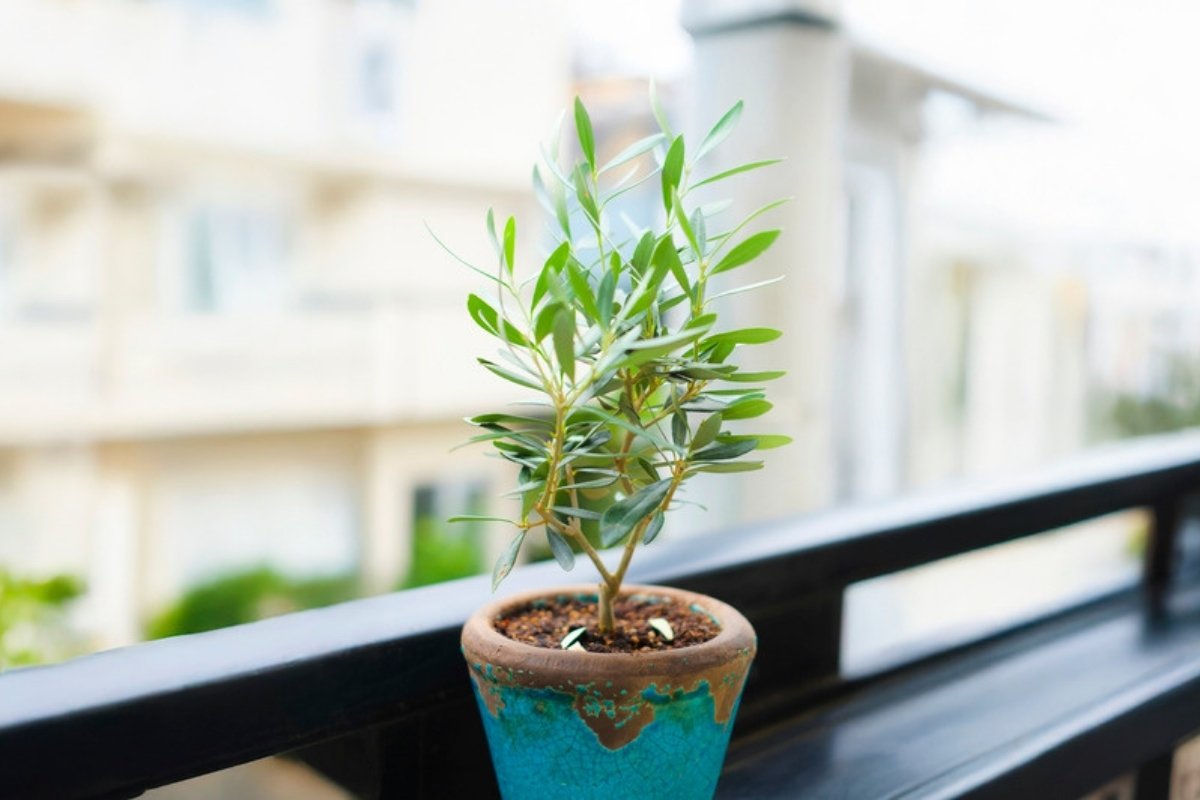
An olive tree can live for decades in a pot, as long as it has sun outdoors, compost that drains quickly and water only once the surface has dried. Most potted olives that fail are lost to too much water or to a spot inside a warm home, where the tree never gets the winter chill it needs to flower, and far less often to cold or drought.
The pot must drain well and grow with the tree
Olives evolved on the thin, stony, fast-draining soils of the Mediterranean and have no tolerance for waterlogging. The pot therefore needs drainage holes and should never stand in a saucer of water. Because terracotta is porous, it lets the compost dry between waterings more readily than plastic or glazed ceramic, which suits a drought-tolerant tree.
Pot size follows the tree. A young olive starts in a medium pot and is moved up gradually every few years, because a huge pot around a small root system holds water the roots cannot use. On sunny balconies dark plastic pots heat up a lot in summer, so light-coloured or terracotta pots protect the roots better.
The compost needs drainage more than nutrients
The Royal Horticultural Society (RHS) recommends potting compost with controlled-release fertiliser granules for olives in containers. Many growers add coarse material such as perlite, grit or sharp sand to keep the root zone aerated. Moisture-retentive, highly organic mixes, such as those sold for houseplants, are the most common cause of root rot. Olives grow well even in poor soils, but they do not survive in compost that stays wet.
A potted olive needs a sunny position outdoors
Olives want as much direct sun as possible all year, and on a balcony south- and west-facing spots are best. On high balconies and roof terraces wind matters almost as much as cold, because it dries out the foliage and, together with winter cold, causes the most serious damage, so a sheltered corner helps a great deal.
Indoors an olive rarely flowers
The olive is one of the few evergreen trees that needs cold to flower. It needs at least ten weeks below 16°C for its buds to become flower buds, and chilling between 5 and 12°C is considered effective. In a heated home at 20 to 22°C the tree never gets this chill, and in an ELGO-DIMITRA experiment with Greek cultivars, even one to three months in a greenhouse in winter reduced inflorescences.
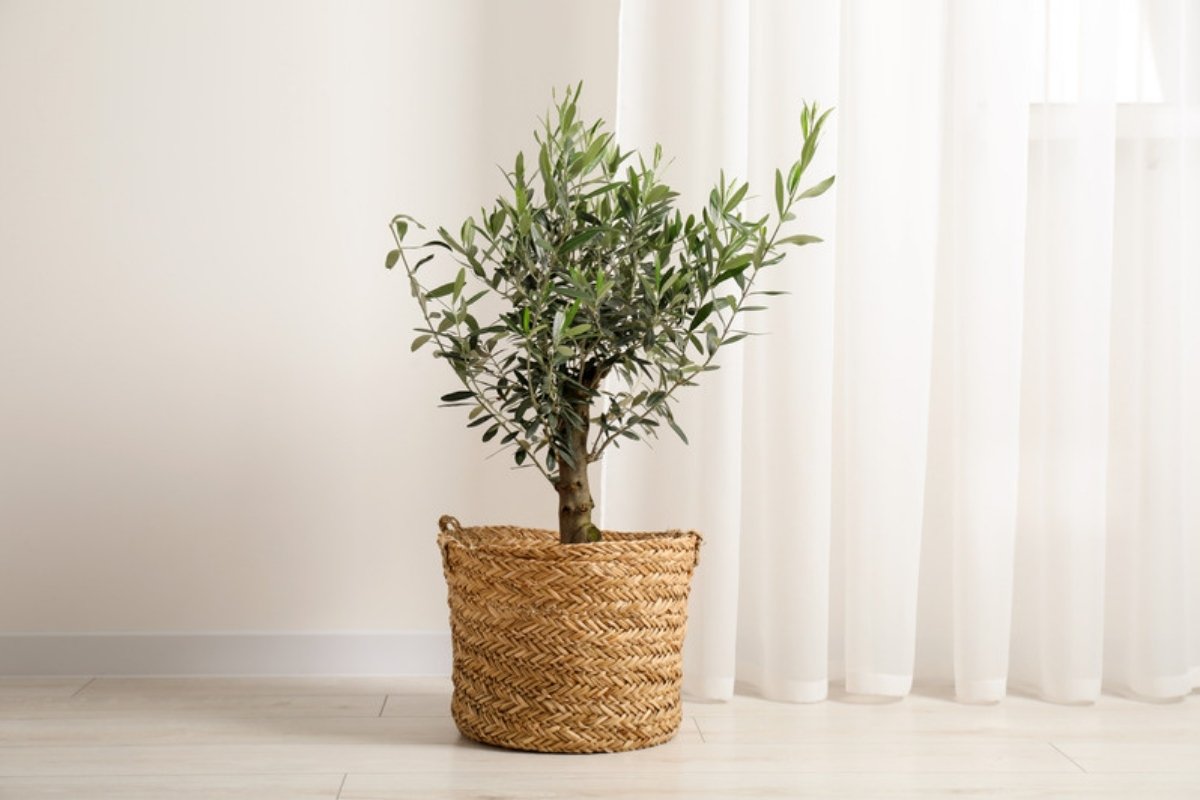
In a heated home an olive rarely gets the winter chill it needs to flower.
Indoors, light is also lower than the tree needs, and dry air from heating favours scale insects and spider mites, with scale among the most common olive problems. In mild climates a potted olive therefore stays outdoors all year.
In colder areas with hard frosts things are different. Roots in a pot are more exposed than roots in the ground, and for potted olives the RHS recommends, in severe winters, a frost-free place or covering the branches with horticultural fleece. That place is ideally bright, cool and unheated, such as an enclosed porch rather than the living room, and the tree goes back out as soon as the frosts pass. Cold-hardy olive varieties differ considerably, and Koroneiki is among the most sensitive.
Watering follows the compost rather than the calendar
Water a potted olive thoroughly, until water runs from the holes, once the top few centimetres of compost have dried, then leave it until they dry again. In summer, in heat and wind, that may mean watering two or three times a week, while in winter a few waterings a month are usually enough, and in rainy spells rain often covers its needs.
The simplest check is a finger in the compost. If it is moist a few centimetres below the surface, watering waits. Yellow leaves starting with the oldest usually mean too much water rather than too little, while a thirsty olive drops or dries leaves but quickly puts out new growth once it is watered properly.
Feeding takes place in spring and summer
In a pot nutrients wash out of the compost faster than from open ground, so a potted olive needs feeding that a grove tree often does without. The RHS recommends mixing controlled-release granules into the compost at planting and, for trees expected to fruit, a balanced liquid feed every month during the growing season, from spring to late summer. Feeding stops in autumn and winter, and too much nitrogen produces soft, sappy growth that attracts pests, so liquid feeds are given at the label rate and no more.
Pruning keeps the tree the size of its pot
A potted olive is pruned in early spring to keep its shape and remove dead, diseased and crossing branches. To restrict size, the RHS recommends tip pruning the main branches each year, cutting back to a good replacement shoot. Suckers from the base of the trunk are removed whenever they appear.
Because olives flower on the previous year's shoots, hard pruning every year gives a neat shape but few or no olives. The "olive ball" sold by nurseries, which is clipped constantly to keep its round shape, rarely fruits for the same reason.
Repotting takes place in spring every few years
When roots have filled the pot and are coming out of the holes, or when water runs straight through without soaking in, the olive needs a larger pot. Spring is the best time for planting and repotting, because the tree establishes more easily in the warmth of spring and summer.
After purchase or repotting, olives often drop some leaves, because light, temperature and root zone change suddenly. This does not mean the tree is dying, as long as the compost does not stay wet. When a large olive cannot go into a bigger pot, the top layer of compost is replaced with fresh compost each spring.
Which cultivar suits a pot
Most ornamental olives in nurseries are sold without a named cultivar and chosen for their shape. For anyone who also wants fruit, two traits decide the choice. The first is self-fertility, so that a single tree fruits without a pollinator, and self-fertile cultivars include Koroneiki and Manaki, which was found self-fruitful in a comparison of twelve Greek cultivars.
The second is a low chilling requirement, since balcony winters in warm cities are mild. Koroneiki and Arbequina flower even after mild winters, while Chalkidikis and Amfissis need a lot of cold and flower poorly in a warm city. Among Greek olive varieties, those grown for table olives also need plenty of water to produce large fruit, which is hard to provide in a pot.
The most common problems of potted olives
| Symptom | Most common cause | What to do |
| Yellow leaves, oldest first | Too much water, poor drainage | Water less often, check drainage holes |
| Leaf drop after buying | Sudden change of position and light | Stable position, patience |
| Dry, crisp leaves | Thirst, overheated pot | Deep watering, shade the pot |
| White cottony masses | Olive psyllid | See the olive psyllid guide |
| Sticky or black leaves | Scale insects and sooty mould | See the scale insects guide |
| Round spots on the leaves | Peacock spot | See the peacock spot guide |
| Never flowers | Lack of winter chill, hard pruning | Outdoors in winter, lighter pruning |
Sources: RHS, Association of Olive-Growing Municipalities of Crete, International Olive Council and Wikifarmer guides to olive pests and diseases.
Pests and diseases of potted olives are the same as in the grove, from the olive psyllid to peacock spot. Black leaves are usually sooty mould growing on the honeydew of scale insects.
Frequently asked questions
Can an olive tree live indoors?
It can survive for a while, but it rarely flowers, because it needs at least ten weeks below 16°C in winter and a lot of light. In mild climates its place is outdoors all year.
How often should a potted olive be watered?
When the top few centimetres of compost have dried. In summer that can mean two or three times a week, in winter a few times a month.
What compost should I use for an olive in a pot?
A free-draining potting compost with added perlite, grit or sharp sand. Mixes that hold a lot of moisture lead to root rot.
Does a potted olive tree produce olives?
Yes, if it stays outdoors in winter, gets plenty of sun and is not clipped hard every year. Self-fertile cultivars with a low chilling requirement, such as Koroneiki, fruit more easily on warm balconies.
When should a potted olive be moved to a bigger pot?
In spring, when the roots have filled the pot. The new pot should be a little larger than the old one, not much larger.
Why is my newly bought olive dropping leaves?
Usually because of the sudden change of light and temperature from nursery to home. With a stable, sunny position and water only when the compost dries, the tree puts out new leaves.
Important notes
Every plant and every environment is unique. Conditions vary considerably with region, exposure, water quality, soil pH and the overall health of the plant. The guidance above is general and a starting point.
If you suspect a serious nutrient deficiency or a disease that basic practices do not resolve, contact an agronomist for an accurate diagnosis.
Plant protection products should be used carefully and responsibly. Always try non-chemical methods first (cultural practices, soft soap, summer oil). When chemical intervention is needed, use only approved products and follow the label instructions.
Sources
- Royal Horticultural Society. How to grow olives, grow your own.
- Royal Horticultural Society. How to grow olives.
- Bartzokas, N. (2023). The role of chilling in olive fruiting. Association of Olive-Growing Municipalities of Crete (in Greek).
- International Olive Council. High temperatures, World Catalogue of Olive Varieties.
- Koubouris, G., Limperaki, I., Darioti, M., Sergentani, C. (2019). Effects of various winter chilling regimes on flowering quality indicators of Greek olive cultivars. Biologia Plantarum, 63, 504-510.
- Dimassi, K., Therios, I., Balatsos, A. (1999). The blooming period and self-fruitfulness in twelve Greek and three foreign olive cultivars. Acta Horticulturae, 474, 275-278.
- NC State Extension. Olea europaea, plant toolbox.
- Garden Ninja (2026). Growing olive trees in the UK, pots, winter care and pruning.
- The Olive Grove Oundle (2026). Growing olive trees in containers or pots.