
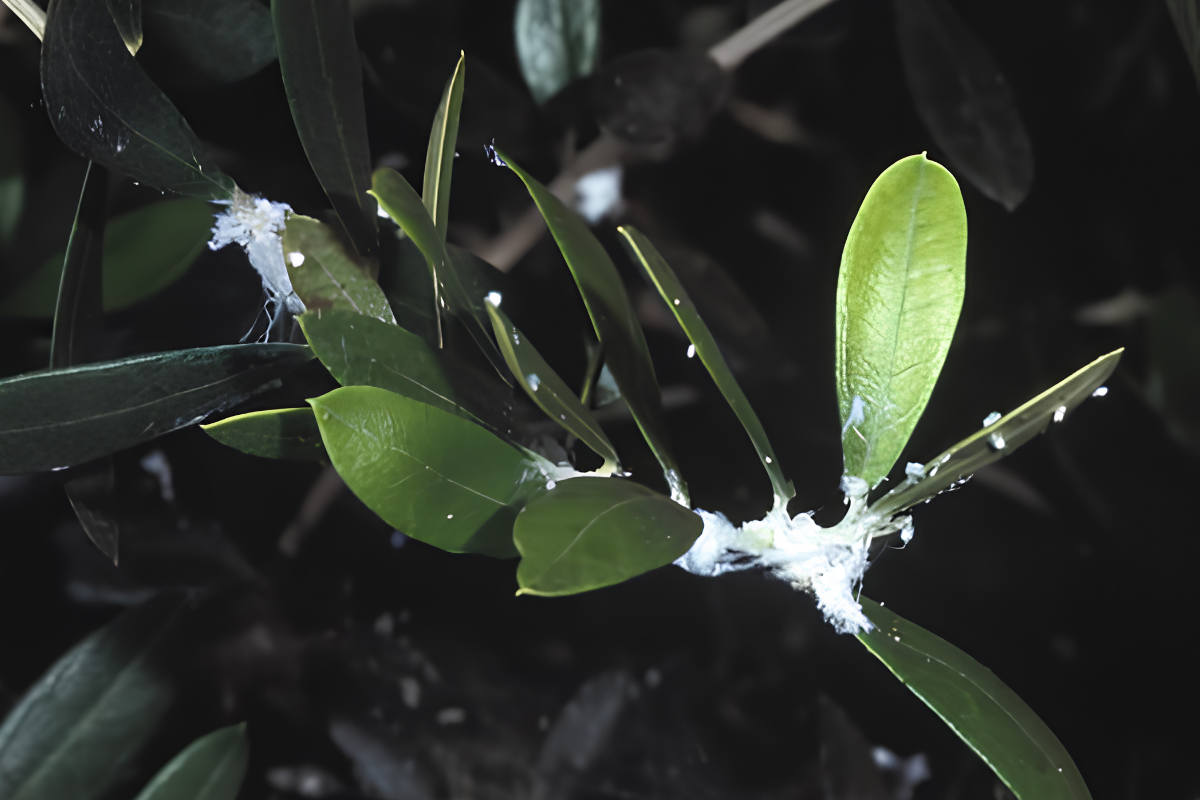
Every April, in many groves, the inflorescences and soft shoots of the olive dress themselves in white, cottony masses, and the grower's first reflex is to ask what to spray. In most cases, the correct answer is nothing. The culprit is the olive psyllid, Euphyllura olivina, a sap-sucking insect that the olive tolerates at low populations without economic damage, and one that the first heat of summer suppresses on its own. This guide covers what the insect is, why it has nothing to do with the mealybugs that produce similar cotton on citrus and ornamentals, when an infestation justifies treatment, and how to treat without sacrificing bees and beneficial insects.
Two different insects behind one appearance
White, waxy, cotton-like secretions are produced by many unrelated sucking insects, which creates confusion. Advice circulating for the "cottony" pests of lemon trees, bougainvillaea, or pine concerns entirely different insects with a different cycle.
| Feature | Olive psyllid | Mealybugs on citrus and ornamentals |
|---|---|---|
| Insect | Euphyllura olivina, a psyllid | Mealybugs and other scale insects |
| Hosts | Almost exclusively olive and mock privet | Citrus, bougainvillaea, oleander, gardenia and dozens more |
| Season | Spring, during bloom, with a natural collapse in summer | Late spring to autumn, peaking in heat |
| Where it sits | Inflorescences and soft shoot tips | Leaf axils, undersides, stems, roots |
| Usual need for treatment | Rare | Frequent, especially in containers |
Everything that follows concerns the olive psyllid alone.
What the olive psyllid is
Euphyllura olivina, together with the related E. phillyreae, belongs to the family Liviidae, formerly placed in the Psyllidae, and feeds almost exclusively on olive. The adult is tiny, around 2.5 mm, light tan in colour, and jumps strongly when disturbed. The nymphs are flattened, green to tan, pass through five growth stages, and are almost never seen because they live beneath the white, waxy secretion they produce, which covers the whole colony. That secretion is the "cotton".
Life cycle
The insect overwinters as an adult on the olive trees and becomes active as growth starts. Egg laying begins around March, with eggs placed on new shoots and flower buds. The nymphs that hatch cluster on the inflorescences, feed by sucking sap and produce the characteristic waxy cover. From egg to adult takes about three months at 20 to 25°C, and the insect completes three generations a year.
The first generation, in spring, is the largest and the only one of practical importance. High temperatures and summer dryness sharply reduce populations, so later generations are noticeably smaller.
Symptoms and damage
The visible symptom is white, sticky cotton on inflorescences and shoot tips, often accompanied by honeydew, on which sooty mould can develop. The insect feeds by sucking sap from soft tissue and, in dense colonies, causes flower drop and reduced fruit set.
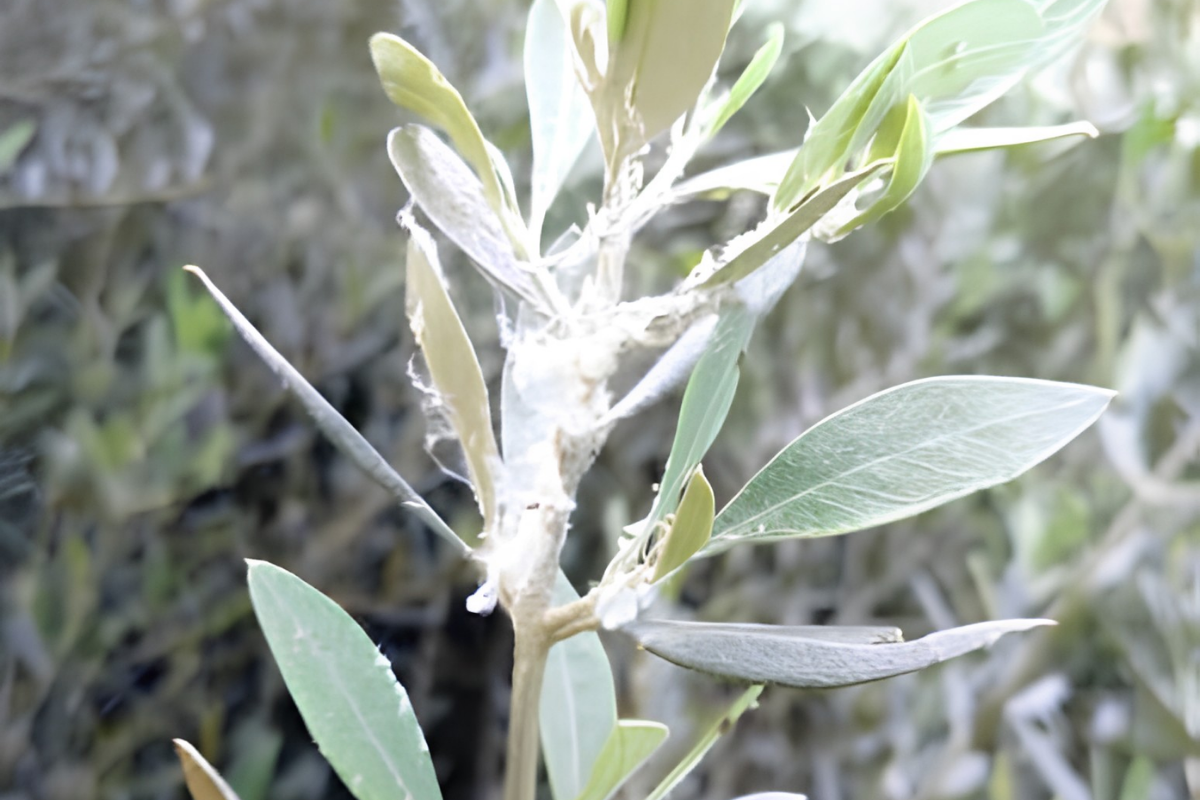
The damage, however, rarely reaches economically significant levels. The olive tolerates low and moderate populations without measurable yield loss, and in groves with a normal bloom, the loss of a percentage of flowers is compensated by the tree itself, exactly as with the flower generation of the olive moth. The sight of "white" trees impresses more than it harms.
Why spraying is usually unnecessary
Three reasons explain why treatment against the psyllid is not justified in the great majority of cases:
- Summer does the job: high temperatures naturally suppress populations, and the colonies covering inflorescences in April have vanished by June
- Natural enemies are many: predators such as minute pirate bugs (Anthocoris), lacewings and lady beetles, and the parasitoid Psyllaephagus euphyllurae, the insect's main natural enemy in the Mediterranean, keep numbers low when sprays do not wipe them out
- The spray costs more than the damage: the psyllid is active precisely during bloom, when any broad-spectrum insecticide hits bees and beneficial insects, with consequences that far outweigh whatever the insect itself would have cost
When treatment is justified
Intervention is recommended only where populations are high and infestation severe, meaning inflorescences are almost completely covered in wax, particularly on young trees, in nurseries and on trees already weakened by another cause, where the loss of growth matters more.
If treatment is deemed necessary, the target is the first generation, from March to April, before the flowers open, when the nymphs are small, and the protective wax has not yet thickened. The second generation, in May and June, is far harder to control because the cotton is dense by then and shields the insects from the spray.
How treatment is applied
Soft control relies on products that act mechanically, coating and smothering the insects:
- Summer oil: paraffinic oil applied as a spray, the classic answer to the psyllid, dissolving the waxy cover and coating nymphs and eggs
- Potassium salts of fatty acids: registered insecticidal soap products at label rates, or for a few garden trees, a solution of 20 g of grated soft soap per litre of water
- Rapeseed oil and natural pyrethrum: plant-derived organic insecticides, with pyrethrum acting directly on the nymphs and combining with summer oil in heavier infestations
The application rules are the same throughout. Spray late in the afternoon or at dusk, at temperatures below 28 to 30°C to avoid phytotoxicity, on trees that have been watered, with thorough wetting of the inflorescences and new growth where the colonies hide. Repeat after 7 to 10 days, since these products have no residual activity.
Conventional insecticides are used only in severe infestations, exclusively with products registered for olive, and never during full bloom. In practice, when a grove with a light bloom is sprayed against the flower generation of the olive moth with a conventional insecticide, that spray also covers the psyllid, so no separate treatment is needed.
Cultural measures
- Pruning the centre of the canopy: good airflow and exposure of the interior to sun and heat stress the insect, as covered in the guide to olive tree pruning
- Restraint in irrigation: frequent watering near the trunk and poor drainage favour the soft growth that the psyllid seeks
- Restraint with nitrogen: heavy nitrogen fertilisation produces abundant soft growth that hosts larger populations
- Protecting beneficials: avoiding needless broad-spectrum sprays is the most effective long-term strategy
Frequently asked questions
When should olive trees be sprayed for psyllid?
In most cases, they should not be. Where infestation is severe, treatment is applied in March to April against the first generation, before the flowers open, using summer oil or insecticidal soap products.
Is it the same pest as the cottony bugs on lemon trees
No. On olive, the cotton comes from a psyllid, while on citrus and ornamentals, it comes from mealybugs and other scale insects. They have a different cycle, season and method of control.
Does it damage the crop?
Rarely. The olive tolerates low populations without economic loss, and in dense colonies, the flower drop is usually compensated by the tree's abundant bloom. Economically significant damage occurs only in very heavy infestations.
Does insecticidal soap work
Yes, potassium salts of fatty acids and soft soap solutions act mechanically by dissolving the waxy covering and coating the nymphs. They need thorough wetting and a repeat after 7 to 10 days.
Can I use alcohol
On a few garden trees, a small amount of alcohol is added to the soap solution to prevent foaming, or it is applied locally with cotton wool to isolated colonies. It is never sprayed in strong sun, as it scorches foliage.
Which insecticide should I use?
Only products registered for olive, only in severe infestation and never during full bloom, to protect bees. In most cases, summer oil is enough.
Important notes
Infestation pressure varies by region and year, and the decision to treat depends on the actual colony density, the strength of the bloom, and local plant protection guidance, in consultation with an agronomist.
Prefer soft products and cultural measures; use only products registered for the crop in your country according to the label; and avoid spraying during full bloom.
References
- UC Statewide IPM Program, Olive psyllid.
- UC Statewide IPM Program, Olive psyllid in home and landscape.
- Hougardy E. et al., Current distribution of the olive psyllid and evaluation of the parasitoid Psyllaephagus euphyllurae, Insects, 2020.