
The olive moth (Prays oleae) ranks second only to the olive fly among insect pests of the olive. It completes three generations a year, and each attacks a different organ of the tree: the leaves, the flowers and the fruit. The critical one is the fruit generation, because the larva bores into the young fruit, reaches the stone and causes fruit drop. Control is not a question of which product to use but of when to use it, and the right moment is set by trap catches and by the size of the fruit. This guide covers the insect's cycle, how the damage of each generation is recognised, and when treatment is justified and when it is not.
The three generations and their damage
| Generation | Season | What it attacks and the damage it does |
|---|---|---|
| Leaf generation | Autumn and winter | Larvae mine galleries inside the leaf blade. The damage is usually of minor economic importance |
| Flower generation | Spring, during bloom | Destroys buds and flowers, binding them together with silken threads. In a heavy bloom the loss is compensated by the tree |
| Fruit generation | June to September | The larva enters the young fruit and reaches the stone. On exit it severs the vascular tissue of the pedicel and the fruit drops |
The fruit generation is the damaging one, because the loss is immediate and irreversible. Fruit drop shows mainly in late summer and early autumn, as mature larvae leave the fruit.
How to recognise it
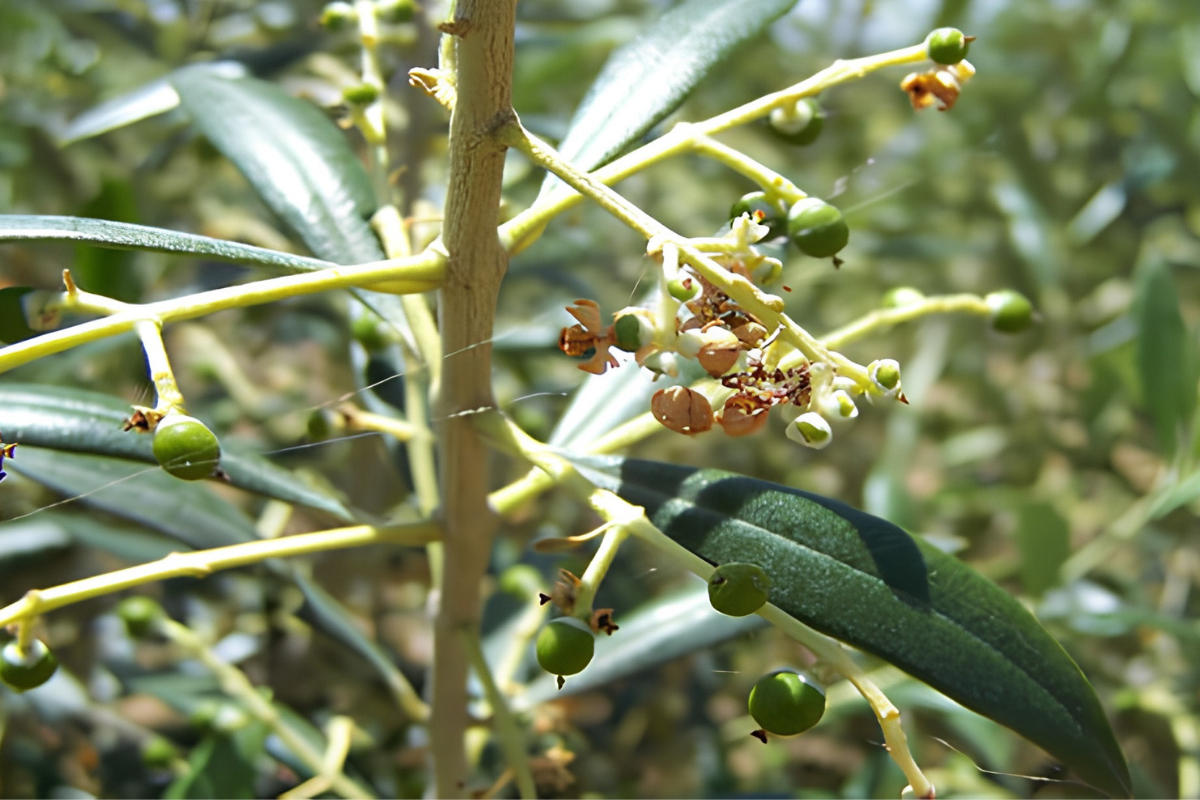
The fully grown larva is 7 to 10 mm long, green with light brown tones. On leaves, the leaf generation leaves clearly visible feeding galleries inside the blade. During bloom, affected flowers are bound together with fine silken threads. In fruit, the entry point is hard to see, but the damage becomes obvious when the fruit drops with the pedicel attached, or when cutting a fruit open reveals the gallery running toward the stone.
The main monitoring tool is the delta pheromone trap, hung in the grove to record adult flights. Catches show when each generation starts and, combined with the crop stage, set the treatment date. Spraying too early or too late is the main reason treatments fail.
The flower generation, when spraying pays off
This is where the most common misjudgement happens. In groves with a heavy bloom, treatment is usually not justified, because the olive produces far more flowers than it needs for a normal fruit set, and the tree absorbs the loss on its own. Intervention is recommended only where populations are high and damage is severe.
In groves with a light to moderate bloom, the picture changes, since every flower counts. There, the spray is applied at the start of flowering, when a small percentage of flowers have opened.
The preferred option for this generation is a Bacillus thuringiensis-based product that targets larvae without harming beneficial insects and bees. Sprays with bee-toxic products during full bloom are avoided, and when treatment is unavoidable, they are applied in the late afternoon.
The fruit generation, the critical spray
The objective is precise, namely, to kill the young larvae immediately after hatching and before they enter the fruit. Once inside, no product reaches them.
 symptoms.jpg)
Timing is set by fruit size. Treatment goes on when fruits have reached 3 to 5 mm in diameter, and when the bulk of the crop in the grove is at that stage. In most regions, this falls in late May and early June, with early coastal areas ahead of inland and upland ones. Some varieties run about a week later than the regional average, so local bulletins matter.
Whether to repeat after 10 to 15 days, once fruit reaches 6 to 10 mm, is judged on a case-by-case basis. It depends on fresh trap catches, the residual activity of the product used, how fast the fruit is sizing, and the weather. In seasons with uneven fruit set, where fruits of different sizes sit on the same tree, a second application is almost always needed.
Regional plant protection services publish dates for each area, and each grove is treated as a separate case.
Organic control
In organic groves and wherever chemical inputs are being reduced, the approach rests on three legs. On Bacillus thuringiensis products, applied at larval hatching and repeated at a short interval. Potassium salts of fatty acids are approved for organic production. And on protecting natural enemies, chiefly egg parasitoids of the genus Trichogramma and lacewings, which cut populations substantially when they are not wiped out by broad-spectrum sprays.
Mass trapping with pheromone traps works as a support measure, in combination with the above rather than on its own.
How it fits with the other pests
The olive moth is rarely managed in isolation. The olive bark beetle and scale insects are active in the same window, while the olive psyllid appears during bloom and, in most cases, needs no chemical treatment, since rising temperatures reduce the population on their own. One spray aimed at the olive moth may also cover other pests, so product choice should follow the grove's overall pest profile.
Because fruit injury also opens the door to secondary infections, olive moth management connects closely with that of the olive fly and anthracnose, both of which come later in the season. A full picture of the season's interventions sits in the guide to olive tree diseases and pests.
Frequently asked questions
When do you spray for the olive moth?
For the fruit generation, fruits are usually 3 to 5 mm across, and it occurs in late May to early June, depending on the region. A repeat follows after 10 to 15 days if trap catches continue.
Is a spray always needed at flowering
No. In groves with a heavy bloom, the damage from the flower generation is absorbed by the tree, and treatment is not justified. With a light or moderate bloom, the spray goes on at the start of flowering.
How many generations does the olive moth have
Three a year. The leaf generation on foliage through winter, the flower generation during spring bloom, and the fruit generation from June to September.
How do I know if my grove has olive moth?
Through delta pheromone traps, which record adult flights. Visually, the galleries in leaves, flowers bound with silken threads and fruit dropping with the pedicel attached are the giveaway signs.
Which product is preferred in organic production
Bacillus thuringiensis, applied at larval hatching, alongside potassium salts of fatty acids, protects beneficial insects.
How does the olive moth differ from the olive fly?
They are different insects with different cycles. The olive moth attacks leaves, flowers and young fruit early in the season, while the olive fly attacks only the fruit later, as ripening approaches.
Important notes
Every grove has its own pest population, its own earliness and its own history, so the dates above work as a framework rather than a recipe. Trap monitoring, regional advisory bulletins and a local agronomist determine the final decision.
Use only products registered for olive in your country, respect the dose rates and pre-harvest intervals, and avoid spraying during full bloom to protect pollinators.
References
- Hellenic Association of Agricultural Cooperatives, Guidance on controlling the fruit generation of the olive moth.
- Region of Eastern Macedonia and Thrace, Olive, olive moth.