An olive grove trap does not catch only olive flies. It catches other diptera of similar size, including the Mediterranean fruit fly, a polyphagous species that attacks more than 200 kinds of fruit. Correct identification decides whether your trap data means anything at all.
One character makes the distinction straightforward, and it sits on the wing.
Taxonomy and naming
The species is Bactrocera oleae (Rossi, 1790), family Tephritidae, order Diptera, subfamily Dacinae.
It was originally described in the genus Dacus, and the name Dacus oleae remains widespread in older literature and in several databases. The current name is Bactrocera oleae, and it is the one to use when searching scientific data or approved plant protection products.
An insect that feeds only on olives
The olive fly is monophagous. Its larvae develop exclusively in the fruit of the genus Olea, both cultivated olive and wild olive.
This has two consequences. There are no alternative hosts sustaining the population outside olive groves, so management concentrates on a single crop. And wild olives, together with abandoned trees, act as population reservoirs feeding neighbouring managed groves.
Where it occurs
The distribution of the olive fly follows that of the olive tree almost exactly. It occurs throughout the Mediterranean, across northern, eastern and southern Africa, in the Middle East, India and Pakistan.
It reached the Americas recently. It was first recorded in California in October 1998, when a single female was trapped in West Los Angeles. By autumn 1999 it had been caught in seven further counties, and it now occurs across all olive-growing areas of the state.
Worth noting is that Australia remains the only olive-growing zone worldwide free of the species.
The wing character
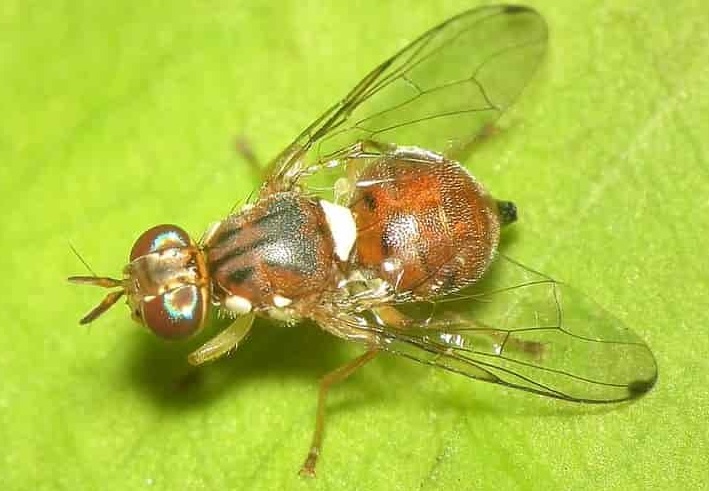
This is the key to identification, and a simple hand lens is enough to see it.
The olive fly carries a dark spot at the wing apex and has no bands running across the wing. Most related species show the opposite.
The Mediterranean fruit fly (Ceratitis capitata) has wings that are relatively broad for their length, cloudy yellow, carrying three brown bands across the apical two-thirds, together with smaller dark irregular streaks in the proximal half.
The same holds for other species it might be confused with, which carry banding rather than a simple apical spot.
The practical rule is short. A spot at the tip and an otherwise clear wing mean olive fly. Bands across the wing mean something else.
Adult morphology
Adults are 4 to 5 mm long. The thorax is brown-yellowish with two to four parallel greyish bands, carrying white or ivory patches on the sides and shoulders. The abdomen is pale, with dark spots along each side that, in some individuals, merge into bands.
Telling the sexes apart
The distinction lies at the tip of the abdomen. The female carries an ovipositor, a dark, pointed structure used to pierce the fruit and lay eggs. The male has none and its abdomen ends rounded.
The distinction is not merely taxonomic. In monitoring data, the sex ratio and the presence of mature females carry different information from a simple total catch figure.
The immature stages
Eggs are creamy white, smooth and elongate, roughly 0.7 mm long, and are deposited beneath the fruit skin. Newly hatched larvae sit immediately below the surface and are too small to spot with the naked eye.
Larvae are legless, yellowish white maggots with a pointed anterior end, passing through three instars, from about 1 mm in the first to 7 or 8 mm in the third.
The pupa is enclosed in a brown puparium, formed either inside the fruit while it is still firm, or a short depth into the soil once the fruit has softened.
Cultivar affects preference
One point of practical weight emerges from field observation. Females prefer large-fruited cultivars over small-fruited ones for oviposition.
Large-fruited cultivars also show more than one egg laid per fruit, whereas the general pattern is a single egg. This partly explains why table olive cultivars often face heavier pressure than oil cultivars.
Natural enemies
The olive fly has natural enemies, the most significant being the parasitoid Psyttalia concolor, a braconid wasp used in biological control programmes.
Its effectiveness runs into a physical limit. The ovipositor of the female parasitoid measures about 2.7 mm, so it parasitises larvae lying up to roughly 1.5 mm below the surface. Beyond that depth, as happens in large-fruited cultivars, oviposition is inhibited.
This explains why the parasitoid performs better in small olives, and why biological control gives different results from one cultivar to another.
Related articles
Notes
The morphological characters described come from the international literature and are sufficient for field identification with a simple hand lens. Identification at the level of official phytosanitary inspection requires examination by a specialist. Management of the pest rests on trap monitoring, action thresholds and approved plant protection products, following local plant protection bulletins.
Sources
- International Olive Council. The olive fruit fly Bactrocera oleae (Rossi), World Catalogue of Olive Varieties.
- University of California Statewide IPM Program. Olive Fruit Fly, Home and Landscape.
- Fruit Fly Identification Australia. Bactrocera oleae.
- Fruit Fly Identification Australia. Ceratitis capitata.
- Influence of Distance from the Host on Parasitisation by Psyttalia concolor.