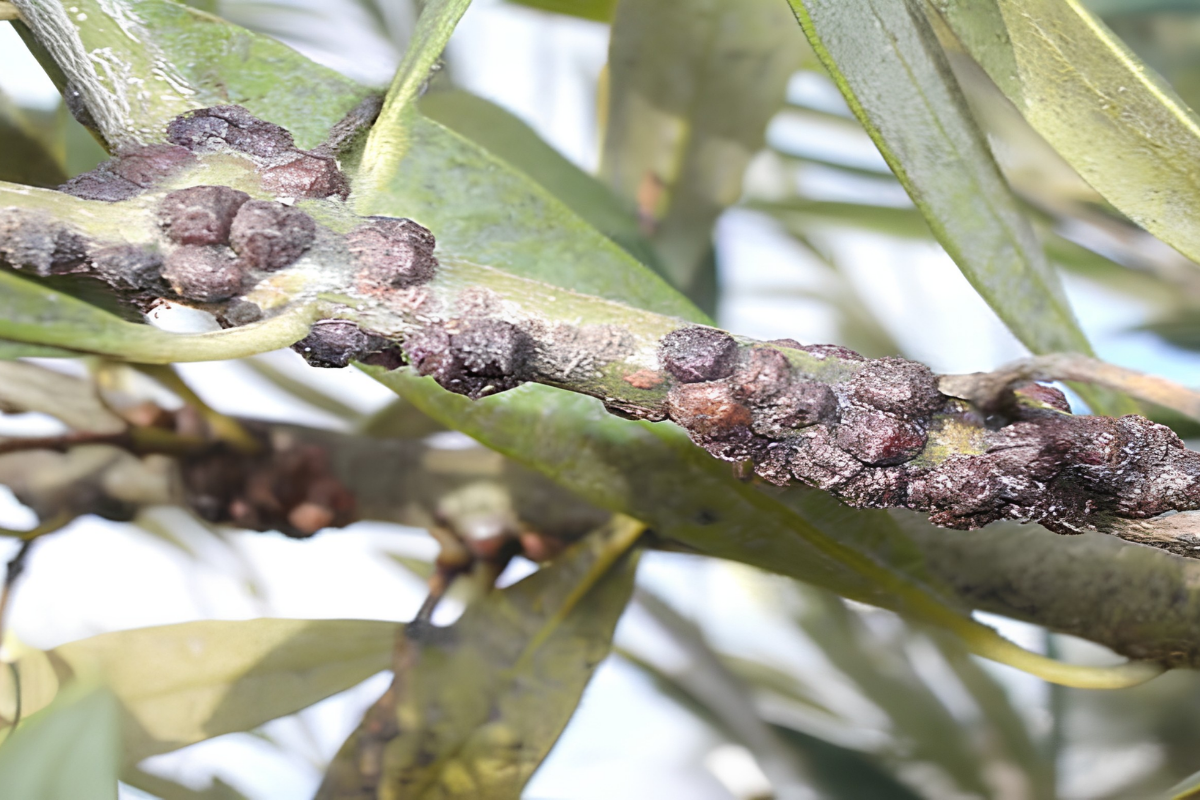
Scale insects are sap-sucking pests that sit under a waxy or hard armour and look like small limpets on branches and leaves. That armour explains why most sprays fail. Nothing reaches the insect once it is an adult, so treatment only works within a short window, while the young mobile stage, known as crawlers, is moving about. The black film that appears on the foliage, sooty mould, develops on the honeydew these same insects excrete. This guide covers which species attack olives, how they are recognised, why shaded and dense trees suffer most, and exactly when treatment goes on.
Which species attack olives
| Species | How it is recognised | Importance |
|---|---|---|
| Black scale (Saissetia oleae) | Adult female about 5 mm, dark brown to black, with a prominent H-shaped ridge on the back | The most important scale on olive, responsible for most honeydew and sooty mould |
| Olive scale (Parlatoria oleae) | Hard, pale armour on twigs, leaves and fruit | Downgrades fruit, particularly in table varieties |
| Pollinia scale (Pollinia pollini) | Small swellings in bark cracks and in scars on branches and twigs | Secondary, though it builds up in neglected groves |
| Oleander scale (Aspidiotus nerii) | Round, whitish armour, a polyphagous species that also attacks other crops | Secondary on olive |
| Filippia scale (Filippia follicularis) | White waxy secretions on shoots and leaves | Local, usually alongside black scale |
Symptoms and damage
The insects feed by sucking sap from leaves, shoots and fruit. The damage shows in four ways. The leaves turn yellow, dry and drop; new growth stays stunted, fruit remains small and falls early, and the tree weakens overall, which cuts the following year's crop.
On branches and leaves, small swellings like limpets or scales are visible, brown, black, grey or white depending on the species. In most cases, the grower notices the sticky feel of the foliage from honeydew first and finds the insects themselves later.
Why is sooty mould not the problem
Sooty mould, the black film covering leaves and fruit, grows on the honeydew excreted by scale insects. The fungi involved do not attack plant tissue and feed on sugars in the tree's excretions rather than on the tree itself. Their damage is indirect, since the black layer blocks light and reduces photosynthesis, while also downgrading the appearance of table fruit.
A fungicide does nothing about sooty mould because it does nothing about the cause. Once the scale population drops, honeydew stops, and the mould weathers off with rain and new growth.
One detail that often goes unnoticed is the role of ants. Ants feed on the honeydew and protect scale insects from their natural enemies, so heavy ant traffic on the trunk makes biological control markedly harder.
Why dense shaded trees suffer most
Scale insects are favoured by shade, high humidity and dense growth, so serious infestations concentrate in trees with closed canopies, in closely planted orchards and in neglected groves. UC IPM guidance is categorical on this point, stating that pruning to produce open, airy trees discourages black scale infestation and is preferred to chemical treatment.
In the same vein, balanced nutrition and correct irrigation keep trees vigorous and less vulnerable, while excess nitrogen produces abundant soft growth that hosts larger populations.
The only stage a spray reaches
The adult female is immobile and protected by a waxy or hard cover that makes her practically untouchable by any product. Under that cover, she lays up to two thousand eggs, which hatch into young nymphs known as crawlers. These emerge, move across the tree to find a feeding site, and are exposed only during that period.
Timing is, therefore, the single factor that decides success. Treatment continues once hatching is complete and crawlers have left the shelter of the old female's body, before they form their own armour. Double-sided sticky tape wrapped around branches is used to monitor crawler movement.
When and how treatment is applied
- Summer oil or paraffinic oil: the mainstay, acting mechanically by coating the insects. Applied when new growth reaches 6 to 8 cm and before flowering, or later as crawlers appear
- Combining with other sprays: in groves with a history, the treatment against the fruit generation of the olive moth also covers scale, while adding paraffinic oil to the tank handles mites at the same time
- Temperature limits: paraffinic oils are not applied above 30°C or to drought-stressed and weakened trees, since they cause phytotoxicity
- Incompatibilities: avoid combining them with copper products close to the sensitive flowering period
- Registered insecticides: in severe infestations, use products registered for olive and for the specific pest, preferring those that are least disruptive to beneficials
Coverage has to be thorough because the insects hide inside the canopy, in leaf axils and in bark cracks, all places a rushed spray leaves untouched.
Natural enemies and what destroys them
Black scale is attacked by several parasitoids, most commonly Metaphycus helvolus, Metaphycus bartletti and Scutellista caerulea, while predators such as lady beetles and lacewing larvae complete the picture. In many regions, combining parasitoids with proper pruning keeps populations below the damage threshold without chemical treatment.
Broad-spectrum insecticides easily disrupt that balance, and organophosphates, carbamates, and pyrethroids in particular wipe out the beneficials and lead to scale outbreaks, often larger than the original infestation. Avoiding unnecessary broad-spectrum sprays is the most effective long-term strategy.
Cultural measures
- Thinning cuts: opening the canopy brings sun and air into the interior and is the single most effective preventive measure
- Removing infested wood: heavily infested branches and twigs are cut out and burned rather than left in the grove
- Renewal pruning: on old and neglected trees, which carry the heaviest infestations
- Tree vigour: balanced fertilisation and adequate irrigation, so trees withstand the pressure better
- Managing ants: keeping them off the trunk lets the beneficials do their work
Frequently asked questions
When should olive trees be sprayed for scale?
Only while crawlers are moving, after hatching is complete. In practice, that means when new growth reaches 6 to 8 cm, before flowering, or later, as the crawlers appear.
Why do sprays fail against scale insects?
Because the adult is protected by a waxy or hard cover that stops the product from reaching the insect. Any spray outside the crawler stage is wasted.
What is sooty mould, and how does it go away
It is a fungus growing on the honeydew of scale insects, and they do not attack the tree's tissue. It clears on its own once the insect population is reduced, which is why control targets the insect rather than the fungus.
Does insecticidal soap work on scale
It acts mechanically and helps with light infestations and a few trees, always during the crawler stage. For widespread infestations, summer oil or registered insecticides remain the basis.
Which is the main scale insect on olive
Black scale (Saissetia oleae), recognised by the dark adult of about 5 mm with the H-shaped ridge on its back. Olive scale, pollinia, oleander scale and filippia are secondary.
Is a separate spray needed from the olive moth treatment
Not necessarily. In groves with a history of infestation, the spray against the fruit generation of the olive moth also covers scale insects, especially with paraffinic oil added to the tank.
Important notes
Crawler emergence dates vary by region and season, so follow local plant protection guidance and monitor with sticky tape rather than spraying to a calendar.
Use only products registered for olive in your country, follow the label and the maximum number of applications per season, and apply cultural measures first.
References
- UC Statewide IPM Program, Black scale in olive.
- UC Statewide IPM Program, Olive scale.
- Australian Olive Association, Black scale, industry fact sheet.