

Food recalls in Europe | February 2026 monthly analysis
For three consecutive months, the proportion of EU food safety alerts driven by pesticide residues has climbed. In December 2025, pesticides accounted for 25.9% of all hazards flagged by the Rapid Alert System for Food and Feed (RASFF). In January, that figure rose to 31.3%. By February, it reached 40.7%, meaning that nearly two in every five food recall notifications across the European Union involved a pesticide problem.
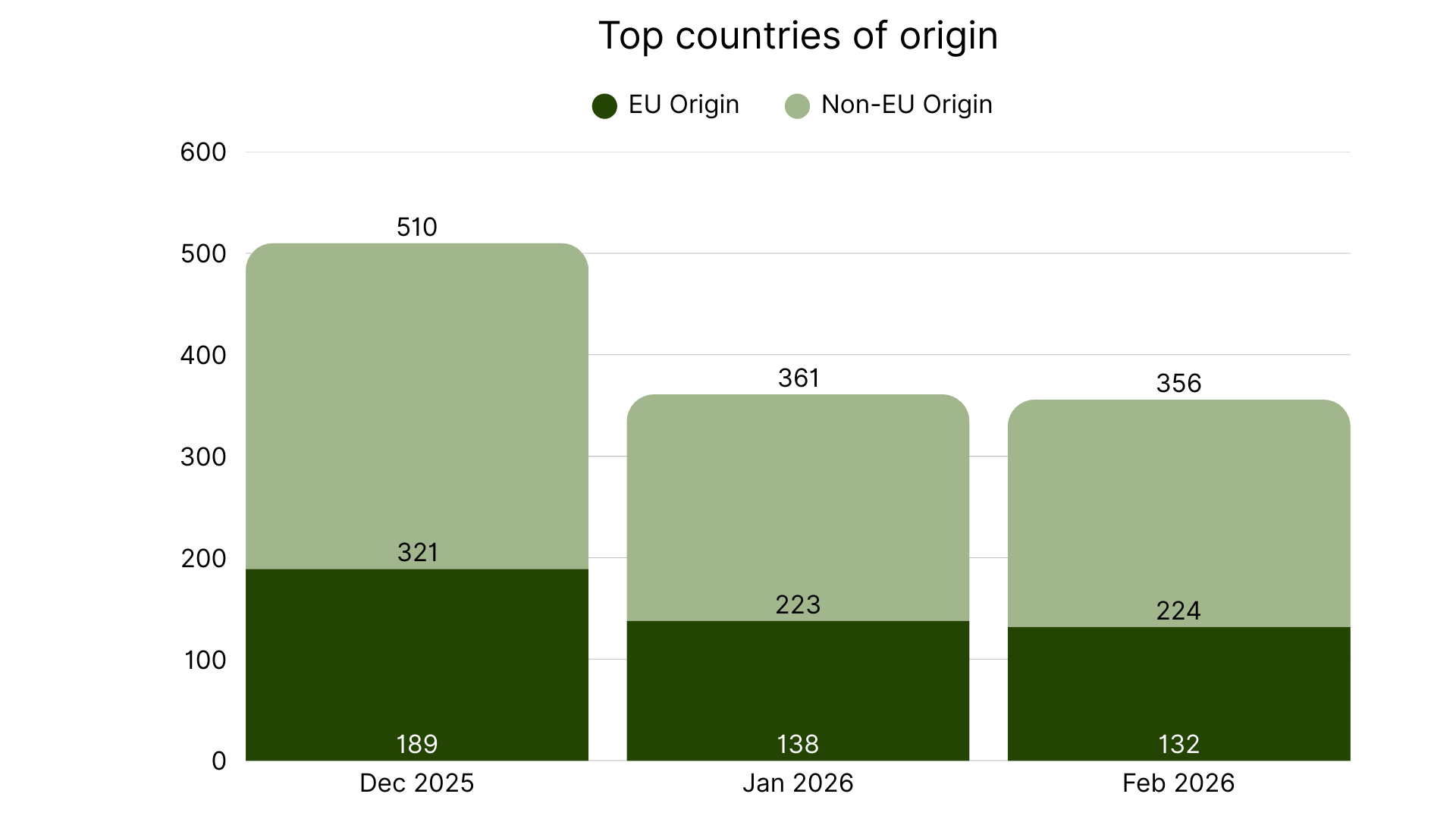
February 2026 recorded 356 total RASFF notifications, a number that sits marginally below January's 361 but significantly below December's 510. The drop in volume might suggest improving conditions, but the composition of those alerts tells a different story. Pesticide residues dominated the hazard rankings, appearing in 145 individual hazard entries across the month. To put that in context: mycotoxins, the second most common hazard, appeared in 72 entries, exactly half the pesticide figure.
This pattern should concern anyone sourcing fresh produce into European markets right now. The overall number of alerts may fluctuate with seasonal inspection cycles and holiday disruptions, but the steady escalation of pesticide-related flags points to something structural. Residues of chlorpyrifos, a broad-spectrum pesticide the EU banned for agricultural use in 2020, appeared in 22 separate notifications across 14 different origin countries. Southeast Asian chili peppers continued to arrive at EU borders carrying cocktails of five to eight different pesticide substances in a single product. And a new pattern emerged in Latin American avocados, where cadmium contamination flagged four times from Colombia alone.
For farmers competing with imports and wholesale buyers managing supply chain risk, February's data carries a clear message: the chemical profile of imported produce is intensifying, not stabilising.
February 2026 at a glance
- 356 total RASFF notifications in February 2026, down slightly from 361 in January but 30% below December's 510
- 324 food alerts, 23 feed alerts, and 9 food contact material notifications
- Pesticide residues appeared in 145 hazard entries (40.7%) — up from 31.3% in January and 25.9% in December
- Fruits and vegetables accounted for 98 alerts (27.5%), the highest category share since December
- Turkey led origin alerts with 36 notifications, followed by China (19), Poland (17), France (17), and the Netherlands (17)
- Chlorpyrifos appeared in 22 alerts from 14 countries — the most flagged single substance for the third consecutive month
- EU member states originated 37.1% of all alerts (132 of 356), identical to December's ratio
- Mycotoxins drove 72 entries (20.2%), with Turkey's dried figs accounting for 17 of those
- Salmonella was detected in 50 notifications, with 25 in poultry meat — Poland alone accounting for 10
- Colombian avocados flagged for cadmium 4 times — a new geographic cluster for heavy metal contamination.
 (1).png)
Top product categories affected
Fruits and vegetables reclaimed the top position in February with 98 alerts, representing 27.5% of all notifications. This marks a rebound from January's 77 alerts (21.3%) and moves closer to December's 119 (23.3%), suggesting that the dip in early-year produce alerts was a seasonal inspection effect rather than a genuine improvement.

Nuts and seeds held second place with 33 alerts, driven almost entirely by aflatoxin contamination. Peanuts from the United States accounted for 6 alerts, while hazelnuts from Georgia added 3. Both represent established risk corridors that buyers should factor into sourcing decisions. The sharp decline in dietetic foods and supplements (from 46 to 22) likely reflects a shift in enforcement attention back toward primary food products after the new year supplement screening wave.
Poultry meat remained stubbornly consistent at 29 alerts, with Salmonella as the near-universal hazard. Poland generated 10 of the 32 Salmonella-in-poultry recalls, making it the single largest contributor to this specific product-hazard combination in February.
Fresh produce focus
Combining fruits and vegetables (98), herbs and spices (11), nuts and seeds (33), and cereals (15), fresh produce-related categories accounted for 157 of February's 356 notifications, or 44.1% of the total. The hazard profile within this group is overwhelmingly chemical: pesticide residues appeared 117 times in fruits and vegetables alone, with mycotoxins contributing 21 entries and heavy metals adding 8.
Turkey dominated fresh produce origins with 32 alerts, more than triple the next country (Egypt at 10). India followed with 8, then the United States and Colombia with 6 each.
For buyers relying on Turkish produce, the risk is now split. Dried figs carry mycotoxin risk (17 fig-related alerts in February), while fresh products like pomegranates, mandarins, and peppers carry pesticide risk, including substances like imazalil, prochloraz, and the banned chlorpyrifos-methyl.
Egypt's pesticide problem deepens
Egypt recorded 11 alerts in February, and the pattern is stark: 10 of those 11 were in fruits and vegetables, and at least 6 involved chlorpyrifos specifically. Egyptian oranges accounted for 4 chlorpyrifos alerts on their own. Additional flags hit potatoes (fenamiphos, imidacloprid), black olives (chlorpyrifos), frozen strawberries (oxamyl), dried tomatoes, and grape leaves. For buyers sourcing Egyptian citrus, the data now suggests that chlorpyrifos testing should be treated as a default requirement rather than a risk-based screening.
Colombian and Peruvian avocados with cadmium contamination
Colombia triggered 6 alerts in February, of which 4 were cadmium in avocados. This is notable because cadmium in avocados is typically a soil-composition issue rather than a farming-practice failure. Volcanic soils in parts of Colombia's growing regions naturally concentrate cadmium. Peru also recorded a cadmium-in-avocado alert, suggesting this is a regional risk corridor rather than an isolated incident. Buyers sourcing Latin American avocados should consider requesting cadmium certificates as part of pre-shipment documentation, particularly for products destined for EU markets, where the maximum level is 0.050 mg/kg.
Frozen food recalls in February 2026
Frozen products accounted for 22 recalls in February, nearly double January's 12 and approaching December's 27. The increase matters because frozen food is often perceived as lower-risk by consumers and buyers, on the assumption that freezing halts degradation.
Pathogenic micro-organisms dominated frozen food alerts, with Salmonella appearing in frozen chicken products from Poland, Brazil, Ukraine, and Finland. Frozen seafood carried its own set of problems: mercury in frozen red tuna and swordfish from Spain; cadmium in frozen octopus from India; unauthorised crystal violet and malachite green in frozen fish from Vietnam and Bangladesh; and parasites in frozen mackerel from China.
The frozen produce segment is where the data gets relevant for fresh produce buyers considering frozen alternatives.
- Frozen strawberries from Egypt tested positive for oxamyl (an unauthorised insecticide),
- frozen okra from Vietnam contained flonicamid, and
- frozen mixed vegetables from Poland were recalled after glass fragments were found.
- Frozen blueberries from Belarus were pulled from market entirely for entering the EU without mandatory official controls, a documentation failure that raises questions about what testing those products bypassed.
Organic food recalls
Organic products generated 10 notifications in February, compared to 7 in January and 15 in December. The number may appear modest relative to the 356 total alerts, but the nature of these recalls carries disproportionate significance for the organic supply chain, because every organic recall involves a substance or condition that, by definition, should not be present in certified organic produce.
The most striking pattern is the presence of pesticide residues in products labelled organic.
- Italian organic dried porcini mushrooms contained permethrin, an unauthorised insecticide.
- Chinese organic tea tested positive for both anthraquinone and folpet.
- Turkish organic dried figs were flagged for ochratoxin A, and Turkish organic dried mulberries carried the same mycotoxin.
Salmonella appeared in three organic products in February: Belgian organic sprout seeds, Romanian organic sunflower seeds, and ground organic bay leaves of unknown origin. Aflatoxins were detected in organic Brazil nuts from Bolivia. German organic broths were recalled after glass and plastic fragments were found in them.
Why were products recalled from the market?
The three-month trajectory of pesticide residues is the defining story of the 2025–26 winter quarter. From December's 25.9% to February's 40.7%, the share of pesticide-driven alerts has increased by nearly 15 percentage points in just 90 days. This cannot be explained by seasonal variation alone. The shift reflects both increased border testing intensity and the structural reality that many exporting countries continue to use substances the EU has restricted or banned.

Mycotoxins remained in second place at 20.2%, though well below December's 26.5%. The decline corresponds directly with the tapering of Turkey's dried fig season; fig-related mycotoxin alerts dropped from 46 in December to 24 in January and 17 in February. Pathogenic micro-organisms held remarkably steady at 18.0–18.4% across all three months, driven by persistent Salmonella findings in poultry meat.
Heavy metals doubled their share from January (2.2%) to February (5.1%), driven largely by cadmium in Latin American avocados and lead detections in Indian spice products. This category deserves closer attention in the coming months, particularly as avocado import volumes climb with spring demand.
Where do recalled products come from?
Turkey: For the third month running, Turkey topped the origin ranking. The 36 alerts are split between mycotoxins (25 entries, overwhelmingly dried figs) and pesticides (18 entries, covering pomegranates, mandarins, vine leaves, peppers, and eggplants). The good news for buyers is that fig-related alerts continue trending downward (46 → 24 → 17), suggesting the tail end of the seasonal processing window. The concern is that fresh produce alerts from Turkey are not declining at the same rate.
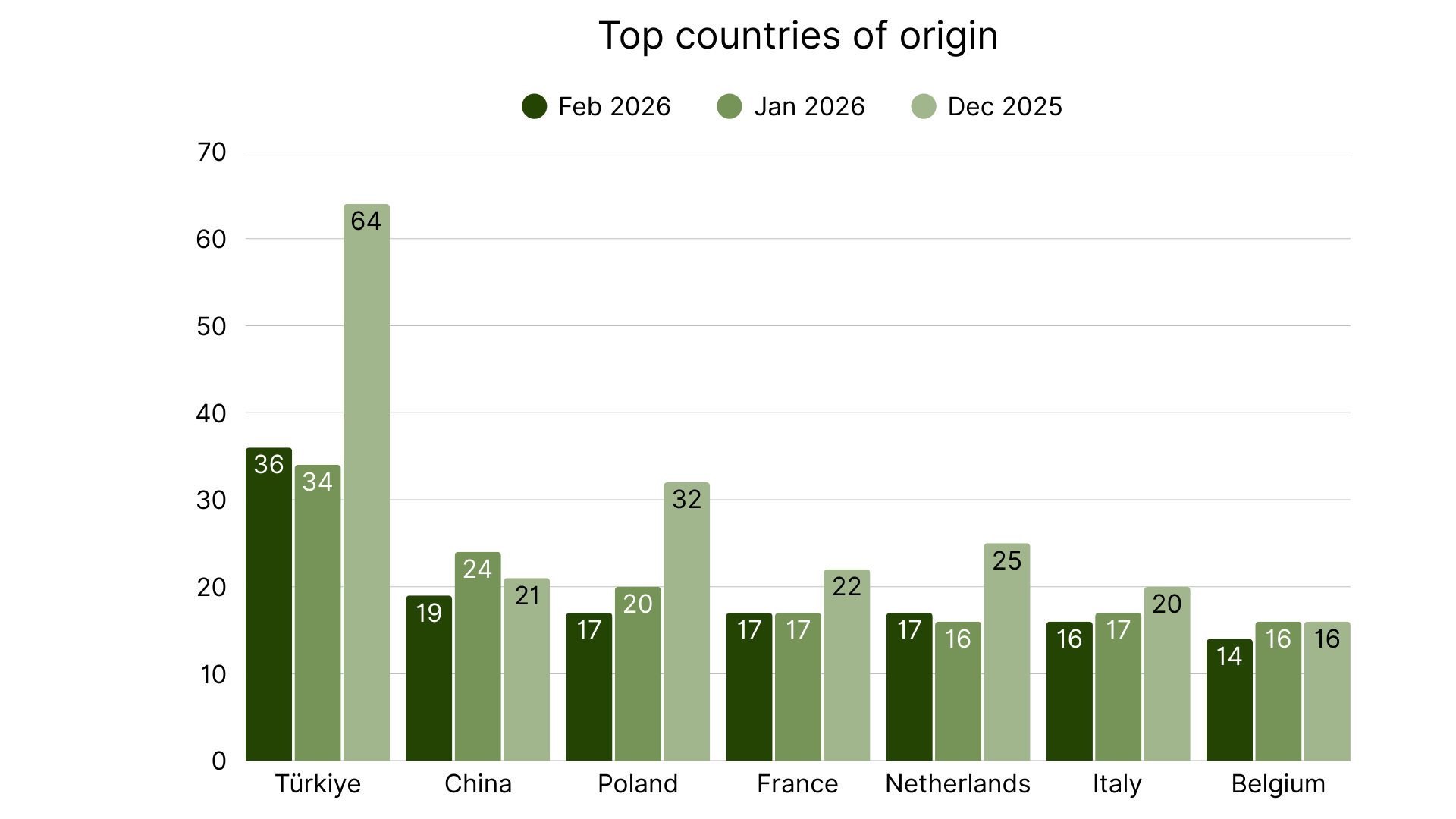
The EU internal challenge: EU member states collectively generated 132 of the 356 notifications, or 37.1%, matching December exactly and close to January's 38.2%. Poland led EU-origin alerts with 17 (10 of them Salmonella in poultry), followed by France (17), the Netherlands (17), Italy (16), and Belgium (14). For a deeper look at how the EU food recall systems operate, including labelling requirements and enforcement procedures, see our dedicated explainer.
Egypt: Eleven alerts with a concentrated risk profile. Six involved chlorpyrifos across oranges, olives, and grape leaves, making Egypt the single largest contributor to chlorpyrifos alerts from any one country in February.
What this means for March and beyond
February's data closes out a winter quarter that has seen the balance of EU food safety enforcement shift measurably toward chemical contamination. The three-month trajectory, with pesticide residues climbing from a quarter to two-fifths of all hazard entries, sets the baseline for spring, when fresh produce import volumes typically increase, and border inspection rates adjust to seasonal flows.
Three specific patterns from February deserve attention in March sourcing decisions. First, Egyptian citrus and chlorpyrifos have become a near-automatic combination. Four orange-specific alerts in a single month should trigger upgraded testing protocols for any buyer in this supply chain. Second, the cadmium cluster in Colombian avocados is early-stage data, but it aligns with what soil science predicts for volcanic growing regions, and it may escalate as EU import volumes grow. Third, Southeast Asian chilli pepper shipments carrying five to eight residues at once are not occasional outliers; they are a recurring pattern that buyers should incorporate into standard risk models for the region. For practical guidance on evaluating fresh produce supplier safety compliance in Europe, see our step-by-step guide.