
Table olives are among the most widely consumed pickled products in the world, with Spain the leading producer and exporter, and Greece among the major producers, mainly through the Kalamon, Halkidiki, and Konservolia varieties. Every processing method pursues the same goal: to remove or transform oleuropein, the glucoside responsible for the bitter taste, while producing a stable product that remains safe. The International Olive Council and the Codex Alimentarius precisely define the commercial types and their specifications. This guide covers how table olives are classified, the four trade preparations, the stages of processing inside a plant, the mechanisms that preserve the product, and the quality criteria. Home processing is covered separately in the guide to curing olives at home.
Types by stage of ripeness
Under the Codex standard for table olives, the first division is made on the ripeness of the fruit at harvest:
- Green olives: fruit harvested during the ripening period, before colouring and once it has reached normal size
- Olives turning colour: fruit harvested before full ripeness, while its colour is changing
- Black olives: fruit harvested fully or nearly fully ripe, once it has taken on the dark colour of maturity
For table use, harvesting is often done by hand because the fruit must reach the plant unbruised, and, ideally, it is processed as soon as possible after picking. The stage of ripeness also predetermines the method, since green olives are destined mainly for the Spanish method, while ripe olives go to the natural fermentation of the Greek style.
The four trade preparations
| Preparation | Known as | How it is made |
|---|---|---|
| Treated olives | Spanish-style green | Debittered in an alkaline solution, rinsed, then lactic-fermented in brine |
| Natural olives | Greek-style black | Placed directly in brine, where fermentation takes place with no alkaline treatment |
| Dehydrated or shrivelled olives | Throumbes | Dry salt or a mild alkaline treatment, with partial dehydration of the fruit |
| Olives darkened by oxidation | Californian-style black | Green or turning-coloured olives held in brine, darkened by oxidation in an alkaline medium and sterilised. |
The stages inside a processing plant
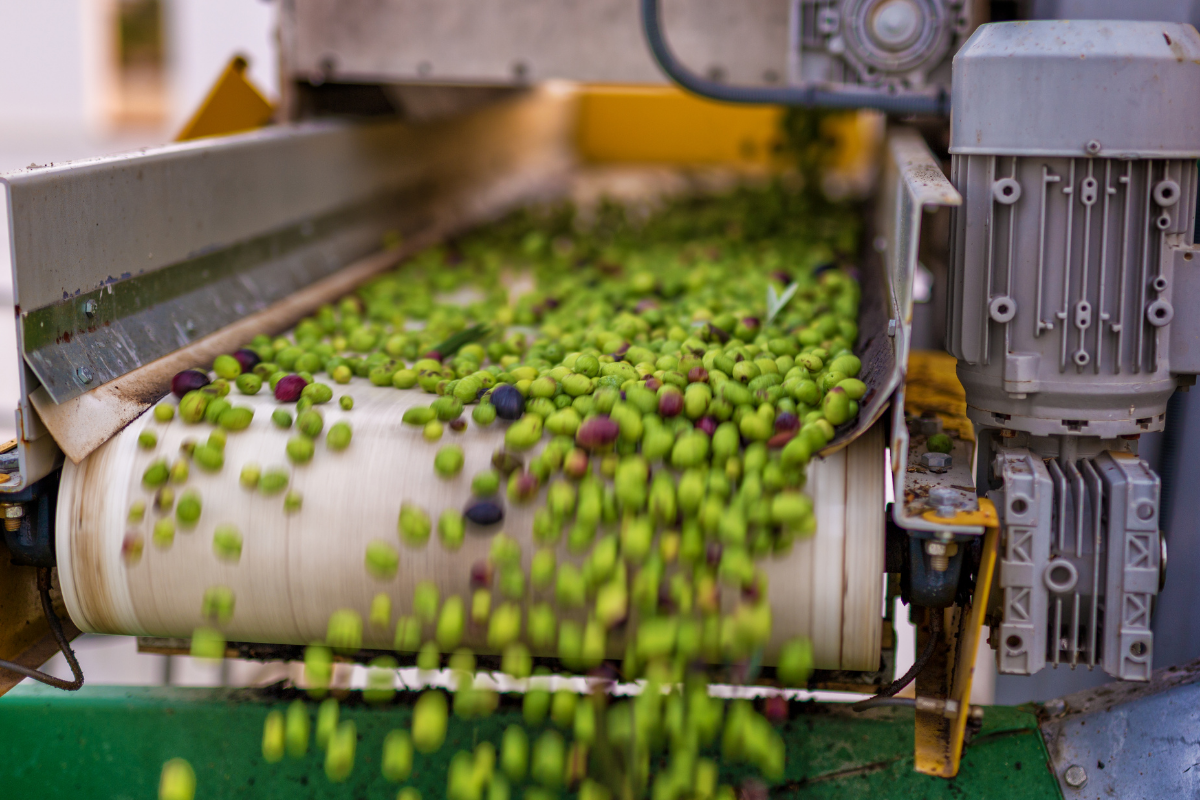
Whatever the type, processing follows a basic sequence. On receipt, the olives are weighed and checked for quality, and leaves, twigs and foreign matter are then removed by machine. The fruit is washed and sorted by size and colour, a step known as grading.
Debittering comes next, by the method that matches the type, followed by fermentation and storage in large fibreglass or concrete tanks with controlled salinity and acidity, for anything from a few weeks to several months. At the end, the olives are sorted again, pitted or stuffed where required, and packed in glass jars, plastic containers, vacuum pouches or tinplate cans, together with fresh brine, oil, vinegar or spices. Traditional bulk packing uses plastic containers of up to 150 kg. Pasteurisation or sterilisation is applied where needed to secure the product's shelf life.
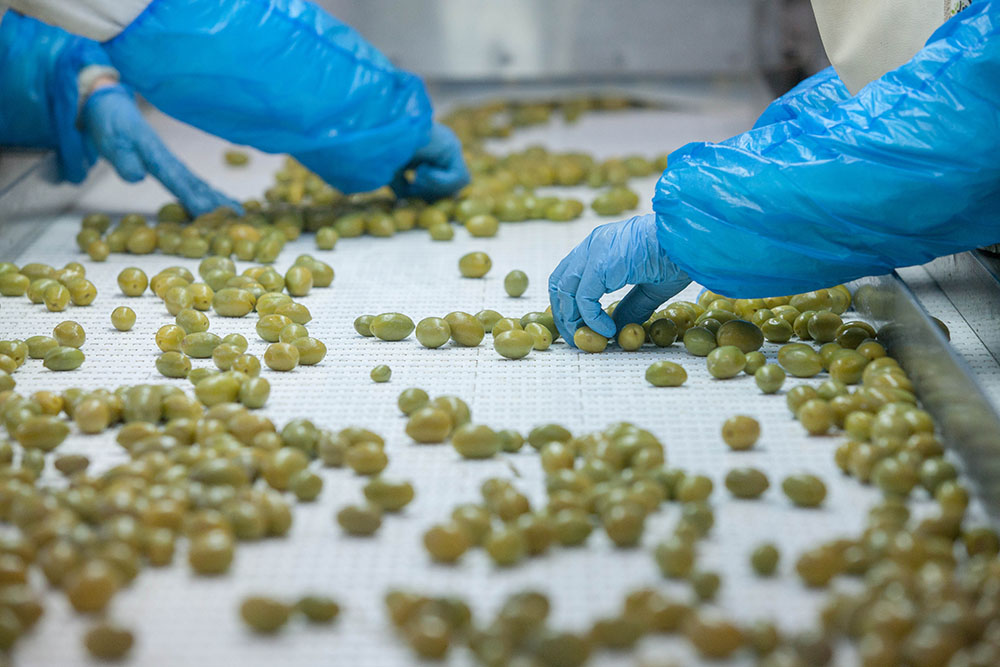
After washing, the olives are sorted by size and colour, a step known as grading.
Spanish-style green olives
This is the most widespread preparation in the world. Green olives are immersed in tanks of dilute sodium hydroxide, usually at a concentration of 1.8 to 2.2%, for 6 to 8 hours, until the solution has penetrated two thirds of the way into the flesh. The alkaline solution hydrolyses oleuropein, so the bitterness is removed within hours rather than weeks.
Thorough rinsing in water is performed for 12 to 24 hours to remove residues of the alkaline solution. The olives then go into brine at 8 to 10%, where lactic acid bacteria carry out lactic fermentation over two to three months. In total, about three to four months pass from harvest to the finished product.
Greek-style natural black olives
No alkaline solution is used here at all. Ripe or turning-colour olives are placed directly in brine, where they undergo a lactic fermentation driven by the microorganisms the fruit itself carries. Oleuropein is slowly removed as it diffuses from the flesh into the brine, and the process takes several months. The result is a fuller flavour and flesh that retains more of the fruit's natural constituents.
This category covers the natural black olives of Konservolia and the Kalamon olives, which are often slit and preserved in brine with vinegar, as well as the naturally cured green olives of Halkidiki, which follow the same principle without lye.
Californian-style black olives
These olives start green or turning colour, are stored in brine with partial or no fermentation, and darken through oxidation in an alkaline medium, with air bubbled through the solution. Under the Codex standard, they must have a uniform colour from brown to black.
Because the fruit at the end of the process lacks the protection of high acidity, sterilisation is mandatory. Olives preserved by heat sterilisation, such as those darkened by alkaline oxidation, must receive a treatment sufficient in time and temperature to destroy the spores of Clostridium botulinum. That is why they are almost always sold canned.
Dehydrated olives and throumbes
Dehydrated or shrivelled olives lose part of their water through dry salt or a mild alkaline treatment, and they call for the highest salt concentrations of any preparation. A special case is the Greek Throumbolia variety, one of the few that naturally turn sweeter as they ripen on the tree, so the fruit dehydrates partly on its own and becomes edible with light salting, as with the well-known throumba of Thassos.
How the product is preserved
Table olives keep thanks to three mechanisms working together:
- Salinity: the salt in the brine inhibits the growth of undesirable microorganisms
- Acidity: the lactic acid produced during fermentation lowers the pH to levels at which pathogens cannot grow
- Anaerobic conditions: the absence of air, with the olives always submerged in brine, prevents moulds and aerobic spoilage
The International Olive Council trade standard sets a minimum salt content and a maximum pH for each preparation. For preparations that are not pasteurised, sterilised or refrigerated, the minimum salt content is 5% for treated olives, 6% for natural olives and 10% for dehydrated olives, while the maximum pH is 4.0 for treated and 4.3 for natural olives. Where pasteurisation, sterilisation, refrigeration, or modified atmosphere is used, these limits are adjusted accordingly.
Quality criteria and grades
Size directly affects presentation and commercial value. Olives weighing 3 to 5 grams are considered medium-sized, while those over 5 grams are considered large and are generally preferred for table use. Stone size, the ratio of flesh to stone, skin quality and the absence of defects matter just as much, as set out in the quality traits of table olives.
Based on sensory assessment, table olives are classified into four categories: extra, first choice, second choice, and not marketable as table olives. Fermentation defects, such as abnormal fermentations, and the presence of foreign matter, insects or damaged fruit all count against the grade.
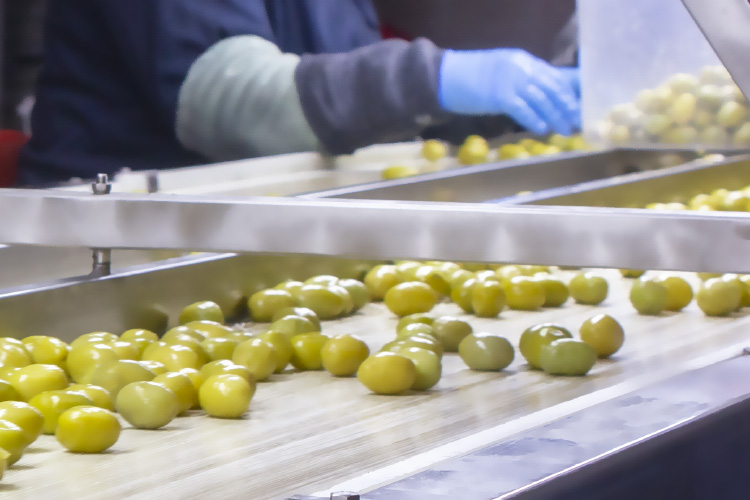
Size, skin quality and the absence of defects decide the commercial grade of table olives.
The environmental issue of alkaline processing
The alkaline solution and the rinse waters of the Spanish method are heavily polluting effluents, carrying a high organic load and a strongly alkaline character. Managing them is one of the main environmental challenges for the industry, and one of the reasons research pursues methods with lower water use and solution reuse. The natural methods of the Greek style, which use no alkali, have a markedly smaller environmental footprint.
Frequently asked questions
What is the difference between Spanish-style and Greek-style olives
Spanish-style olives are green olives that are de-bittered in an alkaline solution within hours and then fermented in brine. Greek-style olives are ripe olives placed directly in brine and de-bittered by natural fermentation over months, with no alkali added.
How do canned black olives turn black?
Californian-style black olives start green or turning colour and darken through oxidation in an alkaline medium, with air bubbled through the solution. That gives them their uniform colour and makes sterilisation mandatory.
How long does industrial processing take
For Spanish-style green olives, it takes about three to four months from harvest to the finished product. Greek-style natural black olives usually take longer, because debittering relies entirely on natural fermentation.
Is oleuropein harmful
No. Oleuropein gives the fruit its strong, bitter taste but is not harmful to health. It is removed or transformed during processing only to make the olive pleasant to eat.
Why do throumbes need no debittering
Because Throumbolia is one of the few varieties that turn naturally sweeter as they ripen on the tree, the fruit partly dehydrates on its own and becomes edible with light salting.
How much salt does table olive brine need
The IOC trade standard sets a minimum salt content of 5% for treated and 6% for natural olives where no pasteurisation, sterilisation or refrigeration is applied. Fermentation brines are usually 8-10%.
Important notes
The information above outlines the basic principles of industrial processing in accordance with international standards. The exact conditions in each plant depend on the variety, the product type and the food legislation in force, and every processing business must operate a food safety management system in line with the requirements of its national authority.
References
- International Olive Council, Trade standard applying to table olives, COI/OT/NC no. 1, 2004.
- International Olive Council, T.OT/Doc. no. 14, processing phases by trade preparation, 2005.
- Codex Alimentarius, Standard for table olives, CXS 66-1981.
- International Olive Council, Table olives.