


In September 2026 Thai white rice with 5% broken grains cost $482 per tonne free on board in Bangkok, 6.2% less than in June 2023, the last month before India banned exports of non-basmati white rice, according to a Wikifarmer analysis of World Bank monthly commodity prices. In between, the price rose 28.4% to January 2024 and fell to $356 in October 2025, its lowest level since November 2007, and it has since climbed 35.4%.
After India's ban the price rose 28.4% to January 2024
India banned exports of non-basmati white rice, the most traded category of rice worldwide, on 20 July 2023, and according to the US Department of Agriculture export prices climbed to their highest level in 15 years (USDA FAS). Thai 5% rice was $514 per tonne in June 2023 and reached $660 in January 2024, a rise of 28.4%, while Vietnamese rice of the same grade rose from $508.2 to $632.9 in December 2023, a rise of 24.5% (World Bank).
Two months after the ban was lifted the price was back below its earlier level
India lifted the ban on 28 September 2024, after 14 months, when Thai rice cost $580 per tonne and Vietnamese rice $540.5. In November 2024, ten months after the peak, the Thai price was at or below its June 2023 level for the first time since the peak, and the Vietnamese price followed in December 2024.
In October 2025 the price fell to its lowest level since 2007
The fall continued, and in October 2025 Thai rice reached $356 per tonne, 30.7% below June 2023 and the lowest level since November 2007, just below the lowest monthly price of 2015 to 2022, which was $357. Vietnamese rice fell more slowly and reached its low in March 2026 at $345.8, 32.0% below June 2023 and the lowest level since December 2019.
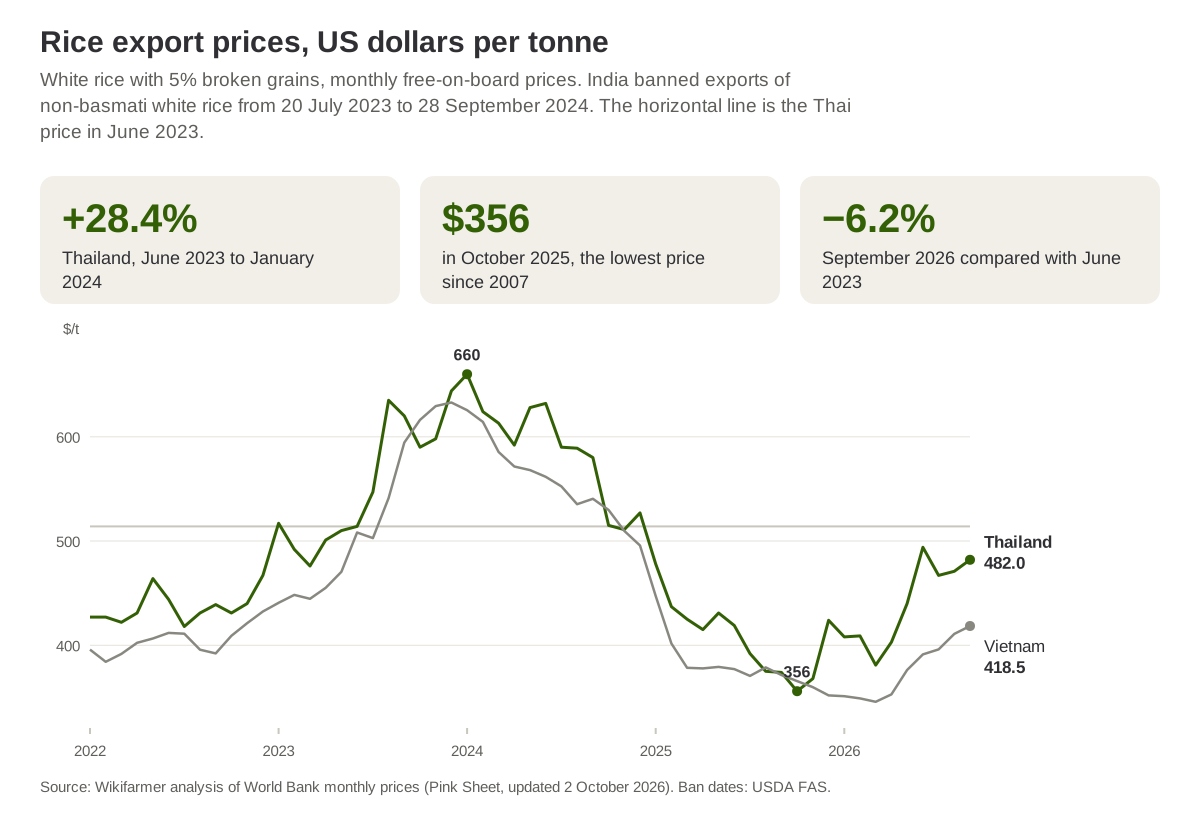
Source: Wikifarmer analysis of World Bank monthly prices (Pink Sheet, updated 2 October 2026), in US dollars per tonne. The horizontal line marks the Thai price in June 2023.
The price has risen 35.4% since the October low
In September 2026 Thai rice cost $482 per tonne, 35.4% above the October 2025 low and 28.9% above September 2025, but 27.0% below the January 2024 peak and 6.2% below June 2023. Vietnamese rice, at $418.5 per tonne, has risen 21.0% from its March low and remains 17.7% below June 2023. Over the same period the FAO Food Price Index rose for a third consecutive month in September, although this price analysis does not test what caused the new rise in rice.
After the 2008 crisis the return to the earlier price took seven years
In April 2008 Thai rice reached $907 per tonne, 141.5% above January of that year, at a time when export restrictions amplified the rise in the world rice price. The price fell back to its January 2008 level of $375.6 only in August 2015, 88 months after the peak, whereas after the January 2024 peak the return to the level before the ban took ten months.
Importers and growers saw the price change direction twice since 2023
From June 2023 the Thai price rose 28.4% to its peak, then fell to 30.7% below its starting point by October 2025, before rising 35.4% again. These swings reach countries that import much of the rice they eat, exporters in Thailand, Vietnam and India, and growers in other countries who sell at prices influenced by the world market, as in Greece, where this year farm-gate prices fell by half.
The World Bank prices are export prices at the loading port and differ from the prices importers pay or growers receive in each country, which also reflect transport, duties and the exchange rate. In the coming months, the World Bank monthly prices for October, published in early November, and the FAO All Rice Price Index are worth following. The figures show how the price moved, not what caused it, and are not a forecast.
Sources
- World Bank. (2026). Commodity Markets, Pink Sheet monthly prices. World Bank Group.
- USDA Foreign Agricultural Service. (2024, October). Grain: World Markets and Trade. United States Department of Agriculture.