When food prices spike, governments often reach for the same tool: restrict or tax exports so that grain stays home and local prices stay low. It looks like the responsible move, protecting your own consumers first. FAO's State of Agricultural Commodity Markets 2026 shows it usually does the opposite. Export restrictions pull supply out of the world market and push global prices higher, and when many countries act at once the effect compounds until the policy defeats its own purpose. It is the same weather-to-price chain seen from the policy side, where the response to a shock ends up amplifying it.
The report traces this across the 2007-2008 food price crisis, the COVID-19 pandemic and the war in Ukraine, and the pattern is consistent. Closing the border feels protective for one country in isolation, but when it becomes the collective reflex it makes everyone worse off, including the countries doing it.
Key takeaways
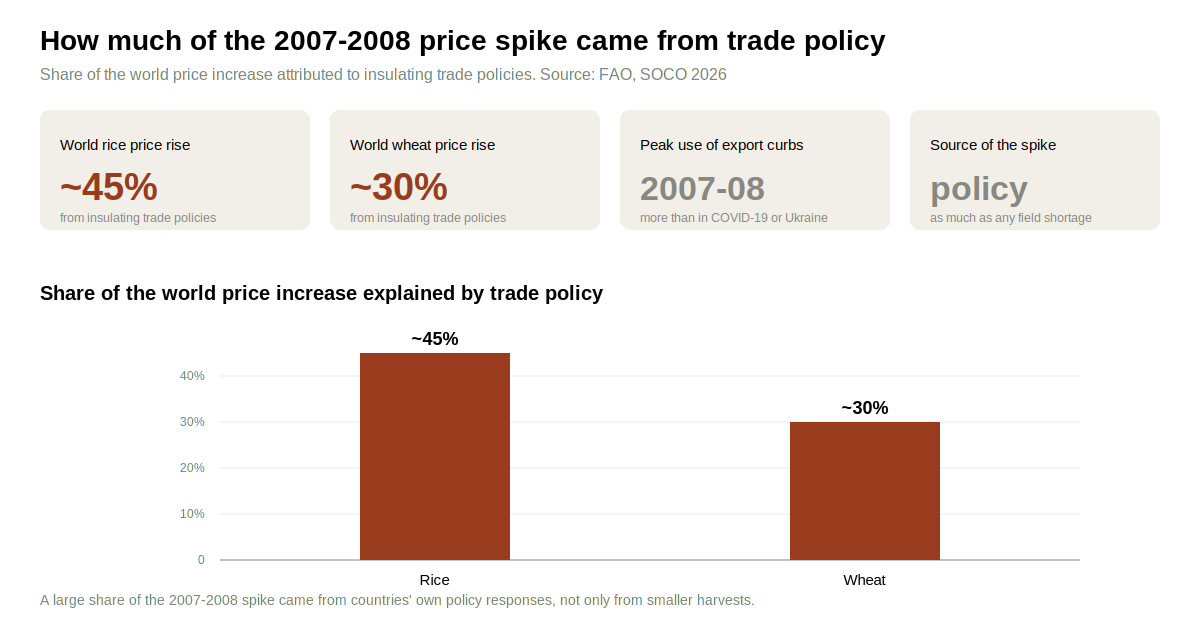
- Trade policy, not just weather, drove the 2007-2008 spike. Insulating measures are estimated to explain about 45% of the rise in world rice prices and roughly 30% of the rise in wheat prices during that crisis.
- Restrictions work on both sides of the market. Exporters hold grain back while importers cut their own tariffs to soften the blow, and both moves push the world price up.
- The effect compounds. A 20% increase in trade restrictions globally has been associated with world food prices rising by between 22% and 56%.
- It quietly taxes farmers. Holding exports down lowers the price growers receive, which weakens the incentive to plant, so supply is thinner the following season.
- Cooperation works better. During COVID-19 restrictions were short-lived and trade stayed open, and markets settled instead of spiralling.
The instinct to close the border in a crisis
The appeal of an export restriction is obvious. It is quick to introduce, cheap to run, and it visibly keeps food inside the country when prices are climbing. A government facing angry consumers can act in days, where building up domestic supply or supporting incomes takes far longer.
The problem is that importers respond in the mirror image. When world prices rise, food-importing countries often cut their own import tariffs to shield domestic buyers from the increase. One side withholds supply, the other props up demand, and both pull in the same direction on the world price.
Why it pushes world prices up instead of down
A large exporter that bans shipments removes a chunk of grain from a market that still has to feed everyone else. The supply that disappears has to be found somewhere, and the only thing that clears the gap in the short run is a higher price. The 2007-2008 crisis is the clearest case on record. Alongside the harvest shortfalls, insulating trade policies are estimated to account for about 45% of the increase in world rice prices and around 30% of the increase in wheat prices. A large share of that spike came from the policy responses themselves rather than from any shortage in the field.
The mechanism matters most for staples with few big exporters. When a handful of countries supply most of the traded rice or wheat, a restriction by even one of them moves the whole market, because buyers have few other places to turn.
When everyone does it at once, the effect compounds
The real damage comes from imitation. A price rise pushes one country to restrict exports, that restriction lifts the world price further, and the higher price prompts the next country to do the same. Each move looks rational on its own and the sum is a spiral. The report describes this as a multiplier effect, with evidence from 2008 to 2011 that simultaneous, self-protective trade policies drove world prices well beyond what the underlying supply picture justified. One estimate puts it starkly: a 20% increase in trade restrictions across the world has gone hand in hand with food prices rising by between 22% and 56%.
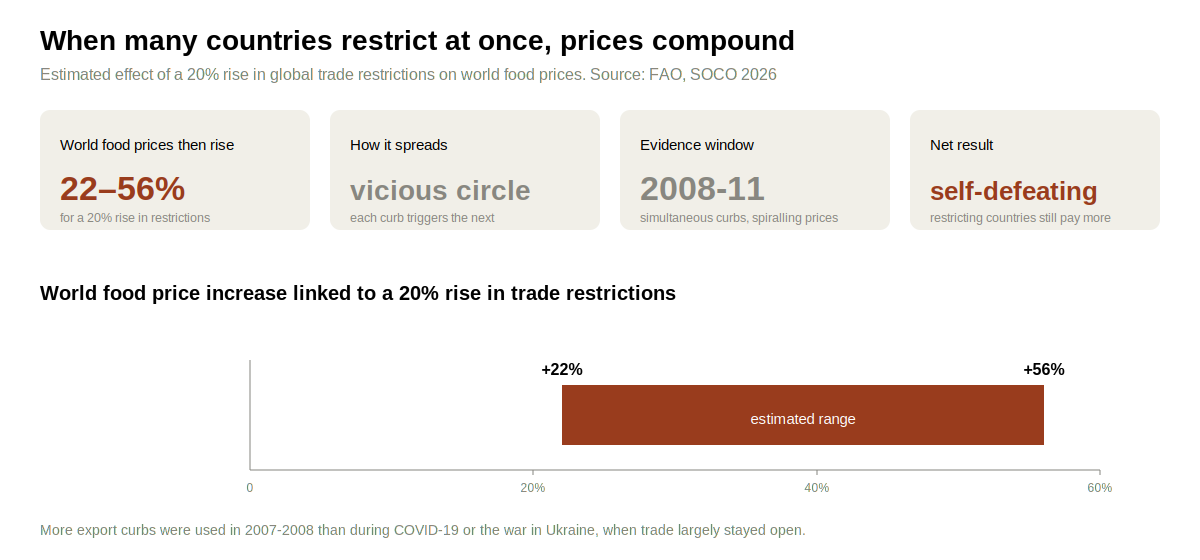
Past a certain point the policy stops doing what it was meant to do. So many countries are insulating at the same time that the world price climbs faster than any single border measure can offset, and the country that restricted its exports still faces expensive food, now with the added cost of lost export revenue.
The hidden cost to farmers
An export ban also lands on the people it is supposed to help feed in the long run. By capping the price growers can get for their crop, it acts as a tax on farmers, and a lower farm-gate price weakens the incentive to plant and invest for the next season. The short-term relief for consumers is bought partly by suppressing the supply response that would ease prices later, which is why the report treats export restrictions as a drag on food security rather than a support for it.
What worked better during COVID-19
The pandemic is the useful counter-example. Some countries did impose export curbs in early 2020, but they were short-lived and covered a smaller share of trade than in 2007-2008, and international coordination kept food moving. Trade stayed open, and after an initial jump markets settled rather than spiralling. The lesson the report draws is that all countries gain when trade stays open in a crisis, and that the better way to protect vulnerable households is targeted domestic support, such as cash transfers and food assistance, which shields the poorest without starving the world market of supply or undermining food security elsewhere.
Sources
- FAO. 2026. The State of Agricultural Commodity Markets 2026. Rome.