



The global olive oil market is currently facing significant price tension and volatility as key producing countries grapple with adverse weather conditions and low stock ahead of the new harvest. Spain and Greece, which hold most of the Mediterranean basin's stock, are at the center of this dynamic.
Stay up-to-date with our weekly olive oil digest
Spain's Market Update: Heat, Drought, and Tight Supply
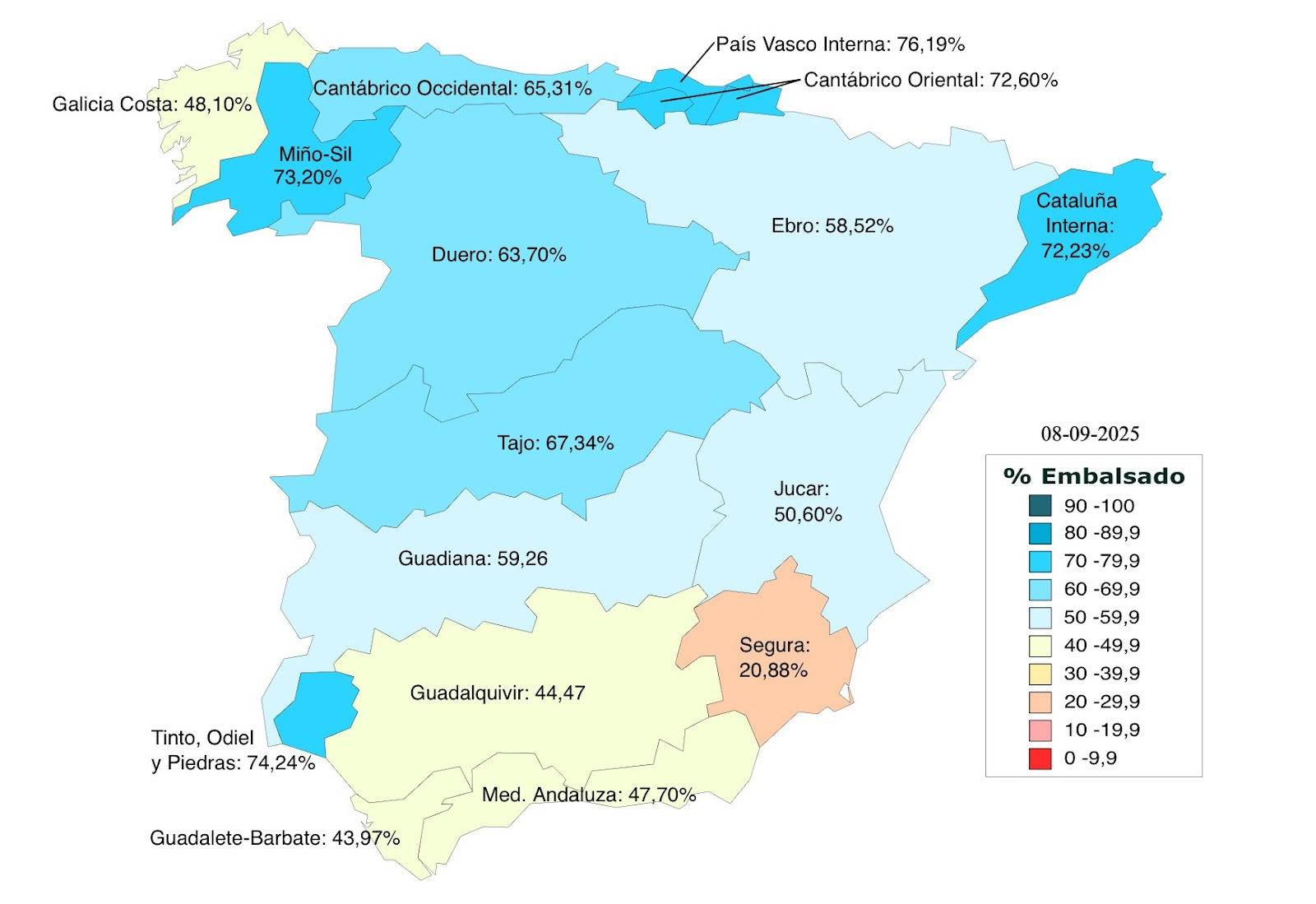
Spain's olive oil market is under tension due to heat waves and a lack of rain. This absence of precipitation has consolidated expectations of a reduced harvest. Current forecasts show no significant precipitation in the coming weeks. Without substantial rain in September and October, fruit yields will deteriorate further, leading to lower production volumes and reinforcing concerns over supply scarcity. The potential offer in Spain, concentrated in the province of Jaén, remains very contained as producers hold out for a higher price, while buyers purchase only what is necessary.
For regions in Spain that have yet to begin their harvest, rainfall over the next few weeks could determine the season's success. "We expect to start harvesting at the beginning of October, but everything depends on the rain," said Fran Gómez of Almazara Gómez Cano in Baena, Spain. "From now until the first half of October, it's crucial that it rains so we can get a good olive oil."
Gómez described a difficult summer: "Since May, we haven't had a single drop of rain and we've had a pretty hot summer. In this region, the fruit has suffered a lot, and right now, our olive trees just need rain. If it doesn't rain soon, we could lose an important part of our harvest." The combination of drought and high temperatures, he warned, could significantly reduce production.
On pricing, Gómez noted that shortages typically push prices upward but tempered expectations: "What's normal is that if there's less oil, prices rise, although I don't think they'll get even close to the price levels we had during the 2023/2024 season."
Despite the challenges, Gómez pointed to growing global demand as a stabilizing factor: "Our output depends on the global awareness of the health benefits of extra virgin olive oil, one of the healthiest fats in the world. It's growing, and this is noticeable in the heightened exports from Spain."
- Production and Availability: The total global availability of olive oil, including carryover, is expected to be sufficient worldwide. Spain's total availability for the 2025-26 season is estimated at 1,822,893 tons, factoring in a 293,162-ton carryover as of October 1. Production for Spain is estimated at 1,529,731 tons, though some forecasts are more conservative, estimating a medium harvest of 1,500,000 tons. A lack of rain in September and October could cause a 10% drop, bringing production down to 1,400,000 tons, but this is still believed to be more than sufficient. As of August 30, 2025, total production for the new crop was 1,415,380 tons.
- Current Stock Levels: As of August 30, 2025, total stocks in Spain were 404,613 tons, including crop and carryover. This stock is split between packers (165,842 tons) and farmers (238,771 tons). This limited inventory is considered restricted and creates conditions that favor speculative moves.
- Weekly Prices: Spanish EVOO at €4.21/kg, VOO at €3.68, and Lampante at €3.47.
Olive Oil Price Projections
Short-term prices are projected to rise as buyers re-enter the market to replenish low stock levels. The market is expected to remain tense with high prices through September and October. Prices are reacting weekly to incremental crop and weather updates, sustaining heightened volatility.
Q4 Price Forecast (€/kg):
- Pure: €3.40-€3.50/kg.
- Virgin: €3.60-€3.70/kg.
- Standard Extra Virgin: €4.10-€4.20/kg.
- Premium Extra Virgin: >€4.50/kg.
The price of Spanish EVOO is expected to be firmly above €4.50/kg.
Global Harvest Forecasts
Beyond Spain, the harvest in other key Mediterranean countries will be crucial for the medium and long-term market scenarios.
- Portugal: The harvest is expected to be similar to the last campaign, around 160,000 tons.
- Italy: Italy is expected to have a significantly larger harvest, around 350,000 tons, compared to 200,000 tons in the 2024-25 campaign.
- Greece: Production levels are expected to be similar to the previous year, between 220,000 and 240,000 tons, or perhaps slightly lower. Good quality oil is difficult to find in Crete for below €5.00/kg. Cretan prices this week are €4.50-5.05/kg for EVOO, €3.65-4.15/kg for VOO, and €2.90-3.30/kg for Lampante.
- Tunisia: Tunisia will be a key factor this year, with a high harvest expected to exceed 400,000 tons. This volume could create a significant oversupply. Due to a need for money and lower demand from US tariffs, Tunisia is believed to pull prices down starting in November.
- Turkey: Production is expected to be lower, but the country has a significant stock from the last campaign.
Weekly EVOO Price Comparison: Major Producers
-1.jpg)
Demand and Consumption
Packers in Spain and Italy, the two primary demand hubs, are operating on low stock levels, and this shortage is expected to trigger stronger buying activity. Total global consumption for the 2025-26 season is not expected to exceed 2,929,256 tons, or about 243,271 tons per month. Spain is projected to contribute 112,000 tons monthly to this consumption. In August, Spain's outputs (domestic and exports) totaled 105,215 tons. The average monthly output for 2025 is 117,111 tons.
Conclusion
With low stocks of old oils and a new harvest approaching amidst poor weather forecasts, the olive oil market is set for a period of high prices and continued volatility. The total global stock at the end of the 2025-26 season is projected to be 953,638 tons, with 479,138 tons in Spain and 474,500 tons in the rest of the world.
Buy Olive Oil in Bulk - Olive Oil Bulk Purchase
Olive Oil PET - Olive Oil Bottles
Olive Oil Retailers - Olive Oil in Bottle
Disclaimer: The information provided on this website, including market prices, insights, and projections, is for general informational purposes only. While we strive to ensure accuracy and timeliness, we make no guarantees regarding the completeness, reliability, or suitability of the information presented. Users are solely responsible for independently verifying the data and assessing its relevance to their specific circumstances before making any decisions.Wikifarmer and its operators shall not be held liable for any losses, damages, or consequences arising from the use of the information provided herein.