Organoleptic assessment is the official taste test that involves a trained sensory to decide an olive oil's grade. A group of eight to twelve trained tasters smells and tastes the oil and scores its positive attributes and any defects. To qualify as extra virgin, an oil must have detectable fruitiness and a median score of zero defects. Each defect points to a specific mistake in how the oil was grown, milled or stored. It is the only sensory test in food law, it is compulsory for classifying virgin olive oils, and it catches faults that chemical testing does not.
Why is an official taste test needed for olive oil?
Olive oil's sensory quality is treated as a formal grade criterion, alongside free acidity, peroxide value, and UV absorbances, because chemical tests can confirm freshness and authenticity yet still fail to reveal an off-flavour. The trained human panel is the ultimate determinant of whether an oil is extra virgin.
Introduced by the International Olive Council in the late 1980s and codified in EU law in the early 1990s, the procedure uses statistical methods, including the median of the panel's scores, along with confidence intervals and coefficients of variation, to avoid reliance on individual taste and produce a repeatable result, with margins of error comparable to chemical tests.
How does the panel test work?
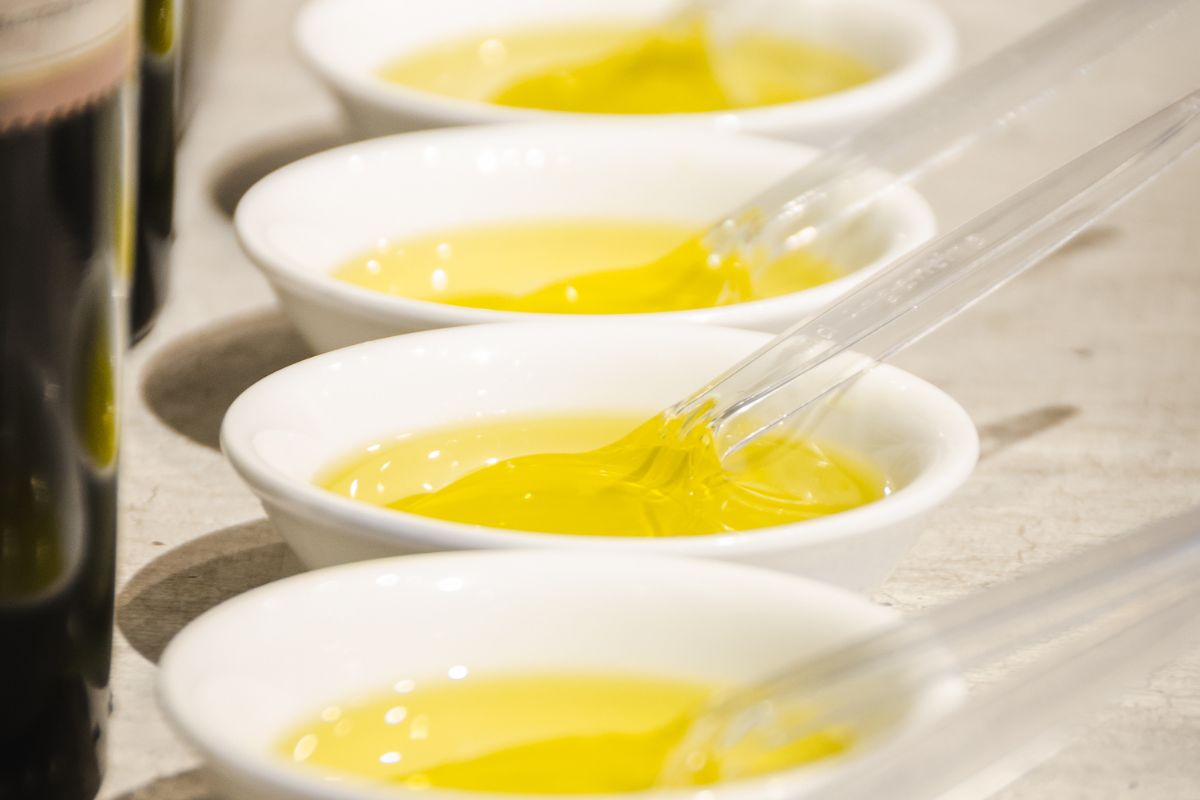
A panel of 8 to 12 trained assessors, guided by a panel leader, evaluates each oil individually. The oil is poured into a cobalt-blue tasting glass, coloured so the oil's colour can't bias the taster, and warmed to 28°C, then covered with a watch glass to release its volatile aromas.
Each taster first smells the oil, then takes a small sip and draws air across the palate to spread the aroma, and reveal bitterness and pungency.
Every assessor scores the intensity of each positive attribute and each defect on a standardized scale. The panel leader then calculates the median score for each attribute across the entire panel, rather than the average, since the median is less affected by the distorting effect of any single outlying taster. The medians classify the oil.
Positive attributes
An extra-virgin oil must exhibit these positive attributes:
● Fruity: the aroma and flavour of good quality, fresh olives, which can be green (from earlier-harvested, greener fruit) or ripe (from later, riper fruit). An oil without fruitiness cannot be extra virgin, even if it has zero defects.
● Bitter: A clean bitterness, felt at the back of the tongue, produced by the oil's natural polyphenols.
● Pungent: The peppery spice at the back of the throat, also from polyphenols.
Bitterness and pungency are positive attributes, not defects. A fresh, high-polyphenol oil is supposed to bite, and it is a sign of quality and of the antioxidants that underpin the oil's health benefits.
Defects
There are many defined defects, but four account for most of what panels find, and each indicates a specific failure:
|
Defect |
What it smells or tastes like |
What it means |
|
Fusty/muddy sediment |
Fermented, sweaty, the most common fault |
Olives were piled in heaps and left too long before milling, fermenting without oxygen, or oil sat on its sediment |
|
Musty, humid, earthy |
Mouldy, damp, stale |
Olives developed fungi and yeasts while stored in damp, humid conditions |
|
Winey, vinegary, acidic, sour |
Wine, vinegar, sharpness |
Oxygen-driven fermentation produced acetic acid and related compounds in the fruit or the oil |
|
Rancid |
Stale, oily, like old nuts |
Oxidation from age and exposure to air, light and heat — the classic fault of old oil |
|
Frostbitten, wet wood |
Damp wood notes |
Olives were caught by frost on the tree before harvest |
|
Metallic |
Metallic tang |
Oil was in prolonged contact with a reactive metal during processing or storage |
Fusty tells you the fruit was mishandled before milling, musty that it was stored damp, winey that fermentation took hold, rancid that the oil is old or badly kept, and frostbitten that the crop was frost-damaged.
Scoring to determine the grade
● Extra virgin olive oil: zero defects, median of fruitiness above zero
● Virgin olive oil: median of defects between zero and 3.5, median of fruitiness above zero
● Lampante olive oil: median of defects above 3.5
Keep in mind: A single defect knocks an oil out of the extra-virgin category, no matter how good its chemistry is. And an oil with no defects but no fruitiness is classified as lampante.
Always request the organoleptic panel results as part of any certificate of analysis.