

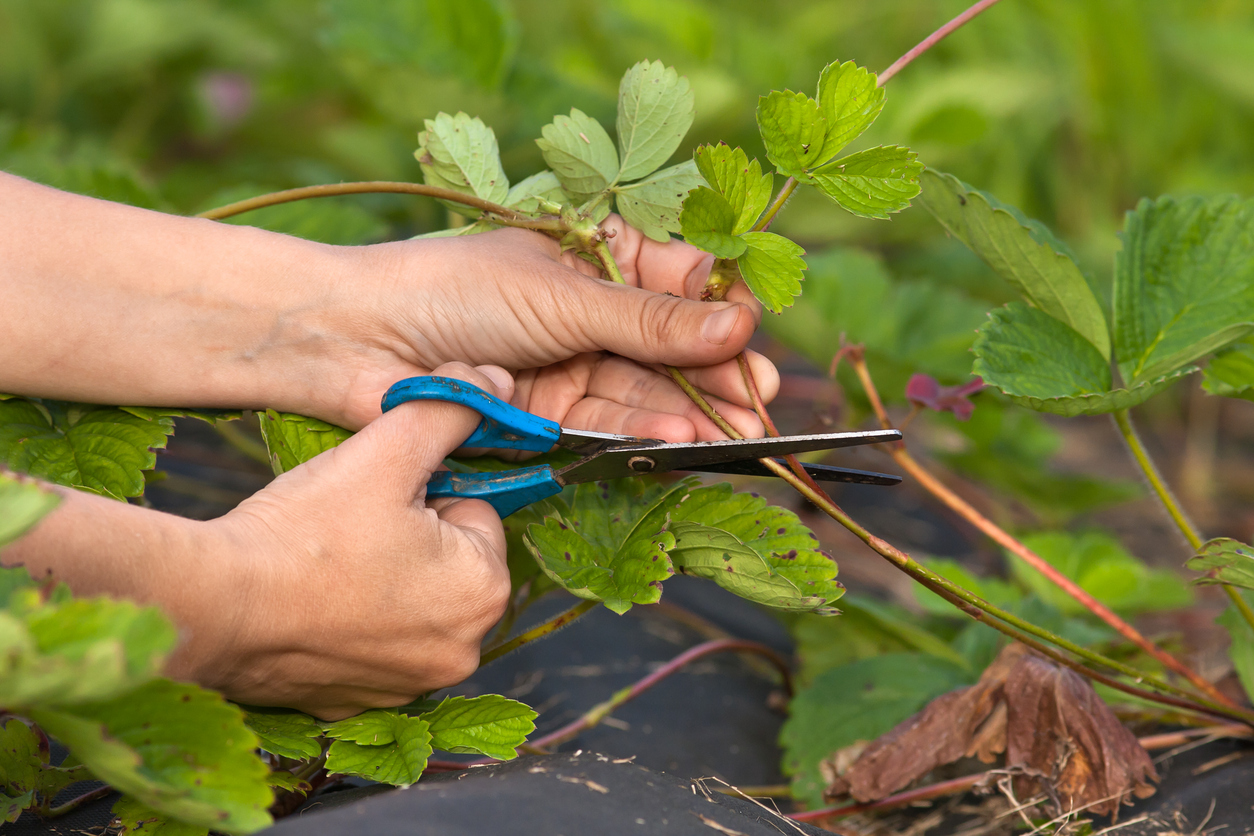
Strawberry Plant Training and Pruning: Systems, Techniques, and Best Practices
How to Train Strawberry Plants and Popular Systems
Training strawberry plants involves selecting a planting system and managing runners to enhance fruit production. The most common methods are:
- Matted-Row System: Suitable for June-bearing varieties. Runners are allowed to root freely, forming a matted row up to 2 feet wide.
- Hill System: Ideal for everbearing and day-neutral varieties, all runners are removed to focus energy on fruit production. Plants are arranged in multiple rows.
- Spaced-Row System: Similar to the matted-row, but runners are spaced at least 4 inches apart, and excess runners are pruned to prevent overcrowding.
How to Prune Strawberry Plants
Like all berries, strawberries need some essential pruning to balance and reinforce vigorous canopy (vegetative growth) and high fruit production (good yield production for multiple years). As a result, this process is mainly used in strawberries cultivated as perennials and in hydroponic cultivation.
Flower pruning is mainly performed when the producer wants to favor vegetative growth over reproduction (fruits) or when the flowers produced are very small (end of the season). Removing the first forming flowers in the first year of cultivation is best when the plants are usually too young to bear a good production. This helps the plant use its energy for root and runner formation and produce larger biomass next year. Repeat this process until the crown has a diameter of at least 10 mm with 5-10 fully grown and healthy leaves.
This happens for day-neutral and ever-bearers varieties at the end of the first summer month (end of June for the northern hemisphere). After that, leave the flowers so the plant can produce its fruit. A flower thinning should also be performed if there are too many per plant to redirect resources (nutrients and water) and form fewer but larger strawberries of higher quality. It is best for the farmer to avoid applying flower pruning in open field cultivation (due to the high cost), and in this case, strawberry is grown annually.
When strawberries are grown in a greenhouse, the farmer can perform leaf pruning (a practice common to many fruiting vegetables) and runner pruning (in hydroponic systems). Leaf pruning concerns cutting old, no longer productive leaves to allocate essential resources to the fruits. Additionally, it is usually used to control the spread of pathogen diseases (e.g., Botrytis sp.). It is common in high or low-tunnel systems and can be performed up to 4 times per growing season.
On the other hand, runner pruning should be performed when the farmer observes extensive growth of the runners in moments like fruit production. Such plant reaction reflects that the crop is under stress, and the grower should check and correct the growing conditions and resource availability in the greenhouse.
Fruit thinning
Fruit thinning in strawberries is an important practice to enhance fruit size, quality, and plant health. Unlike tree fruits, where individual fruits are thinned, strawberry thinning focuses on managing plant density and the number of flowers or runners a plant produces. By reducing overcrowding, plants can allocate more energy to fewer, higher-quality fruits, leading to larger and more flavorful berries. Overcrowded plants often compete for nutrients, light, and water, resulting in smaller fruits and increased vulnerability to pests and diseases.
Thinning is typically done during the plant’s active growing season and after harvest for June-bearing varieties. In matted-row systems, runners are allowed to root initially, but excess plants should be removed to maintain rows that are no more than 18 to 24 inches (46-61 cm) wide. This ensures proper spacing for air circulation and sunlight penetration, both of which are vital for fruit development and disease prevention. For everbearing and day-neutral varieties, thinning involves removing most runners to concentrate the plant’s energy on producing fruit rather than new plants. Additionally, thinning excess flowers or small, misshapen fruit during peak flowering can further improve the size and quality of the remaining strawberries.
This practice not only improves fruit size and taste but also extends the productive lifespan of the strawberry plants by reducing stress on the roots and overall structure. Regular thinning as part of routine care results in healthier plants, higher yields, and a more manageable strawberry patch, especially in commercial farms focused on premium-quality strawberry berries.
Strawberry Renovation
Strawberry renovation is the process of removing some plants or cutting the plant's older foliage about 2.5 cm or 1 inch above the crown to preserve a good fruit yield and quality. It usually takes place after the harvest of June-bearers. Some growers use subsoiling as well to break up compacted soil layers that were created after the harvest. Make the rows narrower (with a rototiller or disk) at 15-50 cm or 6-20 inches, and thin the plants to 10-15 cm or 4-6 inches within the rows.
After applying weed management, the farmer can fertilize his/her plants with a synthetic fertilizer (10-10-10, 12-12-12, or 5-10-5 N-P-K type) or with up to 56 kg of Nitrogen per hectare or 50 lb per acre. Irrigating abundantly during the last summer months is important to ensure good growth this year and good returns next year. However, commercial strawberry growers rarely use this method, as they prefer plastic and grow strawberries as annuals rather than perennials.
When to Replant:
Farmers should consider replanting when:
- Yields noticeably decline despite proper care (usually after the 2nd or 3rd year, depending on the type and variety of strawberries used.
- Fruit size becomes consistently smaller.
- Pest or disease pressure, like root rot or nematodes, becomes unmanageable.
- Plants are more than 3-4 years old, as older plants tend to produce fewer runners and berries.
It is important to rotate strawberries with non-host crops like grains or legumes for 2-3 years to break disease cycles.
References
- https://www.agric.wa.gov.au/strawberries/irrigation-and-fertiliser-guidelines-strawberries?nopaging=1
- Grow Strawberries at Home
- Time to Renovate Strawberries – Michigan State University Extension
- Purdue Extension publication HO-46
- https://extension.illinois.edu/small-fruits/growing-strawberries?utm_source=chatgpt.com
Further reading
- 10 Health Benefits of Strawberries
- 15 Interesting facts about strawberries
- History, Global Production, and Key Varieties of Strawberries
- How to Grow Strawberries in Your Garden or Balcony
- Strawberry Soil Requirements, Cultivation Systems, and Plant Density
- How and Why to cultivate Strawberries in a Hydroponic system
- Strawberry Propagation Methods
- When and How to Irrigate Strawberries
- Heat Stress in Strawberry Production: Effects, Cultivar Variability, and Solutions
- How to Fertilize Strawberry Plants
- How to Prune Strawberries
- The Most Important Strawberry Pests & Diseases and Management Strategies
- Strawberry Yield, Harvest, and Storage