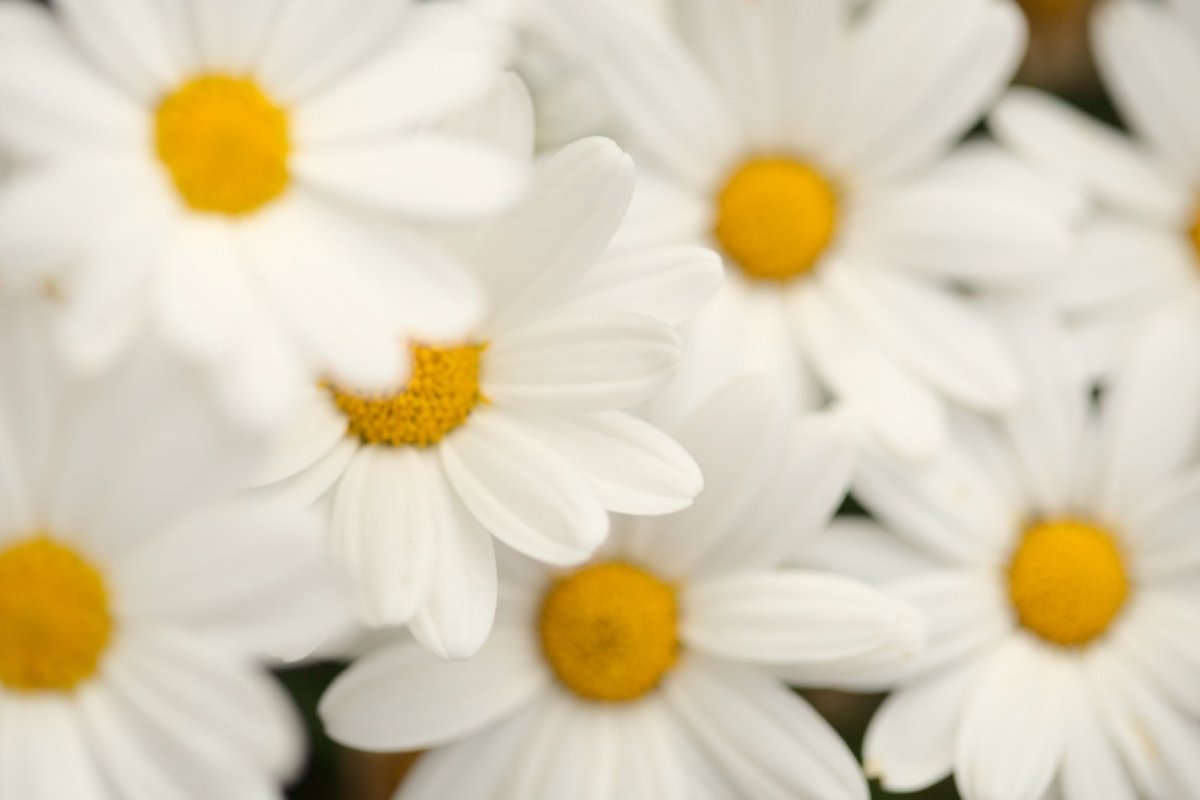
The name daisy covers many different plants in the family Asteraceae, with white, yellow or pink petals around a yellow centre. In gardens and on balconies, three are the most common. The marguerite, or shrubby daisy (Argyranthemum frutescens), is an evergreen subshrub that flowers from spring to autumn but does not tolerate frost. The Shasta daisy (Leucanthemum × superbum) is a perennial with large white summer flowers that dies back in winter and returns. The English daisy (Bellis perennis) is the small daisy of lawns and spring bedding, which also tolerates partial shade. All need sun, free-draining soil and regular deadheading to flower for longer. This guide covers how to tell them apart, how to care for each, how to deadhead them, growing them in pots, and the other plants called daisies.
Which daisy do you have
| Daisy | Botanical name | Type | Flowering | What sets it apart |
| Marguerite, shrubby daisy | Argyranthemum frutescens | Evergreen subshrub | Late spring to autumn | White, yellow or pink flowers, drought tolerant, frost tender |
| Shasta daisy | Leucanthemum × superbum | Herbaceous perennial | Summer | Large white flowers, dies back in winter and returns, also sold as seed |
| English daisy | Bellis perennis | Perennial, usually grown as a biennial | Early spring to summer | Low, 10 to 15 cm, often double-flowered, tolerates partial shade |
The marguerite or shrubby daisy
The marguerite comes from the Canary Islands and Madeira, and is the daisy usually sold in pots at garden centres. According to the Royal Horticultural Society, it is an evergreen subshrub with white, yellow or pink flowers from late spring to autumn.
- Position and soil: full sun, in free-draining soil. The RHS rates it as drought resistant, but in hot summers, and especially in pots, it needs regular watering. Waterlogged soil rots the roots
- Cold: it does not tolerate frost. In mild areas it can stay outdoors over winter with a deep, dry mulch at the base, while in colder areas it is moved in its pot to a frost-free spot, or cuttings are taken as insurance
- Pruning: deadhead continually, and give a light trim after each flush of flowers. A harder shaping prune is done in late winter or early spring
- Cuttings: according to the RHS, softwood cuttings root easily in spring, and semi-ripe cuttings of non-flowering shoots at other times
- Problems: generally trouble-free, with occasional aphids or leaf miners
Shasta daisy
The Shasta daisy is the classic large white daisy of borders and bouquets. According to the RHS, it is a tough, clump-forming perennial with white flowers and yellow centres, and it flowers over a long period in summer if deadheaded regularly.
- Position and soil: full sun, in moderately fertile soil that holds moisture but drains well
- Watering: regularly in the first year, then in dry spells, at the base of the plant
- After flowering: cut spent flowers back to the next bud or pair of leaves. In autumn, once the foliage dies back, cut stems down near the ground
- Division: according to the RHS, divide clumps every 2 to 3 years, in early spring or late autumn, to keep them vigorous
- Sowing: seed can be sown in trays in spring or autumn
Its long stems last more than a week in a vase, and its single flowers are valuable to pollinators.
English daisy
The English daisy (Bellis perennis) is the small daisy that appears in lawns and meadows, native to south-west Eurasia. Gardens mainly grow double-flowered varieties like small pompons, in white, pink and red. According to the RHS, it is a perennial usually grown as a biennial or annual for bedding and containers, and it is useful because it tolerates partial shade.
- Flowering: from early spring into summer, often combined with spring bulbs
- Sowing: the seeds need light, so press them onto the surface of the compost without covering them, in spring or early autumn. Autumn sowing gives plants for flowering the following spring
- Propagation: by seed, or by division after flowering
- Problems: generally pest-free, but it can be affected by rust
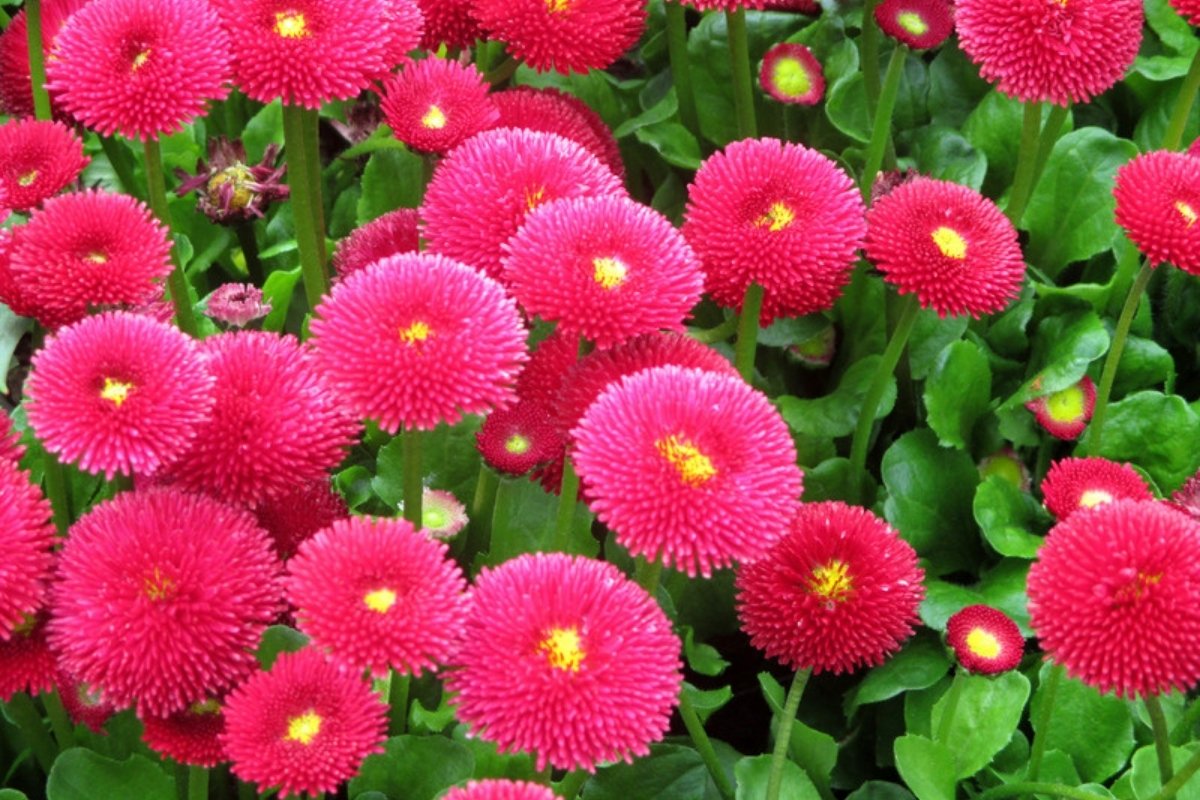
Double-flowered English daisies (Bellis perennis) form small pompons and flower from early spring
How to deadhead daisies
Deadheading keeps daisies flowering, but where to cut depends on how the plant grows. On branching daisies, such as marguerites and Shasta daisies, cut the faded flower stem just above a new bud or a healthy pair of leaves. On daisies whose flower stems rise from the base, such as gerberas and African daisies, follow the stem down to the base of the plant and remove it entirely.
Growing daisies in pots
All three daisies grow well in pots, with compact varieties suiting them best. They need a pot with large drainage holes, light compost and a sunny spot, or partial shade for English daisies. Water when the top of the compost dries, often daily in hot weather, without leaving water in the saucer. A liquid flowering feed once a month in spring and summer supports continuous flowering. Daisies are outdoor plants: a potted daisy can stay a short while in a bright, cool room, but it needs full sun outside to keep flowering.
Do daisies come back every year
Shasta daisies die back in winter and return in spring for years. Marguerites live for years if protected from frost. English daisies are usually grown for one season, but often self-seed.
Other plants called daisies
| Plant | What it is |
| African daisy (Osteospermum, Dimorphotheca) | Flowers in many colours that close in the evening |
| Gerbera | Large, vivid flowers, sensitive to extreme temperatures |
| Blue daisy (Felicia) | Sky-blue petals and a yellow centre |
| Yellow shrub daisy (Euryops) | A yellow-flowered shrubby daisy |
| Gazania | Low and spreading, with bold two-tone flowers |
| Chrysanthemum | A close relative, with flowers in many forms, peaking in autumn |
The wild daisies of Mediterranean meadows in spring are usually species of Anthemis or the oxeye daisy (Leucanthemum vulgare).
Frequently asked questions
What is the classic white daisy
In garden centre pots it is usually the marguerite, while the large white daisy of borders and seed packets is the Shasta daisy (Leucanthemum × superbum).
How often should daisies be watered
When the top of the soil dries. In pots in hot summers, often daily, without leaving water standing in the saucer.
When should daisies be cut back
Deadhead continually. Marguerites get a light trim after each flowering and a harder prune in late winter, while Shasta daisies are cut down near the ground in autumn.
Are daisies frost hardy
Shasta and English daisies are hardy. Marguerites do not tolerate frost and need protection in cold areas.
How do you propagate daisies
Marguerites from cuttings, Shasta daisies by division every 2 to 3 years or from seed, and English daisies from seed or by division after flowering.
What are the best daisies for pots
Compact marguerites, compact Shasta daisy varieties, English daisies and African daisies all suit containers, as long as they get plenty of sun and good drainage.
References
- Royal Horticultural Society, Argyranthemum Madeira Double Rose.
- Royal Horticultural Society, Argyranthemum 'Reflection Pink'.
- Royal Horticultural Society, Leucanthemum × superbum 'Snowcap'.
- Royal Horticultural Society, Bellis perennis.
- Royal Horticultural Society, Bellis perennis Tasso Series.