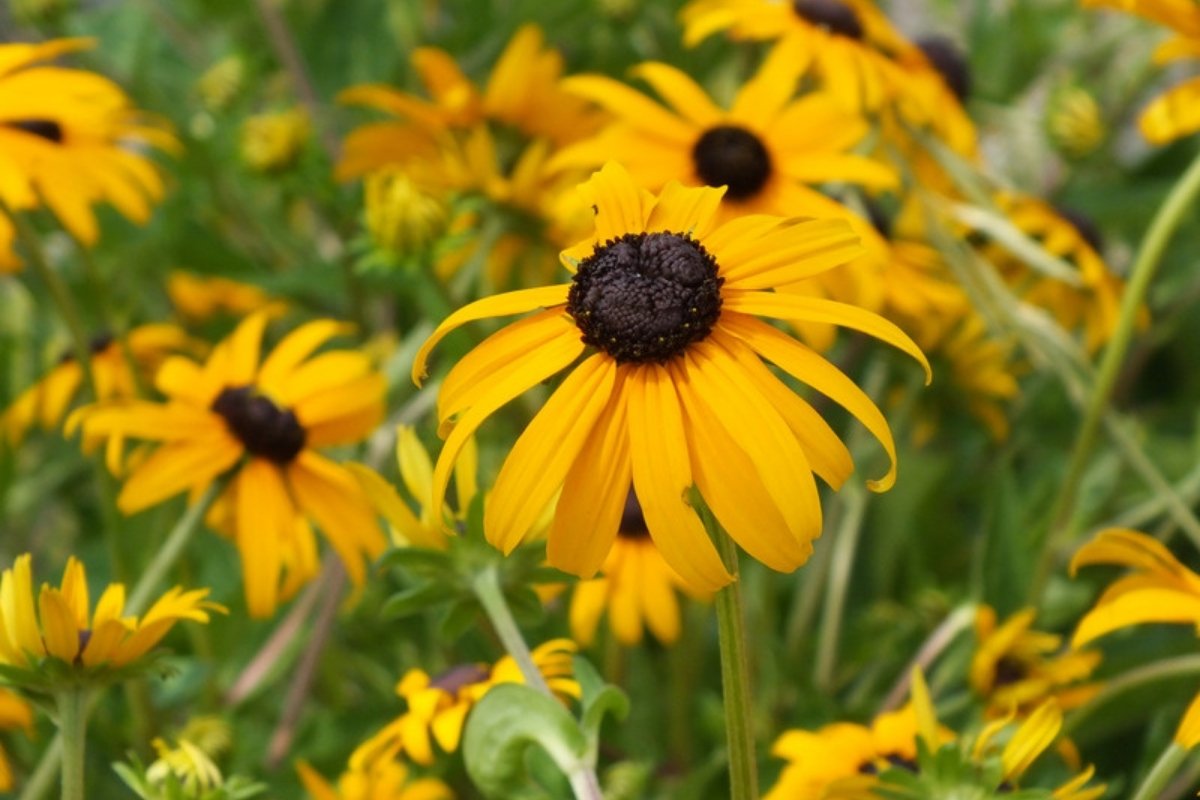
Rudbeckia, often called coneflower or black-eyed Susan, is a genus in the family Asteraceae, native to North America, with daisy-like golden yellow or orange flowers around a dark central cone. It flowers from summer into autumn, just as most garden flowers fade. The genus includes annual, biennial and perennial species, so the popular Rudbeckia hirta is usually short-lived, while Rudbeckia fulgida stays in the garden for years. It needs sun and soil that holds moisture without becoming waterlogged, and in hot summers it needs regular watering, because it wilts in long dry spells. Seed is sown on the surface, because it needs light to germinate, and perennials are divided every 3 to 5 years. This guide covers types and heights, sowing and planting, watering, staking, division, pots and winter.
Popular rudbeckia types
| Species or cultivar | Life cycle | Approximate height | What sets it apart |
| Rudbeckia hirta | Annual or short-lived perennial | 25 cm to 1 m | The most widely grown, in yellow, orange, dark red and brown. Dwarf 'Toto' stays at 25 cm |
| Rudbeckia fulgida and 'Goldsturm' | Perennial | 50 cm to 1 m | Dense clumps of golden yellow flowers, late summer to early autumn |
| Rudbeckia laciniata | Perennial | Up to 3 m | Very tall, spreads by rhizomes |
| Rudbeckia occidentalis 'Green Wizard' | Perennial | Up to 2 m | No yellow petals, just a dark cone with green bracts |
| Rudbeckia triloba | Biennial or short-lived perennial | 60 cm to 1.5 m | Many smaller flowers on a well-branched plant |
According to the Royal Horticultural Society, perennial rudbeckias are usually yellow, while those grown as annuals come in a wider range of colours.
The right position and soil
Rudbeckia flowers best in full sun, and according to the RHS it will not flower well in shade. It thrives in moderately fertile soil that holds moisture but is not soggy, and grows in most soil types. In very hot climates, a little shade in the hottest afternoon hours and a layer of mulch help keep the soil from drying out.
How to grow rudbeckia from seed
Rudbeckia seeds are small and need light to germinate, so scatter them on the surface of moist seed compost and press them in lightly, uncovered or with just a dusting of vermiculite. At around 20°C they usually germinate in one to three weeks. Keep the compost moist by misting or watering from below, so the seeds are not washed away.
| Sowing time | How | What you get |
| February to April | In trays, somewhere warm and bright | Plants for spring planting and flowers the same summer, mainly R. hirta |
| Autumn | Direct in the bed or in trays outdoors | Winter chill helps the seeds of perennial species germinate in spring |
Plant seedlings out once they have their first true leaves, 30 to 45 cm apart, after the risk of frost has passed.
Will rudbeckia flower in the first year
Annual types such as Rudbeckia hirta usually flower in their first summer, as long as they are sown early, in late winter or early spring. Perennials grown from seed often take until their second year to flower well, while bought plants flower the year they are planted.
Planting rudbeckia
Container-grown perennial rudbeckias are planted in spring or autumn, whenever the soil is not frozen or waterlogged. In Mediterranean climates, autumn planting gives the roots the winter to establish before summer. Enrich the planting hole with compost, and set the plant at the same depth as in its pot.
Watering and feeding
Water rudbeckia regularly in its first year, so the soil stays moist but not soggy. Once established it copes better, but according to the RHS it may wilt in long dry spells in summer, so deep watering in hot weather is essential in hot climates. Water at the base of the plant, because wet leaves in dense plantings encourage powdery mildew. In moderately fertile soil it needs little feeding, and a layer of compost each spring is enough.
Staking tall varieties and deadheading
According to the RHS, tall rudbeckias need staking or the Chelsea chop, cutting back the stems in late spring to reduce the final height and remove the need for support. Deadheading keeps the flowers coming for longer. At the end of the season, however, it is worth leaving the dead stems and seed heads of perennials standing over winter, because according to the RHS they provide food for birds and shelter for wildlife. Cut them down at the end of winter.
Does rudbeckia come back every year
Perennial rudbeckias, such as R. fulgida, die back in winter and return in spring for many years. R. hirta usually lasts one or two seasons, and according to the RHS it struggles to survive winter in most areas, but it often self-seeds and returns from seed.
Does rudbeckia spread
Most rudbeckias form manageable clumps. According to the RHS, perennials benefit from being lifted and divided every 3 to 5 years in early spring, to stay healthy and vigorous. R. laciniata spreads by rhizomes and may need dividing and reducing every 2 to 3 years, while R. hirta self-seeds freely. Rudbeckia can also be propagated from seed.
Growing rudbeckia in pots
Dwarf and medium varieties such as 'Toto' suit pots and window boxes. They need a reasonably large pot with drainage holes, good compost and a sunny spot. According to the RHS, rudbeckias in containers need much more frequent watering than those in the ground, so check them daily in hot weather. A liquid flowering feed every three to four weeks supports flowering. In winter, cut potted perennials back near the base and keep them in a sheltered spot, watering very sparingly.
Rudbeckia and pollinators
According to the RHS, single-flowered rudbeckias are good for pollinators, and many varieties are listed as plants for pollinators. They flower late in the year, when bees find less food, and combine well with asters and chrysanthemums in the autumn garden.
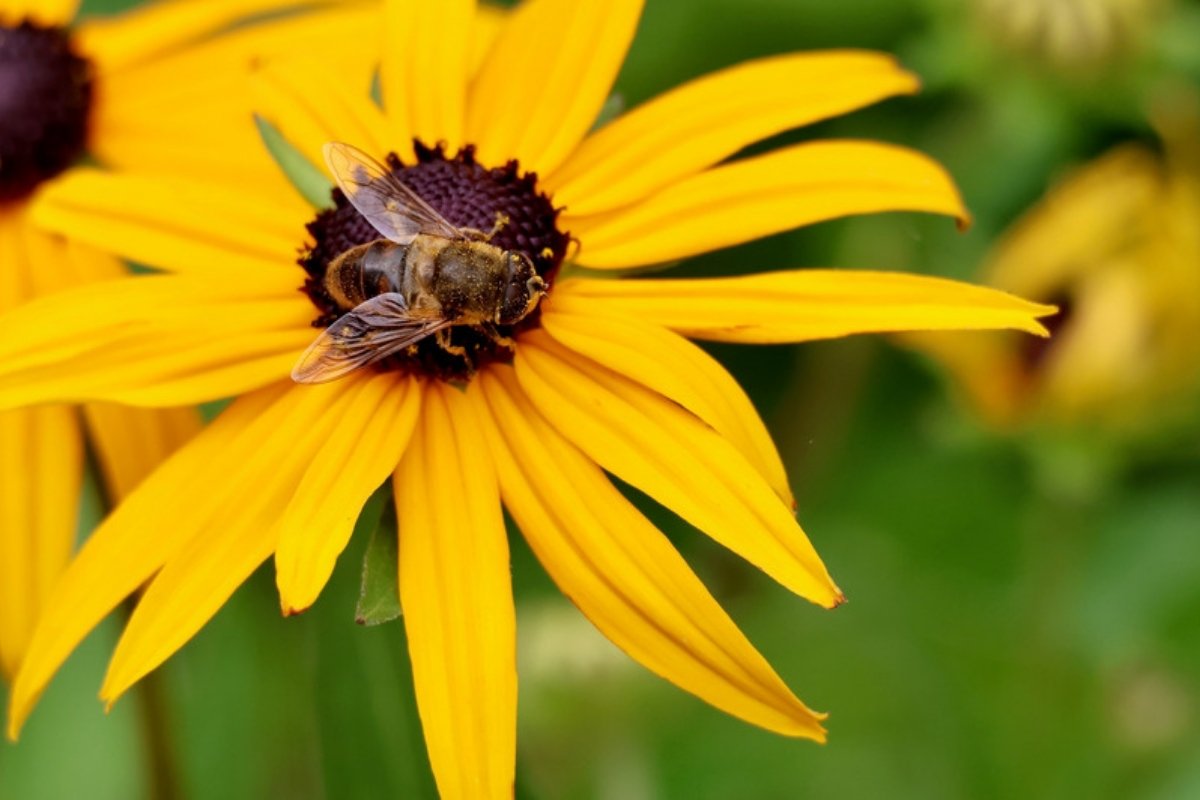
Single-flowered rudbeckias are good for pollinators and flower late in the year, when food is scarce
Frequently asked questions
Is rudbeckia an annual or a perennial
R. hirta usually lasts one or two seasons, while R. fulgida and R. laciniata are perennials that stay in the garden for years.
When does rudbeckia flower
From summer into autumn, depending on the species. Perennials such as R. fulgida usually flower from late summer to early autumn.
How do you grow rudbeckia from seed
Sow the seed on the surface of the compost, uncovered, because it needs light. It germinates in one to three weeks at around 20°C.
How tall does rudbeckia grow
From 25 cm, like dwarf 'Toto', to 3 m, like R. laciniata. Tall types need staking.
Can I sow rudbeckia seeds in autumn
Yes. Autumn sowing outdoors exposes the seed to winter chill, which helps perennial species germinate in spring.
Why is my rudbeckia wilting in summer
Usually because of drought, since it needs soil that holds moisture. Deep watering at the base and mulch help.
References
- Royal Horticultural Society, How to grow Rudbeckia.
- Royal Horticultural Society, Rudbeckia, genus guide.
- Royal Horticultural Society, Rudbeckia fulgida var. fulgida.
- Royal Horticultural Society, Rudbeckia occidentalis.