

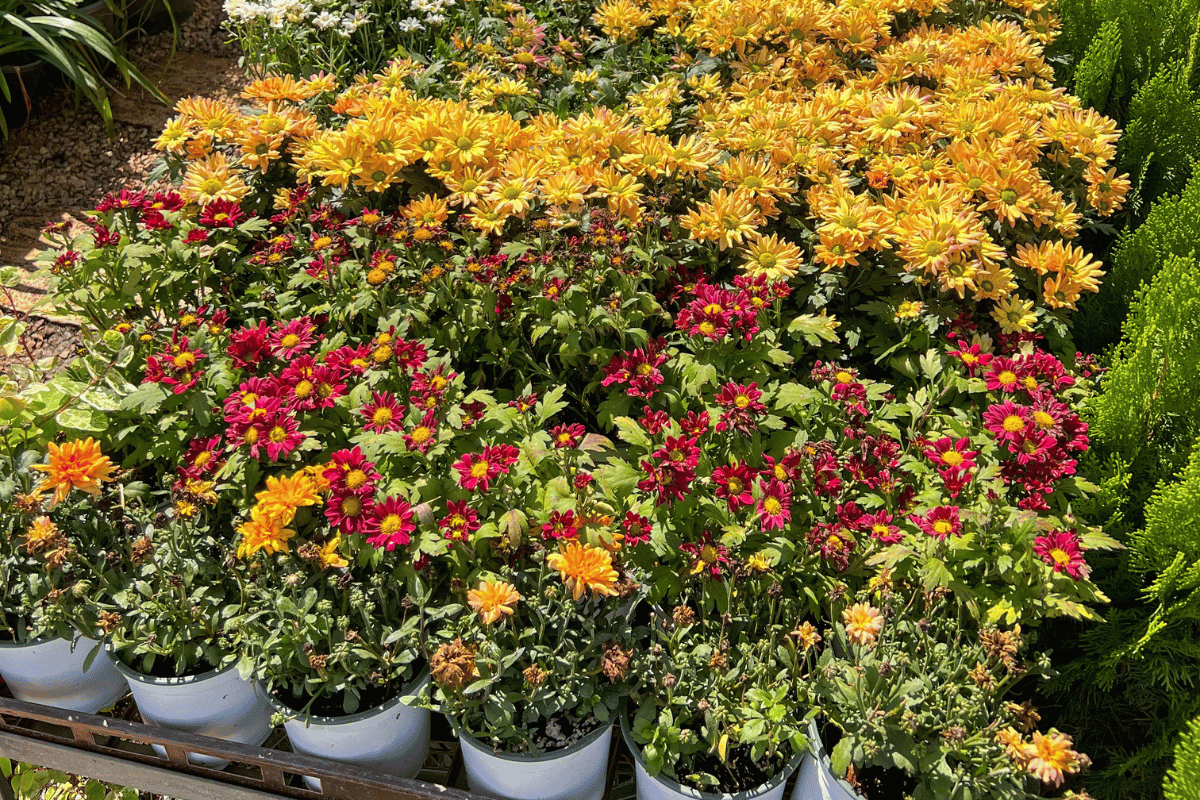
Chrysanthemums rule the autumn garden. When most plants are winding down, mums fill pots and borders with dense flowers in yellow, red, white, pink and purple, and keep going for weeks, often right up to the hard frosts. They are perennials, so with the right pruning and a little winter protection, the same plant returns and flowers again every autumn. This guide covers the types of chrysanthemum, planting in the garden and in pots, watering, feeding, pinching, overwintering and propagation, along with the pests to watch for and a note on their toxicity to pets.
What is a chrysanthemum?
The chrysanthemum (Chrysanthemum) is a genus of perennial herbaceous plants in the daisy family (Asteraceae), native to China and East Asia, where it has been cultivated for well over two thousand years. There are around forty species and more than 20,000 cultivars, ranging from hardy garden plants to the florist's pot mums sold in bloom each autumn. Chrysanthemums are related to marigolds, gerberas and asters, and in China, some varieties are grown as food, with edible shoots, and flowers brewed into the well-known chrysanthemum tea. In Japan, the flower, called kiku, symbolises longevity and is the emblem of the imperial family.
Types of chrysanthemum
Cultivars are grouped by flower form, height and season. The main flower forms are the classic daisy type with a flat, open centre, the rounded, fluffy pompon, the spider type with long, thin, curling petals, and the anemone form with a cushioned centre ringed by larger petals.
Height matters as much when choosing. Dwarf and compact varieties stay around 25 to 30 cm tall, with larger individual blooms, making them well-suited to pots and window boxes. In contrast, tall garden varieties reach 1 to 1.3 metres, form dense mounds covered in smaller flowers, and belong in the border. There is also a practical split between hardy garden mums, which live outdoors year after year, and the florist's pot mums, bred for a single long display indoors.
When do chrysanthemums bloom
Chrysanthemums are short-day plants, meaning their flowering is triggered as nights lengthen, which is why they bloom in autumn. The main season runs from September to November, with early varieties starting in midsummer and late ones holding their flowers into December in mild weather. Each plant stays in bloom for roughly four to eight weeks, depending on variety, position and care.
Where and when to plant chrysanthemums
Plant chrysanthemums in a sunny position with at least six hours of light a day, sheltered from strong winds that snap the flowering stems of taller varieties. They grow in most soils but flower best in fertile, loose, well-drained ground around neutral pH, improved with compost at planting. Space plants 30 to 45 cm apart for good airflow, which also keeps fungal disease down.
For permanent garden plants, plant in spring so they root deeply before their first autumn display. Pot mums bought in flower in autumn can be planted or repotted straight away, handled gently and watered in well.
Growing chrysanthemums in pots
Chrysanthemums have relatively short roots, which makes them well-suited to containers. Choose a compact variety and a pot at least 20 to 30 cm wide and deep with drainage holes. Use a fertile, free-draining potting mix, and place it where it gets morning sun, ideally facing east or west rather than baking in the south. Repot shop-bought plants that are root-bound into a slightly larger container, keeping the root ball intact and teasing out only a few outer roots if they are tightly congested. Planting in the evening rather than the midday heat spares the plant unnecessary stress. On a balcony, pot mums pair naturally with cyclamen, the other pillar of the autumn container display.
Watering
Chrysanthemums need steady moisture to support their dense growth and heavy flowering. Water about twice a week in spring and autumn, and every two days in hot summer weather and once the buds have formed. Always water at the base of the plant, because wet foliage invites powdery mildew and rust, and avoid waterlogging, which rots the roots. In pots, water when the compost surface has dried.
Feeding
In the garden, apply a balanced granular fertiliser once a month from mid-spring to mid-autumn. In containers, feed with a liquid or water-soluble flowering fertiliser every two to three weeks from late spring until late autumn, starting a couple of weeks after repotting. As the flower buds open, switching to a high-potassium feed supports the display.
Pinching and support
Pinching is the trick behind those dense, dome-shaped plants covered in flowers. When young plants reach about 20 cm, pinch out the top few centimetres of each shoot to force branching, and repeat as new shoots lengthen, stopping by midsummer so the flower buds can form undisturbed. Tall varieties also need staking or netting to keep the stems upright through autumn wind and rain.
Deadheading and cutting back
Throughout the flowering season, remove faded blooms regularly so the plant keeps producing new buds rather than setting seed. Once all the flowers are spent, tidy off the dead lower leaves and trim the tips back to just above a branching point. Leave the hard cut-back for late winter, after the frosts have passed, when the whole plant is cut down low to regrow cleanly. After this pruning, new shoots and rooted basal offsets soon appear, and these are perfect material for propagation.
Overwintering chrysanthemums
A chrysanthemum that has finished flowering is dormant, not dead, so it should not be thrown away. Hardy garden types tolerate around −5°C, losing their flowers and much of their foliage over winter and regrowing in spring. Mulch the crown with compost in the garden, move containers to a sheltered spot, such as against a wall or under eaves, and, in cold regions, wrap pots in insulating material. Cut watering right back, giving water only when the compost is completely dry. In early spring, clean off the dead growth and apply a light, balanced feed to restart the plant.
How to propagate chrysanthemums
New plants are easy to raise in three ways:
- Cuttings, the fastest method. In spring or summer, take 10 cm tip cuttings, insert them in a 1:1 mix of peat-free compost and perlite, keep them cool and shaded until rooted, and use rooting hormone to raise the success rate
- Division and basal offsets. In spring, once new shoots reach 10 to 15 cm, lift and split the root ball in two, pinch the tips of the new plants and pot them up separately
- Seed, sown in late winter under cover or in early spring. Seed-raised plants flower the following year, but the flower colour will not necessarily match the parent plant
Pests and diseases
In damp, crowded conditions, chrysanthemums suffer from powdery mildew, which whitens the leaves, and rust, which leaves orange-brown pustules; both are prevented by spacing, airflow, and keeping water off the foliage. Aphids and caterpillars feed on the shoots and leaves and can be controlled with insecticidal soap, with biological pyrethrin products reserved for heavy attacks.
There is a neat irony in that last point, because natural pyrethrin, one of the oldest botanical insecticides, is extracted from a chrysanthemum species known as pyrethrum. The garden plants themselves, though, release far too little of it to repel insects from their neighbours.
Are chrysanthemums toxic to cats and dogs?
Yes. According to the ASPCA, chrysanthemums are toxic to cats, dogs and horses, since they contain pyrethrins and other irritant compounds, and eating them can cause vomiting, diarrhoea, drooling, loss of coordination and skin inflammation. Keep pot mums out of pets' reach indoors, site garden plants away from where animals graze, and contact a vet if a pet has eaten any part of the plant.
Frequently asked questions
Do chrysanthemums grow back every year?
Yes, hardy garden chrysanthemums are perennials that go dormant over winter and regrow in spring, tolerating temperatures down to −5°C when mulched at the crown. Florist's pot mums are less hardy and are often treated as a single-season plant, though many survive with winter protection.
How long do chrysanthemums last
Cut stems last two to four weeks in a vase with regular water changes, a pot mum stays in flower for one to two months, and a garden plant lives and reflowers for many years with annual pruning.
When should I pinch chrysanthemums?
Start when plants are about 20 cm tall, pinching the shoot tips to force branching, and stop by midsummer so the autumn flower buds can develop.
Why are the flowers weaker in the second year?
Nursery plants bloom heavily in their first autumn because of intensive feeding under glass. From the second year, regular feeding, pinching and a proper late-winter cut-back bring the display back towards its original fullness.
Are chrysanthemums poisonous to pets?
Yes. The ASPCA lists them as toxic to cats, dogs and horses, causing vomiting, drooling and skin irritation, so keep plants and cut flowers out of reach.
Important notes
Every garden is different, and conditions vary with your climate, soil and exposure. The guidance above is a general starting point rather than a strict rule.
Because chrysanthemums are toxic to pets and their sap can irritate sensitive skin, plant them thoughtfully and wear gloves when handling them extensively. If plants show persistent problems, consult a horticulturist or your local nursery, and try non-chemical methods first.
References
- Royal Horticultural Society, Chrysanthemums.
- BBC Gardeners' World Magazine, How to grow chrysanthemums.
- ASPCA Animal Poison Control, Chrysanthemum.