

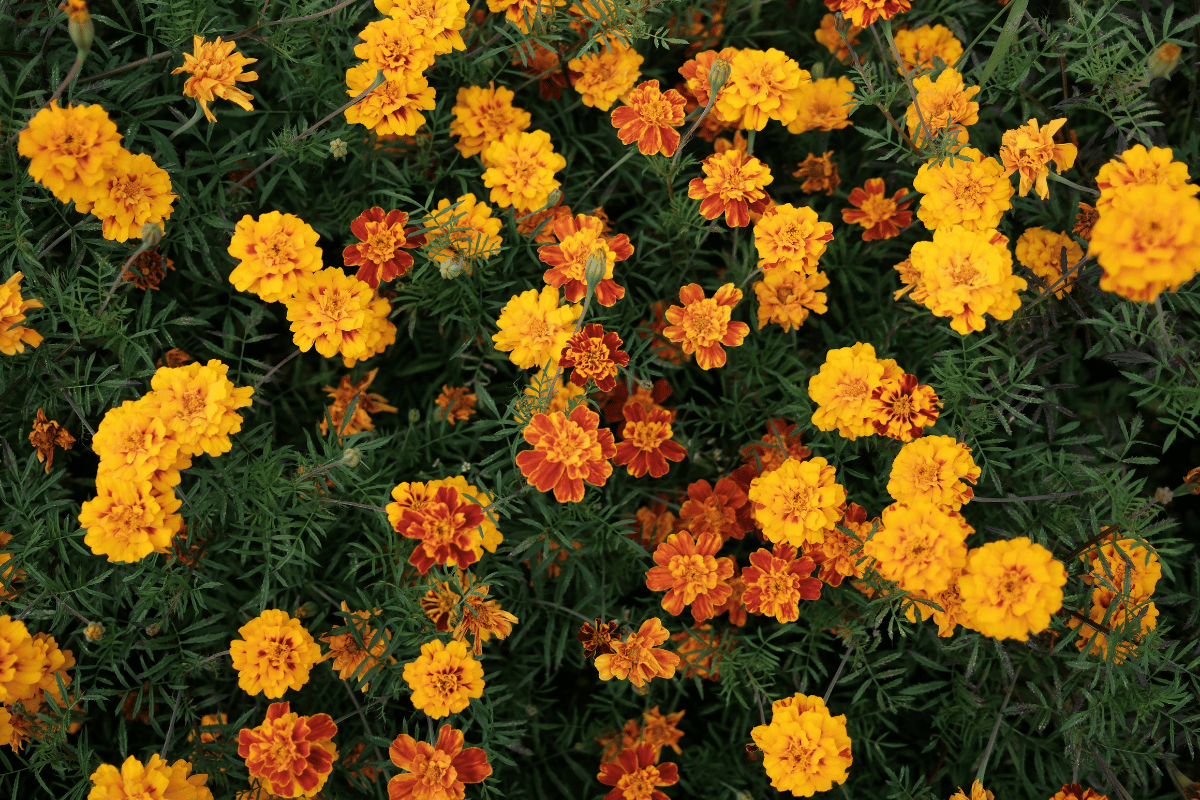
Marigolds are among the easiest and most rewarding flowers to grow from seed, bringing dense, long-lasting colour to beds and borders from early summer until the first frost. Beyond their looks, they earn their place in the vegetable garden, where they attract beneficial insects and, grown the right way, help suppress soil nematodes.
Marigolds (Tagetes spp.) are annuals in the daisy family (Asteraceae), native to the Americas and quick to flower from seed. This guide covers growing them in the ground, from sowing seed and spacing to their role in companion planting. If you are growing them on a balcony or patio, see the dedicated guide on growing marigolds in pots for container sizes, potting mixes and watering.
Types of marigolds
Three species dominate the seed racks. French marigolds (Tagetes patula) are compact, 15 to 30 cm tall, and flower heavily over a long season. African marigolds (Tagetes erecta), also called American marigolds, are tall, 30 to 120 cm, with large pompom flowers that suit the back of a border. Signet marigolds (Tagetes tenuifolia) are low and bushy with masses of small, single flowers and fine, lacy foliage, and their petals are edible. The pots guide has a fuller comparison table if you want to match a type to a spot.
How and when to plant marigold seeds
Marigolds are sown outdoors after the last frost, once the soil has warmed to around 18°C and night temperatures stay above 10°C. They are among the fastest flowers from seed, germinating in about 5 to 10 days in warm soil and flowering roughly 6 to 8 weeks after sowing.
To sow directly in the ground, rake the bed level, sow the seeds about 1 cm deep, water gently, and thin the seedlings to their final spacing once they have a few true leaves. For earlier flowers, start seed indoors 4 to 6 weeks before the last frost and plant the seedlings out once the danger of frost has passed, hardening them off first over several days.
Growing marigolds in the garden
Marigolds need full sun, at least six hours a day, to flower well. In shade they produce more leaf than flower and grow leggy. They are not fussy about soil as long as it drains freely, and they actually flower best in soil of moderate fertility. Rich, heavily fertilised ground, or too much nitrogen, drives lush foliage at the expense of blooms.
Space plants according to their type, roughly 20 cm apart for signet and dwarf French marigolds, 25 to 40 cm for larger French types, and up to 45 cm for tall African marigolds. Good spacing keeps air moving between plants and reduces the risk of powdery mildew. Water new plants regularly until established, then only in dry spells, keeping water on the soil rather than the foliage. Tall African marigolds may need staking in exposed spots.
Are marigolds annuals or perennials?
Garden marigolds are grown as annuals, completing their whole life cycle in a single season from seed to flower to seed. A few Tagetes behave as tender perennials in frost-free climates, but in practice everyone treats them as annuals. The good news is that they self-seed readily, so plants often reappear the following year where seed has dropped. You can also save seed easily by leaving a few flower heads to dry on the plant.
Deadheading and routine care
Removing spent flowers regularly, known as deadheading, is the single most useful job, since it keeps the plant producing new buds instead of setting seed and extends flowering right up to frost. Pinching young plants once encourages bushier growth. Marigolds are otherwise low-maintenance and largely trouble-free, with the occasional spider mites in hot dry spells, treated by hosing off or with insecticidal soap.
Marigolds as companion plants and natural pest control
This is where marigolds go beyond ornament and become a genuine tool in the vegetable garden. Their flowers attract beneficial insects such as hoverflies, parasitic wasps and ladybirds, whose larvae prey on aphids and other soft-bodied pests, and their strong scent is often said to confuse or deter some insects.
Their best-documented benefit is suppressing plant-parasitic nematodes, microscopic soil worms that attack the roots of many crops. French and African marigolds (Tagetes patula and T. erecta) release compounds called thiophenes from their roots, which are toxic to nematodes as they try to penetrate the root. Marigolds are most effective against root-knot nematodes (Meloidogyne spp.) and lesion nematodes (Pratylenchus spp.).
The practical detail that matters is how you grow them for this purpose. A few marigolds dotted among tomatoes do little against nematodes. The real effect comes from growing marigolds as a dense stand over a whole infested bed for two to three months, as a cover or rotation crop, before planting the susceptible vegetable in that ground the following season. Effectiveness varies with the marigold variety, the nematode species and soil temperature, so results are strongest when the marigolds are actively growing on the problem ground rather than interplanted as a token few.
One caution applies to companion planting. Avoid growing marigolds right next to legumes such as beans and peas, since the same root compounds can interfere with the beneficial bacteria those crops rely on. Around tomatoes, peppers and aubergines, on the other hand, marigolds are a classic and useful companion.
Are marigolds edible?
Some marigolds are edible, but it pays to know which. The petals of the signet marigold (Tagetes tenuifolia) have a mild citrus flavour and are used in salads. A common naming mix-up is worth knowing. The flower most often sold as a culinary or medicinal "marigold" is pot marigold, which is actually Calendula officinalis, a different plant in the same family. If you are growing flowers to eat, check the botanical name so you know whether you have a Tagetes or a Calendula.
Are marigolds poisonous to cats and dogs?
True marigolds of the genus Tagetes are mildly toxic to cats and dogs. Eating a large amount can cause stomach upset with vomiting or diarrhoea, and the sap can irritate the skin and mouth on contact. Reactions are usually mild rather than dangerous, but it's best to stop pets chewing on the plants, and to contact a vet if an animal eats a large quantity.
There is often confusion here, because the plant many sources list as "non-toxic marigold" is pot marigold, Calendula officinalis, which is a different genus. If pet safety is the deciding factor, check the botanical name of what you are planting.
Frequently asked questions
When should I plant marigold seeds? Outdoors after the last frost, once the soil has warmed to about 18°C. For earlier flowers, start seed indoors 4 to 6 weeks before the last frost.
Are marigolds annuals or perennials? They are grown as annuals, flowering and setting seed in one season, though they self-seed freely and often return the next year.
Do marigolds really repel pests? They attract beneficial insects and can suppress root-knot and lesion nematodes, but the nematode effect needs a dense stand grown over the whole bed, not just a few plants among vegetables.
Do deer eat marigolds? Deer and rabbits tend to avoid marigolds because of their strong scent, so they are a reasonable choice in gardens troubled by browsing, though no plant is entirely deer-proof.
Are marigolds poisonous to pets? Tagetes marigolds are mildly toxic and can cause stomach upset or skin irritation. The unrelated pot marigold (Calendula) is non-toxic.
Important notes
Every garden and every plant is unique. Conditions vary significantly with your region, climate, sun exposure and soil. The guidance above is general and a starting point rather than a strict rule.
Marigolds of the Tagetes genus can cause mild stomach upset in pets and skin irritation from the sap, so keep pets from chewing them and wear gloves if your skin is sensitive.
If your plants show persistent problems that don't respond to the basic practices, it's worth consulting an agronomist or your local nursery. For pest and disease control, try non-chemical methods first, such as encouraging beneficial insects. When a product is needed, use only approved ones and follow the label instructions.
References
- University of Minnesota Extension. Growing marigolds.
- UF/IFAS Extension. Marigolds (Tagetes spp.) for nematode management.
- UC IPM. Marigold in the garden.