Canning is a time-tested method of seafood preservation that can dramatically extend the shelf life of fish while retaining much of its nutritional value and flavor. In the canned fish industry, freshly caught fish undergo a series of carefully controlled steps, from the moment they leave the water to the point they emerge as a shelf-stable product on store shelves. Each stage of the fish canning process is designed to preserve quality and ensure safety for consumers. Below, we explore the key steps and considerations in how canned fish (such as tuna, sardines, and others) is produced, highlighting the role of cooking, oils, packaging, and safety standards.
Fishing and handling the catch
The journey of canned fish begins at sea. Whether it's tuna, sardine, mackerel, or salmon, maintaining fish quality from the moment of capture is crucial. Immediately after fish are caught, they are typically chilled or flash-frozen to preserve freshness and prevent spoilage. Rapid chilling (near 0 °C or 32°F) on board the fishing vessel slows down bacterial growth and enzymatic activity in the fish. This step is an added safeguard for safety. If fish were allowed to warm up and bacteria multiplied, even the intense heat of canning might not fully eliminate an unusually high bacterial load. By keeping the catch cold (below 4 °C or 39.2°F), processors ensure that bacteria, including potential Clostridium botulinum spores, remain dormant and easier to destroy during sterilization.
Careful handling of the fish is equally important. Fish destined for canning are handled gently to avoid bruising or damage, as broken or crushed fish are less suitable for canning. Upon landing, fish are quickly transported to the cannery in insulated containers or ice-filled bins. This cold chain is maintained until processing begins. For example, small fatty fish (like herring or pilchards) may be held in chilled seawater or ice slurry, which keeps them in prime condition for a few days before canning. By the time the fish arrive at the processing plant, they are in a preserved state (either well-iced or frozen), ready to be cleaned and prepared for packaging. Maintaining this cold, fresh condition is the foundation for high-quality canned seafood.
If you are looking to source premium edible oils for canned fish production, explore verified suppliers on the Wikifarmer Marketplace and connect directly with producers who meet industry standards.
Cleaning and preparing the fish for canning
Once at the cannery, the fish must be prepared and cleaned. The exact preparation steps can vary depending on the species and size of fish, but the goal is to remove inedible parts and get the fish into a form suitable for packing into cans. Typically, this process includes evisceration (removal of viscera or internal organs) and thorough washing of the fish to eliminate blood, scales, and bacteria. Many fish, especially larger ones like tuna, are also deheaded (removal of heads) either at sea or at the plant, to ease handling and reduce waste in the cannery.
For large fish, such as tuna, processing often involves a unique sequence: the fish may be thawed (if previously frozen) and butchered into sections, then pre-cooked before being canned. In this precooking method, the cleaned whole fish or large chunks are cooked using steam, hot air, or other heating methods for 1.5 to 10 hours, depending on the size of the fish. This preliminary cooking step has multiple benefits: it removes excess oils, firms up the flesh, and causes the meat to shrink away from bones and skin, making it easier to separate out the edible portions.
After this initial cook, the fish is cooled thoroughly, often with cold air or refrigeration, to stop the cooking process and firm up the meat. Workers (or machines) then remove the heads, fins, bones, and skin from these pre-cooked fish, yielding clean chunks or loins of meat ready to be canned. Tuna loins prepared this way are a primary input for canned tuna products.
Steam pre-cooking has emerged as the preferred method for high-quality products because it maintains meat integrity, moisture, and color more effectively than boiling. The process typically occurs at temperatures between 85°C and 100°C (185-212°F) for 30 to 60 minutes. For tuna specifically, industry research has established that achieving a core temperature of 60°C (140 °F) for one minute in the coldest spot of the fish delivers a 5.68 log reduction in Morganella morganii, the most heat-resistant histamine-forming bacterium.
Smaller fish like sardines and certain mackerel are often handled with a slightly different approach, sometimes called the raw pack method. These small fish are usually “nobbed,” which means cutting off their heads and tails and gutting them, but they may not be fully cooked before canning. Instead, cleaned sardines might be packed raw (or lightly brined) directly into cans. Any required trimming (like de-scaling or removing fins) is done prior to packing. This method relies on the subsequent cooking of the fish in the sealed can during the sterilization process. Whether precooked or packed raw, the cleaning stage ensures that only the desirable fish meat (free of impurities and most bones) is used, providing a high-quality product for consumers.
Cooking and thermal processing (sterilization)
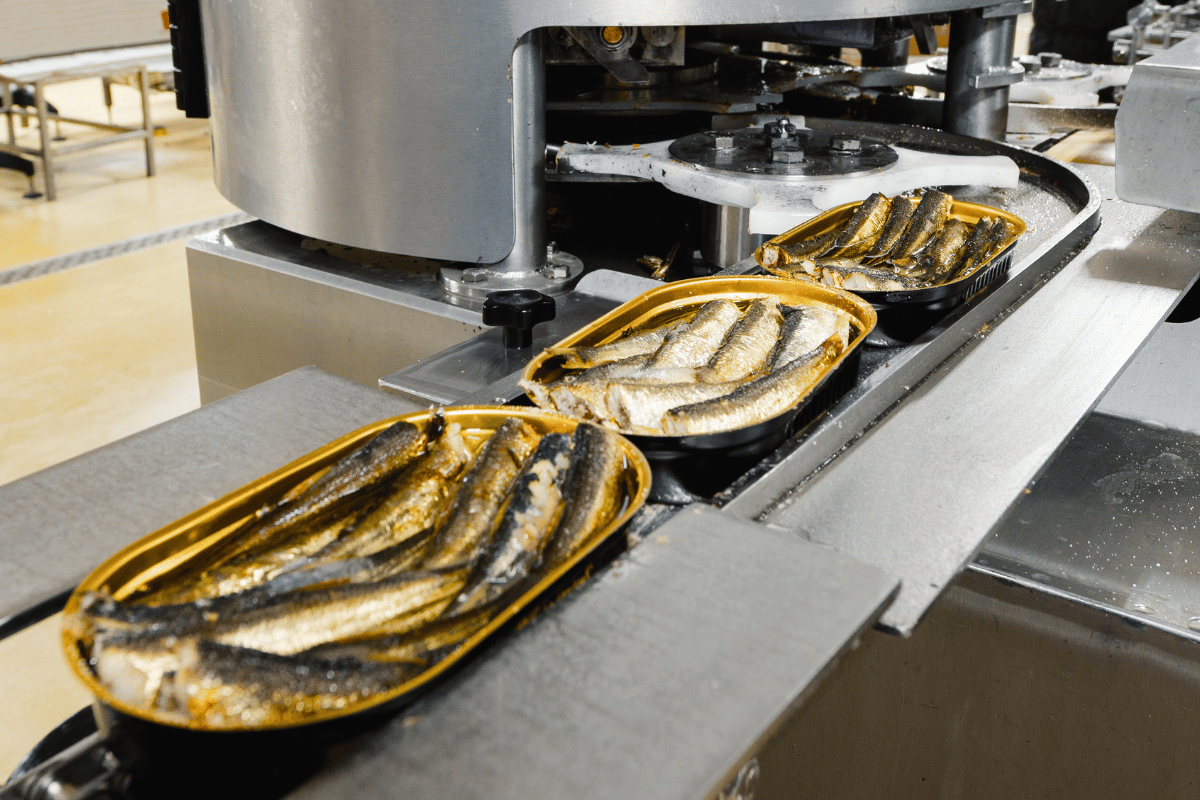
Cooking and sterilization are the heart of the fish canning process. This is where perishable fish is transformed into a shelf-stable product. After cleaning and preparation, fish pieces or fillets are placed into cans (which may be done by hand or automated fillers, depending on the cannery). Often, a measured amount of liquid is added to each can at this stage, which could be a brine (saltwater), water, oil, or sauce (more on the choice of oil or liquid later). The next critical step is sealing the cans with lids through a process called double seaming (a crimping method that creates an airtight seal). Once sealed, the filled cans go into industrial sterilization vessels called retorts.
In the case of tuna and other large fish that were pre-cooked, the canning process now essentially re-cooks the fish in the can. For small fish packed raw, this will be the primary cook. Either way, sealed cans are heated to high temperatures well above boiling – typically around 115–121 °C (239–250 °F) – under pressure. This high-heat, high-pressure cooking is known as retorting, and it is maintained for a set duration to ensure commercial sterility. All canned fish products are effectively sterilized at temperatures above 100 °C (250 °F); the pressurized steam in retorts allows these elevated temperatures without the water boiling off. A typical cycle involves heating the cans, holding them at the target temperature for the required time, and then cooling them back to room temperature.
The purpose of this thermal processing is to destroy any bacteria or microorganisms that could spoil the food or pose a health risk. Of special concern is Clostridium botulinum, a bacterium that can form extremely heat-resistant spores and produce a deadly toxin (botulinum) in low-acid, sealed conditions like a canned fish product. To eliminate this risk, canneries apply a “botulinum cook”, which is a heat treatment sufficient to kill C. botulinum spores, among other microbes.
In industry terms, the goal is commercial sterility, meaning all pathogenic and spoilage microbes are destroyed or inactivated, so the canned fish can be safely stored at room temperature for months or years. Processors typically err on the side of extra caution, using heat schedules far more severe than the minimum required for safety, to ensure a wide margin of protection. For example, many fish canners target the so-called 12D process (twelve decimal reductions of C. botulinum spores), effectively reducing the chance of a surviving spore to near zero.
After the heating period in the retort, the cans are cooled (often by cascading water over them) to stop the cooking. The result of this cooking and sterilization step is fish that is fully cooked inside a hermetically sealed can, protected from any new contamination. At this point, the fish is shelf-stable – it can sit in a pantry for years without refrigeration, all thanks to this precise combination of heat and pressure that preserves the seafood by eliminating bacteria and enzymes that cause spoilage.
It's worth noting that there are two main process variations in fish canning, as hinted earlier: the precooking method vs. the raw-pack method. In the precooking method (used for tuna and other large fish), the fish is cooked once before canning and then again in the can for sterilization. In the raw-pack method (used for smaller fish, such as sardines), the fish is packed raw and essentially cooked only once, in the can itself. Both methods converge on the critical final step of retort sterilization. Regardless of method, the outcome is the same: cooked, safe, and long-lasting canned seafood.
After coming out of the retort and cooling, cans are often cleaned externally (to remove any food residue from processing), labeled, and then packaged for distribution. The end product is a convenient, ready-to-eat fish, with its nutrients and flavors preserved mainly by the canning process.
Filling and the science of headspace
The filling operation requires precision that directly impacts both product safety and quality. Operators pack fish into cans with careful attention to achieving the correct headspace (the unfilled space between the top of the food and the underside of the lid).
For fish and meat products, processors typically maintain 1 to 1.5 inches (~2.5-3.5 cm) of headspace. This measurement proves critical for several reasons. First, it allows for food expansion during the subsequent heating processes. Second, the heated air in this space creates the vacuum necessary for proper sealing as the can cools. Too little headspace causes food to boil over during processing, potentially trapping particles between the lid and rim that prevent proper sealing. Conversely, too much headspace prevents the formation of the strong vacuum needed for long-term storage and may allow bacterial growth.
If your business needs high-quality edible oils for canning or seafood processing, you can find reliable producers through the Wikifarmer Marketplace, where verified suppliers offer olive oil, sunflower oil, and other industry-standard options.
Role of edible oils in flavor and preservation
One distinctive aspect of many canned fish products is the presence of edible oils as the packing medium. If you've ever opened a can of tuna or sardines, you may find the fish immersed in oil (such as olive oil, sunflower oil, or soybean oil). These oils play several important roles in canned fish:
- Flavor and Texture: Oil adds richness and mouthfeel to the fish. For instance, tuna canned in olive oil tends to have a more succulent texture and robust flavor compared to tuna canned in water. The oil infuses the fish with its own flavor and locks in the fish’s natural taste. Consumers often have preferences (e.g., the buttery taste of olive oil vs. the lighter taste of sunflower or soybean oil).
- Moisture Retention: During the high heat of processing, the presence of oil in the can helps prevent the fish from drying out. The oil essentially seals in the moisture of the fish flesh. As a result, oil-packed fish can remain tender, whereas a water-packed or brine-packed fish might have a slightly drier texture after processing.
- Preservative Effects: Oils can contribute to preservation in subtler ways. Firstly, filling the can with oil (or any liquid) leaves less air space (headspace), which reduces the amount of oxygen that could react with the fish. In particular, high-quality oils like extra virgin olive oil contain natural antioxidants (such as polyphenols and vitamin E) that can protect the fish’s fats from oxidation. Oxidation is what causes rancidity and flavor changes in fatty foods. Research has shown that using antioxidant-rich oils can enhance the lipid stability of canned seafood and slow down quality degradation over time. In other words, the right oil can help keep the fish tasting fresh for longer. For example, one review highlighted the preservative effect of polyphenol-rich oils (like extra virgin olive oil) in canned fish, noting that they inhibit lipid oxidation (spoilage of fats) during the high-temperature canning process.
- Nutritional Contribution: The oils used (such as olive, sunflower, and soybean) also contribute to nutritional value, including healthy fats. In the case of olive oil, consumers get the benefit of monounsaturated fats and antioxidants from the oil, along with the protein from the fish. Some artisanal canneries even highlight the use of premium oils to elevate the product’s quality.
It’s important to note that not all canned fish is packed in oil. Some are packed in brine or water, especially for those who prefer lower fat content. However, oil-packed fish tends to be a favorite for its flavor. The choice of oil can vary by region and tradition: for example, Mediterranean canned fish often uses olive oil, while some Asian canned fish products might use soybean or other vegetable oils. Each oil brings a slightly different character to the final product. Regardless of type, the edible oil serves as both a flavor enhancer and a subtle preservative medium in canned fish.
Final thoughts
From the moment a fish is caught to the point it is opened on your kitchen counter, the canned fish undergoes a remarkable transformation. The fish canning steps, including swift chilling of the catch, careful cleaning and preparation, cooking, and sterilization in sealed cans, together ensure that the seafood remains safe, flavorful, and shelf-stable. Each can is a little vault of nutrition, preserved by science and craftsmanship. Whether it’s a hearty tuna in olive oil or a zesty sardine in tomato sauce, canned fish exemplifies how traditional preservation techniques have been honed with modern knowledge to provide a convenient food without compromising safety or quality.
Sources:
- New Perspectives on Canned Fish Quality and Safety on the Road to Sustainability
- Enhancement of Lipid Stability and Acceptability of Canned Seafood by Addition of Natural Antioxidant Compounds to the Packing Medium
- Fish Processing – Process flow for precooking vs. raw-pack canning methods
- Handling Fish Before Canning – Importance of chilling catch for safety and
- Canning Principles – Need for thermal processing to destroy bacteria (botulism)
- Why Allow Headspace when Canning and Freezing Food?
- Processing Tuna for Canning: A Review – Overview of tuna canning steps and safety controls