

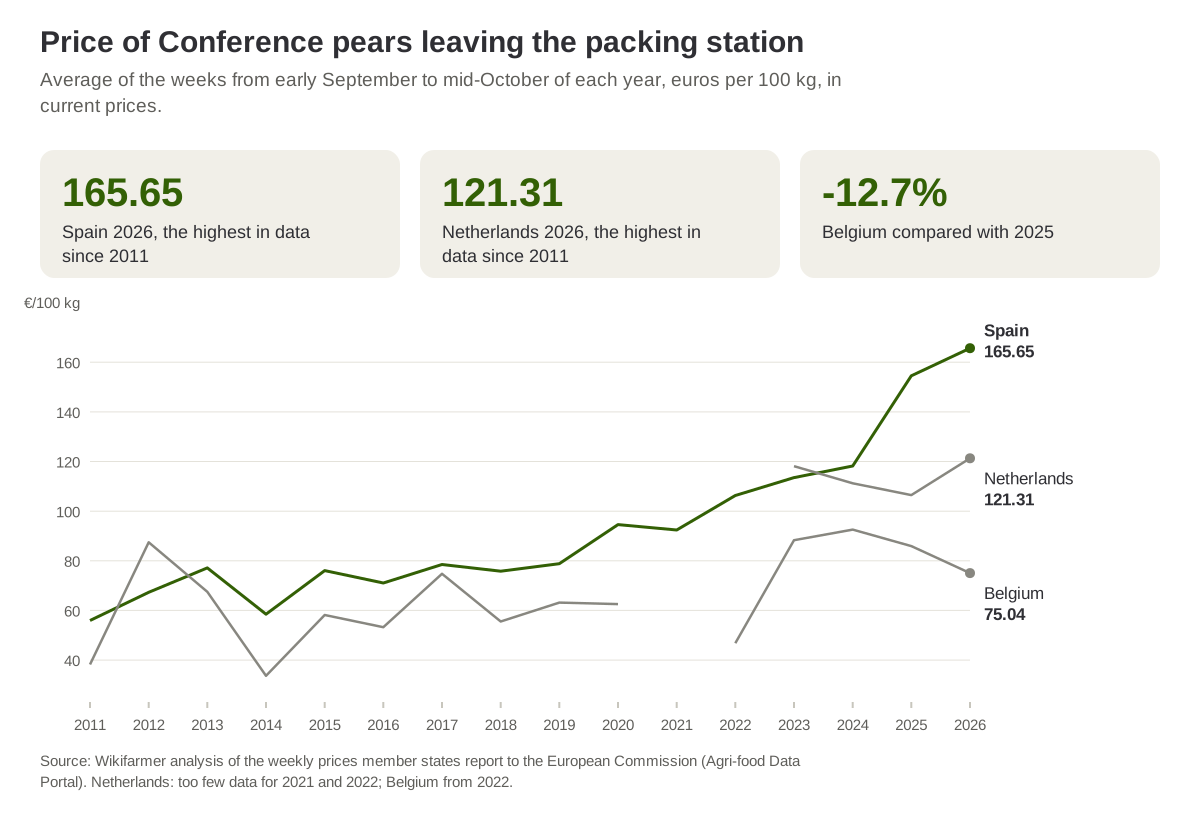
From the week of 7 September to the week of 19 October 2026 the average price of Conference pears leaving the packing station was €165.65 per 100 kg in Spain and €121.31 in the Netherlands, the highest for the same weeks in data going back to 2011, in current prices, according to a Wikifarmer analysis of the weekly prices member states report to the European Commission. These prices come in a year for which the World Apple and Pear Association (WAPA) forecasts an EU pear crop 5.5% larger than last year's and a Conference crop 2.1% larger, as reported by FreshPlaza.
In Spain the price is more than double the 2011-2025 median
In Spain the average Conference price over the same weeks was €154.52 per 100 kg in 2025, so this year's price is 7.2% higher, while the median for 2011 to 2025 was €78.51 (European Commission, Agri-food Data Portal). Since 2019, when it was €78.83, the price has risen every year except 2021 and passed €100 in 2022, at €106.32. In the latest week with data, starting 19 October 2026, the price was €181.45 per 100 kg, 16.9% higher than in the same week of 2025.
In the Netherlands the price passed the previous high of 2023
In the Netherlands the average Conference price was €121.31 per 100 kg against €106.46 in the same weeks of 2025, 14.0% higher, and above the highest price of earlier years, €118.13 in 2023, while the median of the 13 earlier years with data was €63.16. For 2026 the comparison rests on six of the seven weeks, and there are not enough weekly prices for 2021 and 2022.
Source: Wikifarmer analysis of the weekly prices member states report to the European Commission (Agri-food Data Portal), in current prices.
In Belgium the Conference price is 12.7% lower than last year
In Belgium, which since late 2023 reports only Conference prices to the Commission, the average price was €75.04 per 100 kg against €85.93 in the same weeks of 2025, 12.7% lower. The Belgian series starts in 2022, when the price for the same weeks was €46.80, and it was €88.30 in 2023 and €92.57 in 2024.
Prices of other varieties moved in different directions
Of ten price series by variety and country with comparable data for both years, the price was lower than last year in six and higher in four. Besides Belgian Conference, it was lower for Williams in Italy by 9.2% and in Hungary by 8.0%, Rocha in Portugal by 4.2%, Abbé Fétel in Italy by 4.0% and Williams in France by 0.2%, while besides Spanish and Dutch Conference it was higher for Kaiser in Italy by 0.9% and Blanquilla in Greece by 6.7%. In some of these series the price is the same in every week, as for Italian Williams in both years and Greek Blanquilla and Italian Kaiser in 2025, or changes very little from week to week, as for Italian Abbé Fétel, Portuguese Rocha and Italian Kaiser in 2026, so their comparisons are less reliable.
WAPA forecasts a bigger EU pear crop
According to WAPA's first estimate, the EU pear crop will reach 1,946,482 tonnes, 5.5% more than last year and 9.9% above the average of the previous three years, with increases of 17.4% in Italy, to 347,325 tonnes, and 9.6% in the Netherlands, while the forecast for Belgium is 7.2% below last year (FreshPlaza). For Conference WAPA forecasts 905,693 tonnes, 2.1% more than last year. In the Netherlands, where the forecast for all pears is a 9.6% increase, the Conference price was 14.0% higher than last year, while in Belgium, with a forecast fall of 7.2%, it was 12.7% lower; the price analysis does not test what explains these differences.
The comparison matters to those who sell and buy pears
Prices in the first weeks of the season, September and October, the northern hemisphere autumn, concern growers and cooperatives selling to packing stations, the packing stations deciding how many pears to sell now and how many to store, and the buyers, while much of the crop is sold in the following months, depending on how European pears are harvested and stored. The prices are compared in current euros, without adjusting for 15 years of inflation, so the highest prices since 2011 do not mean the highest value in real terms. The data describe how prices moved without testing the causes, and they are not a forecast; the weekly prices of the coming weeks will show whether Conference prices stay at these levels.
The analysis uses the weekly prices of pears leaving the packing station (ex-packaging station prices) that member states report to the European Commission, as national averages by variety in euros per 100 kg. The "all types and varieties" price is not used because the varieties it covers change: Greece, for example, has not reported Abbé Fétel prices since May 2026, so its all-varieties price was 17.2% lower than last year while its Blanquilla price was 6.7% higher. For each year the average of weeks 37 to 43 is used, the weeks starting 7 September to 19 October 2026 and 8 September to 20 October 2025, and a year counts only if it has a price for at least five of the seven weeks. The Conference data used start in 2011 for Spain and the Netherlands and in 2022 for Belgium; older data were not examined. The Netherlands has too few prices for 2021 and 2022, and the 2026 figures for the Netherlands and Greece rest on six weeks. All comparisons are in current prices, and the latest prices may be revised by the Commission. The crop forecast is WAPA's as reported by FreshPlaza and was not read in WAPA's own text. All price figures were recomputed independently from the Commission's original files.
Sources
- European Commission. (2026). Agri-food Data Portal, API guide and fruit and vegetable supply chain prices. Directorate-General for Agriculture and Rural Development.
- FreshPlaza. (2026). EU's 2026 apple harvest to decrease by 15.6%, pear harvest to grow by 5.5%.