
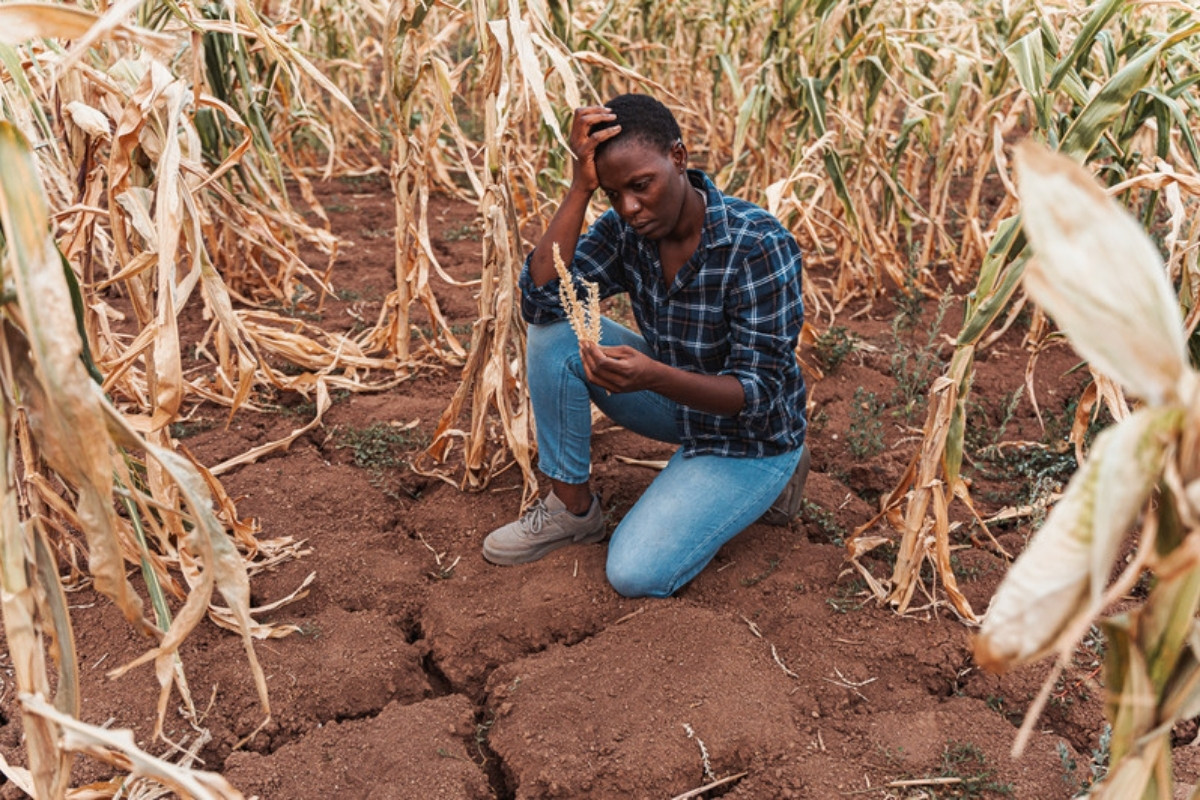
The condition of maize and beans from the first growing season, the Primera, was downgraded to poor in all areas of Guatemala, El Salvador, Honduras and Nicaragua, and many subsistence farmers reported losses above 75%, according to the GEOGLAM early warning bulletin of 1 October 2026. The drought is linked to the 2026 El Niño and the risk it poses to crops and food prices, and the region is now planting its second season, the Postrera, which El Salvador relies on for its main bean crop, while models give a chance of less rain than normal until December.
GEOGLAM downgraded maize and bean conditions to poor in four countries
In its October bulletin, GEOGLAM, the international crop monitoring initiative that combines satellite and ground information, reports that the Primera maize and bean harvest is complete in the four countries and that long dry spells and high temperatures delayed planting and held back crop development, especially in the Dry Corridor (Corredor Seco). Yields are expected to fall on both large farms and the farms of subsistence growers, and some crops died at early stages because of erratic rain. In its special report on El Niño of 16 October, the same initiative attributes to El Niño the drier than normal weather in Central America and the Caribbean during the Primera, from May to September, and at the start of the second season, and notes that across many of the affected regions crops fared poorly or failed.
Rain from May to August was below half of normal at three points
In a Wikifarmer analysis of NASA's gridded POWER estimates, rain from May to August 2026 reached 46% of normal in central and eastern El Salvador, the lowest since 1997, 48% in south-central Honduras, the second lowest, and 44% in west-central Nicaragua, the fourth lowest. From 1 August to 20 September, when the Postrera is planted, rain fell to 31%, 34% and 20% of normal respectively, the lowest of the last 30 years at all three points, while the central Honduras point recorded 65% and 71%. These figures agree with GEOGLAM's special report, which records large rainfall deficits over the same period in much of Guatemala, southern and central Honduras, western Nicaragua and El Salvador, and average maximum temperatures at record highs in western Central America.
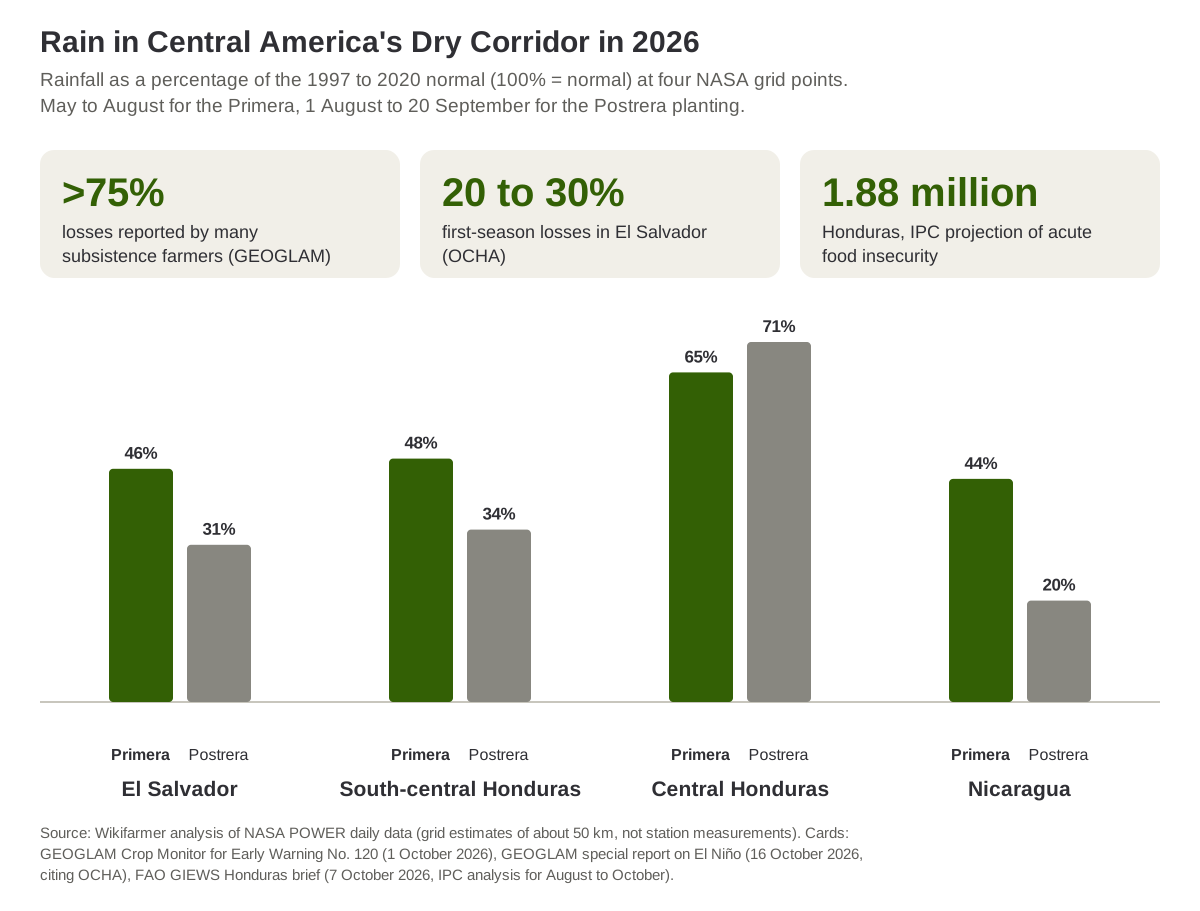
Source: Wikifarmer analysis of NASA POWER daily data (grid estimates, 1997 to 2020 reference period), GEOGLAM Crop Monitor for Early Warning No. 120 (1 October 2026), GEOGLAM special report on El Niño (16 October 2026) and FAO GIEWS for Honduras (7 October 2026).
Honduras and El Salvador declared drought alerts
In Honduras the Primera provides about 70% of annual maize, and its output is expected to be well below average, according to the Global Information and Early Warning System of FAO (GIEWS), with the worst losses in the southern departments of the Dry Corridor. According to GEOGLAM, the government declared a state of drought in several municipalities on 19 August, and a red alert has also been declared because of large crop losses, while high fertiliser prices raised production costs during planting and limited input use among subsistence farmers.
In El Salvador the government declared a nationwide red alert in August, and the GIEWS assessment of 13 October reports that in early September satellite imagery showed very poor crop conditions in the centre and east, where about 40% of the country's maize is grown almost entirely without irrigation. Farmers had planted about a month earlier than usual, in late April, to limit the effect of the expected dry weather, but rainfall deficits and high temperatures in May caused widespread losses at early stages, and then erratic rain in June and July and a long midsummer dry spell (canícula) in August cut yields significantly, especially in the eastern Dry Corridor. Concern over bean planting in August and September, after first-season losses of 20 to 30%, led to a six-month national state of emergency from 7 October, according to GEOGLAM's special report, which cites the 12 October update of the UN Office for the Coordination of Humanitarian Affairs (OCHA). In Guatemala, according to GEOGLAM's bulletin, drought and the canícula caused Primera crops to deteriorate, especially in the Dry Corridor, while erratic rain and high temperatures brought planting delays, unplanted fields and replanting, and heavy rain in mid-July caused local flooding and crop damage in parts of the Franja Transversal del Norte and Alta Verapaz.
Postrera planting began in dry soil with less rain forecast
In El Salvador dry weather is delaying land preparation and planting of Postrera maize, and GIEWS expects a below-average area, as forecasts of persistent El Niño-related dry weather in the first months of 2027 lead farmers towards more drought-tolerant crops. In Honduras planting began in September, and mid-month rain in central areas partly eased the soil moisture deficit without being enough for good planting conditions. According to GEOGLAM's special report, the dry weather during the August and September planting raises major concern for El Salvador's main bean season, while there is concern that the heavy, erratic rain of late September and early October in Guatemala, Honduras and western Nicaragua did not benefit the second season.
Models give moderate to high chances of below-normal rain from October to December 2026 in Honduras, Nicaragua, eastern Guatemala, eastern El Salvador and southern Central America, and a high likelihood of temperatures above the 90th percentile, according to GEOGLAM. The special report links these outlooks to forecasts of a very strong El Niño and of an Atlantic hurricane season weaker than normal.
Cereal import requirements are expected to stay above average
GIEWS expects above-average cereal import requirements in both countries in the 2026/27 marketing year, which runs from September to August. Honduras already imported about 1.8 million tonnes of cereals in 2025/26, almost 30% above the five-year average, and in July 2026 wholesale white maize prices were about 20% higher than a year earlier, while red bean prices rose by 16% in a month. In El Salvador white maize prices were stable from June to September thanks to large imports, but red beans became steadily more expensive over the same period, mainly because supply tightens seasonally before the second-season harvest, which is late this year, while higher prices in Nicaragua, the country's main supplier, also contributed. Thanks to imports, prices of both products in El Salvador were still lower in August 2026 than a year earlier.
In Honduras 1.88 million people were projected to face acute food insecurity
According to the latest Integrated Food Security Phase Classification (IPC) analysis cited by GIEWS, about 1.88 million people in Honduras, 18% of the population analysed, were projected to face acute food insecurity, meaning Phase 3 (Crisis) or worse, from August to October 2026, compared with 1.62 million, or 17%, in the same period of 2025. The deterioration is mainly due to the impact of El Niño on the Primera, especially on subsistence farmers in several departments of the Dry Corridor, as happens worldwide, since according to FAO 8 in 10 people facing acute hunger are farmers themselves. Limited income opportunities and higher prices of food and farm inputs add to the deterioration.
The second harvest depends on rain from October to December
For growers in the Dry Corridor, the Postrera, which according to GEOGLAM runs from August to January, is the second chance of the year, and it started in dry soil, with expensive fertiliser and a forecast of less rain. For traders in white maize and red beans in the region, GIEWS already expects above-average imports, while bean prices in El Salvador also follow Nicaragua, since a drought in one country can raise prices in others. The picture may change if rain from October to December beats the forecasts or if the national authorities publish production estimates, and GEOGLAM updates its assessment every month.
Frequently asked questions
What are the Primera and the Postrera?
They are the two main growing seasons for maize and beans in Central America. According to GEOGLAM, this year's Primera ran from May to September, and the second season, called the Postrera or Segunda, runs from August 2026 to January 2027.
How much did the harvest fall in Central America?
GEOGLAM downgraded Primera maize and bean conditions to poor in Guatemala, El Salvador, Honduras and Nicaragua, and many subsistence farmers reported losses above 75%. In El Salvador first-season losses are put at 20 to 30% by OCHA, while the official sources Wikifarmer checked up to 26 October contained no national production estimates yet.
How is El Niño linked to the drought?
According to GEOGLAM, El Niño tends to bring drier than normal weather to Central America and the Caribbean, and this year's event is expected to peak from October to December as a very strong one. Its special report attributes the Primera drought to El Niño.
Will it rain in Central America before the end of 2026?
The models cited by GEOGLAM give moderate to high chances of below-normal rain from October to December in Honduras, Nicaragua, eastern Guatemala, eastern El Salvador and southern Central America, with above-normal temperatures.
Have maize and beans become more expensive?
In Honduras white maize was about 20% more expensive in July than a year earlier, according to GIEWS. In El Salvador red beans rose in price from June to September, but thanks to imports maize and bean prices were lower in August than a year earlier.
Important notes
The article is based on GEOGLAM's early warning bulletin and special report on El Niño, FAO GIEWS assessments for Honduras and El Salvador and a Wikifarmer analysis of NASA POWER daily data. The NASA data are grid estimates of about 50 km, not station measurements, at 13.6° N 88.5° W (central and eastern El Salvador), 13.8° N 87.2° W (south-central Honduras), 14.5° N 87.5° W (central Honduras) and 12.9° N 86.2° W (west-central Nicaragua). The reference period is 1997 to 2020 and the rankings cover the 30 years 1997 to 2026, because at these points rainfall data before 1997 are not comparable with later years. Estimates of losses, prices and food insecurity belong to the bodies named, and the forecasts are probabilities that change with every new issue.
Sources
- GEOGLAM Crop Monitor. (2026, October 1). Crop Monitor for Early Warning, No. 120.
- GEOGLAM Crop Monitor. (2026, October 16). Special Report, El Niño 2026-2027.
- FAO GIEWS. (2026, October 7). Country Brief, Honduras, retrieved 23 October 2026.
- FAO GIEWS. (2026, October 13). Country Brief, El Salvador, retrieved 23 October 2026.
- NASA Langley Research Center. (2026). POWER, daily point data, community AG, retrieved 23 October 2026.