
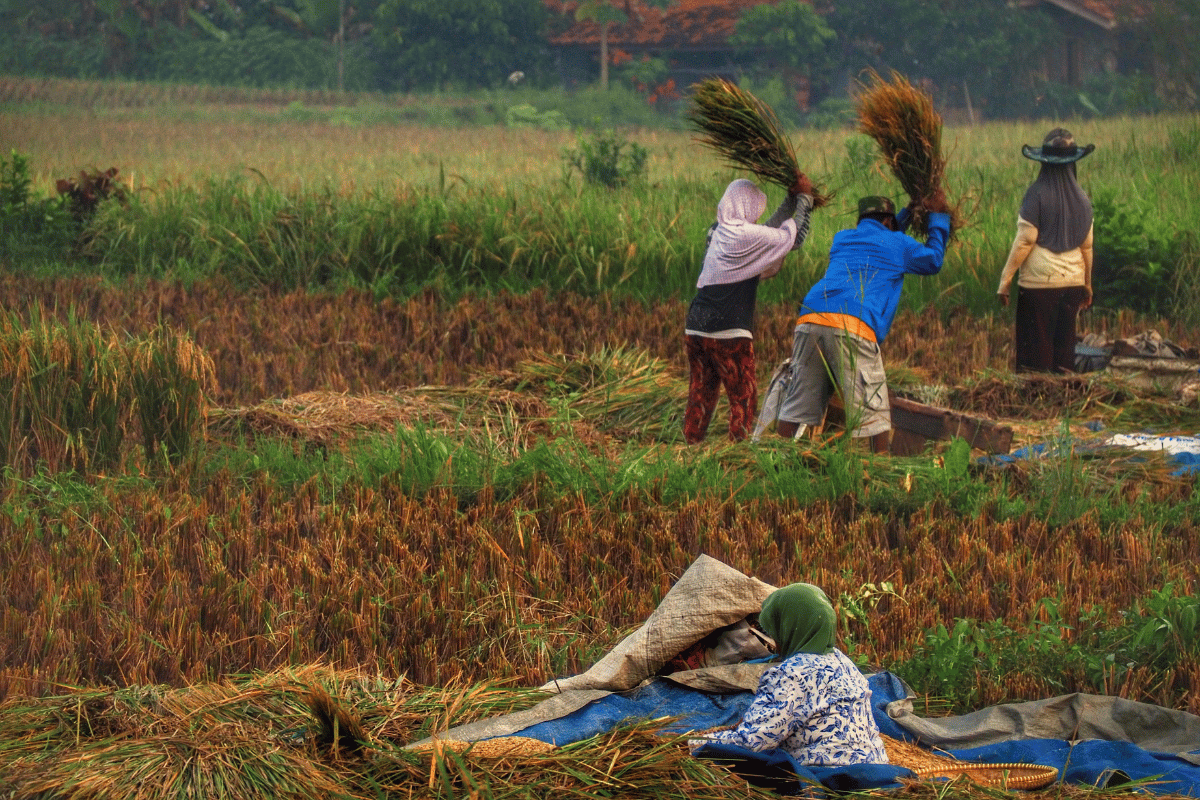
There is a number in FAO's new emergency appeal that does not get the attention it deserves. About 8 in 10 people facing acute hunger today are themselves farmers, herders, fishers or forest-dependent producers. They live in the countryside, and they grow food for a living. Yet for every 100 dollars the world's humanitarian system spends on the food sector, only 5 reach them in the form that would help most: seed, livestock vaccines, tools, irrigation repair, anything that lets them grow their own next meal.
The other 95 go to rations and nutrition assistance. Both matter. Without food parcels, people die. But somewhere in that ratio is a question the appeal is finally asking out loud. What are we doing when we feed farmers from a sack and let their fields fail?
FAO is seeking USD 2.5 billion in 2026 to help more than 100 million people across 54 countries. The headline is the money. The argument is the ratio.
The 80/5 problem the appeal puts on the table
In 2024, global food assistance alone reached USD 8.8 billion — roughly USD 24 million a day in rations, vouchers and nutrition support. Emergency agriculture got a sliver of what was left over. The people on the receiving end of those rations were largely producers themselves, asked to sit out a dry season or a conflict cycle without the inputs that would let them work. Field assessments in Sudan, Yemen, and Afghanistan describe the same loop: a household receives food aid, misses a planting window, loses its goats, and shows up again on the next year's appeal.
This is the part most discussions of food aid skip. Hunger in the world's worst crises is not mostly an urban problem. It is a rural production problem with an urban food-distribution response stapled on top.
There is also a vocabulary issue worth fixing. People classified as acutely food insecure in FAO data are not abstractly "in need." Most of them are subsistence farmers and pastoralists whose households are one bad harvest, one cattle plague or one displacement away from going hungry. The 80% figure describes them. The 5% describes what the system sends back.
Hunger has tripled. The money has gone the other way.
Between 2016 and 2024, the number of people in IPC/CH Phase 3 or worse rose from 105 million to nearly 300 million across more than 50 countries, according to the Global Network Against Food Crises. The most extreme category, IPC Phase 5 (starvation and death), went from about 155,000 people in 2016 to 1.4 million in 2025. That is a 9-fold rise, driven first by conflict in Gaza and Sudan, then by South Sudan, Yemen, Haiti and Mali.
Break the increase down by cause and the structural picture sharpens. Conflict-driven hunger almost doubled in seven years, from 74 to 140 million people. How climate change is reshaping farming shows up in the same numbers: weather-driven food insecurity tripled, from 29 to 96 million. Economic-shock cases grew 6-fold, from 10 to 59 million.
The money has moved in the opposite direction. By November 2025 the Global Humanitarian Overview had received USD 11.5 billion of the USD 45 billion it was asking for. That is the largest funding gap on record. Humanitarian food sector funding fell 31% in 2023, 5% in 2024, and is projected to fall another 25% in 2025 even under optimistic donor scenarios.
Development aid, which tends to be steadier, is structurally worse for agriculture than humanitarian aid is. Only about 1 in 30 development dollars goes to food sector challenges, compared with 1 in 3 humanitarian dollars. Agriculture is underfunded twice, once in emergencies and once in the long-term picture, and the gap is widest in the countries where farming is the single largest employer.
What a dollar buys when it lands in a field
FAO's own outcome calculations, drawn from 2024 distributions, put the average return on emergency agricultural support at about 3 dollars in local food value for every dollar spent. Look at specific cases and the ratio gets larger.
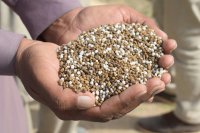
In Somalia in 2024, every dollar invested in seed distribution generated more than 5 dollars in food. In Tigray, Ethiopia, in 2021, small-scale farmers who received seed and fertilizer during the regional blockade produced 900,000 tonnes of grain — roughly 5 times the volume of food aid that reached the region and enough to feed Tigray for six months.
The timelines are short by humanitarian standards. Vegetables come in within 6 to 8 weeks. Cereals and legumes mature in about 3 months. A single 50-kilogram bag of paddy seed handed to a rice-growing household produces the equivalent of 47 bags of milled rice at harvest.
Food parcels move calories from a warehouse to a kitchen. Seeds, animals and tools turn one household's labour into many households' meals. They also do something parcels cannot: they restore the production base, which is the only thing that ends the loop of repeated appeals.
The arithmetic of prevention
Disaster risk reduction, climate adaptation and anticipatory action together receive less than 1% of global humanitarian funding. The returns on what does get through are the kind of numbers that, in any other sector, would shift budgets immediately.
In Yemen, vaccinating one head of livestock against high-impact diseases costs about USD 0.50. Replacing the same animal after it dies costs about 200 times that. Before Super Typhoon Man-yi struck the Philippines in 2024, each dollar spent reinforcing a fishing boat against the storm avoided around USD 70 in losses, and every boat that received the support survived. Across FAO's anticipatory action work, a dollar spent ahead of a known shock can prevent up to 7 dollars in losses.
The ledger gets larger when the lens widens. Climate disasters cost agriculture around USD 99 billion a year in lost crops and livestock. Animal diseases add USD 300 billion. Plant pests another USD 220 billion. Trimming any of those numbers by a few percentage points would free more capital than the entire humanitarian system spends in a year. This is what building resilience in agriculture actually means in budget terms, not as a slogan but as a line item.
Where the 2024 budget actually went
FAO reached 42.4 million people across 75 countries in 2024. The package included 82,000 tonnes of seed (helping nearly 23 million people grow food), USD 108 million in cash and vouchers to 4.5 million people in 37 countries, 37 million livestock vaccinations, and 73,000 tonnes of animal feed. Crop and vegetable packages produced an average 3:1 return at local food prices.
About half of cash recipients got cash combined with productive inputs and training, an arrangement FAO calls cash+. 1 in 3 cash beneficiaries took part in cash-for-work programmes that rebuilt the rural infrastructure underlying production — irrigation canals, water points and farmable land.
The country-level results show what production support does under pressure.
Afghanistan: Assisted families produced 360 kg more wheat per household than those who received no agricultural support. That is enough additional food for two extra people for a year. Nationwide, agricultural assistance contributed to halving the country's acutely food-insecure population from 23 million to 9.5 million between 2021 and 2025, despite drought, floods, locust outbreaks and political transition.
Sudan: In 2025, FAO reached 4 million people with quality seed, including 1.3 million in Darfur and Kordofan. The result was wheat in markets that the conflict would otherwise have emptied.
Chad: Animal health work combined with child nutrition counselling cut severe acute malnutrition by 81%, raised milk production by 66% and cut distress sales of livestock by 45%.
Uganda: Agricultural support raised refugee incomes by 50% and host community incomes by 28%.
Similar input-led recoveries appear in case work with small-scale farmers in tropical Africa and with how Nigerian rice farmers are adapting to climate change, where targeted variety and input support recovers output faster than market signals alone would suggest.
Where the 2026 appeal lands the hardest
Of the USD 2.5 billion FAO is asking for, USD 1.5 billion is earmarked for emergency response, USD 1 billion for multiyear resilience programmes, and USD 70 million for global services such as anticipatory action systems, monitoring and evaluation.
By region:
- West and Central Africa: USD 593.4 million for 17.7 million people in Chad, Mali, the Democratic Republic of the Congo and others under combined conflict and climate stress.
- Near East and North Africa: USD 519.1 million for 29.2 million people across Syria, Yemen, Sudan and Palestine.
- Asia and the Pacific: USD 521.6 million, with Afghanistan, Myanmar and Pakistan accounting for most of the requirement.
The countries on the list are not random. 35 of them have appeared in every annual Global Report on Food Crises for nine consecutive years. 13 have received an annual humanitarian appeal for at least two decades. These are not first-time emergencies that food parcels can resolve and walk away from. They are protracted production failures, and the short-cycle food aid the system currently runs has not solved them.
The 2026 forecast does not give much room for relief. Sudan, Palestine, South Sudan, Yemen, Mali and Haiti are FAO's highest-concern contexts, with populations facing or at risk of Catastrophe (IPC Phase 5). The Democratic Republic of the Congo, Myanmar, Nigeria, Somalia, Syria and Afghanistan already have large populations at critical levels of acute food insecurity, with projections rising into 2026. A forecast La Niña transition is expected to add floods, droughts, cyclones, animal disease and plant pest outbreaks to a system that already has no margin.
The shift the appeal is actually asking for
The central argument in the appeal is not new and it is not complicated. Lift agriculture's share of humanitarian food sector funding from 5% to 10%, and you can feed substantially more people on the same total budget. One billion dollars channelled into staple crops, vegetables and livestock could produce a year's worth of related food for about 108 million people. That is the same order of magnitude as the current global humanitarian shortfall.
The barriers to doing this are not technical. Emergency agricultural protocols already exist. Livestock vaccine supply chains run. Anticipatory cash transfer mechanisms have been tested across multiple regions. Household-level food security monitoring operates at scale through FAO and its partners. What is contested is allocation. A move from 95/5 toward 90/10 or 85/15 would not cut food assistance into acute crises. It would reduce how many crises return, how much each return costs, and how far the 2030 deadline for SDG 2 is from any realistic projection.
The 80/5 ratio is not a sign that the aid system is broken. It is a sign that it was built for one job — food delivery in acute emergencies — and is being asked to do another: ending the food crises themselves. The appeal is a plea to admit the difference and reallocate accordingly.
References
- FAO. (2025). FAO's Global Emergency and Resilience Appeal 2026. Rome.
- Global Network Against Food Crises, FAO and WFP. (2026). 2026 Global Report on Food Crises – Joint analysis for better decisions. Rome, FAO and WFP.
- OCHA. (2025). Global Humanitarian Overview 2025. United Nations Office for the Coordination of Humanitarian Affairs.