



The United States bought 15.2% of the value of Spain's olive oil exports in 2025, €735.3 million, and was its second largest buyer after Italy, according to a Wikifarmer analysis of Eurostat foreign trade data. In a proposed rule published on 15 October 2026, the US Federal Maritime Commission (FMC) proposes a fee on every arrival of a Spanish vessel at a US port and limits on imports of five categories of goods exported from Spain, among them all oils and fats, and it accepts comments until 14 December 2026.
The FMC proposes a $200,000 fee each time a Spanish vessel arrives
Under the proposed rule published in the Federal Register, the FMC would charge a fee of $200,000 each time a Spanish-flagged vessel enters a US port from a foreign port, and it could limit imports of goods exported from Spain in five chapters of the US tariff schedule (HTS), namely perfumery and cosmetics (33), oils and fats (15), ceramics (69), articles of stone (68) and sugar and confectionery (17). The FMC bases the proposal on its finding that Spain prevented US-flagged vessels from docking at Spanish ports on at least three occasions. For chapter 15 the FMC puts US imports from Spain at $1.15 billion in 2025, of which $836.9 million was olive oil and its fractions (HTS 15.09), which on the FMC's two figures is 72.8% of the chapter.
The proposal also provides that if a vessel of any flag carries such goods to the US, the FMC may ask the Department of Homeland Security to deny it entry or detain it. The FMC itself notes that it may choose narrower measures or only some of the categories, that it is seeking comments before deciding, and that it is offering a public hearing, so this is a proposal and not a measure in force.
The US was the second largest buyer of Spanish olive oil in 2025 after Italy
In 2025 Spain exported olive oil worth €4.85 billion and 1,073,590 tonnes to all destinations combined, and the US bought 145,169 tonnes worth €735.3 million, or 13.5% of the volume and 15.2% of the value (Eurostat, Comext). Italy came first with 28.1% of the value and 31.5% of the volume, followed by Portugal with 8.7% of the value, France with 8.1%, the United Kingdom with 3.9% and Australia with 3.0%.
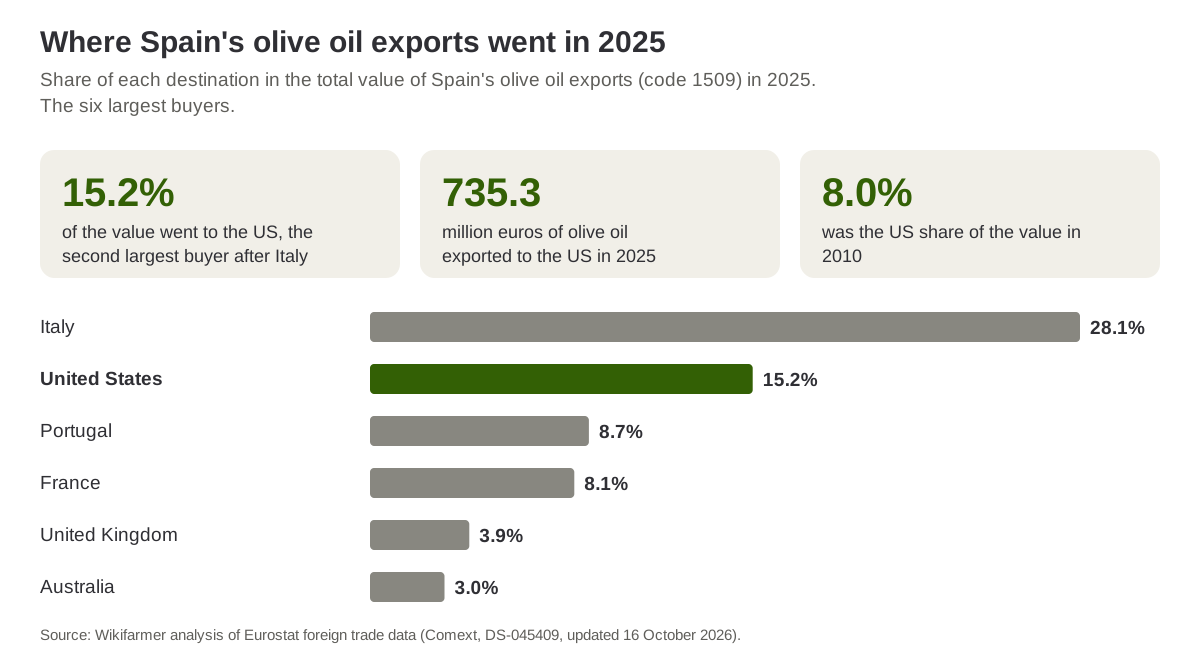
Source: Wikifarmer analysis of Eurostat foreign trade data (Comext, DS-045409, updated 16 October 2026).
The US paid an average of €5.07 per kilo, 12.1% above the average for all destinations of €4.52/kg, while for extra virgin oil specifically Italy pays less per kilo for Spanish extra virgin olive oil than most buyers. The data do not show whether the gap reflects packaging, the grade of oil or the timing of purchases.
The US share has almost doubled since 2010
In 2010 the US bought 8.0% of the value and 6.7% of the volume of Spain's olive oil exports, and since 2020 its share of the value has ranged between 14.6% and 16.4%, with the highest in 2024. In 2025 the share was 15.2% of the value and 13.5% of the volume, almost double the 2010 level, and in every year from 2015 to 2025 the US paid more per kilo than the average for all destinations.
Exports to the US fell 13.9% by value from January to August 2026
In the first eight months of 2026 Spain exported 91,350 tonnes of olive oil worth €452.3 million to the US, against 102,076 tonnes and €525.5 million in the same period of 2025, which is 13.9% less by value and 10.5% less by volume. Spain's total olive oil exports fell less, by 9.4% in value and 8.5% in volume, so the US share of the value fell to 14.6%, with the US still second after Italy. These figures cover months before the FMC proposal.
Italy sends 28.7% of its olive oil exports to the US
The proposal covers only goods exported from Spain and not from other EU countries, of which Italy exported 100,514 tonnes of olive oil worth €678.5 million to the US in 2025, 28.7% of the value of its olive oil exports, at an average of €6.75 per kilo. Greece exported 11,251 tonnes worth €68.8 million to the US, 7.5% of the value of its exports, and Portugal 4,198 tonnes worth €24.4 million, 2.5% of the value. Greece's largest buyer is Italy, which bought 61.6% of the extra virgin olive oil Greece exported from 2022 to 2026.
The proposal matters to those who export and produce olive oil in Spain
The FMC proposal matters to Spanish exporters and bottlers, for whom the US was the second largest destination in 2025 after Italy, to buyers in the US and, indirectly, to Spain's olive growers, at a time when, on Spanish ministry data and forecasts, stocks and production for 2026/27 are above the threshold of the olive oil storage rule. The Spanish Exporters and Investors Club (Club de Exportadores e Inversores Españoles) called on 19 October for prudence and dialogue and said that the five categories accounted in 2025 for Spanish exports to the US worth €2,758 million, 16% of Spain's sales to that market, and that the consequences could be significant, especially for olive oil, according to its statement as reported by Infobae.
The next steps are the comment deadline of 14 December 2026 and the public hearing the FMC is offering, while the same club noted that any response should be coordinated with the EU, since trade policy is an exclusive competence of the Union. For olive growers the proposal comes in a year when Spain expects a bigger crop for 2026/27.
The analysis uses Eurostat's monthly foreign trade data (Comext, DS-045409, updated 16 October 2026) for Combined Nomenclature code 1509, olive oil and its fractions, which covers all grades of olive oil. Shares are calculated on Eurostat's total for all destinations, and rankings exclude aggregates and confidential partner codes. Values are the export values Spain declares in euros, while the FMC figure refers to US imports in dollars, so the two are not directly comparable. The average price per kilo is value divided by volume and does not show whether the oil was sold in bulk or bottled. Figures for the latest months may be revised by Eurostat. All figures were recomputed independently from the original files.
Sources
- Federal Maritime Commission. (2026, 15 October). Investigation Into Conditions Affecting Shipping in the Foreign Trade and Denial of Entry of Vessels Into Spanish Ports and Proposed Remedies To Meet or Adjust the Unfavorable Conditions (FMC-2026-0463). Federal Register.
- Eurostat. (2026). International trade in goods, Comext DS-045409, EU trade since 1988 by HS2-4-6 and CN8. Updated 16 October 2026.
- Infobae. (2026, 19 October). El Club de Exportadores pide prudencia ante la propuesta de EEUU de imponer tasas a los buques españoles.