








100 grams of raw spinach provide just 23 kcal and 91 grams of water, and are exceptionally rich in vitamin K, at 483 µg, or about 6.4 times the reference value. They also supply nearly the full reference value for folate, more than half the reference value for vitamin A, and significant amounts of vitamin C and manganese. Iron, at 2.7 mg, is respectable, but spinach's reputation as an iron powerhouse is largely a myth. For most people, spinach is a nutritious and safe food. Three groups need care, though: people taking anticoagulants, infants and young children, because of nitrates, and people with kidney stones, because of oxalates. This article covers spinach's nutrients, what a typical serving provides, what applies to nutrient claims, the story of iron and Popeye, and the precautions.
Nutrients per 100 grams
Values are for raw spinach, from the USDA FoodData Central database. The percentage refers to the nutrient reference value of EU Regulation 1169/2011, where one is defined.
| Nutrient | Per 100 g | % of reference value |
|---|---|---|
| Energy | 23 kcal | 1% |
| Water | 91.4 g | – |
| Carbohydrate | 3.63 g | 1% |
| Sugars | 0.42 g | under 1% |
| Fibre | 2.2 g | – |
| Protein | 2.86 g | 6% |
| Fat | 0.39 g | 1% |
| Vitamin K | 482.9 µg | 644% |
| Folate | 194 µg | 97% |
| Vitamin A | 469 µg | 59% |
| Vitamin C | 28.1 mg | 35% |
| Vitamin B6 | 0.195 mg | 14% |
| Riboflavin | 0.189 mg | 14% |
| Manganese | 0.897 mg | 45% |
| Potassium | 558 mg | 28% |
| Magnesium | 79 mg | 21% |
| Iron | 2.71 mg | 19% |
| Calcium | 99 mg | 12% |
| Sodium | 79 mg | – |
These values vary from sample to sample, depending on variety, season and growing conditions. In newer USDA data, for example, the iron in raw spinach appears noticeably lower, around 1.1 mg per 100 grams.
What a typical serving provides
Unlike garlic, spinach is eaten in amounts that matter in the diet. A salad with 50 grams of raw spinach provides about 241 µg of vitamin K (more than three times the reference value), about 97 µg of folate (almost half), and about 14 mg of vitamin C (18%) for just 12 kcal. Cooked spinach, as in Greek spanakorizo or spanakopita, shrinks a great deal, so a portion corresponds to a much larger quantity of fresh leaves.
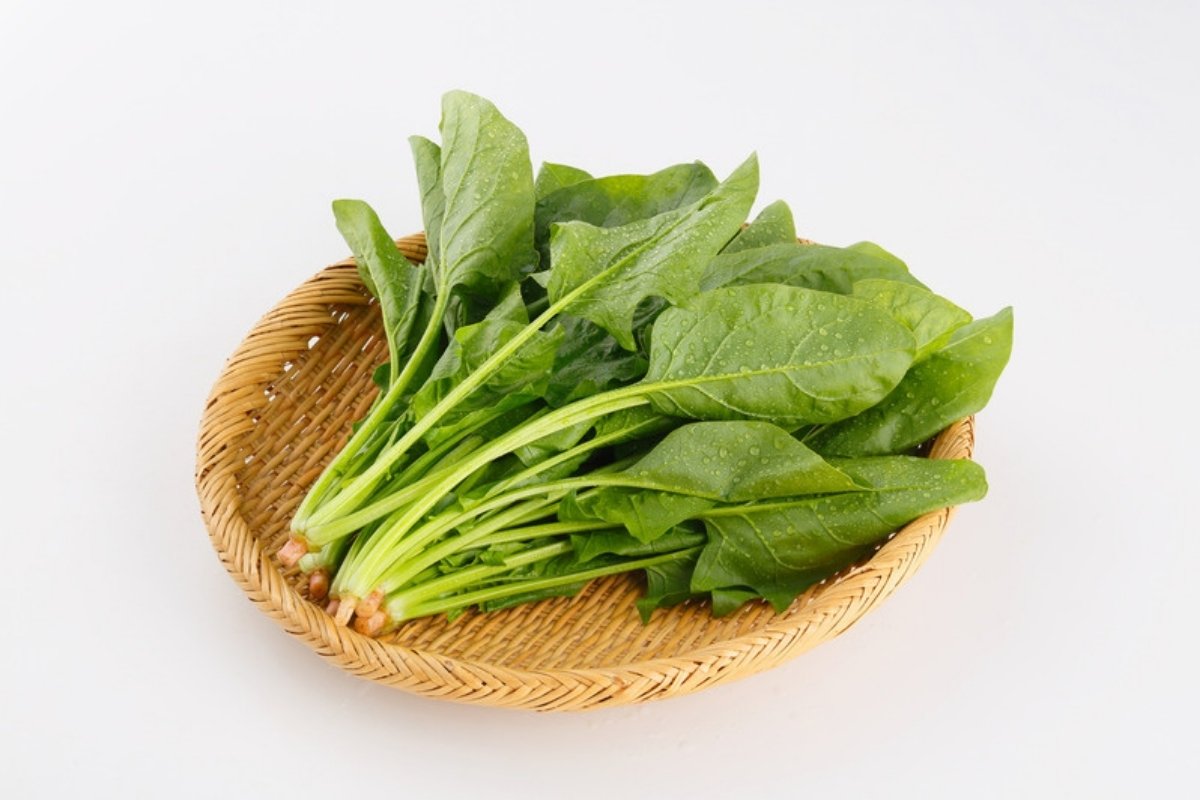
A 50 g salad of raw spinach supplies more than three times the reference value for vitamin K.
Nutrient claims
Under EU Regulation 1924/2006, a food may be described as a source of a vitamin or mineral when it provides at least 15% of the reference value per 100 grams, and as high in it when it provides at least twice that. Based on values per 100 grams, raw spinach meets the high condition for vitamin K, folate, vitamin A, vitamin C and manganese, and the source condition for potassium, magnesium and iron. For calcium, vitamin B6 and riboflavin, the amounts fall below the threshold.
Iron and the Popeye myth
Spinach became famous as a source of iron, mainly thanks to Popeye. It's 2.7 mg of iron per 100 grams, which is respectable for a vegetable, but spinach does not stand out as an iron source, and researcher Mike Sutton describes it as a poor source of absorbable iron.
The story behind that reputation is itself a lesson in scientific myth-making. For decades, the explanation circulated that a misplaced decimal point in 19th-century analyses had inflated spinach's iron content tenfold. In 2010, Sutton showed that the decimal-point story was spread by nutritionist Arnold Bender in 1972 and by a humorous 1981 article in the British Medical Journal, without evidence. According to McGill University's Office for Science and Society, early analyses overstated the iron content due to methodological errors rather than a decimal point, and the correct value was known before Popeye was created. The debate is not entirely closed, and some still dispute Sutton's conclusions. The most unexpected finding is that in a 1932 comic strip, Popeye himself explains that he eats spinach because it is full of vitamin A, not iron.
Precautions
Vitamin K and blood thinners
Vitamin K is involved in blood clotting, and spinach is one of its richest sources. According to the NIH Office of Dietary Supplements, people taking warfarin or similar anticoagulants need to keep their vitamin K intake consistent because sudden changes can increase or decrease the medicine's effect. Spinach is not off the menu. The amount stays roughly the same from day to day, and any major dietary change is discussed with a doctor first.
Nitrates in young children's diets
Spinach, like lettuce and other leafy vegetables, naturally contains high levels of nitrate, especially when grown under cover or in low light. In the body, nitrate is converted to nitrite, which, at high levels, can cause methaemoglobinaemia, a condition that reduces the body's oxygen supply.
According to the European Food Safety Authority (EFSA), nitrate levels in spinach are not of health concern for most children. In infants and children aged 1 to 3 who eat large amounts of spinach with high nitrate levels, however, a risk of methaemoglobinaemia cannot be excluded, and Regulation (EU) No 1258/2011 notes that the risk mainly concerns infants who eat more than one spinach meal a day. For this reason, the EU has set maximum nitrate levels of 3,500 mg/kg for fresh spinach and 2,000 mg/kg for frozen or preserved spinach. For feeding infants, a paediatrician's guidance is the safest course.
Oxalates and kidney stones
Spinach is one of the foods high in oxalates. For most people, this is not a problem, but those who have formed calcium oxalate stones or have high oxalate levels in their urine may need to limit these foods, always under their doctor's advice. According to Alberta Health Services in Canada, calcium-rich foods at the same meal, such as milk, yoghurt or cheese, reduce oxalate absorption.
Frequently asked questions
How many calories are in spinach
100 grams of raw spinach provide just 23 kcal, because they contain more than 91 grams of water. A salad with 50 grams of spinach provides about 12 kcal.
What vitamins does spinach contain?
Spinach is exceptionally rich in vitamin K, at 644% of the reference value per 100 grams, and rich in folate, vitamin A and vitamin C. It also contains significant amounts of manganese, potassium and magnesium.
Is spinach high in iron?
It has 2.7 mg per 100 grams, which is respectable for a vegetable, but spinach does not stand out as an iron source. Its reputation is largely a myth, and Popeye himself ate spinach for its vitamin A.
Can babies eat spinach?
According to EFSA, nitrate in spinach is not a concern for most children. In infants and children aged 1 to 3 who eat large amounts of spinach with high nitrate levels, the risk of methaemoglobinaemia cannot be excluded, so guidance from a paediatrician is the safest course.
Can I eat spinach if I take blood thinners?
Yes, as long as the amount stays consistent from day to day, because sudden changes in vitamin K affect how warfarin works. Discuss any major dietary change with your doctor.
Does spinach cause kidney stones?
Spinach is high in oxalates, which matters for people who have formed calcium oxalate stones. For most people, it is not a problem, and pairing it with calcium-rich foods reduces oxalate absorption.
Important notes
The health information in this article is for general awareness and does not replace medical advice.
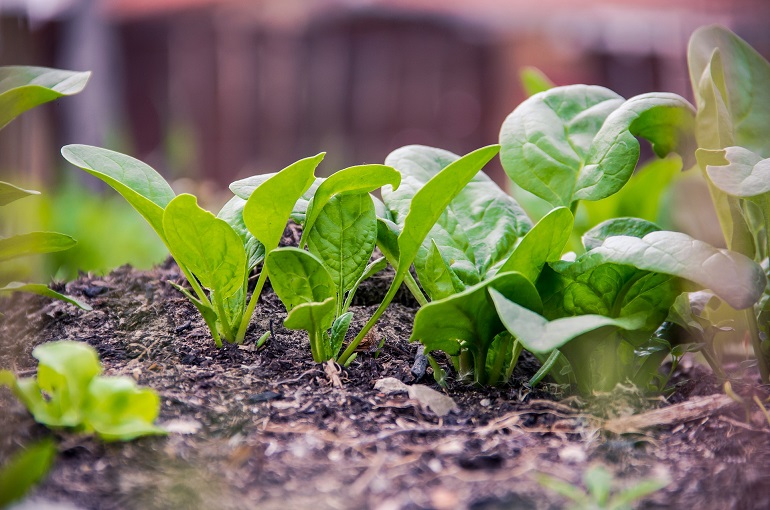
Growing spinach in the garden and in pots is one of the easiest projects in the winter vegetable garden, with fresh leaves from autumn to spring.
References
- USDA FoodData Central, Spinach, raw.
- Food Safety Authority of Ireland, Regulation (EU) 1169/2011, Annex XIII, reference intakes.
- Regulation (EC) No 1924/2006 on nutrition and health claims made on foods.
- EFSA, EFSA assesses possible health risk for children from nitrate in leafy vegetables, 2010.
- Regulation (EU) No 1258/2011 on maximum levels for nitrates in foodstuffs.
- NIH Office of Dietary Supplements, Vitamin K, fact sheet for health professionals.
- Alberta Health Services, Limit foods high in oxalates.
- McGill Office for Science and Society, Setting the facts straight about iron in spinach, 2017.
- Sutton M., Spinach, iron and Popeye, ironic lessons from biochemistry and history, Internet Journal of Criminology, 2010.