


Food recalls in Europe: Week 12, 2026
Your weekly food recall & compliance tracker — Week 12 (16–22 March 2026)
Mycotoxin alerts jumped from 10 to 23 between consecutive weeks. That is the sharpest single-week increase in any hazard category since autumn 2025, and it was driven by two products: Turkish dried figs (9 alerts for ochratoxin A and aflatoxin B1 across fig paste, fig balls, and whole figs) and Argentine groundnuts (3 aflatoxin alerts).
The Argentine groundnut findings are tied to a regulatory change: in 2023, the European Commission removed Argentine peanuts from its list of high-risk imports requiring extra border checks (Regulation (EU) 2019/1793). Three aflatoxin B1 alerts in one week from one origin suggests the risk did not disappear with the inspections.
Highlights at a glance
- 108 total RASFF notifications: down from 119 the week before
- Fruits and vegetables led with 31 alerts (28.7%), the highest produce count in March so far
- Mycotoxins surged to 23 hazard mentions, up from 10 the previous week — Turkish figs (9 alerts) and Argentine peanuts (3) drove the jump
- Pesticide residues remained at 46 mentions, roughly flat versus last week's 40
- 9 allergen labelling failures in a single week, with undeclared soy the most frequent offender (3 alerts)
- Salmonella appeared in 12 alerts: Poland (3 poultry), Romania (3 poultry), Lithuania (2), and others
- Turkey led all origins with 12 alerts, followed by Poland (8), Spain (8), France (7), and China (6)
- Ethylene oxide returned in Lebanese spices (2 alerts), echoing the EU-wide contamination crisis that began in 2020
- EU member states originated 47% of all notifications (51 of 108)
Top product categories
Fruits and vegetables rose from 26 to 31 alerts. Pesticide residues accounted for most of them, but the category also included 9 mycotoxin alerts (all Turkish figs), one norovirus finding in frozen raspberries from Poland, and cadmium in garlic from China and in avocados from Peru.
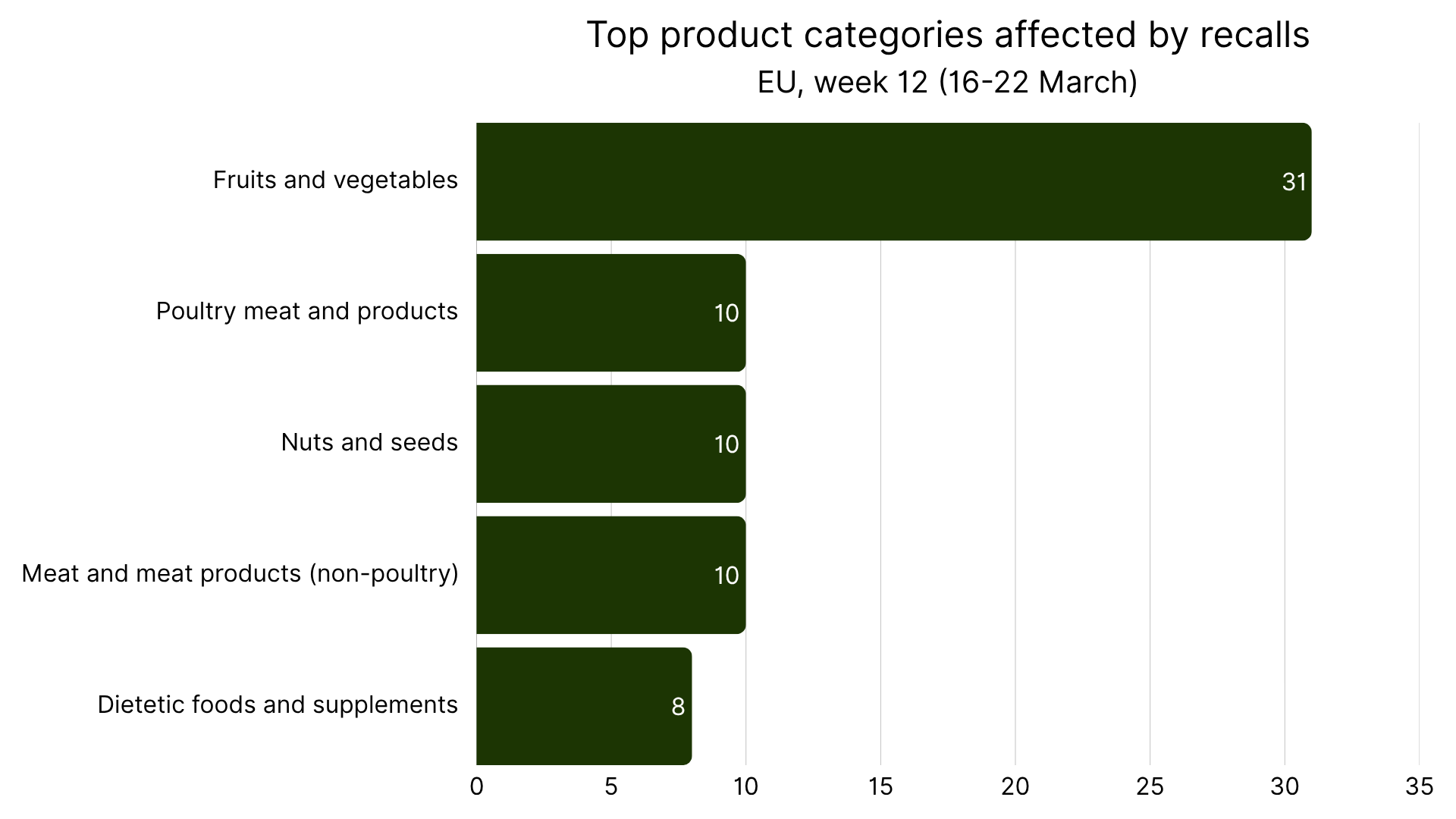
The nut category's 10 alerts were almost entirely mycotoxin-driven, with 7 involving aflatoxins in peanuts, pistachios, hazelnuts, or chia seeds. Non-poultry meat included Salmonella in beef (Lithuania), Listeria in cured meats (Spain, Netherlands), hormone residues (progesterone) in beef from Argentina and Uruguay, and allergen labelling errors.
Argentine peanuts and the question of relaxed controls
Three of last week's 10 nut/seed alerts were aflatoxin contamination in Argentine groundnuts. Argentina supplies roughly 58% of the peanuts consumed in the EU. In 2023, the European Commission removed Argentine peanuts from Regulation (EU) 2019/1793, which had required increased border checks on high-risk commodities. The logic was that Argentina's compliance record had improved enough to justify reducing official sampling.
Since that decision, aflatoxin detections in Argentine peanuts have relied entirely on importer self-monitoring rather than systematic border controls. Last week's three alerts (two from Argentina directly, one from US-origin pistachios transiting through Turkey) suggest the aflatoxin risk has not diminished, even if official border sampling has.
Turkish figs and what sits behind the numbers
Mycotoxin mentions jumped from 10 to 23 between consecutive weeks. Turkish dried figs made up 9 of those 23 alerts: 7 for ochratoxin A, 1 for aflatoxin B1, and 1 carrying both. The products included whole dried figs, fig paste, and fig balls.
Turkey's dried fig industry has been under pressure from both sides: a poor 2024/2025 harvest (roughly 60,000 metric tonnes, well below the five-year average of 74,500 M) reduced supply, while drought and humidity in the Aydın growing region created ideal conditions for Aspergillus and Penicillium growth.
Nine allergen labelling failures in one week
Last week recorded 9 allergen-related alerts. Soy (undeclared in whey protein, beef products, and food supplements from Germany, Sweden, and Romania), sesame, sulphur dioxide (in fruit blends from Italy and dried figs from Afghanistan), and general labelling errors in poultry (France) and confectionery (Italy).
The European Commission launched its 2026 food safety communication campaign in February, with allergens as the first topic. The campaign is tied to a broader regulatory push: the EU is preparing harmonised precautionary allergen labelling (PAL) rules, expected by Q4 2027, which will standardise how "may contain" warnings are assessed and displayed. The Netherlands already adopted a risk-assessment-based PAL framework on January 1, 2026.
Soy appeared in 3 of the 9 alerts. Soy protein is increasingly used as a filler or processing aid in meat products, protein supplements, and bakery items, and it frequently goes undeclared because manufacturers treat it as a minor ingredient rather than a mandatory allergen declaration.
Ethylene oxide in Lebanese spices: an old crisis, still alive
Two alerts flagged ethylene oxide in spices from Lebanon. Ethylene oxide has been banned in the EU for use on food since the early 1990s. In September 2020, contaminated sesame seeds from India triggered the largest food recall operation in EU history — over 3,862 RASFF notifications to date. The EU responded with 50% sampling rates on Indian sesame and mandatory monitoring across multiple spice categories.
Lebanon had not been a prominent origin in the ethylene oxide crisis. The two alerts last week (one also carrying chlorate and ethion residues) may indicate either direct fumigation with ethylene oxide during storage or cross-contamination from treated commodities in shared warehouse space. For spice importers, ethylene oxide testing is already standard on Indian-origin products, but last week's data argues for extending it to Middle Eastern spice origins as well.
Complete fresh produce recall list
Fruits and vegetables (31 alerts)
- Oranges (Egypt): oxamyl (unauthorised)
- Frozen raspberries (Poland): norovirus
- Peppers (Rwanda): acetamiprid [2 separate alerts]
- Medlar/mispen (Italy): tetramethrin, permethrin (unauthorised)
- Grape leaves (Egypt): unauthorised pesticides
- Mandarins (Spain): chlorpyrifos (unauthorised)
- Pomegranates (Turkey): prochloraz above MRL
- Chinese cabbage (Poland): chlorpyrifos (unauthorised), tebuconazole
- Pomegranates (Turkey): acetamiprid
- Garlic (China): cadmium
- Strawberries (Spain): formetanate
- Rambutan (Vietnam): chlorantraniliprole, indoxacarb
- Bananas (Ecuador): chlorpyrifos (unauthorised)
- Bananas (Peru): chlorpyrifos (unauthorised)
- Olives in brine (Egypt): chlorpyrifos (unauthorised)
- Green beans and amla (India, Sri Lanka): chlorpyrifos (unauthorised), buprofezin, other residues
- Aubergines (Burkina Faso): chlorpyrifos (unauthorised), profenofos (unauthorised)
- Frozen edamame (China): haloxyfop (unauthorised), bifenthrin, iprodione
- Peppers (Egypt): profenofos (unauthorised)
- Pomegranates (Turkey): malathion, pyraclostrobin, pyrimethanil, sulfoxaflor, pyriproxyfen
- Amaranthus (Togo): acetamiprid, imidacloprid
- Avocado (Peru): cadmium
- Dead mice in green beans (Netherlands)
- Dried prunes (Serbia): sorbic acid (too high)
- Pineapples (Brazil): unauthorised surface coating
- Fig paste (Turkey): ochratoxin A
- Dried figs (Turkey): ochratoxin A, aflatoxin B1 [multiple separate alerts]
- Dried figs (Afghanistan): undeclared sulphur dioxide
- Red kapia peppers (Turkey): cadmium
- Freeze-dried strawberries (China/Egypt): oxamyl (unauthorised)
- Fruit/berry blends (Italy): undeclared sulphur dioxide
- Lupins (Italy): quinolizidine alkaloids
- Bracken fern (South Korea): unauthorised novel food
Herbs and spices (4 alerts)
- Spices (Lebanon): ethylene oxide [2 separate alerts]
- Matcha tea (Japan): difenoconazole, dinotefuran, tolfenpyrad
- Chilli flakes (India): aflatoxin B1
Nuts, nut products and seeds (10 alerts)
- Groundnuts (Argentina): aflatoxin B1 [3 separate alerts, 2 with total aflatoxins]
- Pistachios (USA via Turkey): aflatoxin B1, total aflatoxins
- Black chia seeds (India via Italy): aflatoxin B1
- Sesame seeds (Turkey): Salmonella
- Hazelnuts (Azerbaijan): aflatoxin B1
- Cumin seed (India via Turkey): missing health certificate
- Sunflower seed kernels (Poland/Ukraine): tetramethrin (unauthorised)
Cereals and bakery products (3 alerts)
- Flat bread (Netherlands): metal foreign body
- Quinoa (India via Turkey): chlorpyrifos (unauthorised)
- Wafer rolls (Egypt): skipped border veterinary controls
Cocoa, coffee and tea (1 alert)
- Green tea (China): dinotefuran, tolfenpyrad
Top 5 hazards
Pesticides held the top spot for the third consecutive week. Pathogenic micro-organisms dropped to 17 from 30, with Salmonella declining from 20 to 12 — a week-on-week improvement, though Poland and Romania continued to generate most of the poultry alerts.

Where recalled products come from
Turkey led all origins with 12 alerts, split between dried fig mycotoxins (9) and fresh produce pesticide residues (3 — pomegranates and peppers). Poland and Spain tied at 8 each. Poland's alerts were concentrated in poultry Salmonella and frozen produce, while Spain's spread across Listeria in cured meats, parasites in seafood, formetanate in strawberries, and acrylamide in snack products.

France appeared mostly for labelling and allergen failures in prepared foods.
Argentina generated 5 alerts: 3 for aflatoxin in groundnuts, 1 for titanium dioxide in confectionery, and 1 for non-approved GMO soybean meal (feed). The groundnut cluster connects directly to the 2023 decision to relax border controls.
Rwanda appeared for the second consecutive week with 2 pepper alerts for acetamiprid. Rwanda's chilli pepper exports to the EU have more than doubled since 2020, reaching roughly 1,100 tonnes by 2023 and capturing 13% of Germany's fresh chilli market. The EU increased controls on Rwandan peppers in December 2024 due to pesticide concerns, and last week's data shows those concerns remain justified. For a country actively building its EU horticultural export programme with EU-funded capacity support, getting the pesticide residue issue under control is commercially urgent.
Outlook
Mycotoxins going from 10 to 23 in one week raises a practical question for anyone buying dried figs, groundnuts, or dried fruit right now: Is this a spike or a new baseline?
The Turkish figs generating these alerts were harvested in 2025, dried under drought and humidity stress, and stored through a difficult winter. That inventory is still moving through EU distribution. Until the 2026 harvest enters the supply chain later this year, buyers should expect ochratoxin A and aflatoxin B1 to keep appearing at elevated rates in Turkish figs.
For Argentine peanuts, the answer depends on whether the EU revisits its 2023 decision to drop mandatory border checks; three aflatoxin alerts in a single week from one origin is the kind of data that tends to reopen those conversations.