A practical guide to EU and US mango standards for growers and traders
Mangoes (Mangifera indica L.) are among the world's most traded tropical fruits, valued for their sweetness, aroma, and vibrant colour. But beyond taste, mango trade relies on strict quality standards that determine whether the fruit can be sold in domestic or export markets.
Understanding these standards is key for farmers, exporters, and importers, especially those targeting the EU or U.S. markets, where inspection systems are rigorous and non-compliance can lead to rejection.
This article summarizes the latest UNECE, Codex, and USDA mango standards, focusing on quality classes, maturity, size, packaging, and export requirements, helping you meet buyer expectations and strengthen your market position.
What defines a quality mango
To qualify for export, mangoes must meet minimum quality criteria defined by UNECE (FFV-45 2023), Codex (CXS 184-1993), and U.S. grade standards.
A high-quality mango must be:
- Sound and intact – free from rotting, cracks, or unhealed injuries
- Clean – practically free from dirt, sap stains, or pesticide residues
- Firm but not hard – capable of ripening evenly after harvest
- Properly shaped and typical of the variety
- Free from pests, damage, or black trails under the skin
- Free from abnormal external moisture or foreign odour
These characteristics ensure that fruit maintains flavour, visual appeal, and shelf life from orchard to retailer.
Maturity and ripeness
Mangoes must be harvested mature but not overripe, allowing the ripening process to continue naturally during transport.
|
Region |
Maturity indicators |
Notes |
|
EU |
Must allow further ripening; colour and firmness depend on variety |
Exporters often use °Brix 14–16 % and dry matter ≥ 14 % as practical guides |
|
USA |
“Mature” means capable of proper ripening and flavour development |
Overripe fruit yield to slight pressure and are rejected |
For common varieties like Haden, Keitt, Tommy Atkins, and Kent, mature fruit displays glossy skin with light brown lenticels.
To assess maturity, inspectors often cut mangoes parallel to the seed. For Haden and Keitt varieties, at least 50% of pulp volume on each half should show at least pale yellow color, with remaining flesh displaying light yellow (not white). For Tommy Atkins and Kent, all pulp must show minimum light cream color, white flesh indicates immaturity. Immature mangoes score as serious damage against all grades.
If you’d like to explore practical cultivation techniques, orchard management tips, and postharvest best practices, visit our dedicated section: Mango Cultivation and Management Guides
Stem trimming
U.S. standards permit stems to extend up to 1 inch (2.54 cm) beyond the attachment point, while the Codex limits stems to 1.0 cm. This tighter Codex specification means mangoes prepared for markets following Codex standards need more careful stem trimming.
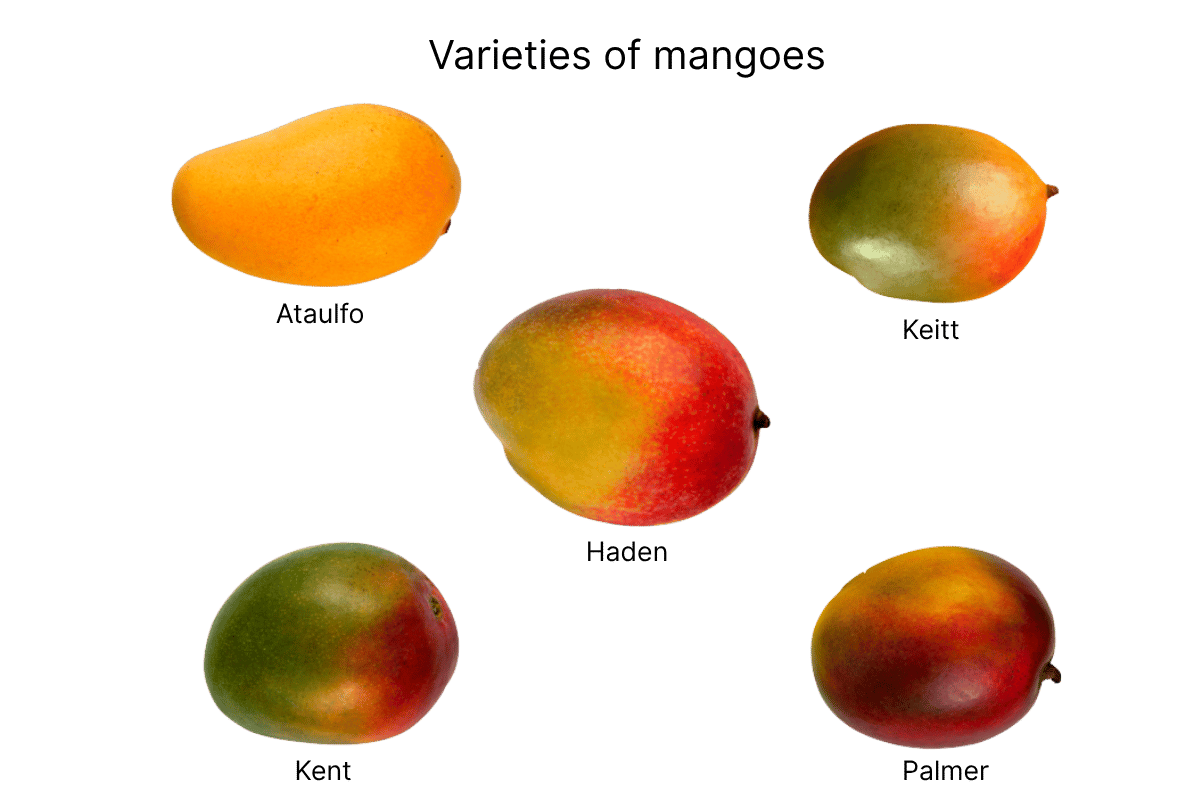
Visual guide of different mango varieties
Mango classification
Both EU and Codex systems use three quality classes; the U.S. follows its own grading but parallels them closely.
|
Class / Grade |
Description |
Allowed surface defects |
|
Extra Class / U.S. Fancy |
Superior fruit, uniform, well-formed, characteristic colour |
Only very slight superficial marks |
|
Class I / U.S. No. 1 |
Good quality, typical shape and colour |
Minor rubbing or sunburn; resin stains ≤ 3–6 cm² (size-dependent); slight bruising |
|
Class II / U.S. No. 2 |
Marketable fruit with visible imperfections |
Defects ≤ 5–8 cm²; moderate bruising or yellowing ≤ 40 % surface |
Tolerance limits:
- Extra Class: 5 % of fruit may meet Class I
- Class I: 10 % may meet Class II
- Class II: 10 % may fall below minimum but not decayed
Mango sizing systems explained
Most international mango trade uses a weight-based classification system with four primary size codes:
|
Size Code |
Weight (g) |
Max difference (g) |
|
A |
100 – 350 |
75 |
|
B |
351 – 550 |
100 |
|
C |
551 – 800 |
125 |
|
D |
> 800 |
150 |
The Count-per-box system
Commercial mango trade frequently uses a count-per-box designation, particularly for the standard 4kg cardboard carton. The "count" indicates how many mangoes fill a 4kg box:
Size 6-7 (6-7 mangoes per 4kg box) finds favour in the German market, where consumers prefer larger individual mangoes. These fruits weigh approximately 570-665 grams each.
Size 7-8 (7-8 mangoes per 4kg box) is the preferred commercial size in the Netherlands, the United Kingdom, and France. This translates to approximately 500-570 grams per mango, a size that balances consumer preference, handling efficiency, and pricing.
Size 9-10 and smaller represents the point where market prices typically begin to adjust, as smaller fruit generally commands lower prices, even when quality matches that of larger sizes.
Notably, U.S. standards don't specify size requirements, providing American buyers and sellers with more flexibility. Mangoes are commonly marketed by count per 4 kg carton (6–12 fruit).
Uniformity within a package is crucial, as weight variation should not exceed ±10 %.
And if you’re looking to source or sell high-quality mangoes directly, explore our global trading platform: Buy and sell mangoes on Wikifarmer marketplace
Packaging standards and best practices
Proper packaging protects mangoes during transport while meeting regulatory requirements and buyer expectations.
Standard packaging formats
The 4kg cardboard carton is the industry standard for mango packaging. These boxes come in two primary configurations:
Single-layer cartons arrange mangoes in one layer, with each fruit visible when the box is opened. Pack tightness is important. "Very tight" packing should be avoided as it causes bruising in ripe fruit, while "tight" packing allows no movement. "Fairly tight" permits only slight fruit movement, while "slack" allows free movement and must be specified in inches of movement.
Volume-filled cartons stack mangoes without strict layering. "Well filled" means contents have little or no movement and are packed within 1 inch (~2.5 cm) of the container top. "Fairly well filled" allows some movement with fruit not more than 2 inches (~5 cm) below the top edge. "Slack" describes loose fruit more than 3 inches (~7.5 cm) below the top edge and must be quantified.
Packaging materials requirements
The materials used inside packages must be clean and of quality sufficient to avoid causing external or internal damage. Paper or stamps bearing trade specifications are allowed provided printing or labeling uses non-toxic ink or glue. Stickers individually affixed to fruit must not leave visible glue traces or cause skin defects when removed. Information lasered on a single fruit should not lead to flesh or skin defects.
Materials must be either new or recycled, of food-grade quality. Packages or lots of produce presented in bulk must be free of all foreign matter and smell.
Protective coatings and shelf-life extension
Several coating options help protect fruit and extend shelf life:
Traditional coatings include beeswax (white or yellow), carnauba wax, shellac, and microcrystalline wax. When supplying organic mangoes, coatings must also be organic, such as organic beeswax or carnauba wax.
Innovative technologies are emerging to further extend mango shelf life. Apeel, a plant-based protection, keeps moisture in fruit while slowing oxygen influence and spoilage rate. Another solution is the use of 1-MCP (1-methylcyclopropene) technology to reduce the respiration rate and increase ethylene resistance. Note that Europe has an MRL for 1-MCP of 0.01mg/kg, though it's difficult to detect as a residue. However, the use of 1-MCP can be detected by recently developed tests.
Research also explores natural coating alternatives, such as Aloe vera and chitosan, which can prolong mango shelf life to 40 days compared to 30 days without treatment when combined with cold storage.
Labeling requirements
Each package must bear specific information:
- Identification: Packer and/or dispatcher/exporter name and physical address (street/city/region/postal code). If different from country of origin, include the country. Code marks officially recognized by national authorities may be used if the country is listed in the UNECE Code Mark Registry.
- Nature of produce: "Mangoes" if contents aren't visible from outside, plus variety name (optional but recommended).
- Origin: Country of origin and optionally, district where grown, or national, regional, or local place name.
- Commercial specifications: Class, size (expressed as minimum and maximum weight, size code, or number of fruit).
For consumer packages (pre-packaged retail), additional requirements follow the Codex General Standard for the Labelling of Prepackaged Foods and EU Regulation No. 1169/2011.
Export considerations: Meeting phytosanitary requirements
Phytosanitary compliance is non-negotiable for mango exports, particularly regarding fruit flies.
To import mangoes into Europe, a phytosanitary certificate is required. The European Directive EU 2019/523 mandates certificates include one of the following statements:
- Fruits originate in a country recognized as free from Tephritidae (fruit flies) (non-European)
- Fruits originate in an area established by the national plant protection organization as being free from Tephritidae (non-European)
- No signs of Tephritidae have been observed at the place of production and its immediate surrounding since the beginning of the last complete cycle of vegetation, including official inspections at least monthly during the 3 months before harvesting and on harvested fruit. Traceability information must be indicated on certificates.
- The product has been subjected to an effective treatment to ensure freedom from Tephritidae. Treatment data should be indicated on certificates.
This requirement places significant pressure on plant health authorities in producing countries. If local authorities aren't sufficiently equipped for phytosanitary control, it affects export potential to Europe.
Hot water treatment
While mango exports to the U.S. must be hot water treated, this doesn't yet apply to EU exports. However, hot water treatment is one of the most effective methods for preventing fruit fly development and is widely used globally. Treatment typically involves immersing fruit in hot water at specific temperatures for specific durations, disrupting the life cycle of fruit fly larvae while not damaging fruit quality.
Some varieties and maturity stages tolerate hot water treatment better than others. Sunken areas with underlying flesh discoloration affecting the stem end/shoulders have been attributed partly to immature mangoes and specific varieties that cannot withstand hot water treatment.
Storage and ripening management
Proper post-harvest handling is essential for mangoes to reach consumers in prime condition. Storage temperature, humidity, and atmosphere must be adjusted to fruit maturity and variety.
|
Condition |
Recommended Temperature |
Relative Humidity |
Shelf Life (Approx.) |
Purpose / Notes |
|
Mature green mangoes |
10–13 °C (50–55 °F) |
85–90 % |
14–28 days |
Slows respiration and ripening; suitable for export and storage prior to ripening. |
|
Ripe mangoes |
7–8 °C (44.6–46.4 °F) |
85–90 % |
Short-term (retail level) |
Maintains eating quality; not ideal for long transport. |
|
Controlled atmosphere (CA) storage |
3–6 % O₂ + 3–10 % CO₂ at 7–9 °C (44.6–48.2 °F) |
≈ 90 % |
— |
Slows ripening and reduces decay; cost-effective mainly for premium or long-distance shipments. |
Common defects affecting grading
Defects that downgrade fruit include:
- Bruising or sap-burn from rough handling
- Sunburn or resin streaks beyond allowed surface area
- Chilling injury (skin darkening below 10 °C)
- Anthracnose spots (fungal)
- Shape deformities or asymmetry
For a detailed explanation of common defect types, you can explore Common mango quality defects.
Global mango trade and market outlook (2023–2025)
United States
The U.S. remains one of the world's largest mango importers, with a strong and growing consumer base. In 2023, the National Mango Board reported that U.S. imports of fresh mangoes reached 554.2 thousand metric tons (TMT), valued at US$571.4 million. Imports were highly concentrated among five countries, which together accounted for 96.9% of the total: Mexico (372.5 TMT), Peru (77.2 TMT), Brazil (48.3 TMT), Ecuador (21.3 TMT), and Guatemala (17.1 TMT).
However, 2024 brought a temporary contraction. During the first five months of the year, U.S. mango imports dropped by 22% compared with the same period in 2023, mainly due to a 71% decline in shipments from Peru following adverse weather and production setbacks, and a 5% decline from Mexico. For the week ending on April 27, 2024, shipments totalled about 4.06 million boxes, with Mexico supplying roughly 3.53 million and Guatemala 0.48 million boxes.
Despite these fluctuations, long-term indicators remain positive. Since 2019, the import value of fresh mangoes to the U.S. has risen by about 32%, reflecting both strong demand and rising prices. The main takeaway for exporters is clear: while the U.S. mango market continues to expand in value, exporters must prioritise consistent supply, quality control, and reliable logistics to mitigate the impact of seasonal disruptions.
European Union
The EU also represents a key destination for mango exporters, though recent data show a moderation in import volumes. In 2024, the EU imported about 487,000 tons of mangoes, mangosteens, and guavas, valued at approximately US$1.1 billion, a decline from previous years.
Imports were concentrated in five countries that together made up around 86% of total EU mango imports:
- Netherlands (~149,000 tons)
- Spain (~76,000 tons)
- Germany (~70,000 tons)
- France (~49,000 tons)
- Portugal (~46,000 tons)
The Netherlands remains the primary entry hub, re-exporting significant volumes across the continent. Spain, on the other hand, has become both an importer and producer, supplying neighbouring markets and strengthening its domestic industry.
For exporters and farmers, targeting major EU trade hubs, such as the Netherlands, Spain, and Germany, remains a strategic approach. However, slower volume growth and strong competition mean that quality differentiation, traceability, and compliance with EU phytosanitary standards are critical to sustain margins.
Global trends and export dynamics
At the global level, the mango industry continues to expand steadily. The Business Research Company estimates the global mango market size to be US$67.4 billion in 2024, projected to reach US$73 billion by 2025 (CAGR ~7.4%). Meanwhile, international trade data shows global exports of fresh mangoes, mangosteens, and guavas rising by 6.7% in 2024 to approximately 2.6 million tonnes.
Mangoes accounted for about 85% of total global shipments, followed by mangosteens (15%). Export growth was primarily driven by Thailand, Ecuador, and Egypt, while traditional suppliers like Mexico, Peru, and Brazil experienced mixed results.
- Mexico, the world's leading exporter, saw shipments fall by 7.7% to 440,000 tonnes, largely due to drought and logistical limitations. Around 90% of its exports went to the United States, and 9% to Canada. Despite reduced volumes, the average export price to the U.S. rose 20% in 2024, reaching US$1,471 per tonne, supported by strong demand.
- Thailand, the top mangosteen exporter, increased shipments by 11.7% to 410,000 tonnes, mainly to China, which absorbed around 60% of Thai exports at premium prices.
- South American suppliers collectively exported 510,000 tonnes, up 2.6% year-on-year, driven by Ecuador's surge of +160% to 70,000 tonnes, while Peru (-9.8%) and Brazil (-2.9%) faced weather and logistics challenges.
- Egypt emerged as a growing player, expanding its exports by nearly 40% to 170,000 tonnes, mainly to Jordan, Saudi Arabia, Russia, and the UAE.
On the import side, total global volumes of mangoes, mangosteens, and guava grew by 2.7% to 2.3 million tonnes in 2024. The U.S. (24%) and EU (15%) remained the top importers, followed by China (13%), where demand for mangosteen continues to rise. Other important markets include Saudi Arabia and the United Arab Emirates, reflecting growing consumption in the Middle East.
Indicative wholesale prices in the U.S. market for 2024 ranged between US$1.77 and 4.42 per kilogram, averaging US$2.86/kg, 27% higher than in 2023. This upward price trajectory confirms robust consumer demand despite supply fluctuations.
Closing remarks
The mango trade illustrates how post-harvest precision defines market success. From orchards in Michoacán and Piura to supermarket shelves in Rotterdam and Paris, international standards form a shared language of quality, defining how fruit are graded, packed, and valued.
For growers and exporters, mastering these standards means fewer rejections, higher prices, and stronger access to premium markets.
Sources
- Shipping Point and Market Inspection Instructions
- United States Standards for Grades of Mangos
- UNECE STANDARD FFV-45: Mangoes
- STANDARD FOR MANGOES (CODEX STAN 184-1993)
- Entering the European market for mangoes
- FAO: Major Tropical Fruits Market Review 2024
- Storage behavior of mango as affected by post harvest application of plant extracts and storage conditions
- Prolonging the Shelf Life and Marketing Period of Mango Fruit by Using Edible Coating and Cold Storage
- Regulation (EU) No 1169/2011 on the provision of food information to consumers — EUR-Lex