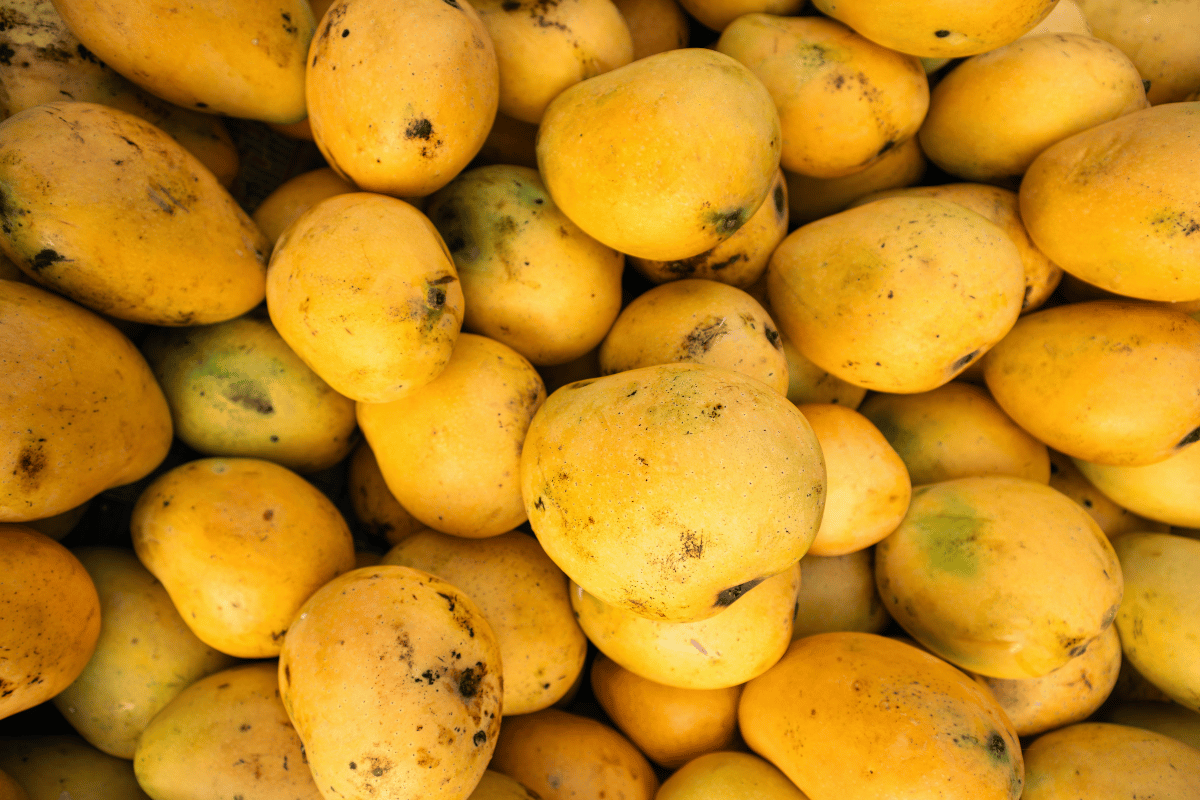
Mango quality standards set strict limits for visible and internal defects that determine whether the fruit qualifies for export or retail sale. These standards are enforced by authorities such as the USDA, UNECE, and Codex Alimentarius.
Surface defects and skin damage
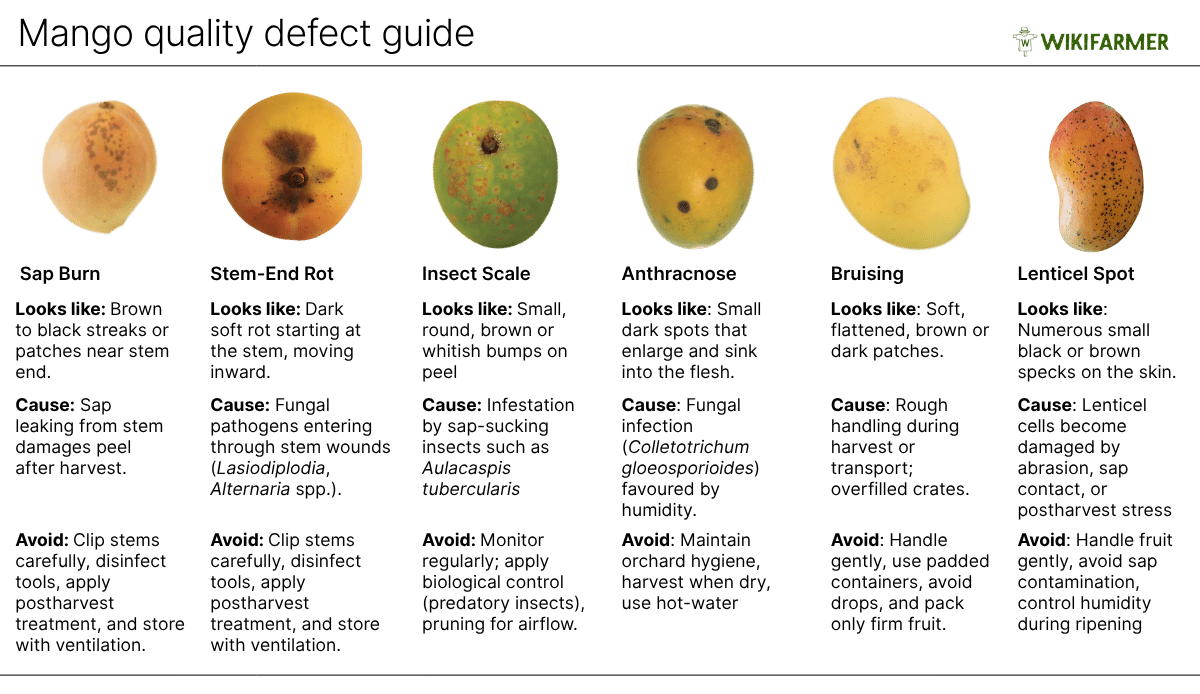
Bruising is one of the most common defects assessed during mango grading.
- Injury: surface indentation with flesh discolouration deeper than 1/8 inch (~0.3 cm) and wider than 1/2 inch (~1.3 cm).
- Damage: bruising deeper than 1/4 inch (~0.6 cm) and over 3/4 inch (~1.9 cm) in diameter.
- Serious damage: discolouration deeper than 1/2 inch (~1.3 cm) and wider than 1 inch (~2.5 cm).
External surface discolouration results from various causes, including sap leakage from freshly cut stems, diseases, or abrasions. Some varieties, like Haden, naturally display pinhead-size black spotting that shouldn't be scored as a defect. Discolouration is scored as an injury when it affects more than 5% of the fruit's surface, damage when it exceeds 15%, and serious damage when it exceeds 25%.
Scars and russeting are evaluated based on colour, roughness, depth, and area. Light-coloured smooth scarring that affects more than 5% of the surface constitutes injury, while dark, rough, or scaly scarring that affects more than 2.5% of the surface also qualifies as injury. Damage and serious damage levels have proportionally higher thresholds.
Skin breaks, defined as ruptures of the fruit's external epidermal tissue, are evaluated as follows:
- Injury: unhealed breaks, or healed breaks exceeding ¼ inch (~0.6 cm) in length or diameter.
- Damage: breaks that extend into the flesh, or healed breaks exceeding ½ inch (~1.3 cm).
- Serious damage: ruptures that penetrate the flesh deeply, or breaks exceeding 1 inch (~2.5 cm).
For EU standards, Class I allows slight skin defects due to rubbing or sunburn, as well as suberized stains from resin exudation (including elongated trails), not exceeding 3-6 cm² in size groups A, B, C, and D, respectively. Class II permits these defects up to 5-8 cm² for the respective size groups.
Internal defects and breakdown disorders
Internal defects are less visible but are often the reason fruit is rejected upon cutting or ripening tests. Any internal discolouration is considered an injury. Damage applies when discoloured areas exceed 0.75 inch (~1.9 cm), and serious damage when larger than 1.5 inch (~3.8 cm) in diameter.
Common internal disorders
- Jelly-seed: flesh around the seed turns translucent and jelly-like due to premature ripening and uneven calcium distribution.
- Soft-nose: overripe or spongy tissue at the blossom end, frequently linked to low calcium or irregular ripening temperatures.
- Spongy tissue (Alphonso type): localised patches of corky tissue that fail to ripen, commonly seen in Indian cultivars.
All these are scored as serious damage since they significantly impair eating quality.
Pest-related issues
Freedom from pests is crucial for international trade, particularly regarding fruit flies (Tephritidae family), which pose significant quarantine concerns for many importing countries. Under U.S. standards, any insects present or any feeding injury evident on fruit is scored as injury. Damage occurs when insects are present or when feeding injury aggregates an area exceeding 1/2 inch in diameter. Serious damage involves insect presence or feeding injury exceeding 1 inch in diameter.
Phytosanitary certification requirements
For European exports, phytosanitary certificates must include specific statements addressing fruit fly status. These statements either confirm: the fruit originates from an officially designated pest-free area, the results of an inspection showing no pest presence, or documentation of effective treatments applied to disinfest the fruit.
The European Union maintains strict surveillance through its EUROPHYT interception notification system, actively monitoring for pest infestations in imported consignments. Mangoes found infested upon arrival face destruction at the exporter's expense, creating strong financial incentives for rigorous pre-shipment treatment and inspection.
Hot water treatment for quarantine
Hot water treatment represents the most common quarantine treatment method, approved by USDA APHIS for controlling Tephritidae fruit flies in mangoes. Standard requirements specify heating at 115°F (46.1°C) for specific durations based on mango weight and variety:
- For rounded varieties (Tommy Atkins, Kent, Haden, Keitt): fruit up to 500g requires 75 minutes; 501-700g requires 90 minutes; 701-900g requires 110 minutes
- For flat, elongated varieties (Frances, Ataulfo, Manila): fruit up to 375g requires 65 minutes; 375-570g requires 75 minutes
Modern protocols now permit hydro-cooling immediately following hot water treatment if 10 minutes are added to the heat treatment time, or alternatively, fruit may be hydro-cooled after a minimum 30-minute waiting period at ambient temperature.
Temperature-related disorders
Chilling injury occurs when mangoes are stored at moderately low temperatures, typically below 50°F (10°C). Susceptibility varies by variety. Haden and Keitt are particularly vulnerable, while Tommy Atkins and Irwin can typically tolerate 50°F (10°C) for up to three weeks. Lenticel discolouration emerges as the first visible symptom, appearing as soon as 1 week at 5°C or 2 weeks at 7.5°C. Subsequent symptoms include grey scald-like skin discolouration, often accompanied by pitting, uneven ripening, and poor flavour development.
The optimal storage range is 10-13°C (50-55°F) with 85-90% relative humidity, providing 14-28 days shelf life for mature green fruit.
Freezing occurs below 30°F (-1°C). True freezing shows ice crystals, while "freezing injury" describes fruit that was frozen but has thawed. Affected fruit may appear soft, glassy, or translucent.
Disease and decay
Anthracnose (Colletotrichum spp.)
Anthracnose, a fungal disease, first manifests as black spots and streaks that become increasingly sunken as fruit ripens. The disease appears relatively early in ripening but may not constitute reportable decay unless sufficiently advanced.
Inspection protocol requires cutting suspected anthracnose lesions to assess internal penetration. Anthracnose is scored as decay only when advanced enough to penetrate skin and affect the flesh, or when spots are large and soft enough to be penetrated easily with slight pressure. If only discoloured without flesh involvement, the defect is scored according to discolouration guidelines: injury when affecting more than 5% surface, damage when exceeding 15%, and serious damage when exceeding 25%.
Alternaria rot and stem-end rots
Common mango decays include Alternaria Rot, Black Mould Rot, and Diplodia Stem-End Rot (caused by Dothiorella dominicana and Lasiodiplodia theobromae). These decay-causing pathogens frequently colonise fruit endophytically at the stem end, remaining dormant until fruit ripening triggers active pathogenic infection. Notably, stem-end rot incidence increases significantly under suboptimal storage temperatures, with more disease developing in fruit stored at 13°C compared to those stored at 25°C.
Shrivelling and sunken areas
Shrivelling results from moisture loss and varies by storage conditions and duration. Some varieties, like Ataulfo, are more prone to shrivelling.
- Injury: affects more than 5% of the fruit surface.
- Damage: affects more than 15% of the surface.
- Serious damage: affects more than 25% of the surface.
Sunken, discoloured areas are particularly common on immature mangoes and certain varieties that don't tolerate hot water treatment well. These sunken areas typically affect the stem end/shoulders with underlying flesh discolouration, exhibiting pithy, starchy, or open areas while flesh remains firm.
- Injury: when affecting more than 5% of the surface.
- Damage: when affecting more than 10% of the surface.
- Serious damage: when affecting more than 15% of the surface.
Why defect management matters
Effective defect management is an essential component of export readiness and long-term commercial success. By identifying, quantifying and preventing defects, growers and exporters ensure that produce meets both buyer expectations and regulatory standards. This leads to fewer rejected consignments, higher prices, stronger relationships with trading partners and a reputation for consistently reliable quality. In a crowded global market, managing defects is a pathway to differentiation and resilience.
Defects are only one side of the grading equation. To fully understand export readiness, growers and exporters should also focus on how quality classes, sizing systems and packaging requirements define market access and price potential.
To get the full picture, read our article on Mango quality standards and export insights, where you'll discover how these factors work together to deliver export-ready produce.