A practical guide to EU and US kiwifruit standards for growers and traders
Kiwifruit (Actinidia spp.) has become one of the most dynamic fruit commodities in international trade, with global exports surpassing 2.5 million tonnes annually. As consumer demand for consistent flavour, texture, and appearance increases, understanding quality standards is key for growers, exporters, and importers who want to access premium markets.
This guide breaks down the complex quality and classification systems used in major markets, providing producers and traders with the tools to evaluate, package, and market kiwis effectively.
What defines a quality kiwi
A high-quality kiwi must meet a set of minimum requirements across markets:
- Sound and intact: free from rotting, cracking, or unhealed damage.
- Clean: no visible soil, pesticide residues, or foreign material.
- Firm but not hard: capable of withstanding transport and storage without shrivelling.
- Properly shaped and well-formed: double or misshapen fruits are excluded.
- Free from pests and pest damage.
- Free from abnormal moisture, foreign odours, or flavours.
These characteristics ensure that the fruit maintains its appearance and taste from harvest to retail shelves.
Maturity and sweetness
Kiwifruit dry matter and Brix levels
Maturity is critical for flavour and post-harvest performance. International standards set precise indicators: Fruits harvested below these levels may not ripen properly, resulting in poor flavour and texture.
|
Region |
Min °Brix |
Min Dry Matter |
|
EU |
6.2 (harvest/packing) / 9.5 (retail) |
15 % |
|
USA |
6.5 at harvest/packing |
not specified |
If you’d like to explore practical cultivation techniques, orchard management tips, and postharvest best practices, visit our dedicated section: Kiwifruit Cultivation and Management Guides
Kiwi classification
Both the EU (Regulation 1673/2004) and OECD classify kiwifruit into three main quality categories. The U.S. system is similar but uses grade names (U.S. Fancy, No.1, No.2).
|
Class / Grade |
Description |
Allowed Surface Defects |
Minimum Shape Ratio (width/length) |
Minimum Weight |
|
Extra Class / U.S. Fancy |
Superior quality, uniform size, no defects |
Only very slight superficial marks |
0.8 |
90 g |
|
Class I / U.S. No.1 |
Good quality, minor shape or skin defects allowed |
Up to 1 cm² |
0.7 |
70 g |
|
Class II / U.S. No.2 |
Marketable, but with visible imperfections |
Up to 2 cm² |
— |
65 g |
In the EU, Class I and II may include slight “Hayward marks” (fine longitudinal lines), while the U.S. standards also account for sunscald, hail, or growth cracks as reasons for downgrading.
Kiwifruit sizing systems explained
Sizing is based on fruit weight, ensuring uniform presentation and packaging:
- 90 g minimum for Extra Class
- 70 g for Class I
- 65 g for Class II
The permitted weight difference within a single package is:
- ±10 g for fruits up to 85 g
- ±15 g for 85–120 g
- ±20 g for 120–150 g
- ±40 g for over 150 g
Uniformity within packages is mandatory:
- Up to 85 g → max 10 g difference
- 85–120 g → max 15 g difference
- 120–150 g → max 20 g difference
- 150 g + → max 40 g difference
Thus, a 100 g label (within the 85–120 g range) cannot include fruit below 85 g or above 115 g, ensuring uniform retail presentation and fair pricing.
Count-based sizing
Many commercial packers use count sizing to indicate how many fruits fit into a standard carton. For example, Size 30 means about 30 fruits per box, while Size 42 indicates smaller fruit. Leading exporters use sizes 18 to 42, adjusting to market preferences: smaller counts (larger fruits) are preferred in Europe, while smaller fruits are favored in Asia for convenience and portion size.
U.S. diameter classifications
In the United States, kiwifruit sizing combines count-based packaging with diameter uniformity requirements to ensure consistent appearance and fair trade. Each size designation (for example, Size 25 or Size 39) corresponds to the approximate number of fruits packed in an 8-pound (3.6 kg) sample.
Larger counts represent smaller fruit and vice versa:
- Size 18–30 include the largest kiwifruit (25–39 fruits per 8-lb package),
- Size 33–42 represent mid-sized fruit (43–53 fruits),
- Size 45–49 cover the smaller grades (55–64 fruits).
Each group also has a maximum diameter variation to maintain uniformity within a lot:
- Sizes 18–30: up to ½ inch (12.7 mm) variation,
- Sizes 33–42: up to ⅜ inch (9.5 mm) variation,
- Sizes 45 and smaller: up to ¼ inch (6.4 mm) variation.
No more than 5 % of fruit in any container may exceed these limits, and up to 10 % of containers in a lot may fall outside them.
This count-plus-diameter system complements the EU’s purely weight-based approach, providing a dual reference that ensures visually consistent displays, predictable packaging, and transparent trade practices across the U.S. market.
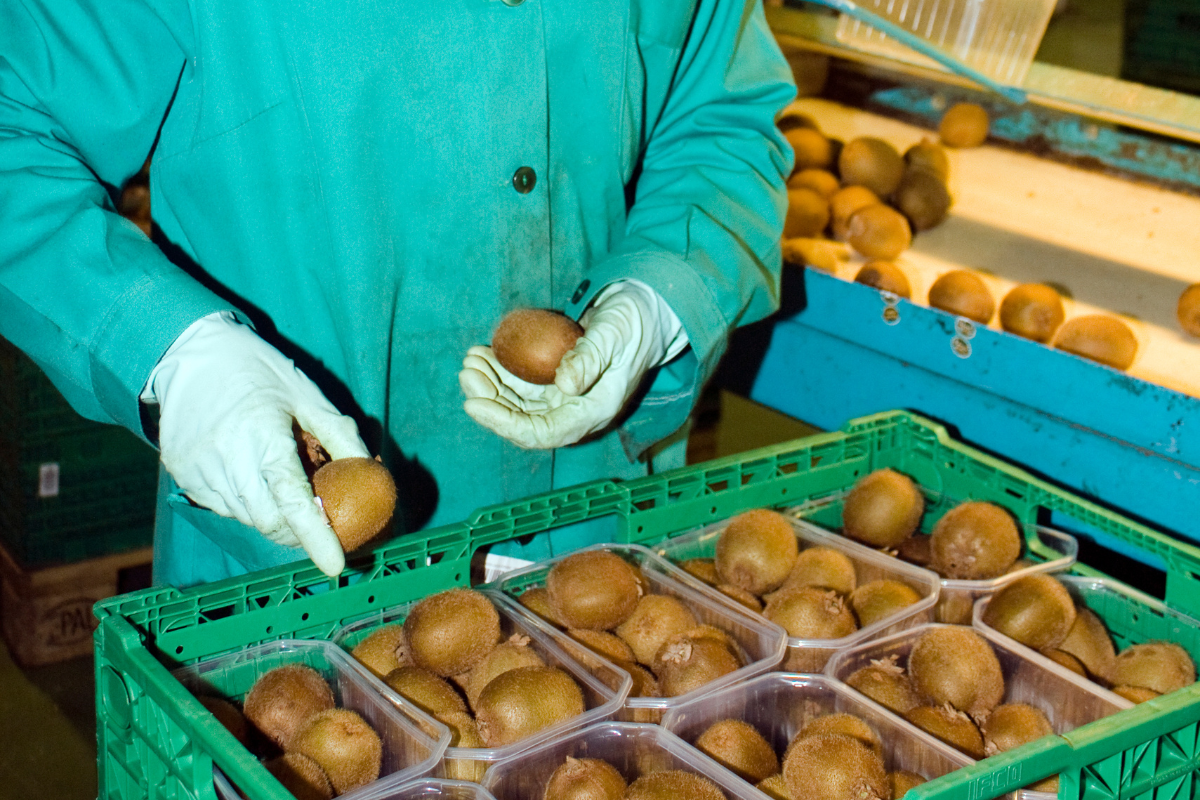
Packaging requirements and specifications
Proper packaging is crucial for protecting the fruit, facilitating handling, and ensuring traceability. International standards regulate packaging materials, arrangement, and labeling.
Packaging materials
Corrugated cardboard boxes are the global standard for packaging. They are lightweight, strong, and recyclable, making them ideal for long-distance shipping.
Typical features:
- Double-wall (5-ply) construction, 4–6 mm thick
- Capacity: 3–10 kg (3–4 kg for retail; 6–10 kg for wholesale)
- Common dimensions: 330 × 250 × 100 mm
- Food-grade, clean, and dry materials free from odour, mould, or contamination
Cardboard provides structural rigidity, breathability, and sustainability—key for maintaining fruit quality and minimising waste.
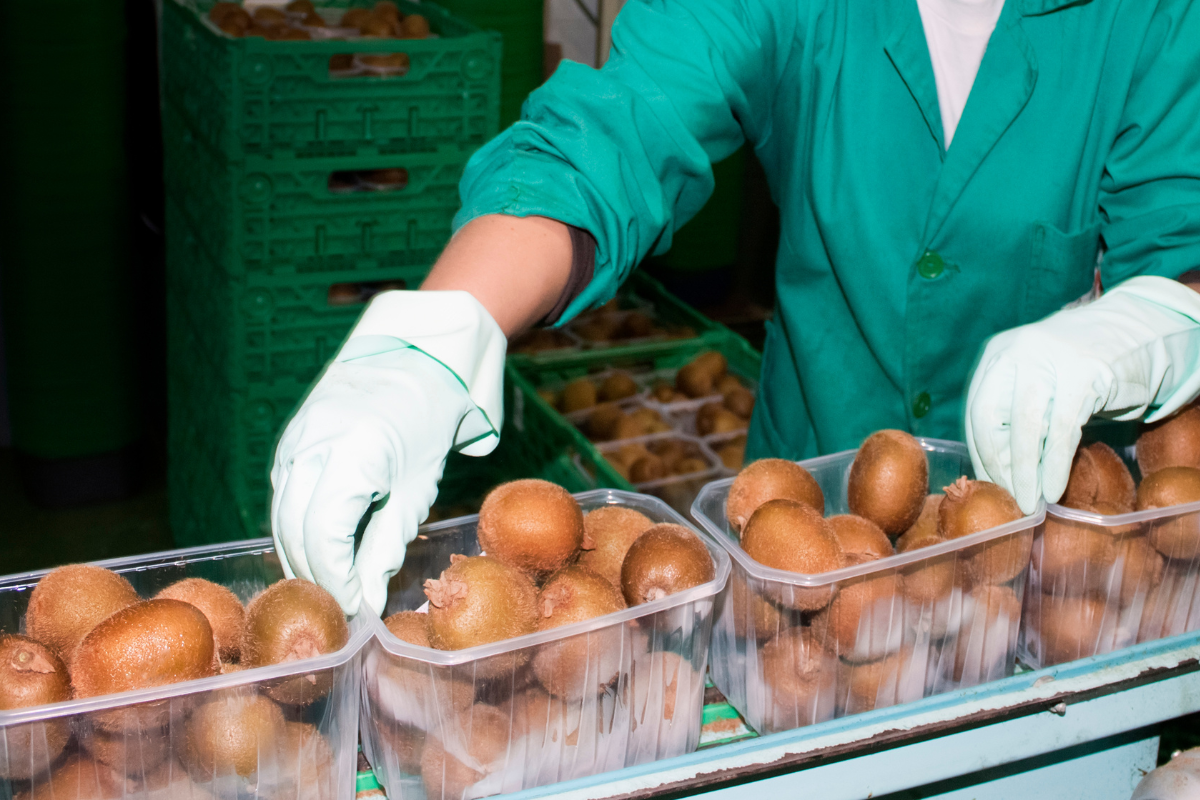
Plastic containers (e.g., PET trays or clamshells) are used in premium markets. Their transparency highlights fruit quality and protects each piece from bruising. A standard size (≈ 175 × 120 × 290 mm) holds 4–8 fruits depending on size. Although more expensive, these packages appeal to high-end retailers emphasising visibility and consumer convenience.
Internal materials such as tissue, paper, or molded pulp trays must be new, food-grade, and odour-free. Printing inks and adhesives must be non-toxic, and stickers must not leave residue or damage the skin when removed.
Common packaging formats
- Trays (7 lbs / ~3.2 kg): molded plastic or pulp trays placed in fiberboard or wooden boxes. Each fruit occupies a dedicated space, preventing it from moving and bruising. Tray packs suit premium grades shipped long distances. Standard configurations include single-layer packs (dimensions around 30×40×6.5cm) and double-layer packs (30×40×12cm).
- Layered cartons (20–23 lbs / 9–10.5 kg): often two or three layers separated by inserts.
- Volume fill (jumble pack): fruit are poured loosely into cartons until filled. A more economical method suited for wholesale or processing markets.
- Bulk bins: large containers (> 55 kg or >121 lbs) used for field transport or processing facilities.
- Consumer packs: film bags or clamshells containing 3 lbs (1.4 kg) or less, placed in master cartons.
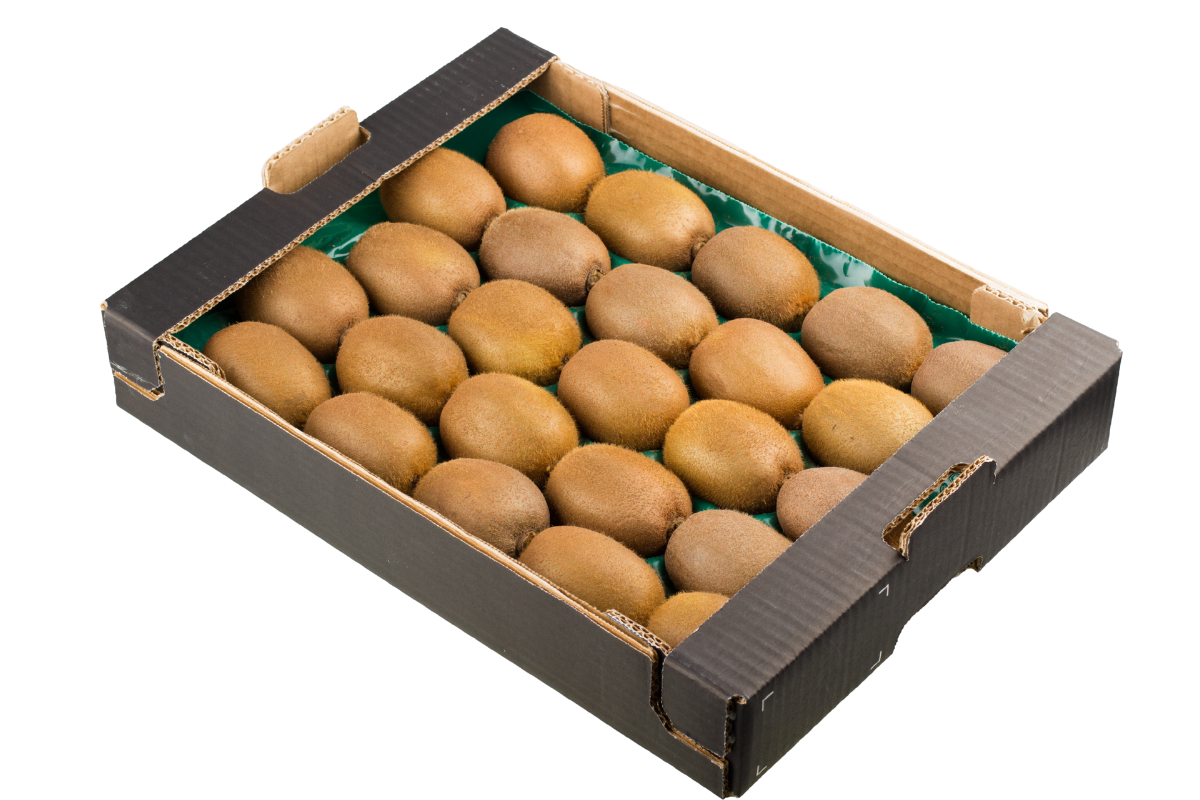
Single-layered kiwis in a tray
Key packaging requirements
- Packages must be uniform in origin, variety, size, and quality.
- All materials in contact with fruit must be clean, non-toxic, and non-damaging.
- Labels and stickers should not leave glue traces or skin marks when removed.
- The visible part of the package must represent the contents inside.
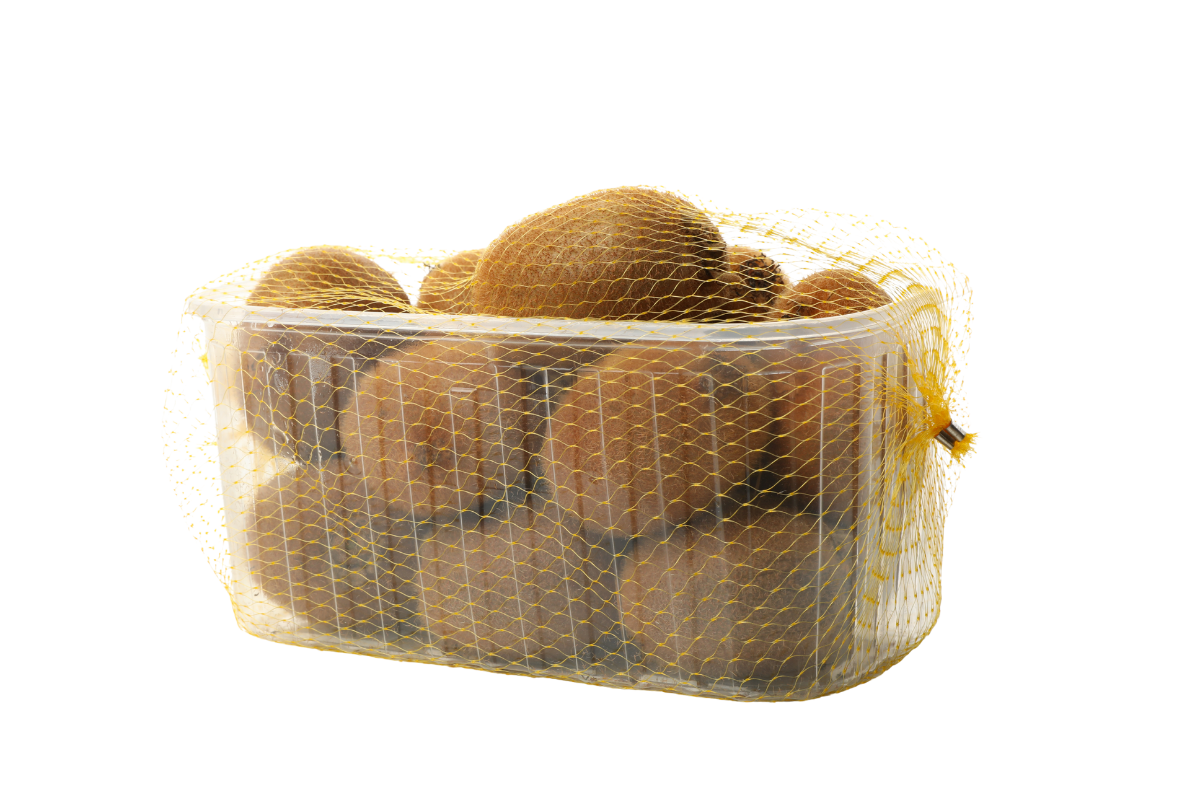
Plastic container with ripe kiwi, retail packaging option
Marking and traceability
Each package must clearly display:
- Packer or dispatcher identification
- The word “Kiwifruit” or “Actinidia”
- Country of origin (region optional)
- Variety name (e.g., Hayward, Kiwigold)
- Quality class or grade
- Size or weight range (and optionally the number of fruits)
- Official inspection mark (optional, for export lots)
Traceability is increasingly important for retailers and importers, supporting food safety and origin transparency.
And if you’re looking to source or sell high-quality kiwifruit directly, explore our global trading platform: Buy and sell kiwifruit on Wikifarmer marketplace
Tolerances allowed in trade
Even with strict standards, small deviations are acceptable to account for handling variations.
|
Class |
Quality Tolerance |
Size Tolerance |
|
Extra |
5% of fruits may meet Class I specs |
10% outside range |
|
Class I |
10% may meet Class II specs |
10% outside range |
|
Class II |
10% below minimum (not decayed) |
10% outside range |
U.S. tolerances are similar, with 8% at shipping point and 12% at destination, ensuring that minor imperfections do not prevent trade.
Common defects and grading impact
Beyond size, sweetness, and firmness, surface condition plays a decisive role in kiwifruit grading. Even fruit that meets weight and maturity requirements can be downgraded if it shows visible marks, bruises, or irregularities. Factors such as skin scarring, shape deformities, or the characteristic Hayward lines influence whether fruit qualifies as Extra Class or falls into a lower category. Understanding how each defect type is evaluated helps producers anticipate grading outcomes and reduce postharvest losses.
For a detailed explanation of common defect types, ranging from bruising and scarring to sunscald, freezing injury, and storage-related issues, you can explore Common Kiwifruit Defects and Their Impact on Grading.
Global trade dynamics: major exporters and importers
Global kiwifruit trade continues to expand, driven by strong demand in Asia, Europe, and North America. New Zealand leads with about USD 2.1 billion in exports in 2024. Italy follows with roughly USD 610 million, supplying mainly European markets, while Belgium has emerged as a major re-export hub, distributing imported fruit across the EU. Greece and Chile complement global supply with counter-seasonal harvests.
On the import side, China tops the list with USD 623 million in purchases, reflecting rising consumer preference for premium gold varieties. Belgium, Japan, Spain, Germany, and the United States also rank among the leading buyers. The EU, China, and Japan together account for nearly two-thirds of global imports, making compliance with EU quality and labelling standards essential for most exporters.
Average global import prices reached about USD 2,960 per ton in 2024, up 12 % year-over-year.
Global Kiwi supply at a glance (2024)
- Export volume: 2.5 million t
- Export value: US $4.3 billion
- Top exporter: New Zealand (42 % share)
- Top importer: China (US $623 million)
- Average export price: ≈ US $2 600 per t
Closing remarks
The kiwifruit trade is a textbook example of how agronomic precision and postharvest quality translate directly into market opportunity.
From orchards in Te Puke and Thessaly to supermarket shelves in Tokyo and Berlin, international standards act as a shared language of quality, defining how fruit are graded, packed, and marketed.
For growers and exporters, mastering these standards not only reduces rejection risk but also builds long-term access to premium markets.
Sources
- Codex Alimentarius: Standard for kiwifruit
- United States Standards for Grades of Kiwifruit
- USDA: Kiwifruit Shipping Point and Market Inspection Instructions
- Official Journal of the European Union: Marketing standard applicable to kiwifruit
- International Standardisation of Fruit and Vegetables KIWIFRUIT