Common kiwifruit defects and their impact on grading
Quality grading in kiwifruit is not only about sweetness and firmness – it also considers the presence, absence, and severity of external and internal defects. Understanding these imperfections and how they affect classification helps growers, packers, and exporters minimise rejections and maintain consistent quality across markets. International standards (e.g. European Union marketing rules and USDA grades) define specific defect types and tolerance thresholds. Some defects, like the Hayward mark, are mostly cosmetic, whereas others – such as bruising, decay, or freezing injury – can render fruit unfit for sale.
Hayward Marks
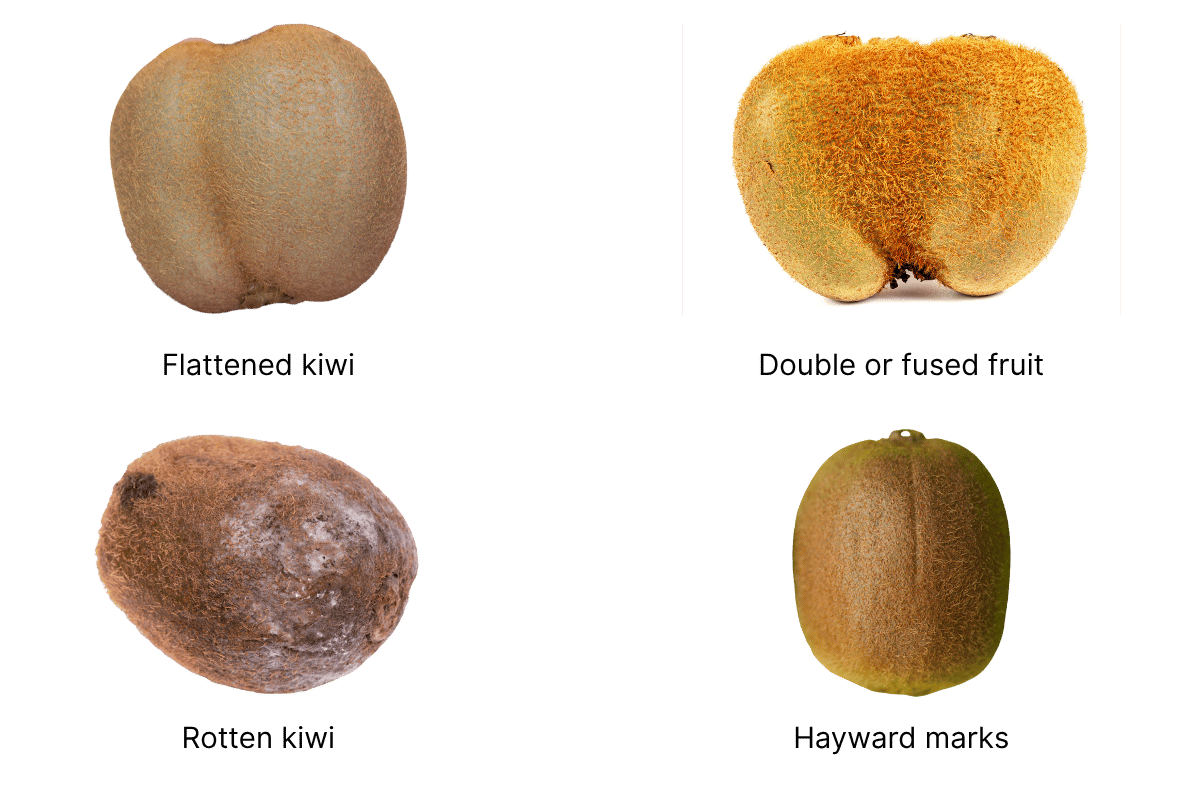
The Hayward variety, which dominates global green kiwifruit trade, naturally develops fine longitudinal lines running from the stem (calyx) toward the flower end. These "Hayward marks" are a genetic trait, not a disease or a result of improper handling.
However, standards limit their visibility to maintain a uniform appearance:
- Extra Class: only one fine line without ridge, not exceeding one-fifth of fruit length.
- Class I: one or two fine lines without raised ridges, total length not exceeding the fruit itself.
- Class II: several more visible lines or slight protuberance tolerated.
When a ridge becomes pronounced and ends in a “beak”, and that beak breaks off, it exposes the flesh, creating an entry point for decay. Broken beaks are scored as damage or serious damage depending on depth and area affected.
Good canopy management, pruning, and reduced fruit crowding can minimize this natural stress and lower the risk of broken beaks.
Skin defects and scarring
Skin imperfections are among the most common causes of downgrades in export consignments. They arise from hail, wind rub, contact with branches or trellis wires, pest feeding, or mechanical injury during harvest and packing.
Inspectors evaluate several aspects:
- the total affected surface area,
- the texture (smooth or rough),
- the colour (light scars are less objectionable than dark ones), and
- whether the skin remains intact or is broken.
Under EU standards, permissible damage depends on the class:
- Extra Class: only very slight, superficial marks.
- Class I: scars up to 1 cm² in total area.
- Class II: more visible marks up to 2 cm².
The U.S. standards take a descriptive approach. Smooth, light-colored scars may still qualify for U.S. No.1, while rough, dark, or extensive marks are downgraded to U.S. No.2 or lower.
Preventing skin damage begins in the orchard. Windbreaks, balanced irrigation, and careful handling during harvest and packing all reduce abrasion. In exposed areas, installing shelterbelts can cut wind-rub incidence by more than half, dramatically improving pack-out rates.
Shape defects
Shape irregularities may be genetic, physiological, or environmental in origin. While they rarely affect eating quality, they do reduce market appeal and complicate packing.
Common shape issues include:
- Dropped or sloping shoulder: one side lower than the other; slight asymmetry is tolerated in Class I, but severe asymmetry relegates fruit to Class II.
- Flattened fruit: caused by pressure against a surface during growth. Standards require a width-to-length ratio of at least 0.8 for Extra Class and 0.7 for Class I to ensure fairly round fruit.
- Malformations: uneven bulges, necks, or distortions. Severe cases are excluded from higher grades.
- Double or fused fruit: explicitly excluded from all EU classes. While U.S. standards don’t list them separately, doubles typically fail the “well-formed” requirement of top grades.
Consistent pollination, pruning, and nutrient balance during fruit set help maintain uniform shapes. Excessive nitrogen or irregular pollination can lead to pointed or misshapen fruits that struggle to meet premium grade standards.
Bruising and physical damage
Bruising is one of the most problematic defects for kiwifruit exporters because it often develops or worsens after packing. Even minor bruises can darken and enlarge during storage and shipment, leading to downgrades or outright rejections upon arrival. In fact, mechanical injuries like bruises, cuts, and abrasions affect an estimated 30–40% of fresh produce and are a major cause of quality loss and rejection in the supply chain.
The U.S. grading standards quantify bruise severity as follows:
- Injury: any slight indentation or flesh discoloration deeper than 1/16 inch (1.6 mm).
- Damage: bruise depth over 1/8 inch (3.2 mm), or affected area larger than a 3/8 inch (9.5 mm) diameter.
- Serious Damage: bruise depth over 1/4 inch (6.4 mm), or area larger than 1/2 inch (12.7 mm) in diameter.
Even if not immediately visible at packing, bruised tissue will continue to break down and can turn into conspicuous brown patches during transit. To prevent such issues, handlers implement several measures:
- Harvest fruit only once they are firm enough to withstand handling (high firmness at picking helps the fruit resist bruising).
- Avoid overfilling bins or stacking fruit too deep, which causes compressive bruising.
- Cushion harvest bins, packing lines, and grading belts to minimize impact shocks.
- Rapidly cool fruit and keep temperatures around 0–5 °C during all postharvest operations to slow metabolism and flesh softening.
Maintaining a strict cold chain is important even slight bruising at packing can escalate into serious damage by the time the kiwifruit reaches its destination if temperatures are mismanaged. Gentle handling at every stage (orchard to packing to loading/unloading) is therefore essential to prevent economic losses from bruising.
Environmental and physiological disorders
Certain defects result from environmental stress or physiological issues during growth. These disorders are often disqualifying if severe, since they indicate compromised fruit. Key examples include:
Sunscald and sunburn
Excess sunlight and high temperatures cause bleached or sunken patches on exposed fruit, sometimes with softened flesh beneath. Both EU and U.S. graders classify sunburn as serious damage, excluding affected fruit from all grades.
Preventive strategies include maintaining adequate leaf cover, using shade netting, and avoiding abrupt canopy openings during summer pruning.
Growth cracks
These longitudinal splits appear during periods of rapid growth — typically after heavy rain or irrigation following drought. Healed cracks near the stem end may be allowed in Class II, provided the flesh isn’t exposed.
Unhealed cracks, which remain open or reach the pulp, disqualify fruit from all grades.
Stable irrigation schedules and soil moisture control are key to prevention.
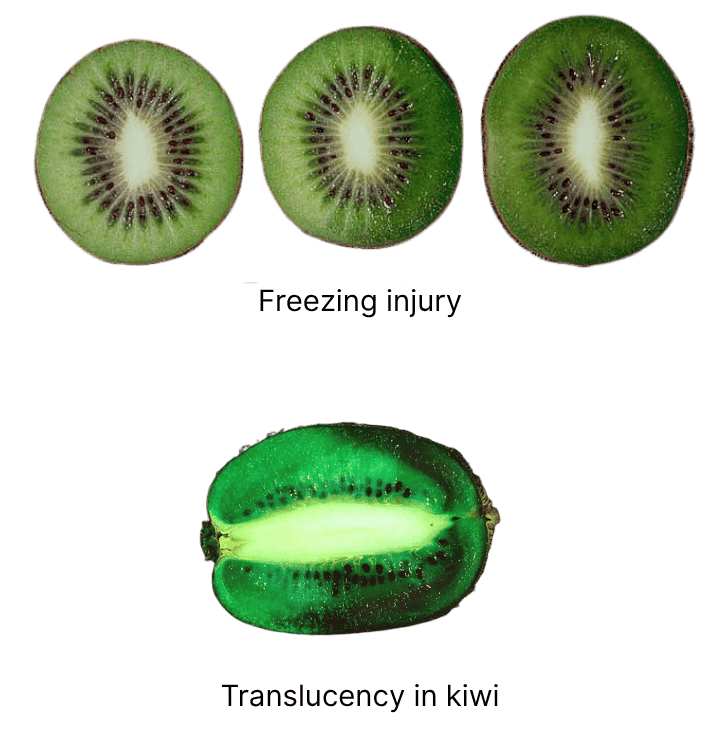
Freezing injury
Freezing injury results from exposure to sub-zero temperatures either in the orchard or during storage. Affected fruit show translucent, water-soaked flesh that later turns brown and mushy.
Any sign of freezing eliminates fruit from marketable classes. Maintaining storage just above –1 °C safeguards fruit texture without risking freeze damage.
Storage and handling issues
Even perfectly graded kiwifruit can lose quality during storage if conditions are poor. The most common storage-related defects are shriveling, surface mold, and decay:
- Shriveling: caused by moisture loss during long storage, leading to wrinkled, dehydrated fruit. Even mild shriveling disqualifies fruit from commercial grades.
- Surface mold: appears under high humidity and poor ventilation. While often superficial, mold covering more than 5% of the surface exceeds tolerance for premium grades.
- Decay: fungal infections (e.g. Botrytis, Phomopsis) make fruit unmarketable. Both EU and U.S. standards allow less than 2% decay tolerance per lot.
To minimize these storage issues, kiwifruit are kept at 0–1 °C with ~95% relative humidity from the moment of packing until arrival in market. Regular inspections are done during storage, and any lots showing shrivel, mold, or off-odors are pulled from distribution to protect the reputation of the brand.
Defects are only one side of the grading equation. To understand how quality classes, sizing systems, and packaging requirements define export readiness find all the information you need: Kiwi quality and export standards.
Common reasons kiwifruit are rejected from markets
In export markets, certain quality problems account for the majority of kiwifruit rejections. A trade analysis noted that the single most serious cause of arrival issues is fruit softness, and that top-quality kiwifruit must be free of all major defects (shriveling, sunscald, scars, cracks, insect damage, bruises, internal breakdown, decay) to avoid rejection. In summary, the most common reasons for kiwifruit being rejected by buyers or inspectors are:
- Over-soft or shriveled fruit (loss of firmness): Kiwifruits that arrive mushy, watery, or severely dehydrated have effectively lost their commercial value. Such fruit often cannot withstand further distribution, so receivers will reject them as “overripe” or “aged” product. Proper cold chain management is crucial to prevent fruit from becoming overripe en route.
- Rotten or moldy fruit: Any incidence of decay (from fungal rot) or widespread surface mold is usually grounds for rejection. Decay not only spoils the affected fruit but can spread to others. Import tolerances for decay are extremely low (only a few percent) and retailers will refuse lots with visible rot. Exporters combat this by pre-sorting out any suspect fruit and using fungicide controls, but if a breakdown occurs in transit, the shipment may be declined.
- Pest infestation or contaminants: If inspectors find insect pests (e.g. scale insects, fruit fly larvae) or signs of contamination (soil, leaves, etc.), the shipment can be turned away or destroyed for phytosanitary reasons. For instance, the discovery of live insects or excessive pesticide residues in a kiwifruit shipment is cause for immediate rejection by authorities. This is less a “grading” issue than a quarantine and food safety mandate.
Why defect management matters
Protecting the value of a kiwifruit crop begins long before harvest and continues until the fruit reaches the market. Every operation (pruning and canopy management to grading and storage) influences how buyers will receive the product.
Growers who apply sound field practices, handle fruit gently, and meet the requirements of export standards achieve higher returns and fewer losses. The difference between a shipment that meets specifications and one that is rejected often comes down to the small details: a clean wound, an intact skin, or a correctly maintained cold chain.
In a trade where appearance and reliability define reputation, consistency is what builds trust and long-term market access.
Sources
- Codex Alimentarius: Standard for kiwifruit
- United States Standards for Grades of Kiwifruit
- USDA: Kiwifruit Shipping Point and Market Inspection Instructions
- Official Journal of the European Union: Marketing standard applicable to kiwifruit
- International Standardisation of Fruit and Vegetables KIWIFRUIT