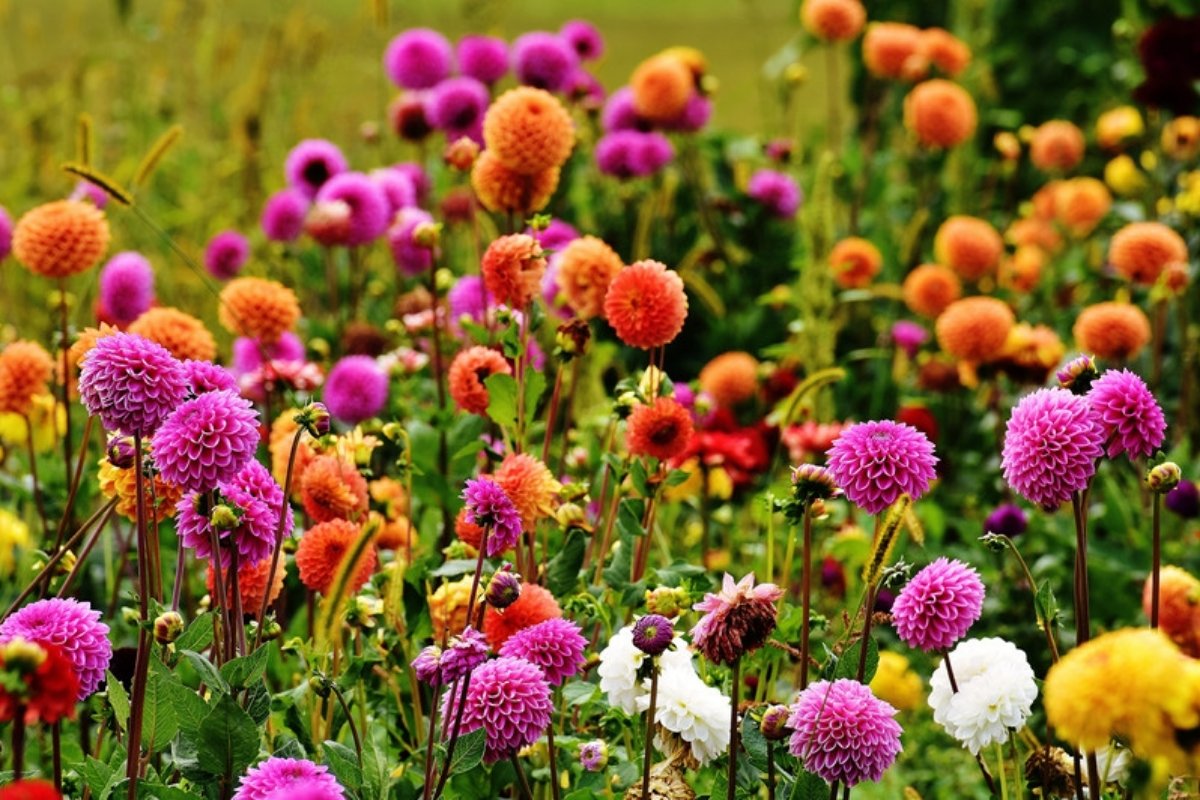
Dahlias (Dahlia) are tuberous perennials in the family Asteraceae, native to Mexico and Central America, grown for their showy flowers from summer until the first frosts. Tubers are planted in spring, once the risk of frost has passed and the soil has warmed, 10 to 15 cm deep, in a sunny, sheltered spot with fertile, well-drained soil. They are not watered after planting until the first shoots appear, because they rot easily. Tall varieties need a stake from the start, and pinching out the tips gives bushier plants with more flowers. In winter, tubers in mild areas with free-draining soil can stay in the ground under a thick mulch, while in cold areas they are lifted and stored. Dahlias are mildly toxic to pets. This guide covers dahlia types, when and how to plant, watering and feeding, pinching and staking, flowering, why dahlias wilt, winter tuber care, propagation, pots, and problems.
Dahlia types and sizes
| Type | Height | What it needs |
| Dwarf and bedding | About 30 to 60 cm | Suits edging and pots, no staking |
| Medium | About 60 cm to 1 m | A stake in exposed spots |
| Tall | 1 to 1.5 m and more | A sturdy stake from planting |
Varieties also differ in flower form. There are single-flowered dahlias, with one or two rows of petals around a central disc, and double-flowered types such as pompons, cactus dahlias and large decorative dahlias.
When to plant dahlias
Dahlias are tender and do not tolerate frost, so tubers are planted in spring, once the risk of frost has passed and the soil has warmed, usually from March to May in a Mediterranean climate and from late April to June in cooler regions. In cold, wet soil, tubers risk rotting before they sprout.
For earlier flowers, tubers can be started in pots in March or April, somewhere light and frost-free, such as a greenhouse or bright windowsill, and planted out once the weather warms.
How to plant dahlia tubers
- Depth: dig a hole 10 to 15 cm deep, with some compost mixed into the soil
- Position: lay the tuber horizontally, with the "eye", the growth bud at the crown, facing up
- Spacing: 40 to 60 cm between plants, depending on their eventual size
- Staking: put the stake for tall varieties in at planting, so you do not damage the tuber later
- Watering: do not water after planting unless the soil is bone dry. The tuber has enough moisture to start, and regular watering begins once shoots appear
You do not usually need to soak firm, healthy tubers before planting. The key is to plant them into warm soil and avoid wet conditions until they are growing.
Sun and soil
Dahlias need full sun, at least 6 to 8 hours a day, and a sheltered spot away from strong winds that snap the stems. In very hot regions, some afternoon shade protects them from heat stress. According to the Royal Horticultural Society, they grow in fertile, humus-rich, well-drained soil enriched with organic matter before planting. In heavy, waterlogged soil the tubers rot.
Watering
Once shoots appear, water deeply and regularly to keep the soil moist but not soggy. In summer, dahlias in the ground need watering two or three times a week in dry spells, while dahlias in pots often need water daily in hot weather. Water at the base of the plant rather than over the leaves, because wet foliage encourages disease. Too much water rots the tubers.
Feeding
Dahlias need fertile soil, enriched with organic matter and a general-purpose fertiliser at planting. During growth, a flowering feed that is low in nitrogen and higher in phosphorus and potassium supports the blooms, while too much nitrogen gives lots of leaves and fewer flowers. In pots, where nutrients wash out with frequent watering, feed more often, every two to four weeks.
Keeping dahlias bushy and flowering
When the main shoot has three or four pairs of leaves, pinch out its tip just above a pair of leaves. The plant then produces side shoots, giving a bushier plant with more flowers. Tie the stems of tall varieties loosely to their stake as they grow, because they are brittle and the flowers heavy.
Deadhead regularly to keep the flowers coming. A useful tip is that spent flowers are cone-shaped, while new buds are round.
When do dahlias bloom
Dahlias flower from early or midsummer until the first autumn frosts, and with regular deadheading they keep producing new flowers through the season. In very hot spells, flowering may slow down and pick up again as the weather cools.
Why is my dahlia wilting
- Natural dormancy: at the end of flowering, and especially after the first frost, the top growth dies back. The tuber is still alive and regrows in spring
- Heat and drought: in summer, lack of water and fierce sun make the plant wilt. Regular watering and some afternoon shade help
- Overwatering: when the soil stays wet, tubers rot, leaves yellow and stems go soft. Stop watering until the soil dries and check the drainage
Do dahlias come back every year
Yes, dahlias are perennials and regrow from their tubers, as long as the tubers survive winter. According to the RHS, in mild areas and on well-drained soils tubers can stay in the ground over winter under a 7.5 to 15 cm layer of mulch, such as bark chips or compost, which protects them from frost.
In colder areas and on heavy soils, tubers are lifted:
- When: after the first frost blackens the foliage
- Cutting back: cut stems to 10 to 15 cm above the ground, then lift the tuber carefully with a fork, without damaging it
- Drying: stand the tubers upside down, stems pointing down, for about two weeks in a dry, frost-free place
- Storing: place them in shallow boxes of dry sand or compost that covers the tubers but leaves the crown exposed, in a cool, dry, frost-free place, and check them from time to time for rot
Dahlias in pots are cut back and the pot moved to a frost-free place, where the compost is left to dry out completely until spring.
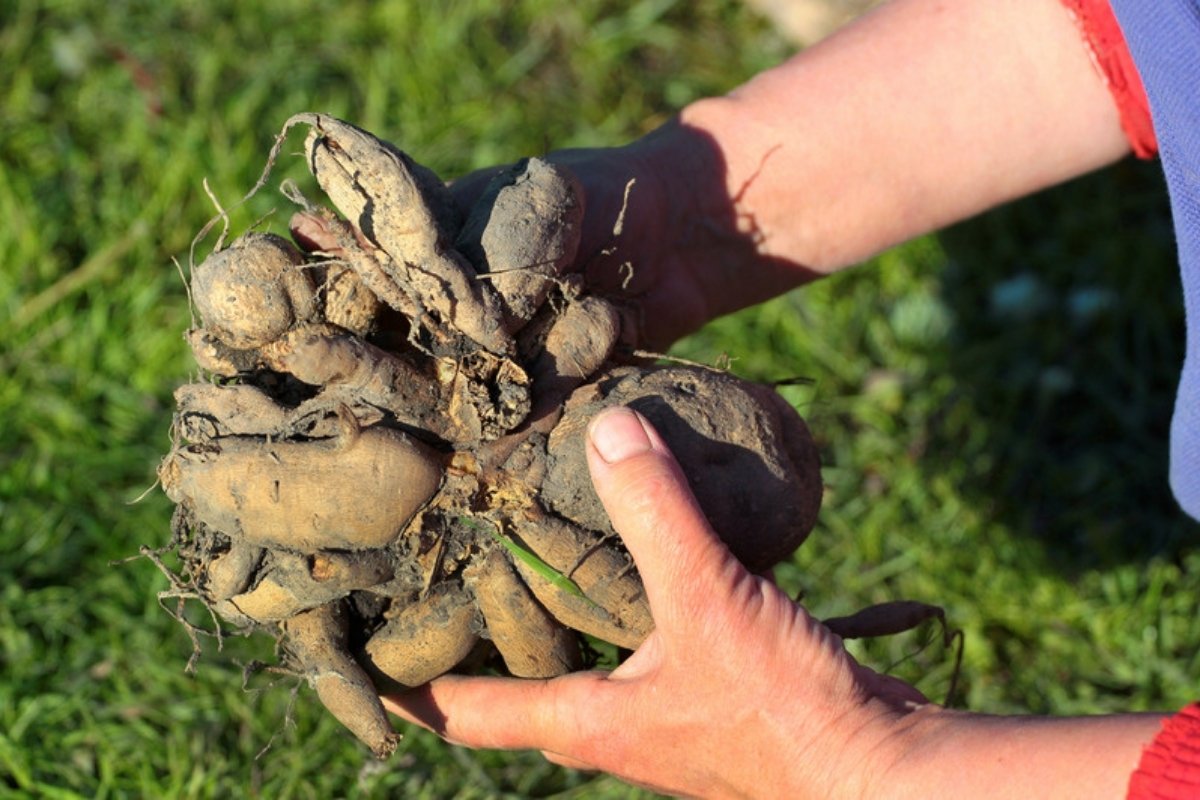
A clump of dahlia tubers lifted from the ground. In cold areas they are dried and stored over winter somewhere cool and frost-free
Propagating dahlias
According to the RHS, dahlias are propagated by dividing the tubers in spring, making sure each piece has a viable bud on the crown, because without one it will not sprout. They can also be propagated from cuttings taken from the young shoots of stored tubers in spring. Dahlias can be grown from seed, sown in trays in late winter or spring, but seedlings usually differ from the parent plant, although they form their own tubers in the first year.
Growing dahlias in pots
Dahlias, especially dwarf varieties, grow very well in pots. Use a pot at least 30 cm wide and deep, larger for tall varieties, with drainage holes and good multipurpose compost. Plant one tuber per pot, with a stake if needed, and place the pot in a sunny, sheltered spot. Compost in pots dries out quickly, so check it daily in summer.
Pests and diseases
- Powdery mildew: a white, floury coating on the leaves, mainly in dry conditions
- Grey mould and other rots: in wet weather and waterlogged soil, where tubers also rot
- Leaf spots: such as the white smut caused by the fungus Entyloma
- Viruses: stunted plants with distorted, mottled leaves, which are removed
- Aphids, spider mites and thrips: on young shoots and leaves, especially in hot weather. Aphids are controlled like aphids on other garden plants
- Slugs, snails and earwigs: eat young shoots and flowers
Dahlias for bees and around pets
According to the RHS, single-flowered dahlias have small tubular florets at the centre that are valuable for bees and butterflies, while double flowers offer them no food. For a pollinator-friendly garden, choose single-flowered varieties.
According to the ASPCA, dahlias are toxic to dogs, cats and horses, with mild symptoms, namely stomach upset and skin irritation.
Frequently asked questions
When should dahlias be planted
In spring, once the risk of frost has passed and the soil has warmed, usually March to May in a Mediterranean climate and late April to June in cooler regions.
How deep do you plant dahlia tubers
10 to 15 cm deep, laid horizontally with the eye facing up, 40 to 60 cm from neighbouring plants.
Should you water dahlias after planting
No, unless the soil is bone dry. Start watering once the first shoots appear, because tubers rot easily in wet soil.
Do you need to soak dahlia tubers before planting
Not usually. Firm, healthy tubers can be planted as they are into warm soil, and the main thing is to avoid wet conditions until they start growing.
Can you leave dahlia tubers in the ground over winter
In mild areas with free-draining soil, yes, under a thick mulch. In cold areas and on heavy soils, lift them after the first frost, dry them and store them somewhere cool, dry and frost-free.
Why is my dahlia wilting
Usually because of natural dormancy at the end of the season, after which the tuber regrows in spring. In summer, heat and drought are the usual causes, while constantly wet soil makes the tuber rot.
Important notes
For persistent pest or disease problems, a local agronomist can help with an accurate diagnosis, and any treatment should use only registered products, following the label.
References
- Royal Horticultural Society, Dahlia 'Twyning's Candy'.
- Sarah Raven, How to plant, grow and care for dahlias.
- Crocus, How to grow dahlias from tubers.
- ASPCA, Dahlia.