


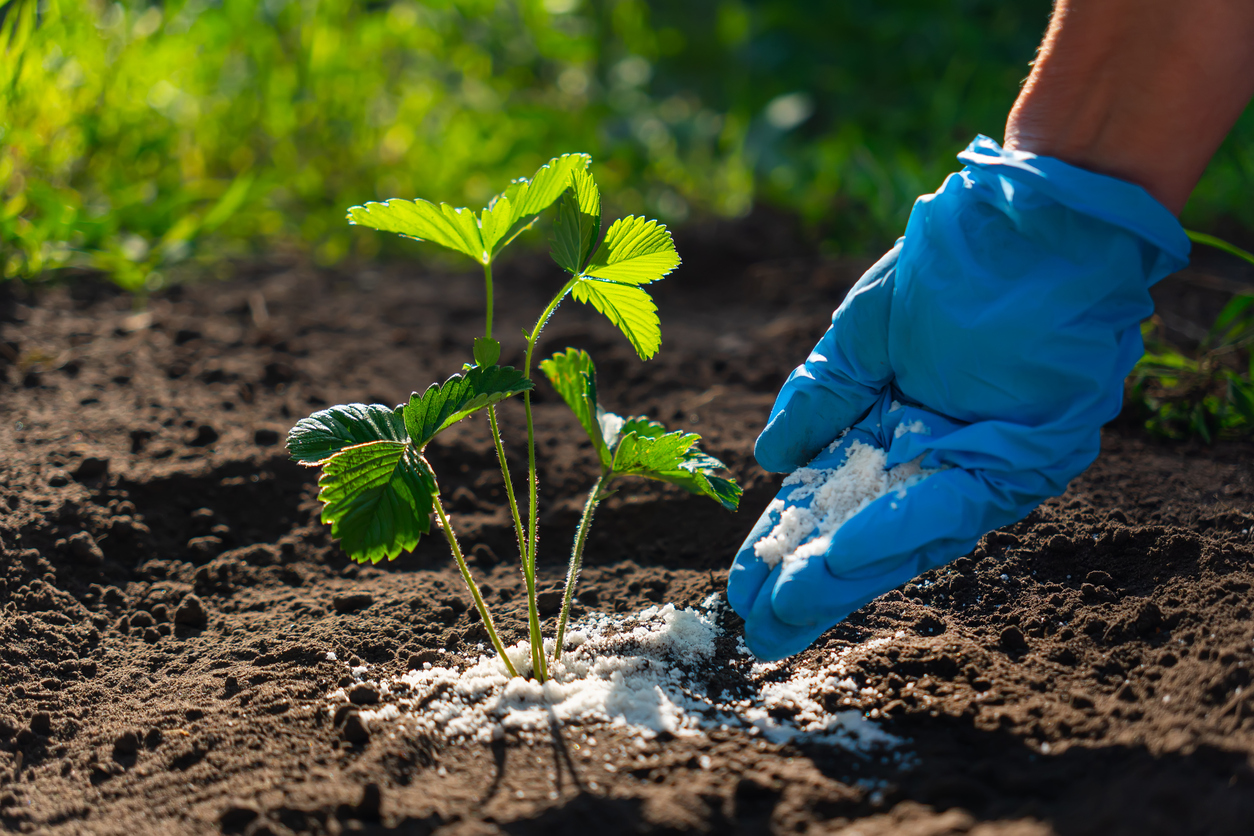
Strawberry Fertilization Guide: Essential Tips for High Yields and Quality
Strawberries have relatively high nutrient demands and benefit from regular, well-planned, tailored fertilization strategy to support their growth and fruit production. It is essential to highlight that no two fields are the same, nor can anyone advise a farmer on fertilization methods without considering the soil test data, tissue analysis, and crop history of a specific field. However, some common schemes and fertilization strategies many farmers use are presented below.
A soil analysis provides valuable insights into soil characteristics, pH levels, and available nutrients, which are critical for building an effective fertilization plan. Consider the strawberry variety, cultivation system, nutrient sources, available delivery systems, and desired yield when creating your plan. The primary objectives of strawberry fertilization are to:
- Encourage rapid early growth of new plants.
- Promote vigorous plant growth and runner formation (especially in mid-summer)
- Maximize crown development and yield potential.
Strawberries grow best in slightly acidic soil with a pH of 5.3–6.5. To adjust the soil pH as needed, you can apply elemental sulfur to lower it or lime to increase it, ideally one year before planting.
Essential Nutrients for Strawberry Plants
Ideally, the soil should be prepared before planting the strawberries by adding compost or complex fertilizers. Nitrogen (N), phosphorus (P), and potassium (K) are the three main elements needed by strawberry plants, and they should be added with fertilization to cover the plants' needs.
Fertilizers can be applied directly to the soil or via fertigation—a method that combines fertilization and irrigation. Fertigation, often used in commercial strawberry production, is highly effective for supplementing nitrogen, iron, magnesium, boron, and calcium. Fertilization timing and nutrient amounts can vary depending on whether strawberries are grown as annual or perennial crops, the variety, and the production system.
Nitrogen (N) encourages runner, branch crown, and bud formation (increasing potential yield). In perennial crops, application in late summer should be preferred, while it should be avoided in late fall. Pre-planting application (during fall) can be performed using controlled-release N fertilizer (CRF) to supply the crop for 6-8 months. You should apply them in bands and incorporate them into the soil before laying down the plastic mulch.
Due to the difficulty of covering the increased needs of the plants during spring, farmers prefer to supply the strawberries with complementary amounts of N through fertigation (4-6 applications). The combined application of ammonium and nitrate forms gives the best results. Supplementary foliar N fertilization can be applied during spring. All applications should cover the total seasonal plant requirements, which are around 90-135 kg per hectare (80-120 lb/acre).
Attention: Nitrogen over-fertilization may lead to a decrease in strawberry quality (soft fruits).
Phosphorus (P) and Potassium (K) are also needed for good quality and yield of strawberries. Still, they are usually found in sufficient amounts in fields previously planted with vegetable crops. However, if the soil (or leaf) analysis shows nutrient deficiencies, P and K can be added before planting or during spring. For pre-planting, the farmer can use:
- diammonium phosphate or DAP (18-46-0) or triple superphosphate (0-46-0) and
- potassium chloride or muriate of potash (0-0-60).
The farmer should keep in mind that most P and K are removed from the field crop with fruit harvest. As a result, these amounts should be replaced in perennial crops through fertilization and cover the seasonal phosphorus uptake, which is 100 kg P₂O₅ per hectare (45 kg P/ha) or 90 lbs P₂O₅/acre (40 lbs P/acre), and the potassium uptake is 320 kg K₂O per hectare (270 kg K/ha)) or 290 lbs K₂O/acre (240 lbs K/acre).
Attention:
In a fertigation system, a farmer can use ammonium sulfate (S 17 kg/ha or 15 lb/acre), ammonium nitrate, calcium nitrate, ammonium phosphate, muriate of potash, urea, and borax. However, nutrient forms like phosphoric acid, anhydrous ammonia, superphosphates, and lime should not be used.
In organic strawberry cultivation, the farmer should invest in and increase the soil's organic matter and nutrient availability by using suitable cover crops, manure (from an organic farm), or other organic fertilizers. In this case, fertigation is not an option, and if the farmer wants to cultivate day-neutral cultivars as annuals, he/she needs to apply the manure (8–10 t/ha or 7,000-9,000 lb/ac) early enough to make the Nitrogen available to the plants on time (1). Some manures, like poultry manure, may be restricted in certain areas, so check local regulations before application.
Regular monitoring of soil and tissue nutrient levels allows for timely adjustments to fertilization practices. If you observe signs of nutrient deficiency, take samples to determine the exact cause and make targeted corrections. Identifying and addressing deficiencies promptly helps maintain healthy growth and optimal production.
By following these guidelines and planning the fertilization schedule based on the factors mentioned above, strawberry growers can enhance plant growth, maximize yield, and improve fruit quality.
References
- https://extension.umn.edu/strawberry-farming/strawberry-nutrient-management
- https://www.gov.mb.ca/agriculture/crops/crop-management/fruit-crops/strawberry-fertilizer.html
- https://www.dpi.nsw.gov.au/__data/assets/pdf_file/0020/333362/Strawberry-fertiliser-guide.pdf
- https://www.cdfa.ca.gov/is/ffldrs/frep/FertilizationGuidelines/Strawberry.html
- https://www.purdue.edu/hla/sites/yardandgarden/wp-content/uploads/sites/2/2016/10/HO-46.pdf
- https://www.ncagr.gov/agronomi/documents/StrawberryFertility-Feb2015.pdf
- https://www.agric.wa.gov.au/strawberries/irrigation-and-fertiliser-guidelines-strawberries?nopaging=1
Further reading
- 10 Health Benefits of Strawberries
- 15 Interesting facts about strawberries
- History, Global Production, and Key Varieties of Strawberries
- How to Grow Strawberries in Your Garden or Balcony
- Strawberry Soil Requirements, Cultivation Systems, and Plant Density
- How and Why to cultivate Strawberries in a Hydroponic system
- Strawberry Propagation Methods
- When and How to Irrigate Strawberries
- Heat Stress in Strawberry Production: Effects, Cultivar Variability, and Solutions
- How to Fertilize Strawberry Plants
- How to Prune Strawberries
- The Most Important Strawberry Pests & Diseases and Management Strategies
- Strawberry Yield, Harvest, and Storage