
Boron and zinc are needed in tiny amounts, yet their absence affects flowering, fruit set, and the development of new growth. In Mediterranean soils, which are largely calcareous and high in pH, these two micronutrients are often present in the soil but get locked up and remain unavailable to the tree. As a result, deficiency can appear even when the base fertilization with nitrogen, phosphorus, and potassium is adequate. Below, we look at how to recognize symptoms in olive, grapevine, and citrus, and how to correct them with the right form and timing.
Why soil pH locks up the micronutrients
The availability of micronutrients depends directly on soil pH. When it rises above neutral, as in calcareous soils, zinc and boron are bound in forms that the root cannot take up. The problem is made worse by excessive phosphorus or nitrogen fertilization, which competes with zinc uptake. For this reason, on these soils soil application of zinc is often ineffective and foliar application is preferred, bypassing the lock-up in the soil. The single most useful test remains soil pH, because correcting it prevents many deficiencies at once.
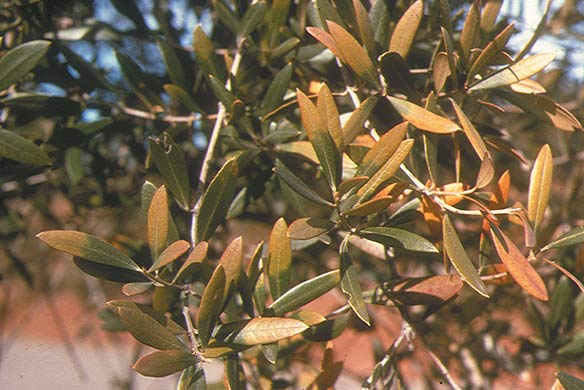
Boron deficiency symptoms on olive leaves, dead tips with a yellow band and green base
Image source: U.S. Borax.
Boron and its role in fruit set
Boron contributes to cell wall integrity, to sugar transport, and above all to reproduction, since it affects pollen viability and germination, pollen tube growth, and the proportion of flowers that set fruit. In olive, the symptoms of deficiency start at the growing tips and appear as dead leaf tips with a characteristic yellow band and green base, twig and limb dieback, and misshapen fruit with poor set and premature drop. Because the tree moves boron from the leaves to the flowers and the fruit, deficiency can show up in reproduction even when leaf levels look adequate.
In olive, boron is mobile in the phloem because the tree transports sugars as polyols, so foliar application is effective. In grapevine, autumn foliar sprays prevent the symptoms of the following season, while in citrus boron deficiency produces characteristic corky veins on the leaves.
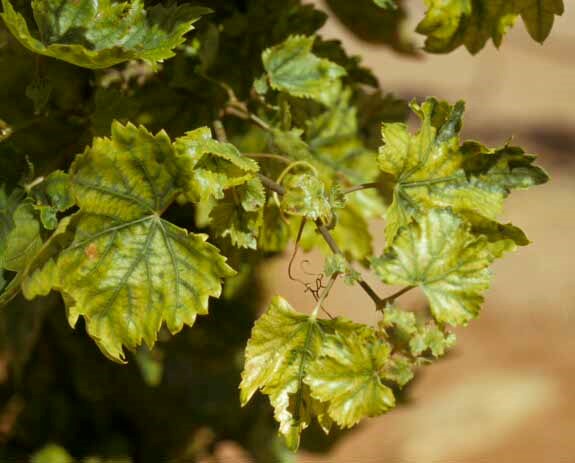
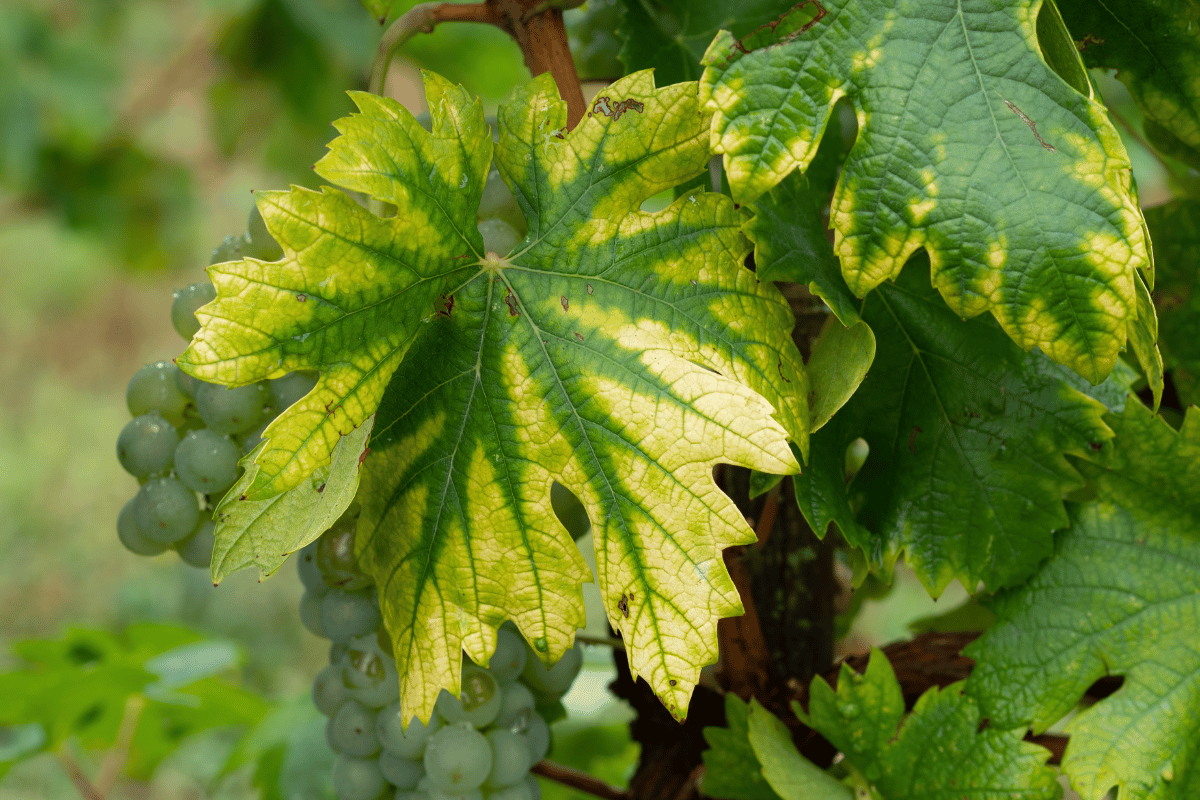
Ζinc deficiency symptoms on grapevine leaves, small, malformed leaves
Image source: Lodi Winegrape Commission.
Zinc and little leaf
Zinc is involved in auxin synthesis and growth metabolism, which is why its deficiency leaves a distinctive mark on new growth. The young leaves emerge small, narrow, and pointed, with interveinal yellowing, while the shortened internodes crowd the leaves into rosettes, the well-known little leaf. Leaf-out and bloom are delayed, older leaves drop prematurely, and in severe cases the twigs die back.
In grapevines, zinc deficiency results in sparse, uneven bunches and reduced yield. In citrus, it appears as a mottled leaf, with yellow patches between the veins and an irregular green band along them, with small, pointed leaves and fruit of reduced size and poor quality. Both zinc and manganese become harder to access on calcareous soils, so the picture is more pronounced there.
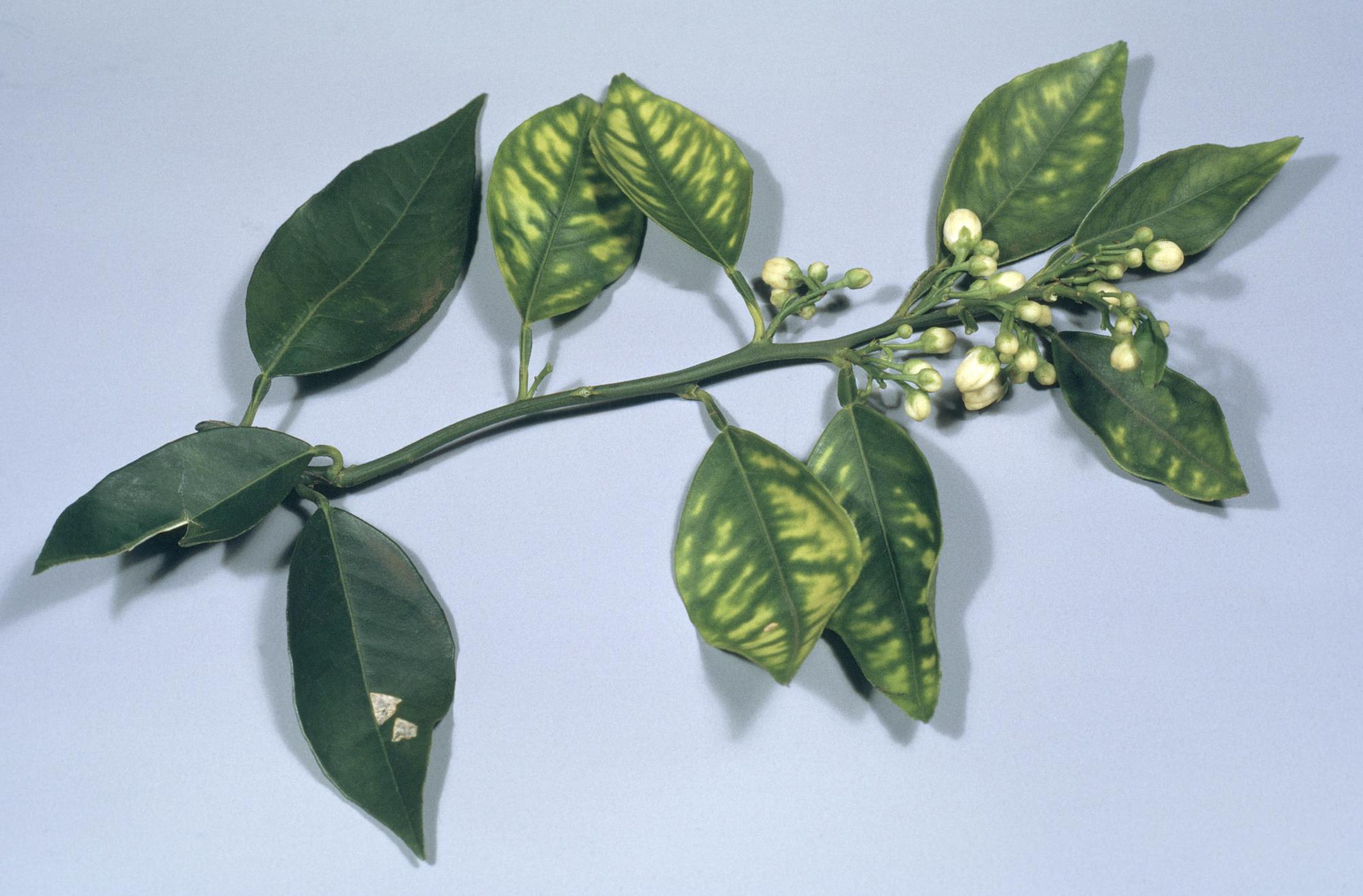
Ζinc deficiency mottle leaf on a citrus leaf
Image source: University of Hawaiʻi Master Gardeners.
How to correct it in practice
Diagnosis rests on the symptoms and on leaf analysis, sampling uniform blocks of the orchard and avoiding trees that have recently received foliar feeding. For boron in olive in particular, foliar application before bloom improves fruit set even on trees with no visible symptoms, so leaf analysis alone does not always predict the benefit.
On form and timing, boron is sold as borax, boric acid, or the more soluble Solubor at 20.5% B, and the foliar application in olive is placed about three weeks before bloom. In trials on the Manzanillo cultivar, foliar boron at 246 and 491 mg per litre reduced imperfect flowers and increased fruit set. Zinc is applied as zinc sulphate or as a chelate, with chelates performing better on alkaline soils, and in citrus it is applied to each new flush of growth.
In every case, we keep the concentrations low and watch for two risks. Boron has a narrow margin between sufficiency and toxicity, so an excessive dose causes damage. Foliar zinc can become phytotoxic, which is why timing matters, while at very high tissue concentrations, of the order of 300 to 400 mg per kilogram of dry weight in grapevine, toxicity symptoms appear. How micronutrients fit into a complete program alongside the main elements is covered in our guides on choosing NPK fertilizers by crop and on commercial olive cultivation.
| Crop and element | Key symptoms | Timing and form |
|---|---|---|
| Olive, boron | Dead leaf tips with a yellow band, poor fruit set | Foliar three weeks before bloom, as Solubor or borate |
| Grapevine, zinc, and boron | Little leaf, sparse bunches | Zinc on the new growth, boron foliar in autumn |
| Citrus, zinc | Mottle leaf, small pointed leaves | Foliar to each new flush, zinc sulphate or chelate |
The right response is not a single spray but a program that combines pH management where feasible, leaf analysis, and targeted foliar application at the critical stages of each crop.
Sources
- University of California Agriculture and Natural Resources (UC ANR), "Boron on Olives", Topics in Subtropics.
- University of California Davis, Geisseler Lab, "Olives, Nutrient Management".
- Stellacci, A.M. et al. (2010), "Effect of foliar boron application on olive (Olea europaea L.) fruit set and yield", Acta Horticulturae, ISHS.
- University of California Statewide IPM Program (UC IPM), "Zinc Deficiency".
- University of California Cooperative Extension Central Sierra, "Grapevine Nutrition".
- UF/IFAS Extension, "A Guide to Citrus Nutritional Deficiency and Toxicity Identification" and "Zinc Deficiency in Citrus".
- University of California Cooperative Extension, "Citrus Fertilization".
- "Assessment of physicochemical parameters in two winegrape varieties after foliar application of ZnSO4 and ZnO" (2023).