
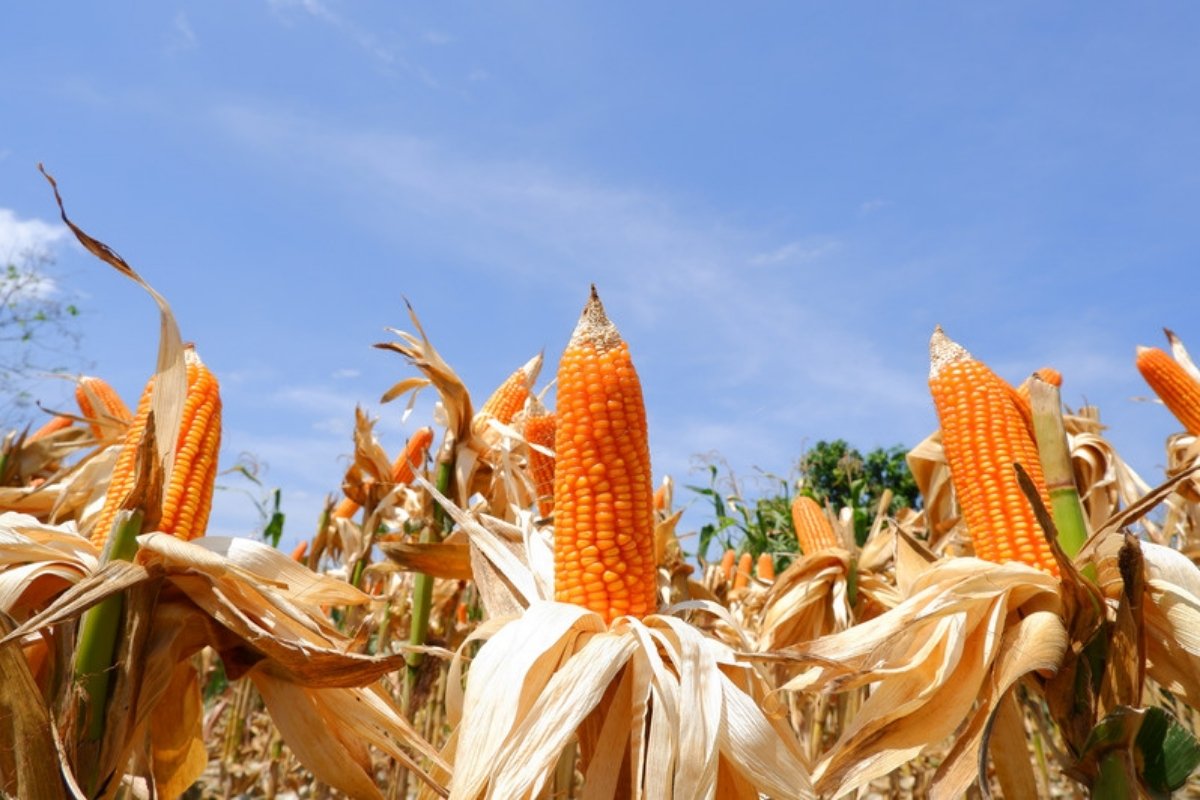
Greece's summer crops, such as maize, sunflower and potatoes, harvested from August to October, closed 2026 with yields close to their five-year average, in a year when drought and heat cut yields across much of Europe, according to the October crop monitoring bulletin of the European Commission's Joint Research Centre (JRC). The JRC puts Greek grain maize at 11.0 t/ha, 1% above the five-year average and 20% above last year, while across the EU the grain maize yield is 9% below average. Rain in mid-October replenished soil moisture, and sowing of winter cereals is expected to start in late October or early November.
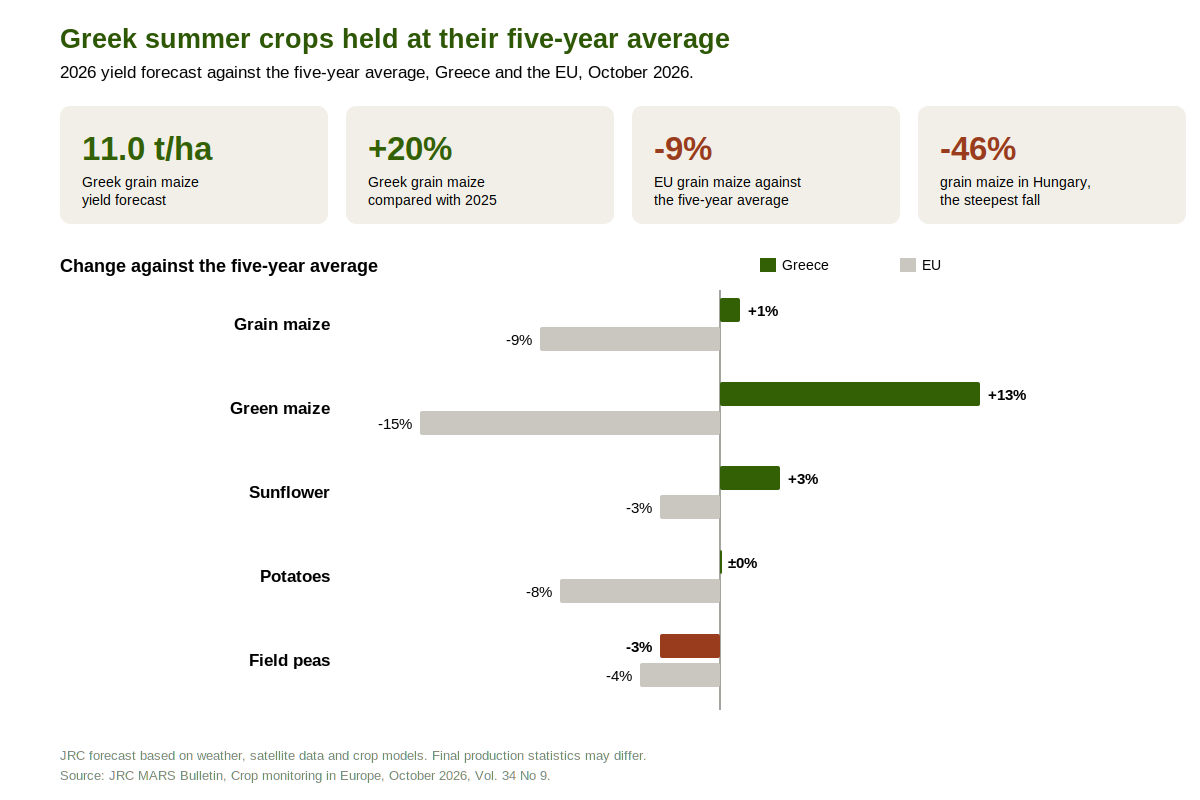
JRC yield forecasts for Greece and the EU against the five-year average. Source: JRC MARS Bulletin, October 2026.
| Crop | Greece 2026, t/ha | Greece vs five-year average | Greece vs 2025 | EU vs five-year average |
| Grain maize | 11.0 | +1% | +20% | -9% |
| Green maize | 46.7 | +13% | +73% | -15% |
| Sunflower | 2.49 | +3% | +19% | -3% |
| Potatoes | 27.9 | ±0% | +12% | -8% |
| Field peas | 1.51 | -3% | +10% | -4% |
Source: JRC MARS Bulletin, Crop monitoring in Europe, October 2026.
September favoured the harvest
A warm and mostly dry September helped the harvest of summer crops in Greece. Sunflower and green maize harvesting was largely complete with satisfactory results, while the grain maize harvest moved northwards, with generally satisfactory yields despite local heat-related losses. Potato harvesting continued in northern Greece, with yields varying from area to area depending on the weather and the availability of water.
The JRC kept its forecasts for Greece unchanged from September, with green maize standing out at 46.7 t/ha, 13% above average and 73% above 2025, when the yield fell to 27.0 t/ha. Sunflower is at 2.49 t/ha, 3% above average, potatoes at 27.9 t/ha, on the average, and field peas at 1.51 t/ha, 3% below.
Greece stands out in a difficult year for Europe
Across the EU the summer season is closing with yields below the five-year average for most crops after a summer of heat and drought, and, as we reported, the JRC had already cut its summer crop forecasts in August. According to the October bulletin, grain maize is 9% below average in the EU, green maize and soybeans 15% below, sugar beet 12% and potatoes 8%.
The largest losses are in central and western Europe, where grain maize is 46% below average in Hungary, 34% in Slovakia, 31% in France, 30% in Austria and 15% in Italy. The Balkans, by contrast, had a good year, with grain maize 34% above average in Bulgaria and 15% in Romania, and Greece belongs to this group. For Greek production this means it reaches a European market in which large producers such as France and Hungary had far lower yields.
Winter sowing starts on moist soils
Abundant rain in mid-October replenished soil moisture ahead of winter sowing. Farmers are preparing seedbeds for winter cereals, sowing has not yet started on a large scale and is expected to begin in late October or early November, depending on soil moisture. In Cyprus, rainfall well above average, mainly in late September and early October, improved soil moisture ahead of winter barley sowing, which usually starts in November.
This differs from much of Europe, since in central and southern Italy, Hungary, Czechia, Slovakia and western Romania dry soils are delaying sowing and emergence, while in the Baltic countries excess rain has stopped winter sowing in some areas, according to the JRC's summary.
Frequently asked questions
How did Greece's summer crops do in 2026? According to the JRC, yields are close to the five-year average. Grain maize is forecast at 11.0 t/ha, 1% above the average and 20% above last year.
How did maize do in the rest of Europe? Across the EU the grain maize yield is 9% below the average, with the largest losses in Hungary, at 46%, Slovakia, at 34%, and France, at 31%. Bulgaria and Romania are above the average.
When does winter cereal sowing start in Greece? According to the JRC, in late October or early November, depending on soil moisture, which improved with the rain in mid-October.
Which crop had the best year? Green maize, at 46.7 t/ha, 13% above the five-year average and 73% above 2025.
What is the JRC MARS Bulletin? It is the monthly bulletin of the European Commission's Joint Research Centre on crop conditions and yield forecasts in the EU, based on weather data, satellite images and crop models.
Important notes
The figures are yield forecasts per unit of area, not final production statistics, and they do not take the cultivated area into account. National averages hide differences between regions and between irrigated and rainfed crops.
Sources
- European Commission Joint Research Centre. (2026). JRC MARS Bulletin, Crop monitoring in Europe, October 2026, Vol. 34 No 9. 26 October 2026.
- European Commission Joint Research Centre. (2026). Summer crop season closes with below-average yield prospects. 23 October 2026.