
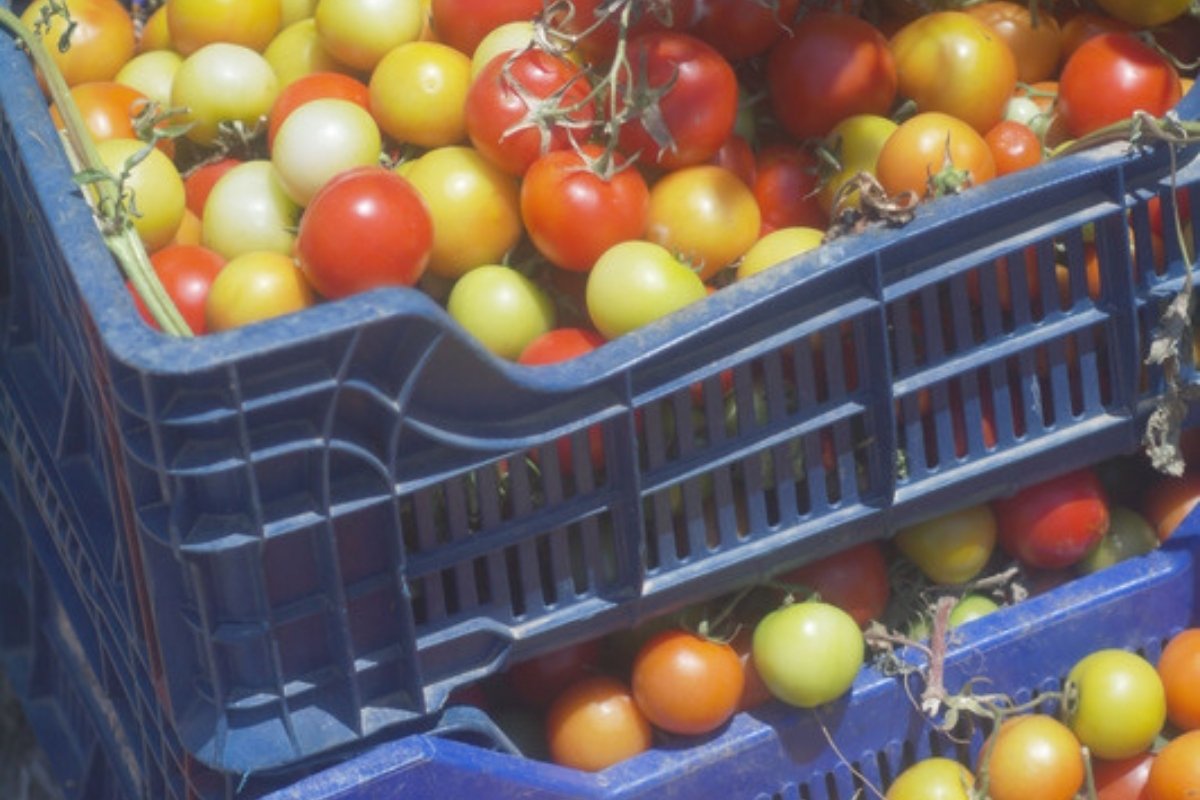
Every 29 September, the International Day of Awareness of Food Loss and Waste encourages people to consider food before it reaches the bin. A single greenhouse tomato from Ierapetra, in Crete, shows why: it travels by truck to Heraklion and by overnight ferry to Piraeus, and by the time it sits on a shelf in Athens, it has used irrigation water, fertiliser, hours of hand labour, a cardboard crate, diesel and cold storage. If it goes soft in a fruit bowl, everything in it goes in the bin.
The UN General Assembly proclaimed the day in resolution 74/209 of 19 December 2019, and FAO and UNEP lead it. FAO frames the 2026 edition around three gains from cutting food loss and waste: more food for people, less pressure on natural resources and the climate, and higher productivity along the food chain.
Three journeys put numbers on those gains: a tomato grown and eaten in Greece, a tomato grown in Almería and sold in Germany, and a Hass avocado grown on the desert coast of Peru and eaten in Europe. Each uses different amounts of water, labour and fuel, and each is lost at different points on the way. Following each one from the field to the bin shows how long the journey is, what it costs, and how little we think about it when fresh produce is thrown away.
Fruit and vegetables are the food group that is lost most often
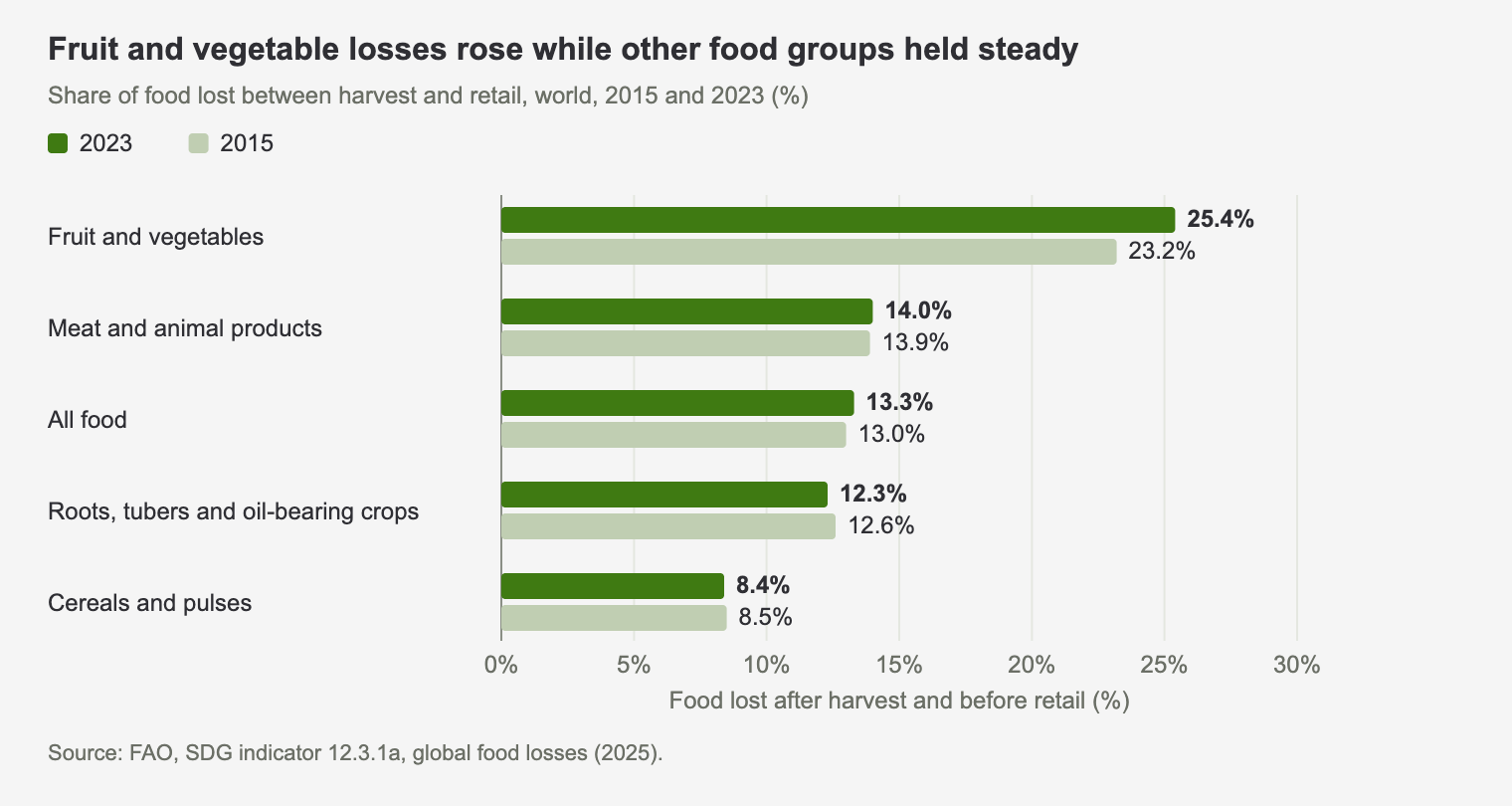
FAO estimates that 13.3% of the world's food was lost in 2023 after harvest and before retail, on farms, in transport, in storage, at wholesale and in processing. The share has hardly moved since 2015, when it stood at 13.0%. For fruit and vegetables, it rose from 23.2% to 25.4% over the same period, the highest of any food group, because the produce is perishable and needs careful handling.
On top of those losses, the UNEP Food Waste Index Report 2024 estimates that shops, restaurants and homes threw away 1.05 billion tonnes of food in 2022, 19% of all food available to consumers. Households produced 60% of it, 79 kg per person per year. Food loss and food waste are measured separately, loss up to retail and waste from retail onwards, and together they generate 8 to 10% of global greenhouse gas emissions.
Counting every stage, The State of Food Security and Nutrition in the World 2026 puts losses of fruit and vegetables at roughly 40-50% of production by weight. The same report notes that less than half of the food that needs refrigeration worldwide is actually refrigerated, and that missing cold chains caused the loss of an estimated 526 million tonnes of food in 2017.
In the EU, Eurostat recorded 129 kg of food waste per person in 2024. Households produced 69 kg of it, or 54%, and shops 10 kg. The EU figures for 2024 are Eurostat estimates, as data from some countries, including Germany, are still missing.
A tomato grown in Crete is most likely to be wasted in the kitchen
About a third of Greece's greenhouse area is in Crete. The 2020 agricultural census of ELSTAT counted 48,720 stremmata of greenhouses in the country, about 4,872 ha on 8,319 holdings, and the municipality of Ierapetra alone reports more than 12,000 stremmata of greenhouses, about 1,200 ha.
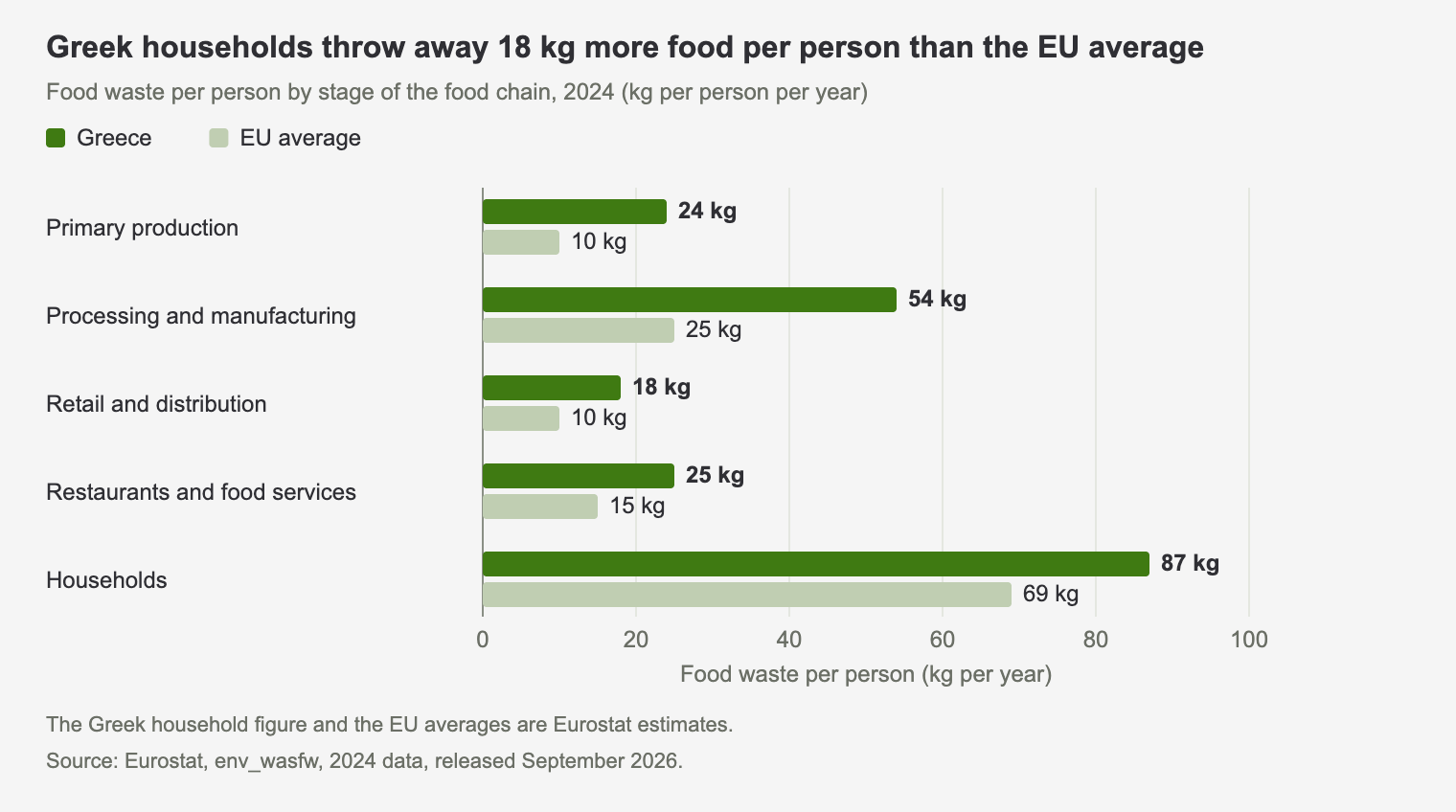
The trip to Athens crosses no border, yet the tomato still has to get through the same stages as any fresh vegetable. Worldwide, a quarter of fruit and vegetables is lost between harvest and the shop, and in Greece, the losses continue after that. Eurostat's figures for 2024 put Greek food waste at 208 kg per person: 24 kg in primary production, 54 kg in food manufacturing, 18 kg in retail, 25 kg in restaurants and food services and an estimated 87 kg in households. The kitchen accounts for 42% of the total, and Greek households produce 18 kg more food waste per person than the EU average of 69 kg.
The UC Davis Postharvest Center recommends 7 to 10°C for firm-ripe tomatoes for 3 to 5 days and reports chilling injury when tomatoes are held below 10°C for more than two weeks, or at 5°C, close to the temperature of a household fridge, for more than 6 to 8 days. Chilled tomatoes fail to develop full colour and flavour, soften early, pit, and decay faster, so storage accounts for part of the household loss. Storing tomatoes to minimise post-harvest losses starts with temperature.
A Cretan tomato thrown out in an Athens kitchen has spent months in the greenhouse, made it through the stages where a quarter of the world's fruit and vegetables are lost before reaching a shop, and passed through a packhouse, a truck, a ferry and a shop. Throwing it away takes a few seconds.
A tomato from Almería travels 2,500 km to reach Germany
Almería grows vegetables under about 33,000 ha of greenhouses. In the 2024/25 season, the province produced more than 4 million tonnes of fruit and vegetables, including 751,000 tonnes of tomatoes on 8,170 ha. It exported 2.5 million tonnes worth €3,716 million, according to the Junta de Andalucía. Germany is a leading buyer: a life-cycle study of Spanish tomato exports reports that 26.54% of Spanish tomato production went to Germany and models the trip at an average of 2,500 km.
In a three-year trial in the University of Almería's experimental greenhouse, published in 2025, each cubic metre of water produced about 20 kg of tomatoes but only about 15 kg of marketable fruit, and the water footprint came to just over 100 litres per kilo in soil.
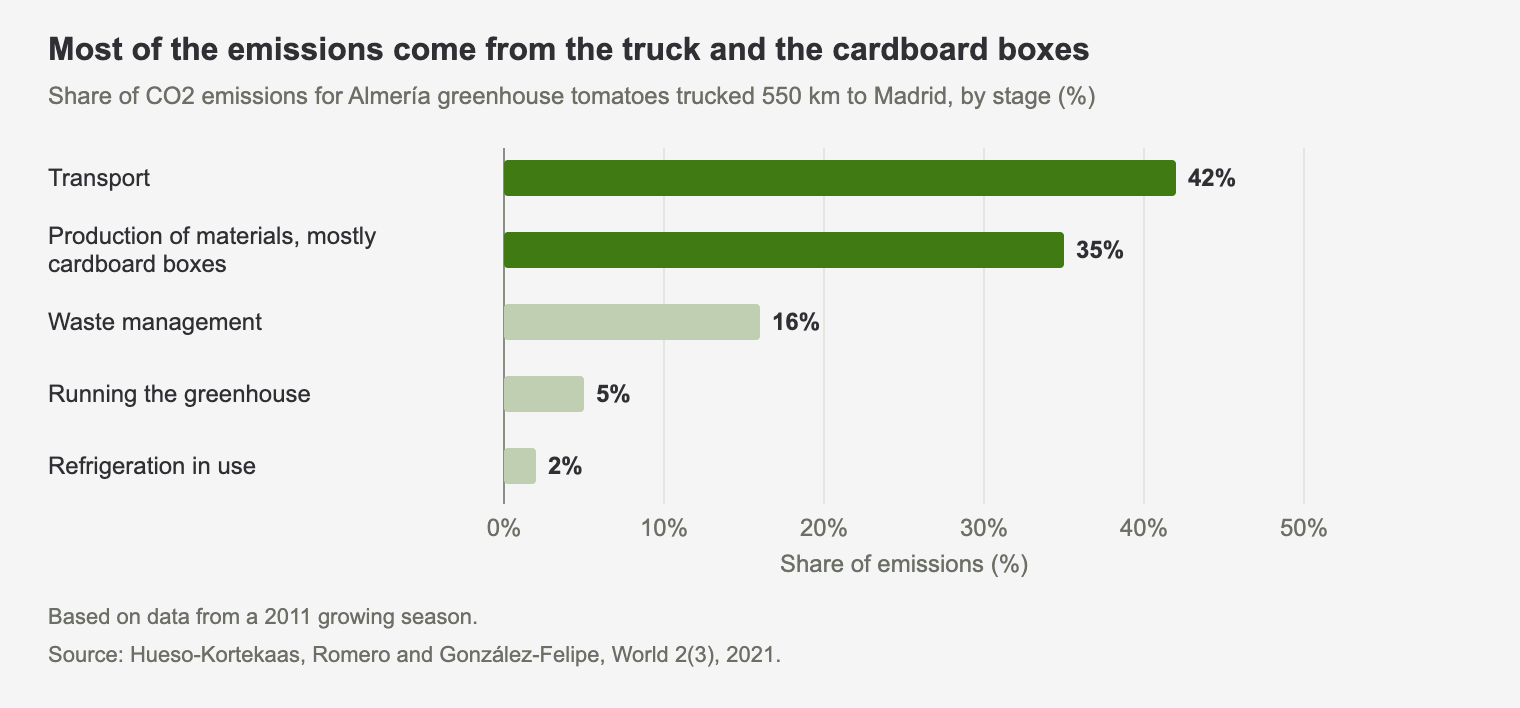
A 2025 review of 50 life-cycle studies put the median carbon footprint of tomatoes from unheated protected structures, such as Almería's, at 83 kg CO2e per tonne, close to that of open-field tomatoes at 80 kg and far below the 1,709 kg for tomatoes grown under climate control. With cultivation this low in emissions, the trip weighs more: in a life-cycle assessment of Almería tomatoes trucked 550 km to Madrid, transport made up 42% of emissions and the production of materials 35%, about three quarters of it for the cardboard boxes, against 5% for running the greenhouse.
In a 2022/23 cost study for vine tomatoes in Almería, labour came to €32,439 per hectare, about 42% of direct costs, with total costs of €77,160 per hectare, or €0.59 per kg at a yield of 13 kg/m².
Before the tomatoes leave the packhouse, they are graded against buyer specifications for size, colour and firmness, and quality standards for fresh fruit and vegetables decide which of them count as saleable. At the other end of the trip, German households produced 76 of the 131 kg of food waste per person that Eurostat recorded for Germany in 2023, the latest year available for the country, and fresh fruit and vegetables make up 35% of avoidable household food waste in the German agriculture ministry's latest household survey, from 2020.
Each kilo that reaches a German kitchen carries a water footprint of just over 100 litres, roughly €0.25 of labour at Almería's 2022/23 costs and a 2,500 km truck journey, and most of its emissions have already been spent on the road and on packaging. None of that shows on the shelf, and none of it comes back when the tomato is thrown away.
A Peruvian avocado spends about three weeks at sea before it ripens
Peru exported 722,754 tonnes of Hass avocados in 2025, 38% more than in 2024, and 63% of the volume went to Europe, with the Netherlands as the main entry point. The crop covers 83,529 ha, farmed by more than 30,000 producers, 94.5% of them on less than 5 ha. La Libertad has the largest planted area, 19,106 ha, on a coast where the Chavimochic irrigation scheme assigns water quotas to each company.
FAO's 2026 review of avocado footprints gives Peru a water footprint of 1,051 m³ of green and blue water plus 81 m³ of grey water per tonne, about 1,130 litres per kilo, or roughly 225 litres for a 200 g avocado. For the coastal area, it reports 1.09 kg CO2e per kilo from orchard to export port, and across the studies it reviews, packaging, refrigeration, and sea freight account for around 10% of emissions. Avocado companies in Peru already measure the carbon and water footprints of their operations, and the national water authority certifies those that meet water-reduction targets.
The fruit leaves the packhouse hard and green for a refrigerated crossing of about 20 to 25 days to northern Europe. The UC Davis Postharvest Center lists 5 to 13°C as the storage range for mature-green avocados, and up to 9 weeks for Hass, in a controlled atmosphere of 2% oxygen and 3 to 5% carbon dioxide at 5 to 7°C. Below that range, the fruit suffers, with skin damage after more than 7 days at 0 to 2°C, and browning of the flesh and sometimes failure to ripen after more than two weeks at 3 to 5°C.
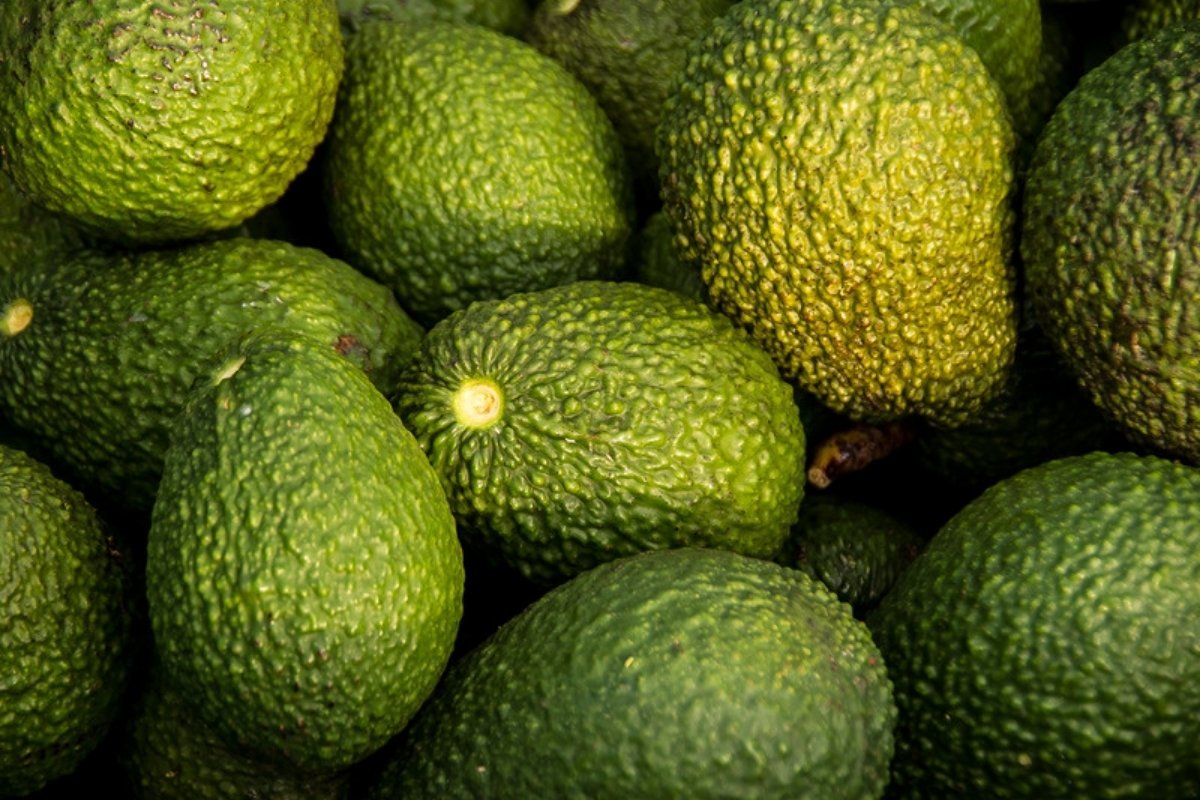
Hass avocados are shipped hard and green and ripen only after they reach Europe.
Europe imported 963,000 tonnes of avocados in 2024, with more than 36% entering via the Netherlands. In ripening rooms, 100 ppm ethylene at 20°C for 12 to 48 hours brings avocados to eating ripeness in 3 to 6 days. Ready-to-eat fruit made up 57% of avocado sales in the Netherlands in 2024, up from 47% in 2020.
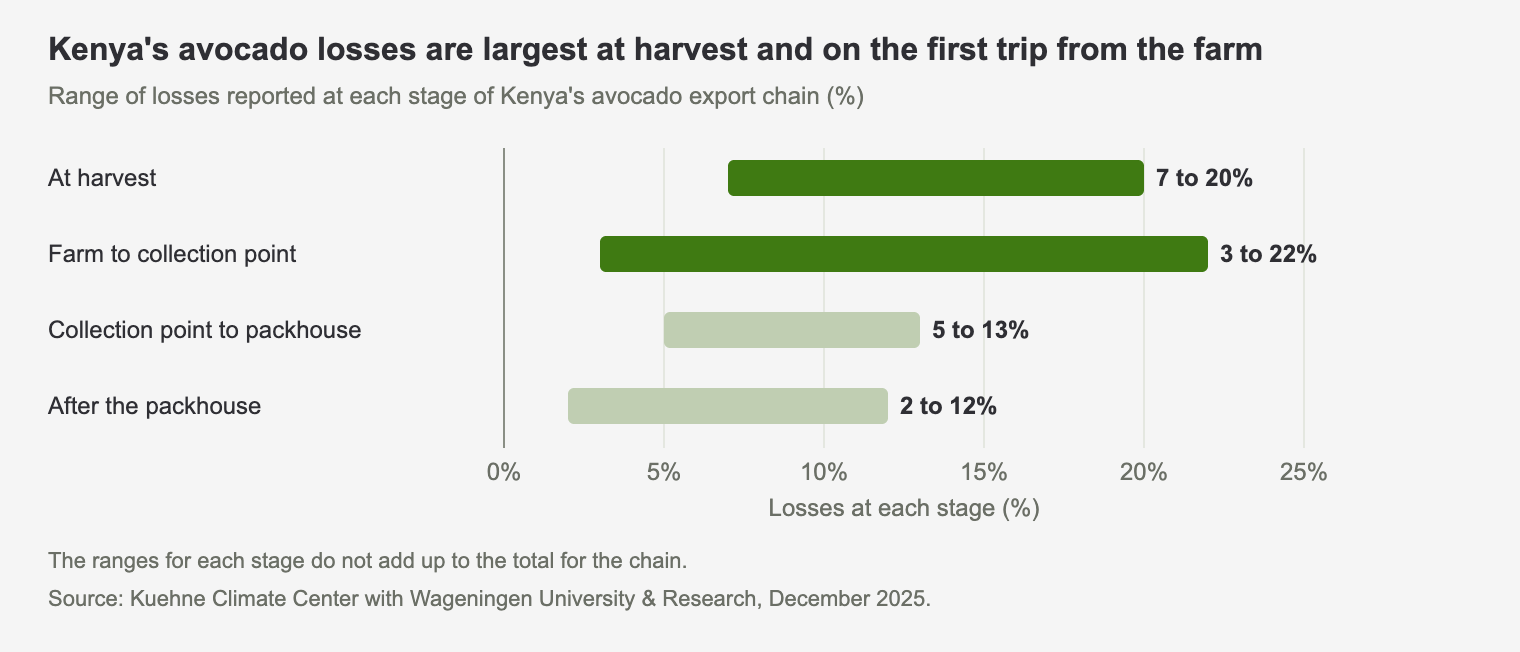
A December 2025 assessment of Kenya's avocado export chain by the Kuehne Climate Center with Wageningen University & Research shows where avocados are lost on the way to export. It puts losses at 13 to 33%, and above 40% in some cases, with 7 to 20% at harvest, 3 to 22% between the farm and the collection point, 5 to 13% on the way to the packhouse, and 2 to 12% after it. Applied to Kenya's 2023 exports, that is 18,000 to 61,000 tonnes worth USD 21 to 69 million, and fruit rejected later in the chain may already have been damaged in the first mile. Fruit that fails avocado export standards can still go to local markets or processing, but it is lost to the export chain it was grown for. At home, a ripe avocado keeps best at 2 to 4°C, so ready-to-eat fruit left on the counter has little time left.
By the time it reaches a European kitchen, a single avocado from coastal Peru has drawn about 225 litres of water, emitted more than 0.2 kg CO2e before reaching the port, crossed an ocean in a refrigerated container and spent days in a ripening room. If it is left on the counter too long, all of that goes into the bin with one soft fruit.
Most of the loss happens before the shop and in the home
The Cretan tomato covers a few hundred kilometres, the Almería tomato 2,500 km and the Peruvian avocado an ocean, yet the losses cluster at the two ends of each chain. At the start, a quarter of the world's fruit and vegetables is lost between harvest and the shop, and in Kenya's avocado exports the largest losses come at harvest and on the first trip from the farm. At the end, households produced 54% of EU food waste in 2024, while shops produced 8%.
Activities after the farm gate account for 70 to 75% of what consumers spend on food, according to SOFI 2026. A tomato graded out in Ierapetra has used water, fertiliser and labour. The same tomato thrown out in an Athens kitchen also carries the cost of the crate, the ferry, the cold room and the shop, which together account for most of its price. For an Almería tomato, the road and the packaging account for most of the emissions, and each Peruvian avocado that ends up in a European bin takes about 225 litres of water from a hyper-arid coast and more than 0.2 kg of CO2e with it. The later a fruit is lost, the more has been spent on it.
No supermarket label shows the water, the labour, the kilometres or the cold storage behind a tomato or an avocado. The bin is the one point in the chain where all of it is lost at once, and it is also the point every household controls.
How losses can be cut at each stage
- Growers and packhouses: harvesting at the right maturity, cooling fruit quickly and finding outlets for graded-out produce in processing or local markets keep more of the crop in the food chain. FAO's Food Loss App, known as FLAPP, helps value chains measure where losses occur.
- Traders and retailers: ordering closer to real demand and ripening to order cut the amount of fruit left unsold, and the Kenyan study lists weak market coordination among the underlying causes of loss. Under Directive (EU) 2025/1892, EU countries must cut food waste per person in retail, restaurants and households by 30%, and in processing and manufacturing by 10%, by 31 December 2030 compared with the 2021 to 2023 average.
- Households: keeping unripe tomatoes and avocados out of the fridge, moving ripe avocados into it, buying fresh produce in smaller amounts and cooking soft tomatoes into sauces keep fruit edible for longer. The same logic runs through strategies for reducing food waste from field to fork.
Frequently asked questions
When is the International Day of Awareness of Food Loss and Waste?
The UN General Assembly proclaimed 29 September as the day in resolution 74/209 on 19 December 2019, and FAO and UNEP lead it every year. The official 2026 theme is "Transformative Potential of Reducing Food Loss and Waste".
What is the difference between food loss and food waste?
Food loss is food that leaves the supply chain after harvest and before retail, on farms, in transport, storage, wholesale and processing, and FAO tracks it with the Food Loss Index. Food waste happens in retail, food service and households, and UNEP tracks it with the Food Waste Index. Both are part of SDG target 12.3.
How much food is lost and wasted in the world?
FAO estimates that 13.3% of food was lost between harvest and retail in 2023. UNEP estimates that 1.05 billion tonnes, 19% of the food available to consumers, were wasted in 2022.
Which foods are lost the most?
Fruit and vegetables lose the most, with 25.4% lost between harvest and retail in 2023. Adding waste in shops and homes, FAO puts their total losses at roughly 40 to 50% of production by weight.
Should tomatoes and avocados be kept in the fridge?
Unripe tomatoes and avocados keep better out of the fridge. UC Davis gives 12.5 to 15°C for mature-green tomatoes and 7 to 10°C for firm-ripe ones, with chilling injury after 6 to 8 days at 5°C. Ripe avocados keep best at 2 to 4°C.
What are the EU targets for food waste?
Directive (EU) 2025/1892, in force since 16 October 2025, requires a 10% cut in processing and manufacturing and a 30% cut per person in retail, food service and households by 31 December 2030, against the 2021 to 2023 average.
How much food does Greece waste?
Eurostat recorded 208 kg of food waste per person in Greece in 2024, including an estimated 87 kg from households. The EU averages were 129 kg and 69 kg.
Sources
- BMLEH. (2024). Lebensmittelabfälle in privaten Haushalten unter die Lupe genommen. Bundesministerium für Landwirtschaft, Ernährung und Heimat.
- CBI. (2025). The European market potential for avocados. Centre for the Promotion of Imports from developing countries.
- European Parliament and Council. (2025). Directive (EU) 2025/1892 amending Directive 2008/98/EC on waste. Official Journal of the European Union.
- Eurostat. (2026). Food waste and food waste prevention by NACE Rev. 2 activity (env_wasfw). European Commission.
- FAO, IFAD, UNICEF, WFP and WHO. (2026). The State of Food Security and Nutrition in the World 2026. FAO.
- FAO. (2025). SDG indicator 12.3.1a, global food losses. FAO SDG Indicators Data Portal.
- FAO. (2026). International Day of Awareness of Food Loss and Waste. Food and Agriculture Organization of the United Nations.
- Hernández Lagana, M. (2026). Measuring carbon and water footprints in avocado value chains. FAO.
- Hueso-Kortekaas, K., Romero, J.C. and González-Felipe, R. (2021). Energy-environmental impact assessment of greenhouse grown tomato. A case study in Almeria (Spain). World, 2(3), 425-441.
- Junta de Andalucía. (2024). Costes de producción de tomate rama, campaña 2022/23. Observatorio de la Cadena Alimentaria, MAPA.
- Junta de Andalucía. (2025). Almería 2024/25 horticultural campaign figures. Consejería de Agricultura, Pesca, Agua y Desarrollo Rural.
- Kuehne Climate Center. (2025). Postharvest assessment of the avocado supply chain in Kenya. With Wageningen University & Research.
- Lo-Iacono-Ferreira, V.G., Viñoles-Cebolla, R., Bastante-Ceca, M.J. and Capuz-Rizo, S.F. (2021). Carbon footprint comparative analysis of cardboard and plastic containers used for the international transport of Spanish tomatoes. Sustainability, 13(5), 2552.
- Municipality of Ierapetra. Ierapetra.
- Oikonomikos Taxydromos. (2025). Θερμοκήπια, το στοίχημα των 3.500 στρεμμάτων και των 10.000 θέσεων εργασίας, with ELSTAT 2020 agricultural census data.
- ProHass. (2026). ProHass Informa, issue 16. Asociación de Productores de Palta Hass del Perú.
- Reca, J., Martínez, J., Marín, P.M., Galindo, C., Peña, A.A. and Valera, D.L. (2025). Experimental evaluation of the water productivity and water footprint of a greenhouse tomato crop for different blends of desalinated seawater and two growing media. Agronomy, 15(6), 1312.
- The Cooperative Logistics Network. (2026). Avocado export logistics, the cold chain from Mexico and Peru to Europe.
- UC Davis Postharvest Research and Extension Center. Avocado, recommendations for maintaining postharvest quality.
- UC Davis Postharvest Research and Extension Center. Tomato, recommendations for maintaining postharvest quality.
- UNEP. (2024). Food Waste Index Report 2024. United Nations Environment Programme.
- Zhu, Z. and Miller, S.A. (2025). Greenhouse gas emissions of tomato production and supply. A systematic review. Resources, Conservation and Recycling, 218, 108236.