A practical guide to EU and U.S. avocado standards for growers and traders
Avocados (Persea americana Mill.) have evolved from a niche fruit into one of the most traded tropical commodities worldwide. In 2024, global exports reached 2.9 million tonnes, a modest 1.8% increase from 2023, following years of double-digit growth. With more consumers demanding consistent quality and ready-to-eat convenience, quality standards have become central to the global avocado business.
The international avocado market operates under strict quality and classification standards. From Mexico and Peru to Kenya and South Africa, meeting the specifications of the European Union, the United States, and OECD markets determines whether fruit reaches supermarket shelves or faces rejection.
This guide brings together the latest international standards and market data to help growers, packers, and traders understand how avocados are graded, sized, packed, and traded globally.
Highlights at a glance
- Avocado exports reached 2.9 million tonnes in 2024, up 1.8% despite reduced output in Mexico and Peru.
- Hass remains the dominant variety in global trade, prized for its quality, firmness, and shelf life.
- Export-quality avocados must meet UNECE, Codex, and USDA standards defining maturity, external appearance, and defects.
- Size and packaging consistency are critical for export acceptance and retail presentation.
Minimum quality requirements
Avocados sold for the fresh market must comply with minimum requirements established by the UNECE Standard FFV-42 (2023), the Codex Alimentarius Standard CXS 197-1995 (Rev. 2013), and the USDA regulations.
All standards agree that fruit must be:
- Intact and sound, free from rotting or damage affecting edibility.
- Clean, practically free from visible foreign matter.
- Free from pests, foreign smell, or taste.
- Free from abnormal external moisture (except condensation after cold storage).
- With a stem not longer than 10 mm, cleanly cut; its absence is allowed if the attachment point is dry and intact. For the U.S. markets, the standard is a maximum of 1 inch (25.4mm).
The fruit must be physiologically mature so it can ripen properly during transport and distribution. These rules ensure fruit can withstand handling and long-distance transport while arriving in good condition at destination markets.
If you'd like to explore practical cultivation techniques, orchard management tips, and postharvest best practices, visit our dedicated section: Avocado Cultivation and Management Guides
Maturity and dry matter standards
Maturity is the cornerstone of avocado quality. Exporters must ensure that fruit is harvested mature enough to ripen properly during transport without becoming rubbery or developing off-flavours.
According to Codex and UNECE standards, avocados must meet minimum dry matter thresholds at harvest, measured after drying the pulp to a constant weight:
|
Variety |
Minimum dry matter (%) |
|
Hass |
21 |
|
Fuerte, Pinkerton, Reed, Edranol |
20 |
|
Other varieties |
19 |
|
Antillean / West Indian types |
lower thresholds allowed |
Fruit should be free from bitterness and physiologically developed to allow full ripening after harvest.
In the U.S., maturity verification is often supported by oil content tests or pressure firmness checks, while in EU markets, dry matter remains the preferred indicator.
Typical pressure thresholds (in PSI) for Hass avocados are:
- Hard: >25
- Firm: 15–25
- Breaking: 10–15
- Firm-ripe: 5–10
- Eating ripe: <5
To explore trading opportunities and connect directly with verified buyers and sellers, visit: Wikifarmer Marketplace – Avocados
Classification and quality classes
Both UNECE and Codex divide avocados into three classes, while USDA uses a grading system that closely mirrors them.
|
Class / Grade |
Description |
Surface defects allowed |
|
Extra Class / U.S. Fancy |
Superior fruit typical of the variety, uniform color and shape |
Only very slight superficial marks |
|
Class I / U.S. No. 1 |
Good quality fruit, slight defects in shape or color permitted |
Skin defects up to 4 cm² (light sunburn, corkiness, healed lenticels) |
|
Class II / U.S. No. 2 |
Marketable fruit with visible imperfections |
Skin defects up to 6 cm²; must not affect flesh |
Tolerance limits permit up to 5–10% of fruit to fall into a lower class within a package, depending on the class designation.
Sizing systems explained
Avocados can be graded either by weight, depending on destination market and variety. Codex and UNECE provide a harmonized table based on individual fruit weight:
|
Size code |
Weight range (g) |
|
2 |
> 1220 |
|
4 |
781 – 1220 |
|
6 |
576 – 780 |
|
8 |
456 – 576 |
|
10 |
364 – 462 |
|
12 |
300 – 371 |
|
14 |
258 – 313 |
|
16 |
227 – 274 |
|
18 |
203 – 243 |
|
20 |
184 – 217 |
|
22 |
165 – 196 |
|
24 |
151 – 175 |
|
26 |
144 – 157 |
|
28 |
134 - 147 |
|
30 |
123 – 137 |
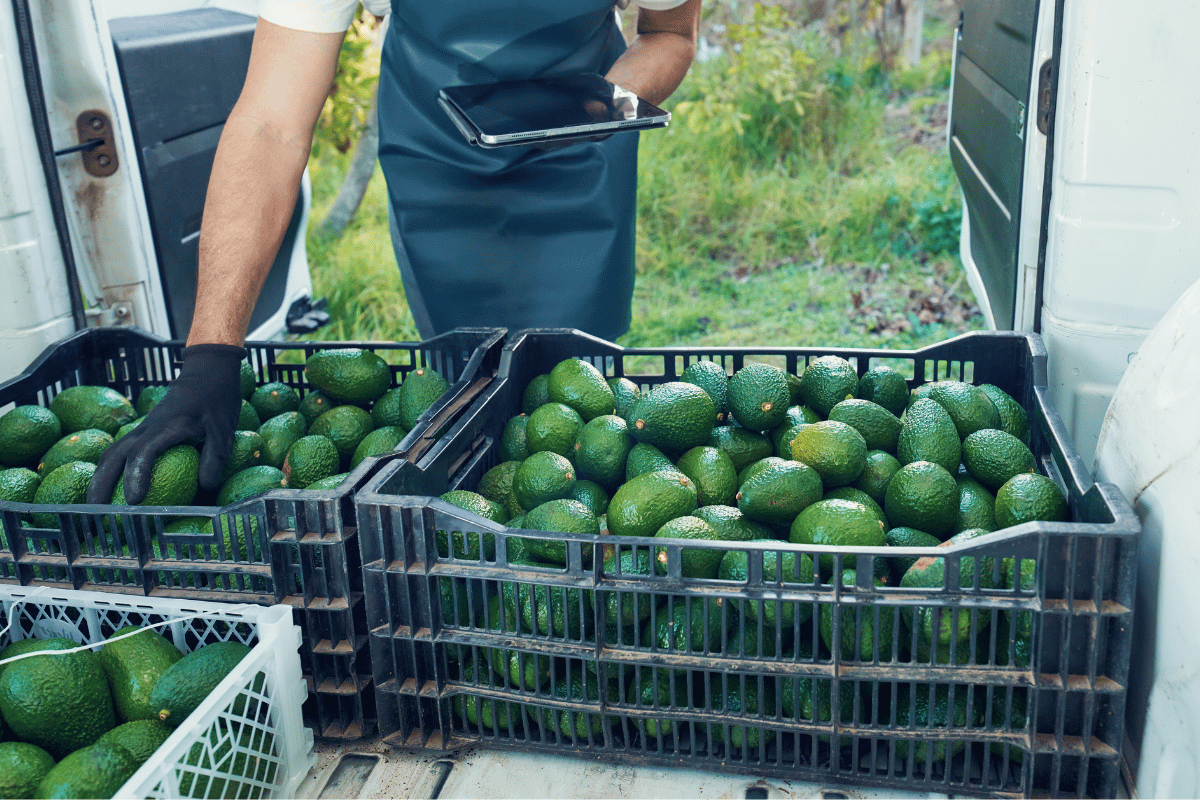
Commercially, exporters and retailers often use the count-per-carton system, especially for 4 kg boxes:
|
Count per 4 kg carton |
Approx. weight per fruit (g) |
Market preference |
|
10–12 |
330–400 |
United Kingdom, Germany (larger size) |
|
14–16 |
250–300 |
Netherlands, France (standard retail) |
|
18–22 |
180–250 |
U.S. retail packs and small fruit markets |
Small sizes (26–30) are also sold in affordable boxes of 10 kg at the start of the season. Uniformity within a package is essential: the difference between the smallest and largest fruits within a package should not exceed 25 g.
For the U.S. market, avocados are usually packed by count (e.g., 32, 36, 40, 48, 60 per carton).
Packaging and labelling
Proper packaging protects avocados from bruising and supports brand traceability. Both Codex and UNECE require:
- New, clean, food-safe materials that prevent contamination or moisture accumulation.
- Uniformity within each package in terms of variety, size, and ripeness.
- Corrugated cardboard boxes (4 kg or 10 kg)
- Recyclable plastic crates or trays
- Small consumer packs (net bags or flow-packs) for pre-ripened fruit
Mandatory labelling
Each package must display:
- Packer or exporter identification (name and address or official code)
- Product name and variety (e.g., "Avocados – Hass")
- Country of origin
- Class and size code or count range
- Official inspection mark (if applicable)
In the U.S., labels must also comply with the FDA's country-of-origin and traceability rules, while EU markets follow Regulation (EU) 543/2011 for fresh produce labelling.
Storage and Handling – Best Practices
- Pre-shipment cooling: Remove field heat promptly; hold around 7°C for <23% DM fruit; lower temperatures (down to 4°C) for late-season, high-DM shipments if properly managed.
- Ethylene management: Avoid cross-contamination from bananas, apples, melons during storage and shipping – avocados are sensitive.
- Controlled Atmosphere: Some exporters ship with 4-6% O₂ and 5-10% CO₂ to extend shelf life.
- Ripening: Best at 18–20°C (65–68°F) for even, safe ripening with high humidity. Allow for 4–7 days shelf life at retail.
Temperature abuse, mixed maturities, and rough handling are leading causes of off-quality and market failures.
Common postharvest defects
External effects
- Lenticel (black spot): Caused by mechanical damage or rough handling
- Sunburn: Strict surface area limits (yellow, brown, or dark, with max area defined per class)
- Cuts, bruises, hail: All strictly limited by size (cm² or % of surface)
- Anthracnose, cercospora, sooty mould: Fungal blemishes heavily inspected (any progress into flesh disqualifies fruit from premium classes)
Internal defects
- Vascular browning and grey pulp: Signs of chilling injury or advanced ripening/ageing
- Stem-end rot, body rots: Infection at ends or throughout,a major cause for rejections
- Internal bruising: Deep flesh damage, often from compression
For a detailed explanation of common defect types, you can explore Common avocado quality defects.
Phytosanitary and compliance hotspots
- EU: Strict plant health and traceability, with four options to control quarantine pests (prefer nationally recognised pest-free status, or official post-harvest treatment/documentation).
- US: Avocados must be free from quarantine pests, treated (e.g., hot water), and certified for maturity for each variety.
- All major buyers now require food safety certification (e.g., GLOBALG.A.P., IFS, BRCGS), as well as traceability, and in some cases, social/ethical audits.
Global avocado trade trends (2023–2025)
Global avocado exports reached 2.9 million tonnes in 2024, marking a moderate 1.8% increase after the sharp 11% growth seen in 2023.
According to FAO data, Mexico and Peru together supplied around 64% of global export volumes. Unfavourable weather reduced yields in both countries, pushing up prices, and Mexican export unit values surged to USD 3,177 per tonne in 2024.
|
Country |
2024 exports (tonnes) |
Change vs 2023 |
Main markets |
Avg. export value (USD/t) |
|
Mexico |
1 300 000 |
−6.6 % |
USA (90 %), Canada (7 %) |
3 177 |
|
Peru |
570 000 |
−4.8 % |
EU (55 %) – Netherlands & Spain |
2 175 |
|
Kenya |
130 000 |
+5.8 % |
EU (>50 %) |
1 200–1 400 |
|
Israel |
110 000 |
+38 % |
EU & UK |
– |
|
South Africa |
80 000 (est.) |
Stable |
EU & Middle East |
– |
Meanwhile, Kenya, Israel, and South Africa expanded their exports, partly filling the supply gap. Kenya shipped 130,000 tonnes (+5.8%), while Israel achieved a remarkable 38% rise to 110,000 tonnes.
On the import side, the United States remained the top destination (41% of global imports, 1.2 million tonnes), followed by the European Union (800,000 tonnes, +5.6%). Demand in Germany, Italy, and Poland grew strongly, supported by the fruit’s healthy image and diversified supply from African and Mediterranean origins.
Tight supplies led to elevated global prices, with wholesale prices in the U.S. averaging USD 6.35/kg in 2024, the highest in a decade.
Final insights for growers and traders
High-quality avocados start with harvest maturity and end with proper handling. To ensure compliance and customer satisfaction:
- Verify dry matter content before harvest for each variety.
- Avoid picking wet fruit and sterilize cutting tools regularly.
- Keep fruit cool from orchard to export container.
- Follow official UNECE, Codex, or USDA classification depending on the target market.
- Use clear, traceable labeling and uniform packaging.
Growers and exporters who monitor maturity levels, adopt gentle handling and cold chain management, and ensure accurate grading can access premium segments and reduce postharvest loss.