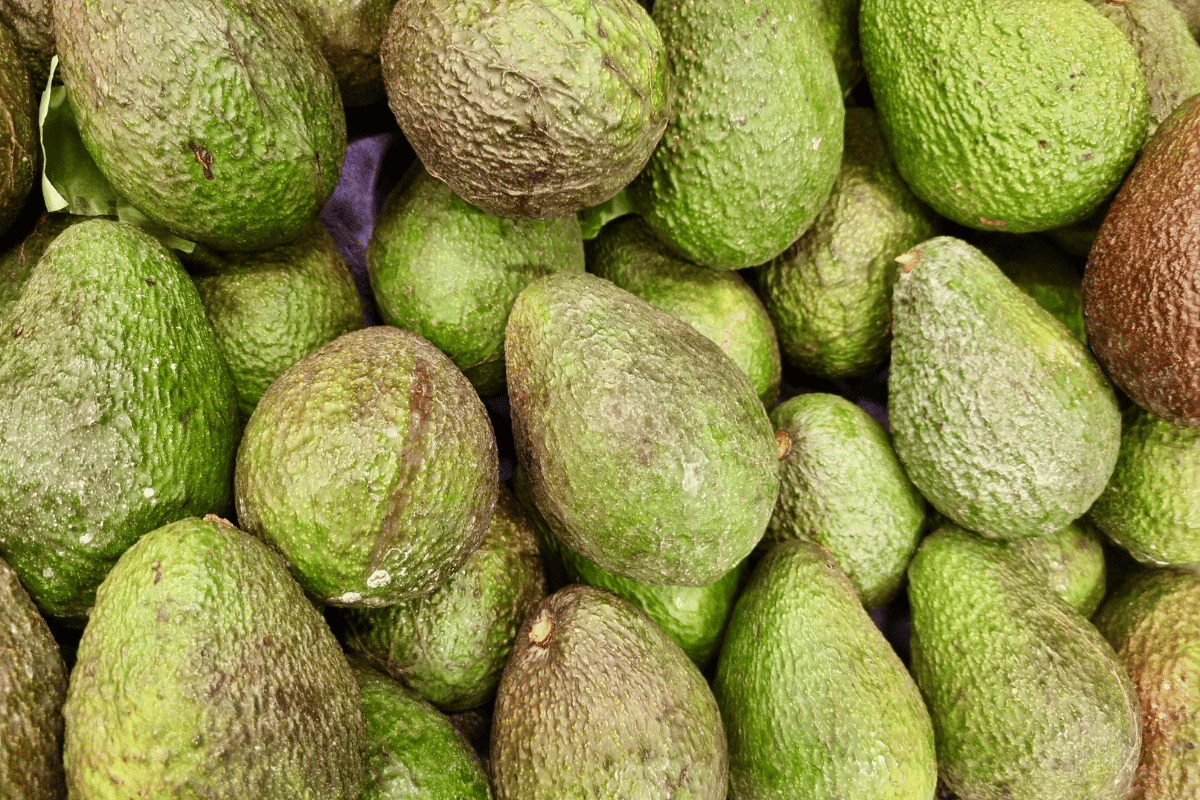
Common avocado quality defects
Quality defects in avocados remain one of the main causes of export rejection worldwide. These issues usually fall into three broad groups:
- External blemishes such as lenticel damage, sunburn, or fungal infections.
- Internal disorders like vascular browning, stem-end rot, or internal bruising.
- Cold chain problems leading to chilling injury and overripe fruit upon arrival.
Both OECD and Codex Alimentarius standards emphasize that only avocados that are intact, sound, clean, and free of abnormal moisture, pests, and odors qualify for export. Proper maturity and handling are critical to ensuring fruit reaches its destination in good condition.
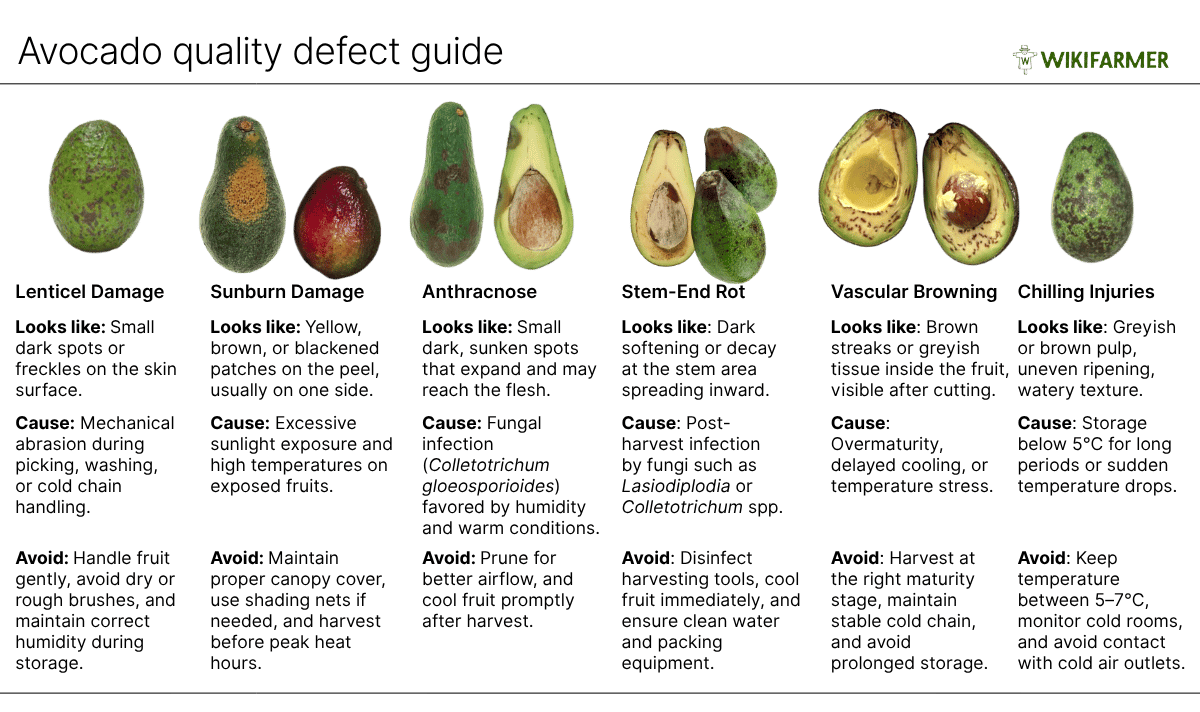
Avocado external defects
Lenticel damage (Black Spot)
Lenticel damage appears as small black or brown spots, typically 1–5 mm wide, concentrated around the fruit's natural pores. It is one of the most common cosmetic defects, reducing fruit grade from "Extra" to Class I or II.
These spots occur when fruit skin is damaged in regions around natural pores (lenticels) that allow gas exchange in plant tissue. The disorder becomes particularly problematic when fruit is harvested with high skin turgidity, making lenticels extremely sensitive to handling damage.
Research demonstrates that lenticel damage develops through a cascade of physiological responses. When avocados absorb water, particularly after rainfall or through artificial soaking, cells beneath lenticels become highly turgid, filling intercellular spaces. These turgid cells are more susceptible to mechanical stress and turn brown more rapidly than other mesocarp cells due to increased cellular distention. The problem intensifies along the handling chain, with severe damage occurring primarily on fruit sampled from pack lines rather than at harvest.
When irrigation stops one month before harvest, damage rates can drop to less than 5% of fruit. Conversely, calcium nitrate sprays applied late in the season may aggravate the problem if followed by rough handling.
Sunburn damage
Sunburn appears as yellow, brown, or dark discolouration on the fruit surface with strict area limits defined per class. Sunburn tolerance limits in avocado grading:
United States (USDA standards)
- US No. 1 grade: sunburn (greenish-yellow discolouration) allowed on up to 10% of fruit surface.
- US No. 2 grade: sunburn permitted on up to 25% of fruit surface.
Europe (UNECE / OECD standards)
- Class I: maximum affected area 4 cm², defect must be non-progressive and not affect the flesh.
- Class II: maximum affected area 6 cm², also must be non-progressive and limited to the skin.
The disorder results from direct sun exposure during fruit development, with less mature early-season fruit showing greater susceptibility. Sunburn can be distinguished from similar disorders by its characteristic surface yellowing or browning pattern that remains confined to the epidermis without penetrating internal tissues.
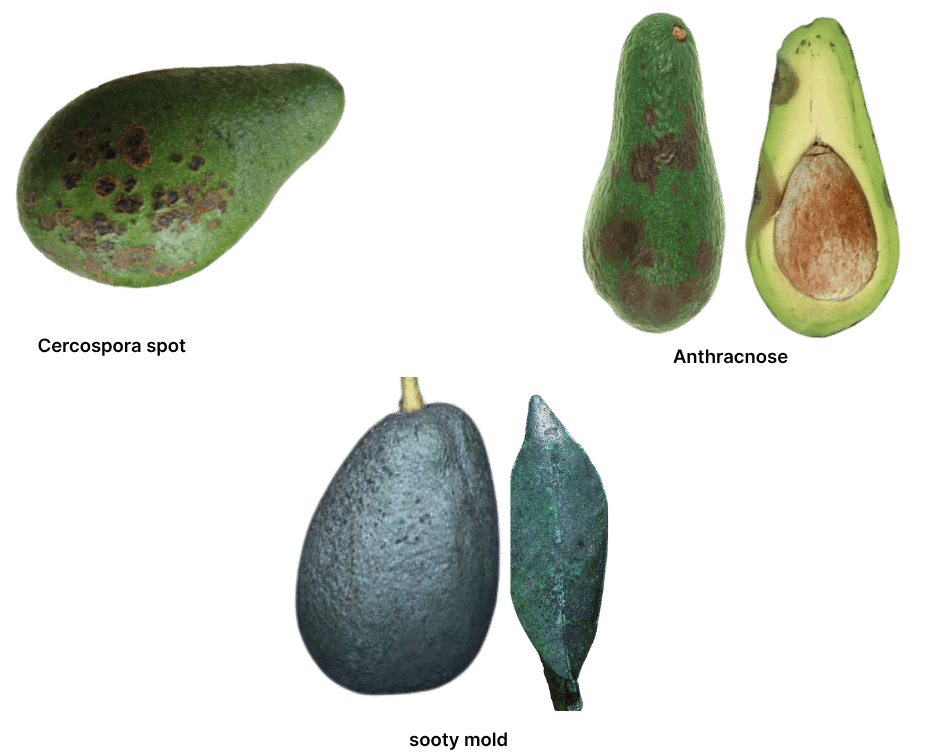
Anthracnose, Cercospora, and sooty mould
Fungal blemishes represent a major cause of export rejection due to their potential to penetrate into fruit flesh, automatically disqualifying fruit from premium classes. Anthracnose, caused by Colletotrichum gloeosporioides and C. acutatum, follows a latent infection pattern where spores infect fruit in the field but symptoms only develop after harvest during ripening.
Pre-harvest anthracnose appears as small, dark spots less than 5 mm (about 0.2 in) in diameter that develop around lenticels on infected fruit. Post-harvest symptoms escalate dramatically, with brown to black lesions becoming increasingly sunken and spreading over the entire fruit surface. As lesions age, they may develop cracks and produce characteristic pinkish, moist masses of fungal spores. When infection spreads into the flesh, it causes a greenish-black, firm decay that rapidly progresses throughout the pulp.
The fungus overwinters in infected plant debris, dead branches, and fruit mummies in the canopy. Infection occurs primarily through wounds, insect damage, or directly through lenticels when conidia germinate under wet conditions and temperatures of 10-35°C (50–95 °F). The optimal infection temperature is approximately 28°C (82 °F). Pre-harvest factors that exacerbate anthracnose include warm, wet conditions, mechanical or insect damage, and dead wood within trees, which serve as inoculum reservoirs.
Cercospora spot (Pseudocercospora purpurea) and sooty mould present similar challenges. Cercospora appears as fungal blemishes on fruit surfaces, while sooty blotch (Akaropeltopsis species) produces characteristic sooty patches on branches, stems, leaf veins, and fruit.
Cuts, bruises, and hail damage
Mechanical defects are strictly limited by size, measured in cm² or as a percentage of the surface area. U.S. standards for No. 1 grade require fruit to be "free from damage caused by bruises, cuts or other skin breaks," while No. 2 grade requires freedom from "serious damage". Surface injuries, including cuts, abrasions, and friction, can affect up to 78% of harvested fruit in poorly managed systems.
Mechanical damage accelerates water loss, disrupts the protective surface arrangement, allowing faster gas exchange, and creates entry points for fungal pathogens. The cicatrization (wound healing) capacity and production of antifungal substances diminish as avocados ripen, making early damage increasingly consequential. Impact studies demonstrate that body rot development is promoted by mechanical injury at harvest and packing, even when the fruit is hard, green, and mature. With increasing drop height, body rot at the eating-ripe stage occurs more frequently and produces larger lesions.
To explore trading opportunities and connect directly with verified buyers and sellers, visit the Wikifarmer Marketplace – Avocados.
Avocado internal defects
Vascular browning and grey pulp
Vascular browning manifests as streaky dark brown to black discolouration affecting vascular tissue (the nutrient and water transport system) of the avocado, typically starting at the blossom end of the seed and extending toward the stem end. The disorder specifically describes brown vascular bundle discolouration that is already visible whenthe fruit is cut but becomes more pronounced upon exposure to air.
The condition results from chilling injury, particularly during extended storage at temperatures too low for fruit maturity, or from advanced ripening and ageing. Cold temperatures weaken cells, leading to tissue death and browning in the vascular bundles. The symptoms are often more pronounced around the distal (bottom) end of the avocado. Vascular browning must be distinguished from stem-end rot, frost injury, and vascular blackening, though all involve vascular tissue discolouration.
Grey pulp represents a diffuse discolouration disorder occurring when fruit has been exposed to suboptimal storage conditions. This includes exposure to chilling temperatures or suffocation during controlled atmosphere (CA) transport. The tissue usually spreads from the blossom end, becomes rubbery, will not ripen properly, and sometimes develops an off smell. Internal browning associated with grey pulp can result from ageing or suffocation during CA transport, with affected tissue becoming unmarketable.
Chilling injury symptoms have been attributed to multiple factors, including storage at low temperatures (particularly below 5°C), high ethylene concentrations, and harvest of overripe fruit. The shortest symptom reproduction (15.5 days) occurred at 5°C with 20% dry matter content, demonstrating the interaction between temperature and maturity.
Stem-end rot and body rots
Stem-end rot represents a major cause of export rejection, appearing as translucent to brown discolored areas in fruit flesh starting from the stem end and progressing downward through the fruit. In severe cases, white fluffy or pinkish fungal mycelium becomes visible. Externally, a black, clearly decaying zone around the stem end may be present, though early-stage development may show no external symptoms.
A complex of fungi causes the disorder present in avocado trees in the field, including Colletotrichum acutatum, C. gloeosporioides, Botryosphaeria parva, B. dothidea, Phomopsis species, Lasiodiplodia theobromae, Neofusicoccum parvum, Nectria pseudotrichia, and various Fusarium species. Dead branches within trees serve as particular sources of fungal spores that infect fruit.
Infection mechanisms involve three possible pathways: smearing fungal tissue present just under the bark over the picking wound with secateurs during harvest, spores landing on wounds from inoculum released from dead fruit and twigs in the canopy by rain or shaking, and possibly spores in small pieces of dead flower tissue attached at the fruit-stalk junction. Following infection, brown streaking extends down the vasculature as a defensive host response, with fungal structures sometimes visible growing through xylem elements.
Fruit becomes infected mainly at harvest time, with the fungi entering through cut fruit pedicels. Picking wet fruit significantly increases infection risk, and less mature fruit are more susceptible. Growth of stem-end rot fungi is suppressed by low temperatures but increases rapidly once fruit starts ripening. This explains why symptoms often appear only after fruit reaches retail or consumer stages despite the infection occurring weeks earlier.
Internal bruising
Flesh bruising represents approximately half of all avocado internal defects detected at the retail level, constituting a major concern for the industry. The problem is particularly insidious because consumers cannot detect internal bruising until cutting the fruit open, leading to disappointment and reduced future purchase intent.
Internal bruising develops when fruit tissue experiences stress beyond its elastic limit, causing cell walls to fail and permanent damage to occur. As cells rupture, compartmentalised contents mix together, bringing phenolic compounds into contact with the enzyme polyphenoloxidase (PPO), which triggers enzymatic browning and produces brown polymerised phenolics characteristic of bruises.
Temperature significantly affects bruising susceptibility. Cold storage prior to impact makes cells stiffer and more easily damaged, while cold storage after impact reduces bruise area. Fruits impacted at flesh temperature of 15°C (59 °F) produced bruise areas (106.60 mm²) exceeding the industry threshold of 100 mm². Storage temperature of 13°C (55.4°F), as recommended in industry standards, helps minimise bruising development.
Major causes of export rejection
Lenticel damage during handling
Most export rejections originate from lenticel damage aggravated by mechanical handling. Long storage or delays before shipment worsen visible symptoms. European inspection protocols disqualify fruit with widespread lenticel spotting, even if flesh remains sound.
Overripe or soft fruit on arrival
Incorrect temperature management during shipping leads to premature ripening. High transport temperatures soften fruit, while excessively low ones cause cold injury. For Hass, the ideal transport range is 5–7 °C (41–45 °F) early in the season and 4.5–5.5 °C (40–42 °F) later, with 85–95 % relative humidity. Rapid pre-cooling within hours of harvest is essential to remove field heat.
Chilling injury from poor cold-chain control
If storage or shipping temperatures fall below the tolerance level for the maturity stage, chilling injury develops. Typical symptoms are black, sunken areas on one side of the fruit, often near the distal end, without initial flesh penetration. Extended exposure at 4–5 °C (39–41 °F) for immature fruit greatly increases risk.
Why avocado quality matters
Quality determines more than market classification; it defines consumer trust, shelf life, and overall profitability. Exporters face not only price penalties for downgraded fruit but also long-term brand damage when arrivals fail to meet expectations. Consistent adherence to international grading standards, precise post-harvest handling, and rigorous cold chain management safeguard the fruit's visual appeal, texture, and nutritional value. In an increasingly competitive market, quality is not just a compliance requirement but a strategic advantage that connects growers to premium buyers and ensures the global reputation of avocado-producing regions.
For a complete overview of avocado classification, maturity requirements, and packaging rules, read our fullAvocado quality guide and export standardsAvocado Quality Guide and Export Standards
Sources
- Entering the European market for avocados
- Shipping Point and Market Inspection Instructions
- International standardisation of fruit and vegetables: Avocado
- UNECE STANDARD FFV-42
- Major Tropical Fruits Market Review 2024
- Florida Avocado Grades and Standards — USDA Agricultural Marketing Service
- AVOCADO Post-harvest Operations
- Impact Injury at Harvest Promotes Body Rots in ‘Hass’ Avocado Fruit upon Ripening
- Avocado lenticel damage: The cause and the effect on fruit quality
- The dark side of avocados: a review of anthracnose and stem-end rot in postharvest fruit
- Images from the Wagenigen University and the University of California Agriculture and Natural Resources