Europe's appetite for avocados shows no sign of slowing down. In 2025, the European Union imported approximately 915,000 tonnes of avocados, a 14% increase from the previous year, making it one of the fastest-growing fresh fruit categories on the continent. Yet behind those headline numbers lies a more nuanced story: European avocado demand does not follow a simple, year-round curve. It rises and falls with the seasons, with consumption peaks that often catch exporters off guard and supply gaps that open genuine commercial windows for well-positioned suppliers.
Why seasonality matters in the European avocado market
Fresh avocados are perishable, climate-sensitive, and harvested over defined windows depending on altitude, variety, and growing region. For European importers and retailers, this means supply availability genuinely changes across the year, and prices move with it.
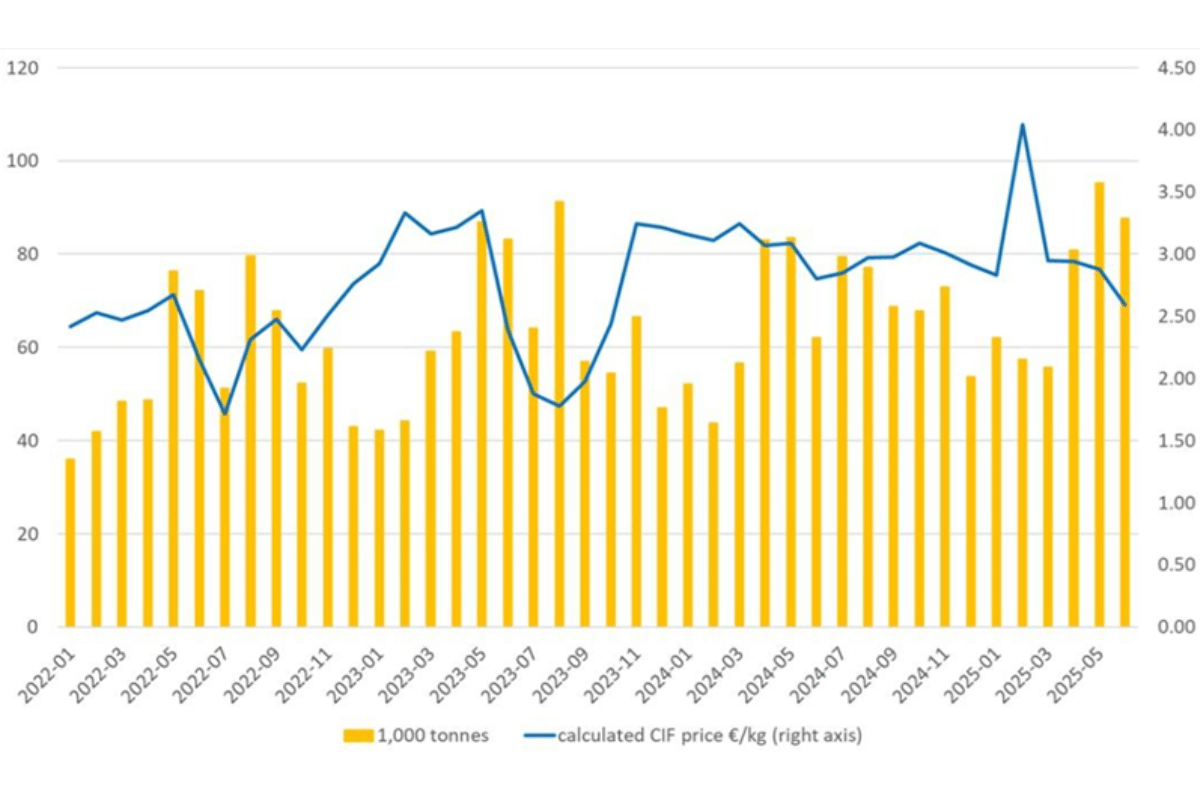
Avocado trade volumes and calculated import prices in Europe per calendar month, 2022-June 2025 (in thousand tonnes and €/kg). Source: Eurostat
The Hass variety dominates European trade, prized for its creamy texture, relatively long shelf life, and the clear visual ripeness cue of its skin darkening as it matures. Understanding Hass harvest timelines across the main supplier countries is therefore the starting point for any serious export strategy.
From a European buyer's perspective, the year broadly divides into two distinct phases: a period of relative scarcity when Northern Hemisphere suppliers wind down, and a period of abundance when Southern Hemisphere harvests arrive. Each phase creates different pricing, quality, and logistics conditions.
The European avocado seasonal calendar, month by month
.png)
The following breakdown reflects typical supply patterns based on harvest windows, shipping times, and historical import flows. Actual timing shifts slightly year to year, depending on weather and growing conditions.
November to February
During the European autumn and winter, Mexico is the anchor supplier. Mexico accounts for roughly 40% of global avocado exports and typically runs its primary Hass harvest from October through March in the Michoacán and Jalisco growing regions. Shipments reach Europe within 10–14 days by sea.
In 2025, however, Mexico's export volumes to the EU softened slightly, dipping around 3% year-on-year as domestic demand absorbed a greater share of the national crop. This creates a structural opportunity: European importers who rely heavily on Mexican supply in winter are increasingly looking for complementary sources.
Morocco has emerged as a genuine alternative for winter supply. In 2025, Moroccan avocado exports nearly doubled year-on-year, reaching 141,000 tonnes globally. The country's proximity to Europe, shipping times of just 3–5 days, and its growing focus on Hass production make it increasingly attractive. Spain, France, and the Netherlands all import Moroccan avocados during the November–February window.
March to April
March and April represent the most challenging period for European buyers. Mexican supplies are winding down as the main harvest concludes. Southern Hemisphere origins like Peru, Chile, and South Africa are not yet shipping in volume. Inventories tighten, and wholesale prices typically rise.
This gap is not total: late-season Mexican fruit and early Moroccan volumes can partially bridge the shortage, and South African early-harvest product sometimes reaches the EU from February onward. But quality can be variable at the season edges, and buyers often manage this period through careful stock management and ripening room scheduling.
May to August: Peru takes centre stage
The May-to-August window is Peru's primary export season to Europe, and in 2025, it was on a dramatic scale. According to preliminary data, Peruvian avocado exports reached 800,000 tonnes globally, a ~40% increase on 2024, with the EU receiving well over half of that volume. Favourable weather in La Libertad, Ica, and Lima produced excellent fruit size and quality, and an extended harvest window pushed shipments deeper into August.
Peru's counter-seasonal position relative to Europe is its key commercial advantage. While European weather is warm and retail demand for avocados peaks with salads, grilling season, and summer entertaining, Peru's growing regions are in their autumn harvest. Shipping times from Peruvian ports to Rotterdam or Algeciras run around 20–22 days, which remains manageable for a fruit that handles well under controlled atmosphere conditions.
The volume surge did compress prices: the EU average import unit value for avocados fell around 8% in 2025 compared to the previous year, partly because Peruvian avocados arrived at an average value of USD 1,760 per tonne, significantly below Mexican product, which averaged USD 3,806 per tonne. For suppliers, this underscores the importance of quality differentiation and building long-term relationships with European retail chains, rather than competing purely on price.
You can find a detailed guide on the avocado quality guide and export standards that cover the technical requirements European importers apply to incoming fruit.
August to October: Chile and South Africa
As Peruvian volumes ease in late August and September, Chile and South Africa supply the European market through the autumn shoulder season. In 2025, Chilean exports grew sharply, up 50.3% year-on-year to 134,255 tonnes globally, as newer plantings in the Coquimbo and Valparaíso regions reached productive maturity.
South Africa, by contrast, faced significant logistical headwinds in 2025. The ongoing Red Sea crisis forced shipping routes around the Cape of Good Hope, extending transit times from South Africa to European ports from around 20 days to 40–45 days. This has squeezed margins and raised cold chain management demands for South African exporters, though fruit quality remained generally strong.
Regardless of origin, proper post-harvest handling is critical across this entire window. Temperature management from farm to port, correct ethylene management during shipping, and systematic quality inspection at destination are non-negotiable for maintaining shelf life.
What European buyers actually need from suppliers
Understanding the seasonal calendar is only half the picture. European importers and retailers operate within specific commercial frameworks that suppliers need to understand before targeting the market.
The role of the Netherlands
Around 50% of EU avocado gross imports enter through the Netherlands, primarily Rotterdam, and are subsequently re-exported to other European markets. Dutch importers function as the hub of the European avocado distribution system, supplying supermarket chains, wholesale markets, and foodservice distributors across Germany, France, the UK (via cross-channel trade), and Eastern Europe.
Building a relationship with a Dutch importer or ripening house is often the most effective entry route for suppliers new to the European market. These companies manage ripening, quality inspection, and distribution logistics, taking significant operational risk off the exporter's plate.
Quality standards and retail expectations
European avocados are almost universally sold as Class I Hass. Fruit must be intact, clean, firm, and free of pests or damage. Defects, scarring, and slight discolouration are permitted only within tight tolerances. Buyers will reject consignments with excessive out-of-specification fruit, and a single problematic shipment can significantly set back a relationship.
The dry matter threshold is a practical standard worth understanding: Hass avocados should have a minimum dry matter content of 21%, with ~23% preferred. This ensures the fruit ripens properly during transit rather than arriving with poor texture. Fruit picked too early, common when harvest pressure is high, frequently fails this benchmark and leads to complaints at the destination.
The preferred pack for Northern European retail is 4 kg cartons, sizes 16–18 per carton. Southern Europe may accept slightly larger fruit (size 14) or smaller fruit (sizes 26–30) in 10 kg nets. All packaging must be new, clean, and labelled in accordance with EU requirements: origin, variety, and producer/exporter identification. Class I fruit in good condition consistently commands wholesale prices around 30% higher than those of lower-grade product; the quality premium is real and measurable.
Certifications required for European retail typically include:
- GLOBALG.A.P. for on-farm practice — effectively a baseline requirement for most retail supply chains
- BRC or IFS (GFSI-recognised) for the packing house
- SMETA or equivalent social audit, increasingly demanded by larger retailers, especially in Germany and Scandinavia
- Organic certification (EU organic logo) for access to premium segments in Germany, France, and Northern Europe — organic typically commands a 10–20% price premium, though this softens when market prices spike
Peru's structural advantages and how to build on them
Peru has become the EU's largest single avocado supplier, and the fundamentals that drove 2025's 40% volume growth are not going away. Multiple growing regions at different altitudes, from coastal valleys like Ica and La Libertad to higher Andean slopes, give Peru an extended harvest window that few competitors can match.
Pricing dynamics in 2025
The 2025 season illustrated how quickly pricing can shift when supply surges. Peru's outsized harvest compressed EU import unit values by around 8% compared to 2024. For Peruvian suppliers, this means that competing on price alone is a diminishing strategy; volume-driven price drops erode margins for everyone.
Logistics, transit, and the cold chain
Ocean freight from Latin America to Northern Europe typically runs 20–30 days under normal conditions. Peru to Rotterdam or Algeciras is around 20–22 days; Mexico is somewhat longer at 21–30 days, depending on routing. Disruptions, port congestion, routing changes, can push this above 40 days, creating serious problems: avocados on journeys longer than around 30 days risk arriving in poor condition, and spoilage claims damage supplier relationships quickly.
An unripe Hass avocado can survive approximately 3–4 weeks under proper cooling (around 5°C, high humidity). Once ripe, shelf life drops to 4–7 days. The cold chain must be maintained from pre-cooling at origin through refrigerated containers to arrival, even a brief warm spell en route can trigger premature ripening and render a consignment unsaleable.
Practical cold chain principles worth following:
- Pre-cool fruit immediately after harvest,
- Use well-ventilated refrigerated containers with temperature data loggers, and avoid long road hauls on hot days between the orchard and port.
- Exporters are now using ethylene scrubbers or plant-based coatings
The Red Sea crisis effect
The Red Sea shipping crisis that began in late 2023 and continued through 2025 has redistributed competitive advantage in ways that are not immediately obvious. African suppliers (South Africa and Kenya) have been hardest hit, with transit times to Europe extending by 20–25 days. South African avocado exports fell 6% in 2025, partly due to this.
For Peruvian suppliers, this is a relative advantage. Latin American routes to Northern Europe via the Panama Canal have not been similarly disrupted, meaning Peruvian transit times have remained broadly stable.
Growth markets within Europe
Not all European markets are at the same stage of avocado consumption. While the Netherlands, Germany, and France are mature markets with established retail and foodservice channels, several countries are growing rapidly from a lower base and offer interesting commercial prospects.
Spain imported 21% more avocados in 2025 than the previous year, driven partly by domestic consumption growth and partly by its role as a distribution hub for Southern Europe. Italy grew 17%, reflecting expanding retail availability and growing culinary interest. Poland, representing a newer Eastern European market, grew 5%, a modest percentage but significant given the market's size and the pace of income growth in the region.
For exporters considering market entry, these growth markets tend to rely on import agents or distributors rather than direct retail relationships. The Dutch hub model (import via Rotterdam, distribute onward) covers much of Eastern Europe, but dedicated country-level partnerships can also work for suppliers with sufficient volume.
Frequently asked questions
When is the best time for Peruvian exporters to target EU markets?
The May–August window is Peru's primary season and aligns well with EU consumption peaks during the European summer. Early May shipments can command better prices before Chilean volumes arrive at scale. Late-season August fruit from higher-altitude Peruvian regions can also fill a useful gap as other origins wind down.
How long does it take for an avocado to ship from Peru to Europe?
Approximately 20–22 days by sea from Peruvian ports to Rotterdam or Algeciras, under controlled atmosphere conditions. Proper pre-cooling at origin and temperature management throughout transit are essential to maintaining fruit quality on arrival.
Why did EU avocado prices fall in 2025?
The combination of Peru's exceptional 40% volume increase and competitive pricing compressed EU import unit values by around 8% on average. When supply surges without a proportional increase in demand, unit prices typically fall. The EU market absorbed the volume without a dramatic price collapse, suggesting strong underlying demand, but margins for price-competitive suppliers narrowed.
What certifications do EU importers typically require?
GlobalG.A.P. is the most widely required certification for EU retail supply chains. SMETA or equivalent ethical trade audits are increasingly standard for larger retailers. Organic certification (EU organic logo) opens premium market segments. Country-specific pesticide residue compliance, particularly the EU's Maximum Residue Levels (MRLs), is a baseline legal requirement, not optional.
Is there demand for avocado products beyond fresh fruit in Europe?
Yes, and growing. Avocado oil in particular is gaining momentum in the European edible oils market. Processed guacamole and ready-to-eat avocado products are also established categories in Northern European retail, though these are typically sourced through separate processing supply chains with certifications and specifications different from those for fresh export.
References
- FAO. (2025). Major Tropical Fruits Market Review – Preliminary Results 2025. Food and Agriculture Organization of the United Nations.
- CBI. (2024). Entering the European market for avocados. Centre for the Promotion of Imports from developing countries.
- All avocado varieties explained – characteristics and advantages.
- Avocado tree climate and soil requirements – planting avocado trees.
- Avocado quality guide and export standards.
- Avocado farming for profit: step-by-step commercial cultivation guide.