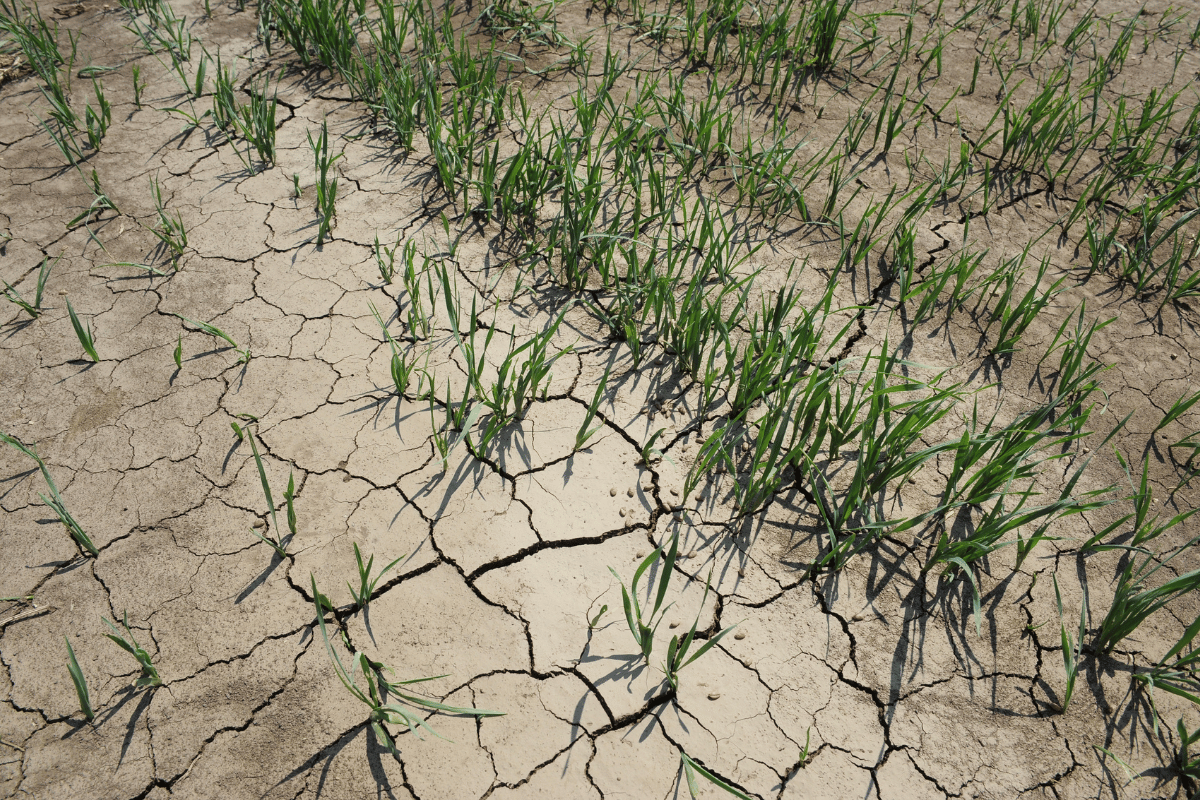
France is heading for one of its smallest maize crops in decades, and it is pulling the whole European harvest down with it. After a third heatwave since late May, the grain trade association COCERAL took the unusual step of publishing an extraordinary crop forecast, cutting its estimate for total EU and UK grain production in 2026 to 286.6 million tonnes, 23.4 million tonnes below last year. This is the kind of weather shock that travels from a single field into the wider supply and price picture, now visible across European cereals in real time.
The damage is uneven. Winter crops that had almost finished growing when the heat arrived came through in reasonable shape, while spring and summer crops caught in mid-development took the hit. Maize, the most exposed of all, is the reason the headline number moved.
Key takeaways
- EU and UK grain output was cut to 286.6 million tonnes, down 23.4 million tonnes from 2025, after COCERAL issued an out-of-cycle forecast prompted by the heat.
- EU maize is now seen at 52.7 million tonnes, the lowest since 2007. France drives most of the fall.
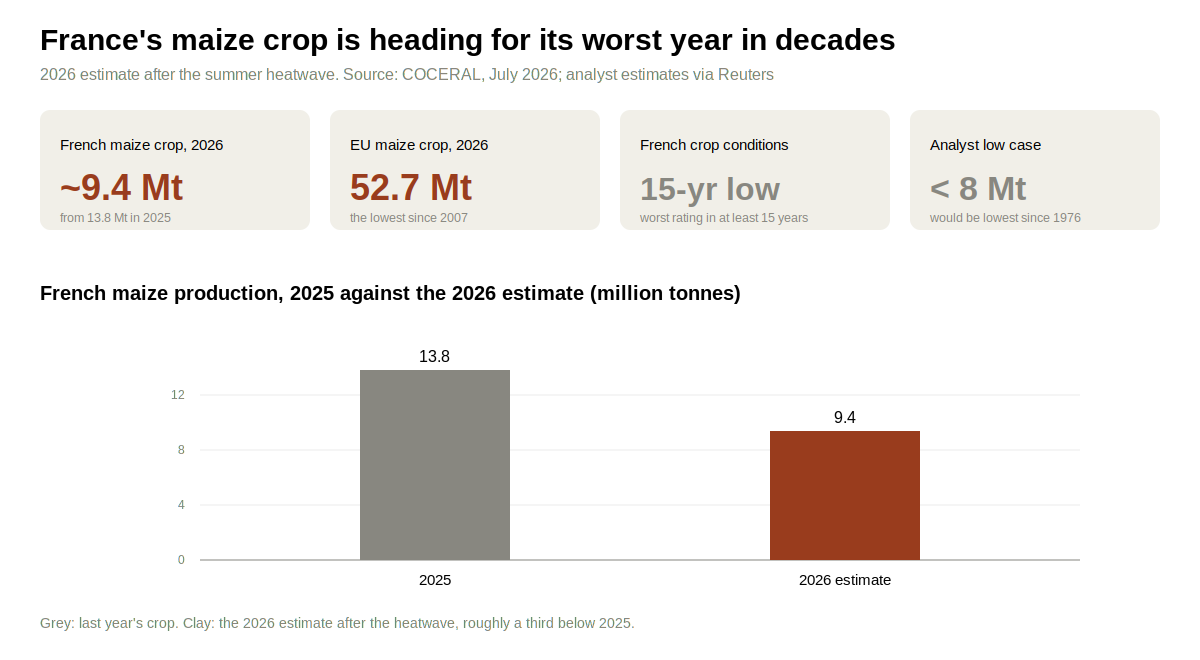
- France's maize crop is forecast around 9.4 million tonnes, against 13.8 million last year, with some analysts seeing it drop below 8 million tonnes, a level not seen since 1976.
- Wheat, barley and maize were all revised down, while rapeseed held up best because the heat reached it after the critical stage.
- Prices are already turning up. Maize export quotes are about 16% higher than a year ago and the EU milling wheat futures curve is rising through 2027.
France's maize crop is heading for its worst year in decades
Maize in France went into the summer already thin on planted area, and the heat has done the rest. COCERAL now puts the French crop near 9.4 million tonnes, down from 13.8 million in 2025 and the lowest in more than twenty years. Some analysts go further, seeing scope for the crop to fall below 8 million tonnes, which would make it the smallest since the scorching summer of 1976. Crop condition ratings dropped to their lowest in at least fifteen years, and in western France some growers began cutting non-irrigated fields for animal fodder before the plants could even reach pollination.
Because France is the largest maize grower in the bloc, its shortfall sets the tone for the whole EU figure of 52.7 million tonnes, the weakest since 2007.
The heatwave revision cut every major cereal
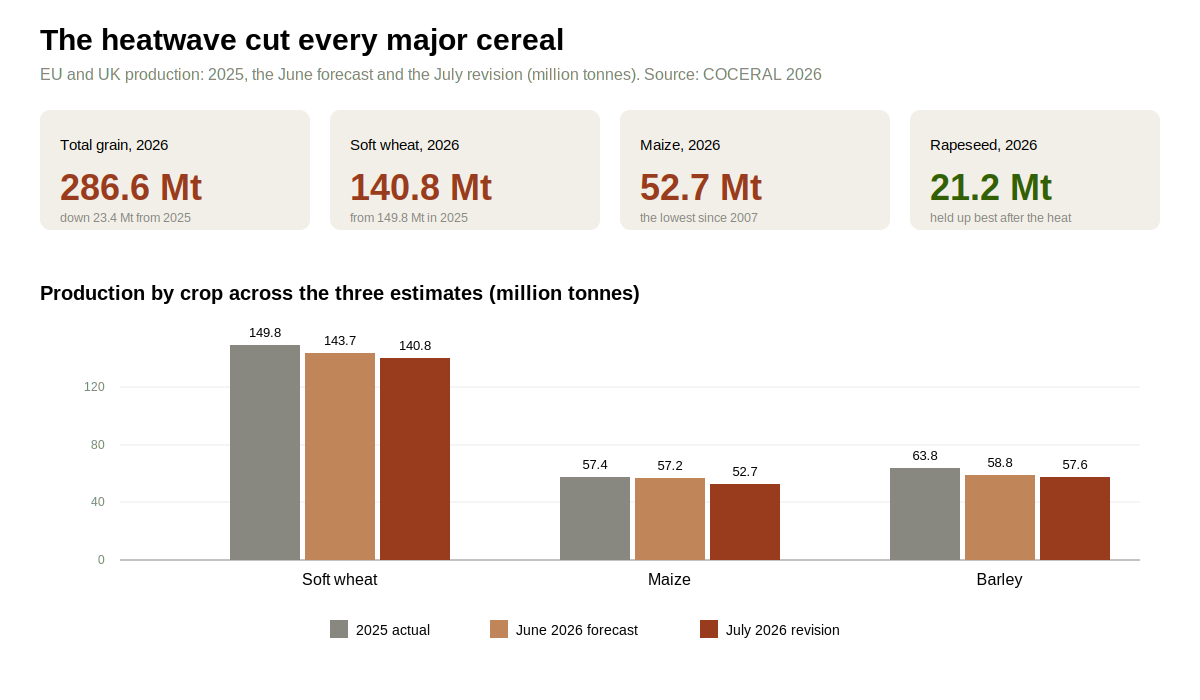
The out-of-cycle forecast trimmed each of the big crops from the June estimate. Soft wheat, excluding durum, came down to 140.8 million tonnes from the 143.7 million expected in June and 149.8 million produced in 2025, as the heat interfered with kernel filling in central and southern France, southern Germany, Austria, Poland and Hungary, with a further cut in Spain after a damaging late-May spell. Barley eased to 57.6 million tonnes, well below the 63.8 million of last year, with spring barley suffering more than winter barley, which had almost completed its development before the heat set in. Rapeseed was the exception, holding near 21.2 million tonnes because the worst of the heat arrived after its most sensitive stage.
Why maize took the hardest hit
Timing explains most of the gap between crops. Winter wheat and winter barley were largely through grain filling when the heat peaked, so their losses were contained. Maize sits on the opposite schedule, growing through the height of summer, so the heat landed squarely on its most delicate phase. The crop is wind-pollinated, and pollen shed and silking are the stages least able to tolerate high temperatures, so a hot, dry spell at that moment leaves ears poorly filled. Fields without irrigation had no way to buffer the stress, which is why some were cut for fodder rather than left to fail as grain.
A slower structural shift sits underneath the weather. EU maize area has fallen below 8 million hectares for the first time this century, down more than 15% over the past decade, as growers discouraged by repeated dry summers switch to other spring crops, sunflower in particular. A smaller area meeting a bad year produces an especially low crop.
Romania shows the other side of the same story
Not every producer is losing. Romania went into summer with good rainfall and little of the suffocating heat seen further west, and its maize crop is on course to rise to around 8.2 million tonnes, up from about 7.75 million in 2025. A better Romanian year cushions part of the French collapse at the EU level. This is the pattern that makes an open, well-connected market more stable than a closed one, a bad year in one region offset by a good year in another, which is the central lesson of FAO's recent work on how weather shocks move through food trade.
What it means for prices and supply
Markets have already started to respond. Maize export quotes are running about 16% above a year ago, soybean quotes are up more than 20%, and the EU milling wheat futures curve is rising across the coming season, with the September, December and March contracts trading progressively higher. Because the EU exports wheat and imports maize, a short maize crop points to firmer import demand into 2027.
For now the effect on shoppers should stay moderate rather than severe. Global grain stocks are comfortable, and the wheat crop is smaller than last year rather than failing, so Europe is short of one crop in a well-supplied world, not facing a broad shortage. The risk to watch is a second blow, another dry spell or a poor harvest in another major exporter, which is the point at which a manageable regional loss starts to test wider food security.
Sources
- COCERAL. 2026. Crop forecasts. Brussels.
- World Grain. 2026. Heat wave drops grain production estimates in EU, UK.