
Food recalls in Europe: Week 11, 2026
Your weekly food recall & compliance tracker
The EU's Rapid Alert System for Food and Feed (RASFF) logged 119 notifications between 9 and 15 March 2026, up 21% from the previous week's 98. Pesticide residues drove that increase. They appeared in 40 hazard mentions, nearly double the 22 recorded the week before, and chlorpyrifos alone accounted for 8 of those, from seven different origin countries.
Separately, four RASFF notifications identified mineral oil aromatic hydrocarbons (MOAH) in vegan protein powders, three of them from German suppliers. And Listeria monocytogenes showed up in frozen broccoli from Poland and frozen mushrooms from the Netherlands, a pathogen more typically associated with ready-to-eat dairy and deli products than with frozen vegetables.
Salmonella remained at high volume (20 alerts, up from 17), but the composition shifted. Where the previous week concentrated on Salmonella Infantis from Eastern Europe, last week it was scattered across six different serovars: Infantis, Derby, Virchow, Agona, Newport, and houtenae.
Highlights at a glance
- 119 total RASFF notifications: 108 food, 2 food contact materials, 9 feed — up 21% from the previous week's 98
- Fruits and vegetables led all categories with 26 alerts, identical to the previous week
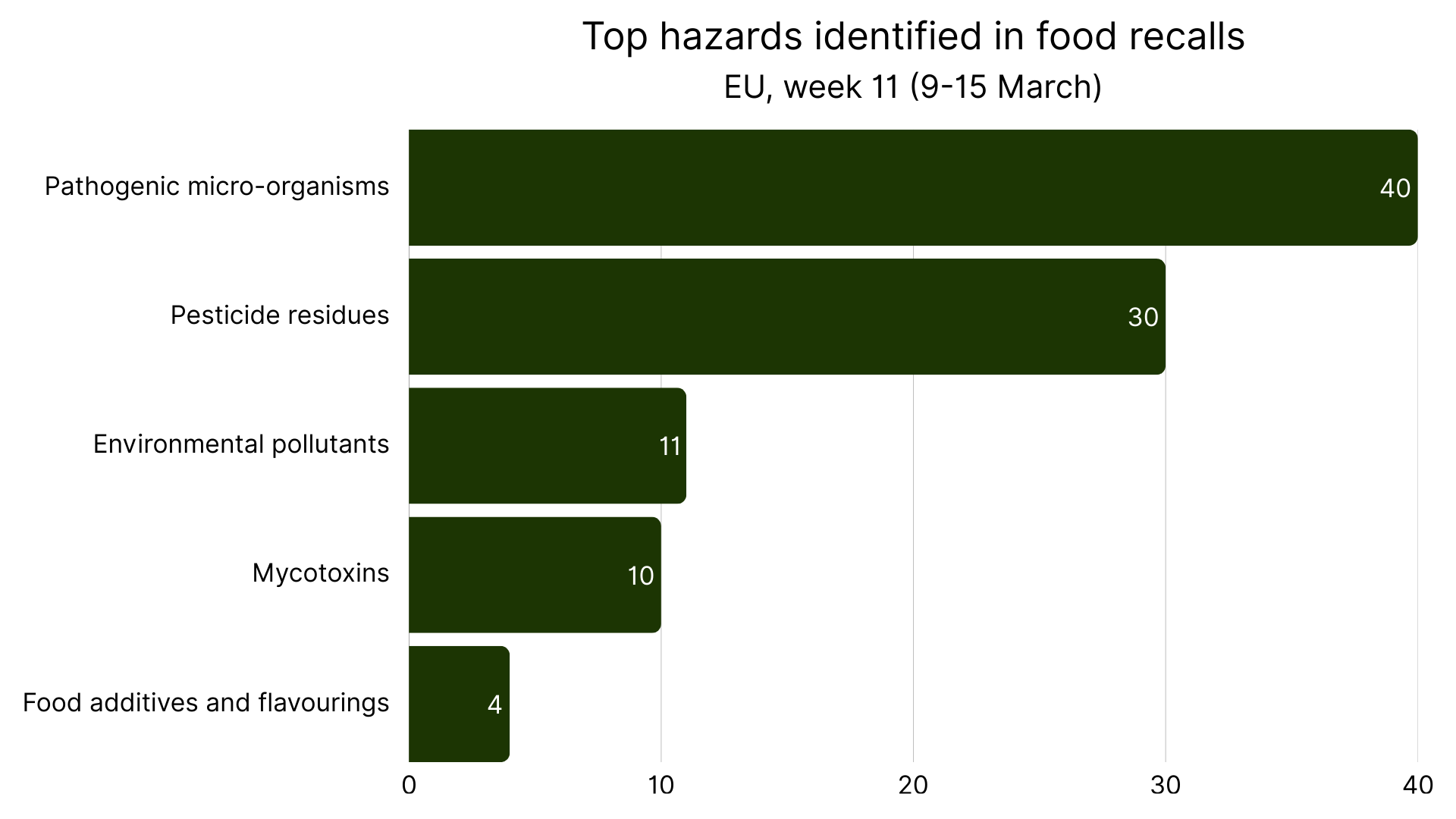
- Pesticide residues surged to 40 hazard mentions, nearly double the 22 recorded the week before
- Chlorpyrifos appeared 8 times from 7 countries: Spain, Egypt, India (×2), Ecuador, China, Brazil, and Poland
- Salmonella registered 20 alerts across 6 different serovars, with Poland (6) and the UK (5, all in feed) as the top origins
- MOAH contamination clustered in vegan protein powders: 4 alerts, 3 from Germany
- Listeria monocytogenes appeared in 6 alerts across frozen vegetables, cheese, and sausages — all from EU member states
- 5 norovirus alerts in oysters from Ireland and France
- Turkish dried figs generated 5 mycotoxin alerts (4 ochratoxin A, 1 aflatoxin B1), as they have every week since autumn 2025
- EU member states originated 46% of all notifications (55 of 119)
Top product categories affected
Fruits and vegetables recorded 26 alerts for the second consecutive week. But the hazard profile shifted. Pesticide residues accounted for 15 of those 26, up from the previous week's share, while mycotoxins held at 5 (all Turkish figs). Two Listeria findings in frozen vegetables from EU member states (Poland, Netherlands) introduced a biological hazard into a category usually dominated by chemical hazards.
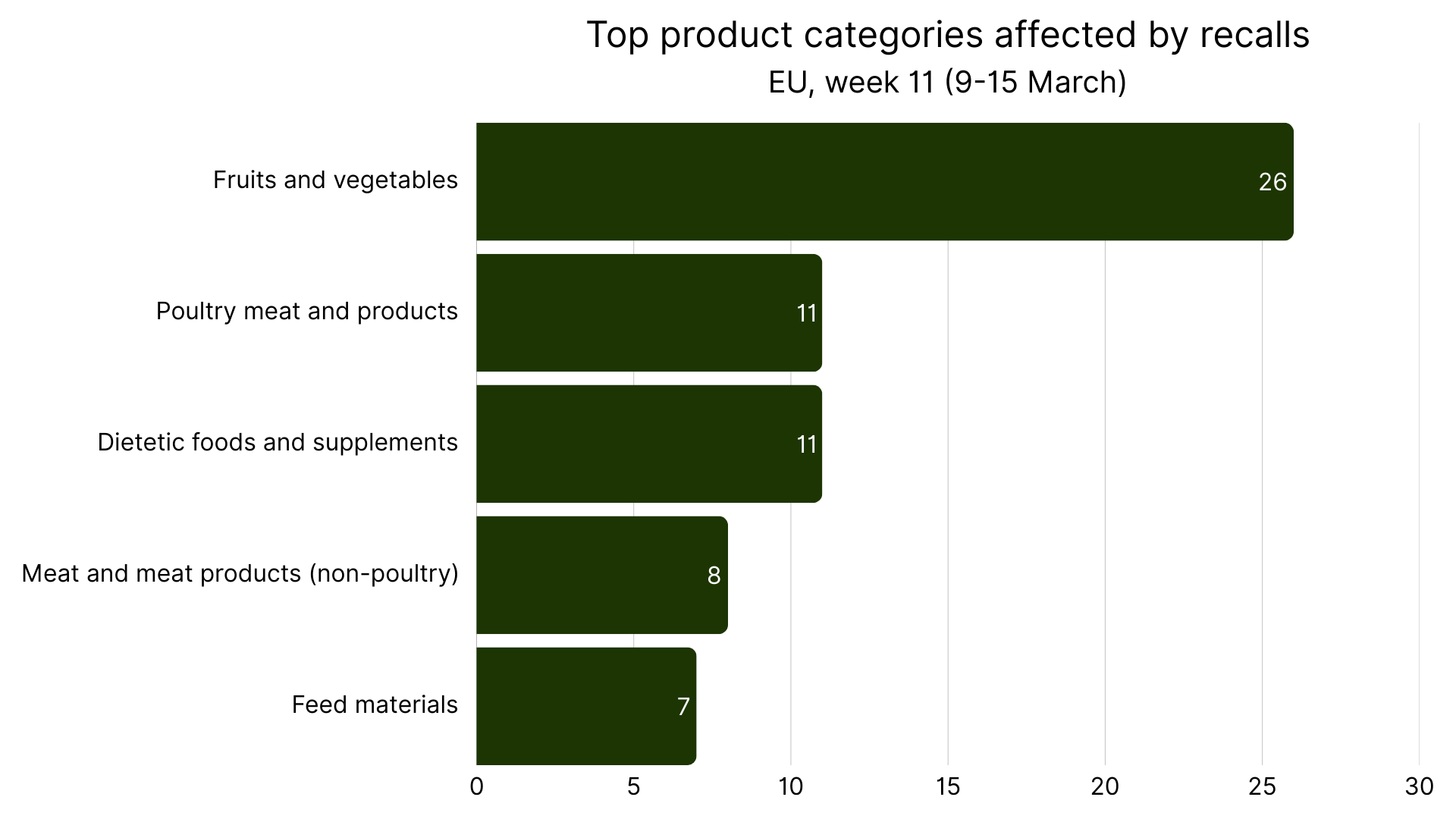
Poultry dropped from 14 to 11 alerts, and the geographic centre moved. Poland still led with 6 poultry-related Salmonella alerts, and Brazil added 3 poultry alerts of its own. The UK's poultry meal crisis (5 Salmonella alerts in feed) sat in the feed category rather than poultry, but the downstream risk flows into the same supply chain.
MOAH in vegan protein powder: a new cluster
Four alerts last week flagged mineral oil aromatic hydrocarbons (MOAH) in vegan protein powders, three from German suppliers and one of unknown origin. A fifth MOAH alert was issued for green peas from the Philippines. Sporadic MOAH findings (instant noodles from China the week before, for example) are common enough, but four alerts in a single product category is very concentrated.
MOAH contamination typically originates from recycled cardboard packaging, printing inks, lubricants in processing machinery, or contaminated raw materials. In protein powders, the most likely source is either the packaging or the processing equipment, since the base ingredients (pea, soy, and rice protein) undergo extensive mechanical extraction.
The three German-origin alerts suggest a common supplier or production facility rather than a raw-material problem affecting multiple sources. For buyers in the sports nutrition and plant-based food sector, MOAH testing on incoming protein powder batches is the immediate takeaway. The EU has had MOAH monitoring recommendations since 2017, but there are still no legally binding maximum levels — which means rejections rely on the general food safety clause of Regulation (EC) No 178/2002 rather than a specific MRL.
Listeria in frozen vegetables
Listeria monocytogenes appeared in 6 alerts last week. All six originated from EU member states: Poland (frozen broccoli), the Netherlands (frozen mushrooms), Belgium (goat cheese and cooked sausage), Estonia (smoked sausage), and France (meat products).
The findings on frozen vegetables are the ones that matter to produce buyers. Listeria in cheese and charcuterie is an established risk; the pathogen thrives in wet, refrigerated environments common in dairy and meat processing. Listeria in frozen vegetables is less expected. The pathogen can survive freezing but does not grow below -0.4°C, so contamination points to a failure before or during freezing, typically a dirty blanching line, contaminated water, or inadequate sanitation of cutting equipment.
For frozen vegetable buyers and processors, the practical response is to review supplier HACCP plans for pre-freezing hygiene controls, particularly at the blanching and cooling stages. Poland and the Netherlands turning up independently for the same hazard in similar products in the same week should prompt quality assurance teams to request Listeria environmental monitoring results from frozen vegetable suppliers.
Fresh produce focus
Pesticides dominated the produce profile
Of 26 fruit and vegetable alerts, 15 involved pesticide residues. The products affected ranged widely: capsicums from Kenya (acetamiprid), pomegranates from Türkiye (prochloraz), pineapples from Mexico (omethoate), green lettuce from Spain (lambda-cyhalothrin), blueberries from China (fenpropathrin, unauthorized), limes from Brazil (chlorpyrifos), and frozen strawberries from Egypt (fosthiazate).
Several of those involved substances are unauthorised in the EU. The Tanzanian chilli peppers carried both chlorfenapyr and lambda-cyhalothrin, the same kind of multi-residue cocktail that has been showing up in East African and Southeast Asian peppers since late 2025. Italian "mispen" (medlar) fruit tested positive for tetramethrin and permethrin, both unauthorised. That is a rare case of an EU-origin product carrying synthetic pyrethroids not approved for use on food crops in Europe.
Complete fresh produce recall list
Fruits and vegetables (26 alerts)
- Capsicum spp. (Kenya): acetamiprid above MRL
- Medlar/mispen (Italy): tetramethrin, permethrin (unauthorised)
- Grape leaves (Egypt): carbendazim (unauthorised), chlorpyrifos (unauthorised), imidacloprid, thiamethoxam
- Mandarins (Spain): chlorpyrifos (unauthorised)
- Pomegranates (Türkiye): prochloraz above MRL
- Frozen broccoli (Poland): Listeria monocytogenes
- Frozen mushrooms (Netherlands): Listeria monocytogenes
- Chilli peppers (Tanzania): chlorfenapyr (unauthorised), lambda-cyhalothrin
- Pineapples (Mexico): omethoate
- Bananas (Ecuador): chlorpyrifos (unauthorised)
- Green lettuce (Spain): lambda-cyhalothrin
- Frozen blueberries (China): fenpropathrin (unauthorised), iprodione
- Fresh fruit (Brazil): unauthorised surface coating additive
- Dried prunes (Serbia): sorbic acid (too high)
- Dried figs (Türkiye): ochratoxin A [4 separate alerts]
- Dried figs (Türkiye): aflatoxin B1
- Frozen strawberries (Egypt): fosthiazate
- Dried figs (Afghanistan): undeclared sulphur dioxide
- Bracken fern (South Korea): unauthorised novel food
- Green peas (Philippines): MOAH
- Limes (Brazil): chlorpyrifos (unauthorised)
- Red kapia peppers (Türkiye): cadmium
- Freeze-dried strawberries (China/Egypt): oxamyl (unauthorised)
Herbs and spices (6 alerts)
- Sichuan pepper (China): chlorpyrifos (unauthorised), anthraquinone, other residues
- Green tea/herbal tea (China): anthraquinone
- Fenugreek leaves (India): chlorpyrifos (unauthorised), carbendazim (unauthorised), other residues
- Marjoram (Egypt): foreign body (metal wires)
- Chilli powder (Sri Lanka): ochratoxin A
- Nutmeg (Indonesia): aflatoxins
Nuts, nut products and seeds (4 alerts)
- Sesame seeds (India): Salmonella spp.
- Peanuts (USA): aflatoxins
- Buckwheat (Poland): cadmium
- Nuts (Uzbekistan): missing durability date
Cereals and bakery products (7 alerts)
- Quinoa (India via Türkiye): chlorpyrifos (unauthorised)
- Rice noodles (China): GMO (cryIAb/Ac)
- Rice (Pakistan): pesticide residues
- Wafer rolls (Egypt): skipped border veterinary controls
- Biscuit pieces (Netherlands): metal foreign body
- Chocolate cake (Poland): sorbic acid (too high)
- Bread (Greece): undeclared allergen (egg)
Cocoa, coffee and tea (2 alerts)
- Tea (South Korea): unauthorised novel food (ginseng extract)
- Chocolate eggs (Italy): foreign body
Top 5 hazards
Pesticides reclaimed the top hazard position after dropping to second the week before. The 40 hazard mentions represent a sharp week-on-week jump and bring early March back in line with February's data, where pesticides accounted for 40.7% of all hazard entries. Environmental pollutants in third place are driven entirely by the MOAH cluster.
Where recalled products come from
Salmonella was detected in ten countries (Poland, the UK, Brazil, Bulgaria, Lithuania, Hungary, India, Spain, Germany, and the Netherlands). The UK accounted for 5 of the 20 alerts, all for the exact same product, Salmonella in processed poultry meal (feed). Five identical notifications in a single week from one country and one product type point to either a single contaminated facility or a systemic quality failure in the UK rendered poultry products.

This matters for the EU poultry chain because contaminated feed is how Salmonella enters flocks in the first place. Poland's continued presence (6 poultry Salmonella alerts) may be connected; if Polish processors use UK-origin poultry meal, the feed-to-fork pathway is direct.
EU member states originated 46% of last week's alerts (55 of 119). That ratio has held between 37% and 46% since mid-2025. Ten EU countries appeared as origins. The Listeria findings in frozen vegetables (Poland, Netherlands), the chlorpyrifos on mandarins (Spain), and the MOAH in protein powder (Germany) all came from EU sources. Domestic production carries distinct hazards that differ from import risks but are no less real.
Outlook
Three things to watch heading into the second half of March.
Chlorpyrifos is accelerating. The substance appeared in alerts originating from 4 countries, then 7. If this trajectory holds through March, it will be the highest weekly chlorpyrifos rate in the RASFF data this year. Spring shipments of Southern Hemisphere produce (South American limes, Ecuadorian bananas) and Mediterranean-origin products (Spanish citrus, Egyptian vegetables) are increasing in volume, meaning more product entering EU borders and greater chances of detection. Buyers who do not already test for chlorpyrifos on every incoming lot, regardless of origin, are exposed.
The UK poultry meal Salmonella cluster is the second. Five identical feed alerts in one week is unusual, and contaminated feed upstream eventually produces contaminated meat downstream. If UK poultry meal is a significant input for EU processors, the feed-to-fork transmission chain could surface as increased poultry meat alerts in the coming weeks.
MOAH in vegan protein powder is a new risk signal for the plant-based food sector. If the cluster recurs, it could trigger regulatory attention — the European Commission has been working toward binding MOAH limits since 2022, and product-specific contamination tends to accelerate that process.