
Since 2011, the ex-packaging station price of oranges, clementines and lemons in Spain, Italy, Greece and Portugal was lower in the two weeks before Christmas than in the first two weeks of November in 114 of 145 cases, according to a Wikifarmer analysis of the weekly prices member states report to the European Commission. The exception is Italian oranges, whose price usually rises in December. This year lemons start the season expensive in Italy, with the second highest season-start price since 2011, but not in Spain, where the agriculture ministry forecasts a larger lemon crop than last year.
In 114 of 145 cases the price fell by Christmas
Clementines are the most consistent example, as in Italy the price fell in all 15 seasons from 2011 to 2025, by a median 20.1%, and in Greece in all 12 seasons with data, by a median 21.8%, while in Spain it fell in 10 of 15, by 7.1% in the median season (European Commission, Agri-food Data Portal). The price of Greek oranges fell in all 14 seasons with data (median fall 15.6%), of Spanish oranges in 13 of 15 (7.1%) and of Portuguese oranges in 12 of 15 (13.3%). The price of lemons fell in 13 of 14 seasons in Greece (15.6%), 12 of 15 in Italy (8.8%) and 11 of 15 in Spain (7.9%).
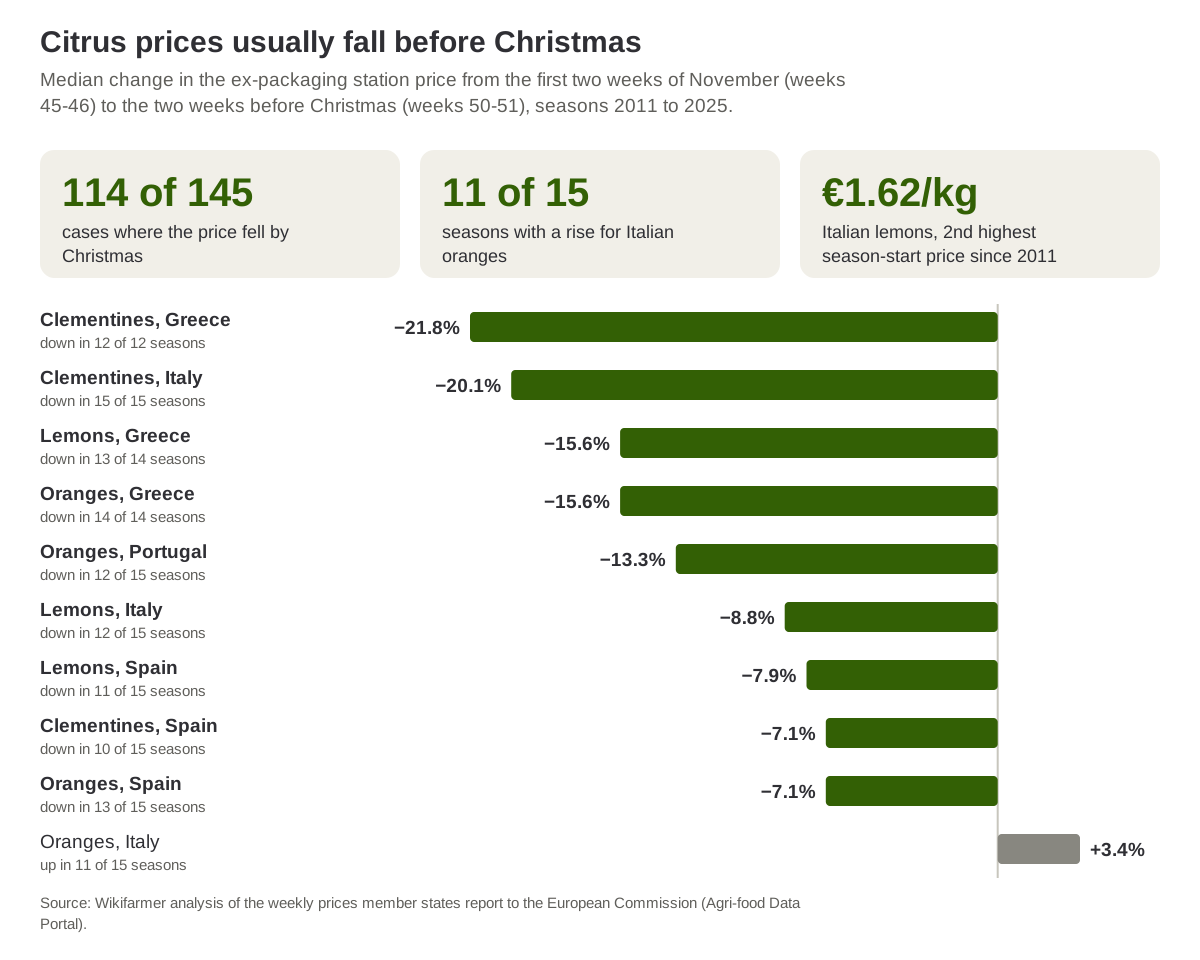
Source: Wikifarmer analysis of the weekly prices member states report to the European Commission.
The price of Italian oranges usually rises in December
The only series that moves the other way is Italian oranges, where the ex-packaging station price before Christmas was higher than in early November in 11 of 15 seasons, by a median 3.4%, and lower only in 2024 and 2025. The Commission's data do not explain the difference, and each country's national average covers different varieties.
Lemons start this season expensive in Italy but not in Spain
In Italy the ex-packaging station price of lemons from 7 September to 18 October 2026 averaged €1.62 per kilogram, with weekly prices between €1.60 and €1.64, the second highest for the same weeks since 2011 after €1.75 in 2016. In Spain, after one week at €2.40 per kilogram (21 to 27 September), the price was €1.37 in each of the following three weeks, level with 2024 and 22% below the same weeks of 2025. At Madrid's central wholesale market lemons sold for an average €1.14 per kilogram in September, 36.4% less than in September 2025, but two thirds of them were imported, mainly from South Africa and Argentina, so that price mostly reflects the southern hemisphere crop.
Spain forecasts more lemons for the 2026/27 season
According to the first 2026/27 crop forecast of Spain's Ministry of Agriculture, Fisheries and Food (MAPA), Spain is expected to produce 991,800 tonnes of lemons, 21.1% more than in 2025/26 and 3.0% above the average of the last five seasons, 2,812,720 tonnes of oranges, 4.6% less than last season and 7.4% below the average, and 1,813,296 tonnes of mandarins and clementines, 0.8% more than last season but 4.5% below the average (MAPA, Aforo nacional de cítricos 2026/27). MAPA calculates these changes against its provisional 2025/26 production statistics. In the same report, against the regions' own estimates for 2025/26, the forecast is higher for all main types, with oranges at +7.8%, lemons at +16.2% and the total at +8.7%, so the direction for oranges depends on the comparison. In total the forecast is 5,744,841 tonnes of citrus, 1.1% more than the provisional 2025/26 figures and 4.2% below the average, after the 2025/26 season started with lower yields in Spain, Italy and Greece.
In Madrid Spanish citrus replaces imports by December
At Mercamadrid, Madrid's central wholesale market, only 32.6% of lemons and 19.7% of mandarins sold in September 2026 were of Spanish origin, while oranges were 65.4% Spanish, with South Africa the main import origin for all three and Argentina also important for lemons (Ayuntamiento de Madrid, Mercamadrid). The Spanish share of lemons in September 2026 was the lowest for any September since 2019, but in previous years the picture changed quickly, as from 2019 to 2025 all lemons and, with one exception, all mandarins sold in Madrid in November and December were Spanish. For oranges the switch comes later, with a Spanish share of 51% to 71% in October, 82% to 98% in November and 97% to 100% in December. Spanish production also supplies neighbouring markets, where Portugal pays far less than other buyers for Spanish oranges.
The first November prices will show where this season starts
Since 2011 packing station prices for clementines and lemons were lower in mid-December than in early November in most seasons in every country with data, and the same holds for oranges, except in Italy. If this season follows the same pattern, prices at Christmas would be lower than in November, but history gives frequencies, not a forecast, and does not show how much prices will change this year. In the coming weeks the first November prices for clementines and oranges, which the Commission publishes weekly, how quickly Spanish lemons replace imports in wholesale markets, and Italian lemon prices, which start the season high, are the things to watch.
The prices matter to growers and cooperatives that sell to packing stations, and to traders and retail chains buying for the holidays. They are neither the price the grower receives nor the shelf price.
The analysis uses the weekly ex-packaging station prices member states report to the European Commission, as national averages in euros per 100 kg, from 2011 to 18 October 2026. For oranges it uses the national weighted average of the main varieties, and for clementines and lemons the price for all types. The season start is ISO weeks 45 and 46 and the pre-Christmas period weeks 50 and 51 of each year, with at least one week with a price in each period. A change of more than 2% downwards counts as a fall, more than 2% upwards as a rise, and the rest as stable prices. Seasons without data, such as some years for Greece, do not count, and mandarins are not included because countries report few and non-consecutive seasons. For the comparison of this season's lemon start the 2026 weeks with a price (39 to 42 for Spain, 37 to 42 for Italy) and the same weeks of each previous year were used; in Spain week 39 is €2.40 per kilogram, far above the following weeks, so the comparison is also given without it. The Mercamadrid data are monthly, with quantities by origin, but the published price is essentially the same for all origins of a variety, so Spanish and imported prices are not compared. The MAPA forecast refers to production on the tree. All numbers were recomputed independently from the original files.
Sources
- European Commission. (2026). Agri-food Data Portal, API guide and fruit and vegetable supply chain prices. Directorate-General for Agriculture and Rural Development.
- Ministerio de Agricultura, Pesca y Alimentación. (2026, 14 September). Aforo nacional de cítricos, campaña 2026/27. MAPA.
- Ayuntamiento de Madrid. (2026). Mercamadrid, volume and price of products traded. Portal de Datos Abiertos.