

From November 2025 to September 2026 the EU imported 190,392 tonnes of olive oil from Tunisia, 38.9% more than the 137,101 tonnes of the same months of the previous season, according to a Wikifarmer analysis of Eurostat data. The value of the imports rose less, by 30.0%, to 692.36 million euros, so the average value per kilo fell 6.4%, from 3.884 to 3.636 euros a kilo. Spain imported 48.3% of the tonnes and Italy 41.6%, while in the previous season Italy had the largest share.
The value per kilo was the lowest of the four seasons since 2022/23
Eurostat's Comext foreign trade database gives olive oil imports under the current four codes from January 2022, so the comparison covers four seasons from November to September. In 2022/23 the EU imported 103,035 tonnes from Tunisia at an average of 4.877 euros a kilo, in 2023/24 117,507 tonnes at 7.548 euros and in 2024/25 137,101 tonnes at 3.884 euros, so the 190,392 tonnes of 2025/26 are the most of the four seasons and 3.636 euros the lowest average value, 51.8% below 2023/24. Within the season the most tonnes came in March, April and May 2026, more than 24,600 tonnes each month, while from January to September the monthly average value moved between 3.516 and 3.751 euros a kilo.
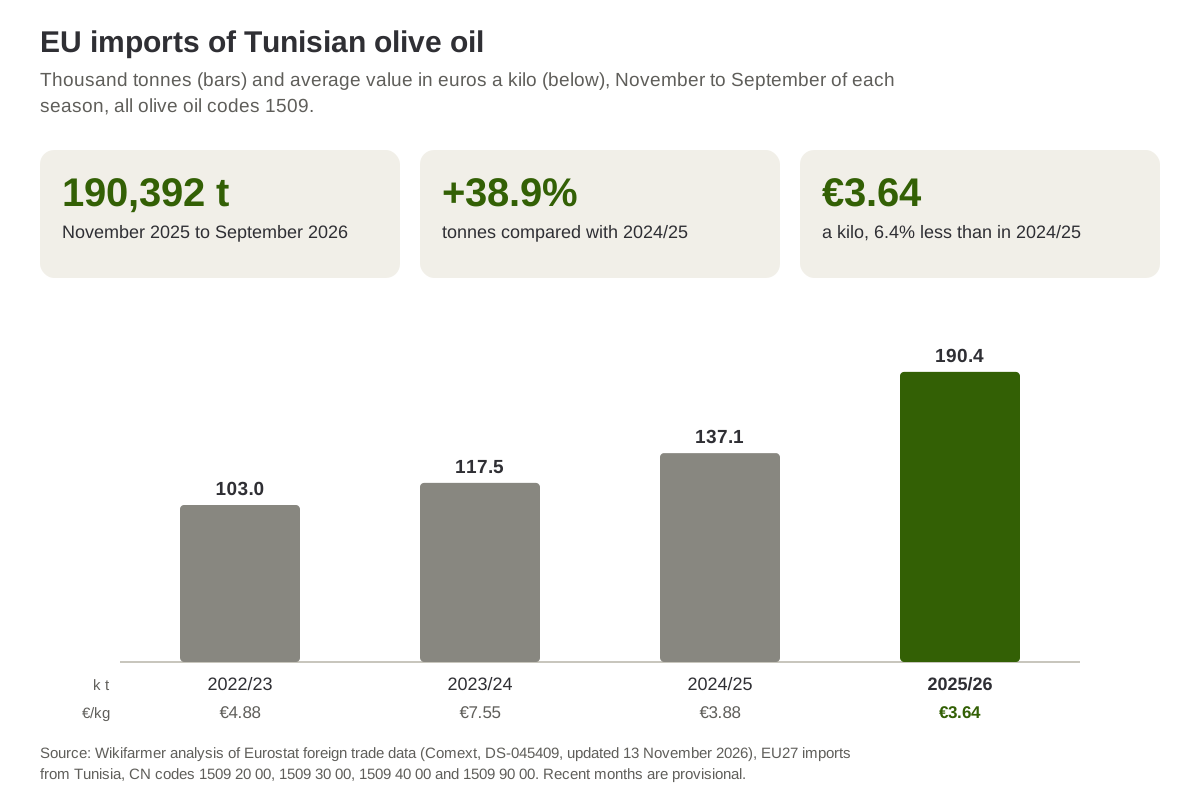
Source: Wikifarmer analysis of Eurostat foreign trade data (Comext, DS-045409, updated 13 November 2026), in euros, not adjusted for inflation.
Extra virgin made up 80.6% of the tonnes
Extra virgin olive oil, CN code 1509 20 00, reached 153,514 tonnes, 47.2% more than in 2024/25, at an average of 3.813 euros a kilo, 9.5% below the 4.214 euros of the previous season, and its share of the tonnes rose to 80.6% from 76.1%. Other virgin olive oils under code 1509 40 00 came to 27,154 tonnes, 14.3% of the total, at 2.819 euros a kilo, the olive oils under code 1509 90 00, which are not virgin, to 7,907 tonnes and virgin olive oil under code 1509 30 00 to 1,817 tonnes. In 2022/23 and 2023/24 extra virgin made up 87.1% and 89.7% of the tonnes respectively.
Spain again imported the largest volume of Tunisian olive oil in the EU
Eurostat records each import in the member state that declared it. In 2025/26 Spain imported 91,993 tonnes from Tunisia, 81.5% more than the 50,673 tonnes of 2024/25, and Italy 79,134 tonnes, 8.7% more, so Spain's share rose to 48.3% from 37.0% and Italy's fell to 41.6% from 53.1%. Spain also had the largest share in 2022/23, with 49.8%, while Italy had it in 2023/24, with 44.4% against 43.9%, and in 2024/25. Portugal imported 9,488 tonnes, almost six times the 1,593 tonnes of 2024/25, and France 6,600 tonnes, 17.1% less.
The average value per kilo was 3.545 euros for Spain, 3.607 for Italy, 3.859 for Portugal and 4.432 for France. The CN codes do not separate bulk from packaged oil, so these differences do not show which country bought more cheaply.
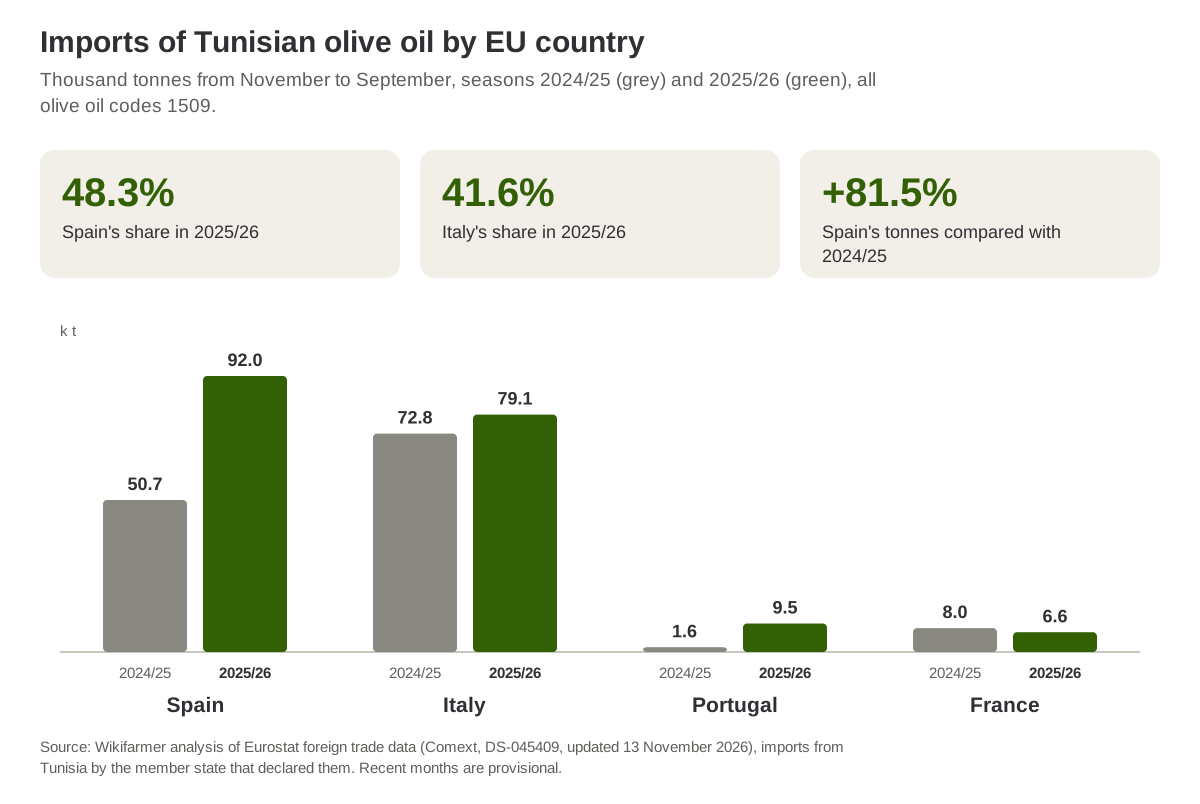
Source: Wikifarmer analysis of Eurostat foreign trade data (Comext, DS-045409, updated 13 November 2026), imports by the member state that declared them.
Italy took 38.3% of Spain's extra virgin exports in September at a lower value per kilo
In September 2026 Spain exported 66,917 tonnes of extra virgin olive oil at an average of 4.405 euros a kilo, against 62,191 tonnes at 4.572 euros in September 2025. Italy took 38.3% of the tonnes at an average of 3.633 euros a kilo, when all other destinations together averaged 4.885 euros, while in September 2025 its share was 32.4%, at 4.198 euros against 4.752 for the rest. In every year since 2022 except 2023 the average value of Spain's extra virgin exports to Italy was below the average of the other destinations, and over the whole period from January 2022 to July 2026 the value per kilo of Spanish extra virgin shipped to Italy was lower than for most destinations.
When the value per kilo of each destination is compared with the average of all the others, Italy's larger share at a lower value pulls that comparison average down. In September 7 of the 15 largest destinations therefore came out at least 10 percentage points above their average gap of the previous 12 months, France, the United Kingdom, China, Japan, Germany, the Netherlands and Colombia, while with Italy left out of the comparison only 2 of 14 moved that much, Portugal and South Korea, both lower. Both counts depend on the 10-point threshold, as Colombia and Portugal sat almost exactly on it, and from August 2025 to July 2026 the median was 2 destinations a month, with 6 in October and 8 in November 2025.
The duty-free quota for Tunisian olive oil is 56,700 tonnes a year
Each calendar year the EU opens a tariff quota of 56,700 tonnes at zero duty for virgin olive oil wholly obtained in Tunisia and transported directly to the EU, under Commission Implementing Regulation (EU) 2020/761. From January to September 2026 EU imports from Tunisia under the three virgin olive oil codes came to 151,222 tonnes, but Eurostat's data do not show how much of this oil entered within the quota and how much under another customs procedure.
The new season starts with a smaller crop in Tunisia
On 23 October the Tunisian government approved up to 150 million dinars for olive oil purchases and in the same statement put 2025/26 production at 500,000 tonnes and exports to all destinations at 399,000 tonnes by the end of September. Tunisia records these exports and the EU records its imports, at different times and under different rules, so one figure cannot be subtracted from the other.
For 2026/27 there is no official estimate yet, while Tunisia expects a much smaller olive oil crop, with estimates from farm organisations of 200,000 to 300,000 tonnes. Eurostat's data on October imports are published in mid-December. The data concern olive oil producers, packers and traders around the Mediterranean, and are not a forecast.
The analysis uses Eurostat trade data
The analysis is Wikifarmer's, based on EU27 imports from Tunisia in Eurostat's Comext database (dataset DS-045409, updated 13 November 2026), for CN codes 1509 20 00 (extra virgin), 1509 30 00 (virgin), 1509 40 00 (other virgin) and 1509 90 00 (other olive oils), which apply from January 2022, and by member state for Spain, Italy, France and Portugal. The season covers the eleven months from November to September, October is not included and each season is compared with the same months of the previous one. The average value per kilo is declared value divided by declared quantity, covers bulk and packaged oil together, and values are not adjusted for inflation. For Spain's extra virgin exports (code 1509 20 00) each destination is compared with the volume-weighted average value of all other destinations, excluding ship and aircraft supplies and unspecified destinations, for the 15 largest destinations of the 12 months to September 2026, and the average gap of the previous 12 months uses months with at least 10 tonnes. Eurostat's figures for the latest months are provisional. The analysis does not examine why volumes and prices changed. All figures were recomputed independently from the original files. The data describe what happened and are not a forecast.
Sources
- Eurostat. (2026). International trade in goods, Comext database (DS-045409), updated 13 November 2026.
- European Commission. (2019). Commission Implementing Regulation (EU) 2020/761 on tariff quotas for agricultural products managed by a system of licences, Annex V, quota 09.4032.
- Présidence du Gouvernement, Tunisia. (2026). Statement of the restricted ministerial council on the 2026/27 olive oil season, 23 October 2026.