

The price at which the EU imports raw sugar from African, Caribbean and Pacific (ACP) countries was a median 3.43 times the world price from January 2000 to June 2006, but from January 2010 to September 2017, before EU production quotas were abolished, it was only 1.06 times, according to a Wikifarmer analysis of World Bank data. In October 2026 the import price was 0.37 US dollars a kilo, below the world price of 0.43 dollars, after the world price of raw sugar had risen from 0.31 dollars in February 2026.
Until mid-2006 the import price was a median 3.43 times the world price
The World Bank publishes in its monthly commodity price series, the Pink Sheet, the EU's negotiated import price for raw, unpackaged sugar from ACP countries, delivered to European ports, which it describes as a price under the Lomé Conventions and takes from the International Monetary Fund. Next to it the World Bank publishes the world price of raw sugar under the International Sugar Agreement (ISA), loaded at greater Caribbean ports. From January 2000 to June 2006 the import price was above the world price in every month, with a median of 0.59 dollars a kilo against 0.18 dollars, although the gap had started to narrow in early 2006, when the world price rose.
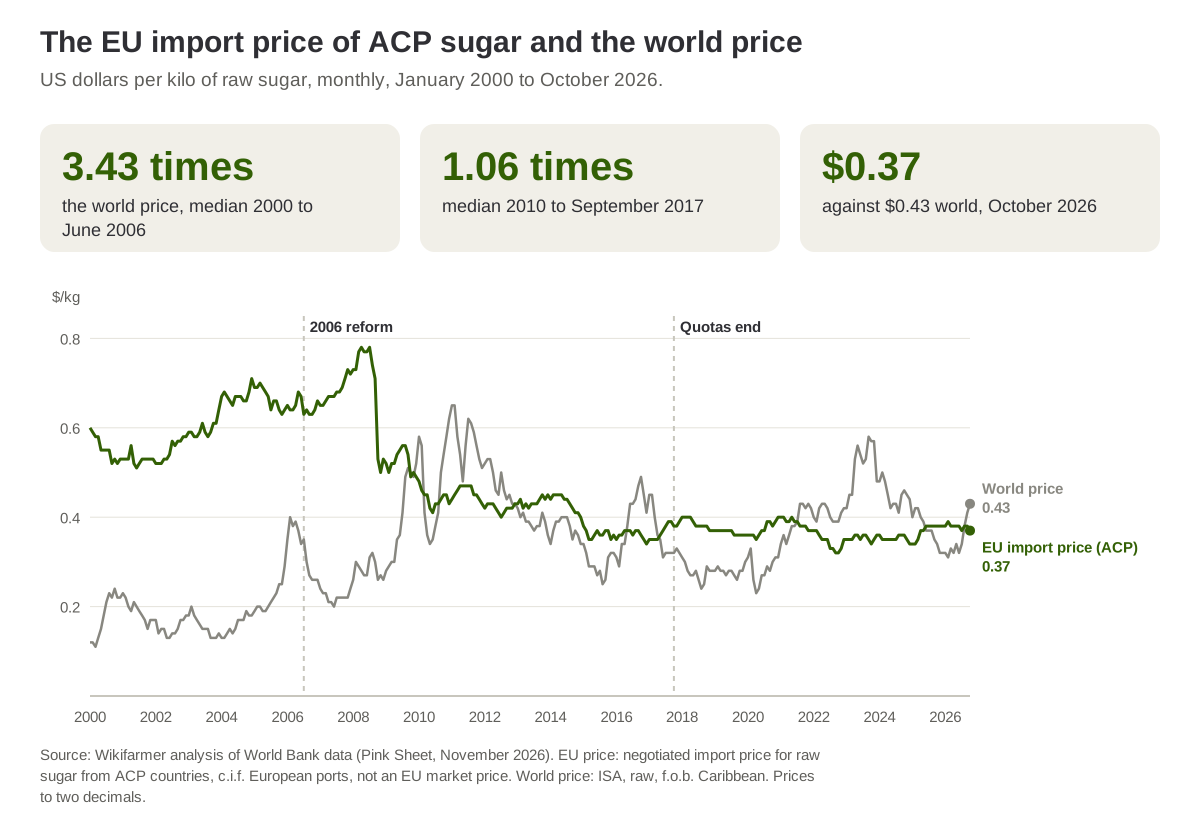
Source: Wikifarmer analysis of World Bank data (Pink Sheet, November 2026), in US dollars a kilo. The EU price is an import price, not an EU market price.
The gap narrowed from 2006 and almost disappeared from 2010
The reform of the sugar market under Council Regulation (EC) No 318/2006 applied from the 2006/2007 marketing year, which began on 1 July 2006, and cut the reference price of raw sugar in two steps, in 2008/2009 and 2009/2010, from 496.8 to 335.2 euros a tonne, down 32.5%, and that of white sugar from 631.9 to 404.4 euros, down 36.0%. From July 2006 to December 2009 the import price was a median 2.43 times the world price and above it in 95.2% of months, while the median import price rose to 0.65 dollars a kilo and the median world price to 0.27 dollars. In October 2009 the import price fell below the world price for the first time since March 1981.
From January 2010 to September 2017 the median ratio was 1.06 times the world price, and the import price was below the world price in 44.1% of months. In the last almost four years before quotas ended, from January 2014 to September 2017, the median ratio was 1.13, so the large gap had already gone when quotas were abolished at the end of the 2016/2017 marketing year, on 30 September 2017, as set by Regulation (EU) No 1308/2013 together with the October to September marketing year of Regulation 318/2006.
Since quotas ended the two prices have moved close together
From October 2017 to October 2026 the median ratio was 1.05, with the import price above the world price in 54.1% of months and below it in 44.0%. The import price was below the world price in every month from August 2021 to May 2025, 46 months in a row, and again in September and October 2026. The import price changes slowly: from November 2017 to October 2026 it was unchanged from one month to the next in 65 of 108 monthly changes (60.2%), while the world price was unchanged in only 21.3%. For the world price, after 18 surges since 1960 the sugar price was higher six months later in 13, while a year later it was higher in only 7.
The average EU white sugar price was €500 a tonne in August
The import price of ACP sugar is not the price at which sugar sells inside the EU. The average EU price of white sugar is published by the European Commission, and in August 2026 it was 500.01 euros a tonne, 6.7% lower than in August 2025. Since October 2017 the price was below 500.01 euros in 60 of the 106 earlier months and above it in 46, with a low of 312.20 euros in January 2019 and a high of 856.41 euros in December 2023. For 2026/27 European sugar swings from glut to shortage in a single season, and prices from September 2026 will show in the Commission's next data.
The comparison concerns sugar the EU buys from ACP countries
The distance between the import price and the world price shows how much more than the world price the EU paid for ACP countries' sugar, and it concerns the countries that export sugar to the EU on these terms. Since 2010 that difference has been small, and in recent years the import price was often below the world price. The data describe the course of two prices and do not explain why they changed, nor are they a forecast.
The analysis uses World Bank prices and EU law for the period breaks
The analysis is Wikifarmer's, based on the World Bank's monthly prices (Pink Sheet, November 2026 edition) for EU sugar, the negotiated import price for raw sugar from ACP countries c.i.f. European ports, and for world sugar, the monthly International Sugar Agreement price for raw sugar f.o.b. greater Caribbean ports, in US dollars a kilo to two decimals, from January 2000 to October 2026. The ratio is the import price divided by the world price each month, and the medians were calculated for periods set by the application of Regulation 318/2006 (July 2006), by 2010 and by the end of quotas (October 2017). Prices to two decimals make the ratios approximate, especially when the world price was low, and "unchanged" means unchanged to the cent. The series starts in 1960, and before October 2009 the import price had been below the world price in 73 months, the last in March 1981. The average EU white sugar price comes from the European Commission's monthly data (Agri-food Data Portal), in euros a tonne, with August 2026 as the latest month. Reference prices and dates come from Regulations 318/2006 and 1308/2013 on EUR-Lex. The analysis does not attribute the change in the gap to any cause. All price figures were recomputed independently from the original files. The data describe what prices did and are not a forecast.
Sources
- World Bank. (2026). Commodity Markets, Pink Sheet monthly prices (CMO Historical Data Monthly), November 2026 edition.
- European Commission. (2026). Agri-food Data Portal, sugar prices (API guide). Monthly average EU white sugar price.
- Council of the European Union. (2006). Council Regulation (EC) No 318/2006 on the common organisation of the markets in the sugar sector. EUR-Lex.
- European Parliament and Council. (2013). Regulation (EU) No 1308/2013 establishing a common organisation of the markets in agricultural products. EUR-Lex.