

In September 2026 the EU-level price of nitrogen fertilisers was 469 euros a tonne, 115.0% above the 2019 and 2020 average and 26.1% higher than in September 2025, while phosphate fertilisers cost 742 euros, 120.6% above the average of those years and the highest since January 2023, when the price was 751 euros, according to a Wikifarmer analysis of the European Commission's monthly fertiliser prices. The potash price, 363 euros a tonne, was 1.6% lower than a year earlier, as fertiliser buying begins for the spring 2027 applications in the northern hemisphere.
The nitrogen price was 26.1% above a year earlier and about half its 2022 peak
The European Commission publishes on its Agri-food Data Portal monthly EU-level prices, in euros a tonne, for three classes of fertiliser by nutrient: nitrogen (N), phosphorus (P) and potash (K). The nitrogen price started 2026 at 405 euros in January, reached 554 euros in April, eased to 451 euros in July and was 469 euros in September, 15.8% above January and 26.1% above the 372 euros of September 2025. The 2019 and 2020 average was 218.17 euros, while the series peaked at 923 euros in April 2022, so the September price is 49.2% below that peak.
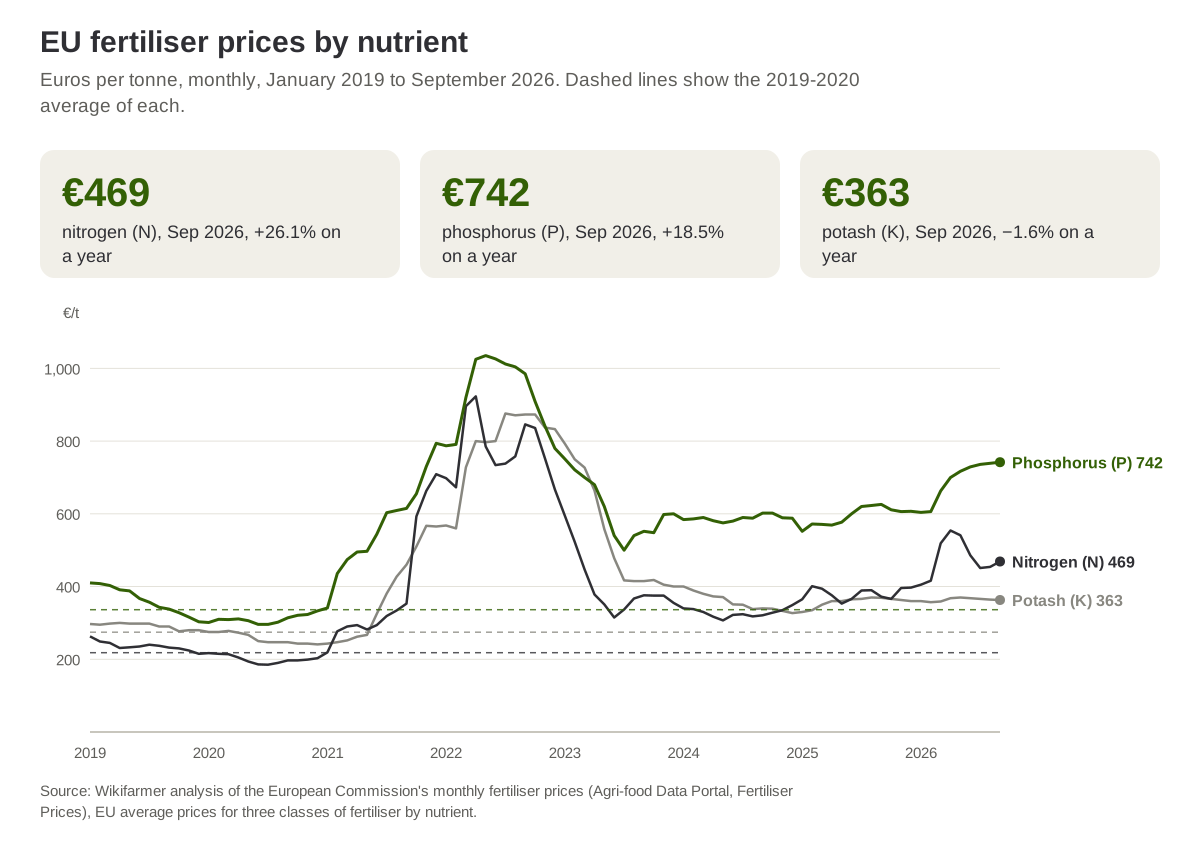
Source: Wikifarmer analysis of the European Commission's monthly fertiliser prices (Agri-food Data Portal, Fertiliser Prices). Dashed lines show the 2019 and 2020 average of each class.
The phosphate price rose every month from February to September 2026
The phosphate fertiliser price was 604 euros a tonne in January 2026, a little below the 607 euros of December 2025, and from February it rose every month to 742 euros in September, up 22.8% on January and 18.5% on the 626 euros of September 2025. The September price is the highest since January 2023 and 120.6% above the 2019 and 2020 average of 336.42 euros, but 28.3% below the peak of 1,035 euros in May 2022.
The potash price stayed close to last year's level
The potash fertiliser price moved between 357 and 370 euros a tonne in 2026 and was 363 euros a tonne in September, 1.6% lower than in September 2025 and 32.3% above the 2019 and 2020 average. Of the three classes it is the furthest from its peak, 58.6% below the 876 euros of July 2022.
Eurostat's nitrogen fertiliser index was about double 2020 in the second quarter
Eurostat's quarterly input price index for nitrogen fertilisers in the EU stood at 200.6 in the second quarter of 2026, a Eurostat estimate, with 2020 equal to 100, about double 2020 and 17.1% above the second quarter of 2025. On world markets the World Bank's urea price was 407.5 US dollars a tonne in September 2026, 11.6% lower than in September 2025, and 420.0 dollars in October, 6.5% higher than in October 2025, while diammonium phosphate (DAP) was 800.6 dollars in September and 803.1 dollars in October.
The world urea price did not follow the year-on-year rise of the EU nitrogen price in September, while in October the urea to natural gas price ratio fell to its lowest level since December 2022. The two series measure different things, as the EU price covers a class of fertilisers in euros and the World Bank price one product in dollars.
The next prices will show the cost for spring 2027 in the northern hemisphere
Many arable farmers in the EU buy part of the nitrogen and phosphorus they will apply in spring during the northern hemisphere autumn and winter, and the Commission's latest prices, for September, are more than double the 2019 and 2020 average for nitrogen and phosphate fertilisers. At September prices, the DAP to wheat price ratio was in the top 5% of months since 1967, with one tonne of DAP costing as much as 2.31 tonnes of wheat, a ratio that measures how much wheat one tonne of phosphate fertiliser is worth. The course of prices will show in the Commission's monthly prices for October onwards, in the World Bank's November prices, published in early December, and in Eurostat's index for the third quarter. The data describe prices up to September and are neither a forecast nor a recommendation on when to buy.
The analysis compares each class with its own 2019 and 2020 average
The analysis is Wikifarmer's, based on monthly EU-level prices for three classes of fertiliser by nutrient, nitrogen, phosphorus and potash, from the "Fertiliser Prices" application of the European Commission's Agri-food Data Portal, in euros a tonne, as read by Wikifarmer on 18 November 2026, from January 2019 to September 2026. The Commission's page says the prices cover the period from June 2019, while the application holds prices from January 2019, and with an average from June 2019 to December 2020 the rise to September 2026 is larger, 121.9% for nitrogen, 132.1% for phosphate and 35.3% for potash. The comparison is with the average of the 24 months of 2019 and 2020, not with each year separately. Eurostat's index (apri_pi_inq) for the second quarter of 2026 is an estimate, and the World Bank prices are world product prices in dollars, so they cannot be compared directly with EU prices in euros. The analysis does not examine why prices changed. All figures were recomputed independently from the original files. The data describe what prices did and are not a forecast.
Sources
- European Commission. (2026). Agri-food Data Portal, Fertiliser. "Fertiliser Prices" application, monthly EU prices by nutrient, read 18 November 2026.
- Eurostat. (2026). Price indices of the means of agricultural production, input, quarterly (apri_pi_inq).
- World Bank. (2026). Commodity Markets, Pink Sheet monthly prices (CMO Historical Data Monthly), November 2026 edition.