
Portugal paid an average of 0.58 €/kg for oranges bought from Spain between January 2022 and July 2026, 38% less than all of Spain’s other customers combined, according to a Wikifarmer analysis of Eurostat export data. The gap appears in every year since 2022 and repeats in peaches, tomatoes and lemons. Morocco bought Spanish peaches and nectarines about 60% cheaper, while the very high prices paid by Kuwait and Qatar apply to a few dozen tonnes in total over four and a half years.
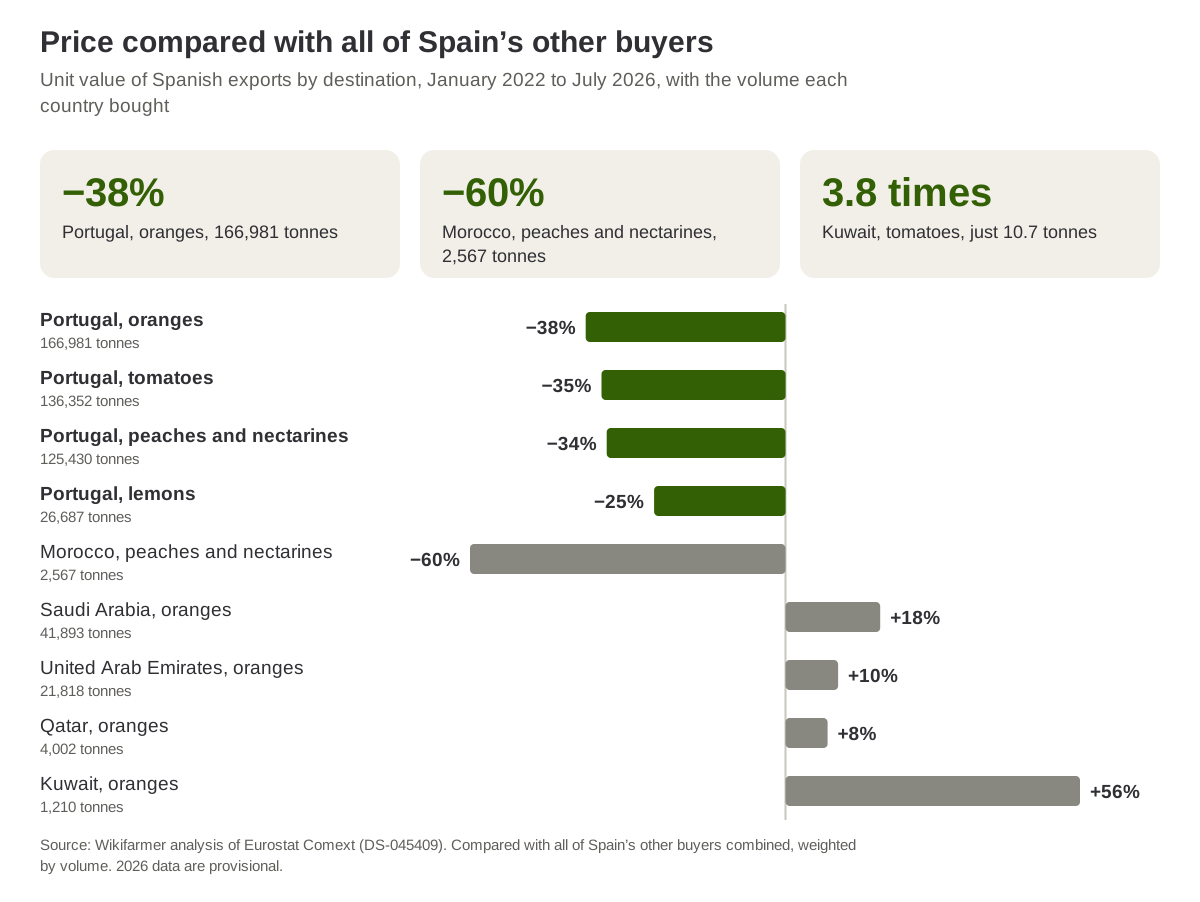
Unit value by destination compared with all of Spain’s other buyers combined, January 2022 to July 2026. Source: Wikifarmer analysis of Eurostat data.
Portugal paid 38% less for 166,981 tonnes of oranges
From January 2022 to July 2026 Spain exported 5.8 million tonnes of oranges at an average unit value of 0.92 €/kg, and Portugal bought 166,981 tonnes, 2.9% of the volume. It paid 0.58 €/kg, while Spain’s other buyers combined paid 0.93 €/kg on average over the same period (Eurostat Comext).
These prices are export unit values, the declared value of shipments divided by their weight, at the Spanish border and before freight. Portugal buys most of its oranges from January to May, and Spanish prices shift within the season, as in early February 2026, when early Navelina fell about 25% while late varieties rose. The comparison was therefore also made month by month, against the other buyers’ average in the months Portugal bought, and the gap was similar, at 41% less.
| Year | Portugal, €/kg | All other buyers, €/kg | Portugal vs other buyers | Portugal, tonnes |
| 2022 | 0.37 | 0.76 | -51% | 27,732 |
| 2023 | 0.72 | 0.98 | -27% | 33,336 |
| 2024 | 0.56 | 0.98 | -43% | 33,494 |
| 2025 | 0.59 | 0.99 | -41% | 45,254 |
| 2026, January to July | 0.62 | 1.00 | -38% | 27,165 |
Source: Wikifarmer analysis of Eurostat Comext (dataset DS-045409), Spanish orange exports under CN codes 0805 10 22, 0805 10 24 and 0805 10 28, downloaded 15 October 2026. 2026 data are provisional.
From 2005 to 2021, too, Portugal paid 33% less than other buyers for Spanish oranges, so the gap has been somewhat larger since 2022, although in 2023 it was narrower, at 27%.
Portugal pays less for all four products
From January 2022 to July 2026 Portugal paid less than Spain’s other buyers for all four fruit and vegetable products examined. It paid 1.08 €/kg for 125,430 tonnes of peaches and nectarines, 34% less, 1.22 €/kg for 136,352 tonnes of tomatoes, 35% less, and 1.00 €/kg for 26,687 tonnes of lemons, 25% less. For peaches the month-by-month comparison gives almost the same result, 33% less, and the gap ranged from 31% to 36% in each year.
The low prices are consistent with bulk or simply packed loads and lower quality classes, which often go to juice or processing. Trade data record neither packaging nor class, so they cannot confirm this.
Morocco paid less than half the price for Spanish peaches
Morocco bought 2,567 tonnes of Spanish peaches and nectarines from January 2022 to July 2026 at an average of 0.65 €/kg, 60% below the 1.61 €/kg paid on average by other buyers. It bought 74% of those tonnes in July and August, at the peak of Spanish exports, when prices are lower than at the start of the season. Compared month by month the gap narrows to 53%, which still means Morocco paid less than half.
The northern hemisphere harvest runs from late spring to early autumn, and the analysis of peach and nectarine prices in 2025 found Spanish fruit reaching 4.96 €/kg at Rungis wholesale while producer prices were 0.65 to 0.85 €/kg. From 2023 to 2026 Morocco’s price stayed between 40% and 43% of the price paid by other buyers in every year. Volumes are small and uneven, though, since only 2024 passed 1,000 tonnes, with 1,741 tonnes, and from 2005 to 2021 the month-by-month gap was much smaller, at 21%.
The largest Gulf premiums apply to small volumes
Gulf markets also paid far more than other buyers, mostly for very small quantities. Kuwait paid 3.8 times the price of other buyers for Spanish tomatoes, for 10.7 tonnes in four and a half years, and Qatar also 3.8 times, for 29.3 tonnes. For peaches Kuwait paid 4.0 times the price of other buyers for 41.5 tonnes, while Qatar paid 1.5 times for 153.5 tonnes. For lemons Kuwait paid 1.7 times the price of other buyers for 34.7 tonnes, and Qatar about the same as other buyers.
The premium usually shrinks as volume grows, with exceptions. The United Arab Emirates paid 2.6 times the price of other buyers for 912 tonnes of peaches and 2.7 times for 260 tonnes of tomatoes. In oranges, where Gulf volumes are largest, Saudi Arabia paid 18% more for 41,893 tonnes, the Emirates 10% more for 21,818 tonnes, Qatar 8% more for 4,002 tonnes and Kuwait 56% more for 1,210 tonnes. Trade data do not show why small consignments carry such prices, so prices on a few dozen tonnes are not a reference for anyone looking at these markets.
A trade code does not show grade or packaging
Each Combined Nomenclature code covers every variety, quality class and pack of the product, from bulk loads for processing to retail punnets. A low unit value can therefore reflect what a country buys as much as the price it negotiates. For exporters and buyers, unit values give a public monthly benchmark per destination that applies only to similar product, and the latest months are revised as Eurostat receives corrected declarations.
Frequently asked questions
How much does Portugal pay for Spanish oranges? An average of 0.58 €/kg from January 2022 to July 2026, against 0.93 €/kg for all of Spain’s other customers combined, according to Eurostat data.
Why does Portugal pay less? Trade data do not show the reason. The same code covers every quality and pack, so the gap may come from purchases of bulk fruit and lower classes for juice or processing, which the data cannot confirm.
Do Gulf countries really pay three to four times the price of other buyers? Mostly on very small volumes, such as 10.7 tonnes of tomatoes for Kuwait in four and a half years. In oranges, where Gulf volumes are largest, Saudi Arabia paid 18% more and the Emirates 10% more.
How much did Morocco pay for Spanish peaches? An average of 0.65 €/kg for 2,567 tonnes from January 2022 to July 2026, 60% less than other buyers, or 53% less in a month-by-month comparison.
What is an export unit value? It is the total declared value of a month’s shipments divided by their total weight. In these data it is a price at the Spanish border, before freight.
Important notes
The analysis is Wikifarmer’s, based on Eurostat’s monthly data on Spanish exports from January 2022 to July 2026. Each country is compared with all of Spain’s other buyers combined, excluding unspecified partner codes, weighted by volume, and where stated with the other buyers’ average in the same months. Where codes changed, the codes before and after the change are added together, for oranges in 2017, tomatoes in 2025 and peaches in 2023. Twelve Gulf comparisons are cited, for Saudi Arabia, the United Arab Emirates, Qatar and Kuwait, and four products for Portugal. Unit values are not transaction prices and depend on quality and packaging. 2026 data are provisional.
Sources
- Eurostat. (2026). International trade in goods database, Comext dataset DS-045409. European Commission.
- Eurostat. (2026). Comext database API, getting started. European Commission.